Pacific Shipping And Cruising Yachts
pp. 51-127 · Read in the full issue
This Month's News of—
-Earning About Fishing In
Noumea
Well-known Sydney Naval archi ,ect. Arthur N. Swinfield, will indertake six weeks of lecturing in Joumea, in November-December. jectures are for junior fisheries tfficers and are being held under he auspices of the UN Food and Agriculture Organisation in co peration with the South Pacific Commission.
Mr. Swinfield’s subject will be Joat Building, Boat Maintenance nd Working Knowledge of Marine Ingines. Quite a subject—but judg ag by the number of mishaps to mall Pacific ships in recent months, little knowledge along these lines ; long overdue.
Mr. Swinfield, in co-operation with tie Commonwealth Pearling Officer, Ir. E. de B. Norman, designed the tandard pearling vessel used in 'hursday Island and West Australia, [e is also well known in the SW 'acific, where he has done some ork for the Western Pacific High ommission. Rosinante, the small essel from the New Hebrides, which lade the Australian headlines hen she survived a series of gales
on the NSW coast a few months ago, is one of his ships.
At the “school” about one-third of the time will be spent on fishing gear and methods, one-quarter on boats, engines and navigation, and the rest on fisheries biology,
elementary oceanography, fish pre servation, transport and marketing, etc.
Japs Pearling Fleet In
Action
The Jap pearling-fleet is again operating in North Australian waters this year. One mother-ship and about 21 luggers are engaged plus one Australian inspection ship.
The Commonwealth has fixed the take of shell at the same level as for 1955—1,000 tons. The Japs are
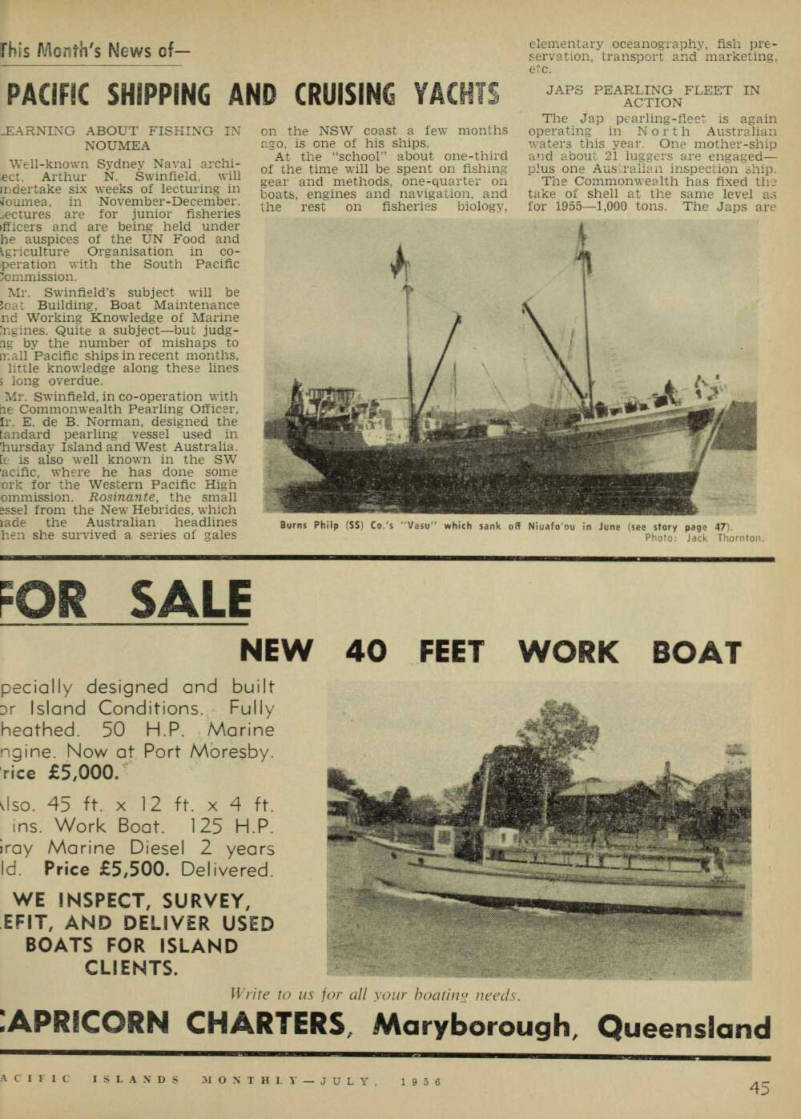
Burns Philp (SS) Co.'s "Vasu" which sank off Niuafo'ou in June (see story page 47).
Photo: Jack Thornton.
permitted to fish —under licence and conforming to conservation regulations—o uts i d e a 10-mile radius of the mainland and in habited islands.
Pearling Case For World
Court
Preliminary hearing of Australia’s case for control of her “continental shelf” is expected to come before the International Court before the end of this year.
By the time the case comes up, almost three years will have been spent by officers of the Australian Commonwealth Law Dept, compil ing the groundwork for the claim.
The claim is regarded as a test case and the decision reached by the Court will be of international im portance.
The issue is whether a maritime nation has the right to control the shallow sea bed of its continental shelf outside the three-mile limit as it slopes to the deep water of the ocean.
Australia formally claimed this continental shelf in September, 1953 —“up to the 100 fathoms line” which, in some cases, extends to several hundred miles off the coast.
The Japanese protested the claim but agreed to take it before the International Court, in the mean time pearling in Australian waters under a system of licencing.
A number of other countries have
claimed their continental shelves — notably America. Naturally, their claims would collapse, too, if Japan should win a favourable de cision against Australia in the In ternational Court.
Resurrection Of Korrigan
The yacht Korrigan, mentioned in these columns in 1955 and before,
was given up as a total wreck by owner Bob Grant after she ran aground on a reef off the west coast of Erromanga, NH, on June 6, 1955.
However there was still life in the old girl, and she was subsequently bought by Tanna planter and trader, Mr. Bob Paul.
Paul refloated the yacht with the help of natives after only 10 hours’
work. A temporary mast was fitted and Korrigan sailed for Tanna, but was dismantled in a storm and drifted for 4h hours before being taken in tow by the BP ketch Damley and brought in to Erro manga.
She was then towed to Tanna and repaired and renamed Bula Tale, meaning “live again.” And that is what she is currently doing.
End Of Vasu, Stern First
A preliminary inquiry into the foundering of the Vasu will be held in Suva early July. (PIM, June).
Vasu, owned by Burns Philp (SS) Company, with 18 crew on board, was on a voyage between Suva and Apia, Western Samoa, with petro leum products, when she began to take in water on June 13. The ship was then about 45 miles SW of Niuafo’ou, in the Tongan Group.
Captain J. Darling and his crew then took to the two ship’s boats and a launch. They were located about 16 hours later by the RNZAF Sunderland from Laucala Bay, Fiji; six hours after that the survivors were picked up by RNZN’s Lachlan and taken to Apia, where they were cared for by the local Red Cross Society and Burns Philp (SS) Company. They returned to Suva by the USS Co.’s Matua on June 20.
Captain Darling said that Vasu had sprung a leak after passing Niuafo’ou. When he had to stop the engines, the engine room flooded; in spite of anything they could do, the leak increased. Vasu had taken 12 hours to go down, stern first.
Fhe crew, he said, “had been wonderful.”
Vasu was a sister ship to Nukalau, which sank off Lord Howe Island about three years ago.
Apia May Enlist Us Know
How To Get Harbour
A somewhat unusual way of acquiring a deepwater harbour may be taken by Western Samoa in re spect of Apia. At present Apia has no “harbour” in the strict sense of the word. Overseas ships lie out in exposed positions near the reef entrance. This arrangement has never been satisfactory, but the cost of constructing anything better has always been considered pro hibitive.
Recently Apia was visited by Mr.
J P. Daniel, an American harbour expert, and he subsequently sub mitted a scheme to the Executive Council of the Territory;
That the harbour be constructed by his firm at its own cost, this cost to be recouped by a 20-years lease of the harbour facilities, in cluding about 50 acres of reclaimed land.
This arrangement would be sub ject to the approval of the New Zealand Government as Administer ing Authority, as it involves the use of dollar funds.
The Executive Council has now asked Mr. Daniel’s firm—Daniel, Mann, Johnson and Mendenhall, of Los Angeles—to submit a firm proposition.
Although some people may wonder how this idea squares with Western Samoa’s policy of keeping
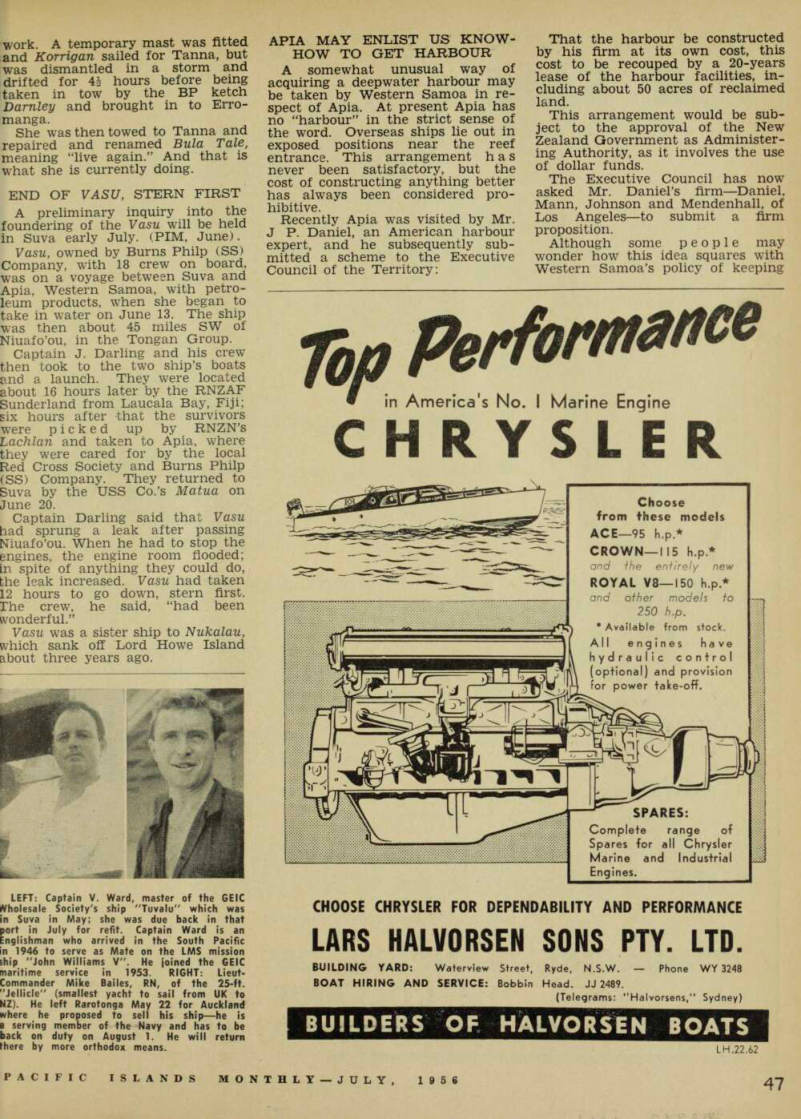
LEFT: Captain V. Ward, master of the GEIC Wholesale Society's ship "Tuvalu” which was in Suva in May; she was due back in that port in July for refit. Captain Ward is an Englishman who arrived in the South Pacific in 1946 to serve as Mate on the LMS mission ship "John Williams V”. He joined the GEIC maritime service in 1953. RIGHT; Lieut- Commander Mike Bailes, RN, of the 25-ft.
"Jellicle” (smallest yacht to sail from UK to NZ). He left Rarotonga May 22 for Auckland where he proposed to sell his ship—he is a serving member of the Navy and has to be back on duty on August 1. He will return there by more orthodox means.
“foreign” companies out of the Territory, it certainly is a realistic approach to the ancient problem of getting a safe harbour for Apia and anyone who had ever had anything
to do with ships or shipping in Apia will wish the plan success.
Shark Tales From Dog
Watch
The 1956 issue of Dog Watch, the
annual publication of the Ship levers’ Societies of Australia, is to hand. This, the 13th edition, con tains the usual interesting assort ment of stories about ships and the men" who sailed in them —with the accent on the Southern Hemisphere.
There are, again as usual, many illustrations and photographs of ships that at one time or another have made news.
A snippet from this issue of Dog Watch seems a fitting companion piece to that Nordman story of the shark that appeared in June PIM, so we reprint it here; In 1834, HMS "Pickle” was cruising off the Isle of Pines, New Caledonia, for the purpose of capturing vessels engaged in the slave trade. She gave chase to a large schooner flying the Spanish flag, overhauled her and boarded her. However, there was nothing in the schooner's papers to connect her with the slave trade, although those on board the "Pickle" were still suspicious of her. But
AT LEFT: Brigadier Miles Smeeton's Hongkong-built yacht "Tsu Hang", mentioned in these notes in May. Photo was taken in Pago Pago shortly after yacht had come in from Fanning; next port of call was to be in Tonga. Smeeton, retired from British Army, was [?]ccompanied by wife and 15-year-old daughter. (Photo; Pan American Prints). RIGHT: Japanese fishing vessel "Sasaya Maru" which called Suva late April to drop a crew member suspected of appendicitis.
She returned to pick him up a month later. In June, "Tenyo Maru No. 3", a large mother-ship, called to put another sick sailor in Suva hospital. (Photo: Jack Thornton).
everything seemed to be in order, so she was allowed to go.
Very soon after, someone on "Pickle put a line down over her taffrail in the hope of getting something from the sea to add to the menu. The line swayed. It was hauled in and a large shark was heaved aboard. According to custom this was opened up, but instead of the usual collection of fish and oddments they were astonished to find a bundle of papers.
These were still legible, and on investigation proved them to be the real papers of the Spanish schooner which had been jettisoned during the chase. The documents stated that she had landed 293 slaves a few hours before she was overhauled. "Pickle" set sail after her immediately, picked her up again after a short time, captured her, and she was con demned on the testimony of the papers.
—H.O'm.
Shades Of Capn. Slocum
Also received this month, the ninth issue of The Spray, the journal of the Slocum Society.
Editorial address is c/o USIS, Ameri can Embassy, Lima, Peru.
The Spray is devoted to the his torical angle of deep-sea cruising, although some items appear con cerning current round-the-world amateur sailors. The editor says: “We would like to publish many more technical articles than we have published, but it seemed essential first to clear away the underbrush of history.”
In the meantime, it is a neat little publication, full of interest for the cruising yachtsman.
Additions To Cl Fleet
The Inspire, which has been operated in the Cook Islands for
several years by Hugh Williams, and has recently been in Auckland for overhaul, returned to Rarotonga, June 11, to join the D. C. Brown fleet. She went into service im mediately.
Delivery from Auckland was made by former owner Williams, who later returned to New Zealand to take delivery of the New Zealand coaster Melva, which he has pur
chased. The 243-ton Melva— sister ship of the ill-fated Noumea trader as launched in Auck land in 1946. Of composite con struction, 103.3 ft X 23.5 ft X 9.5 ft, She was one Of a Standard type built for war-time use in the Islands.
Under command of the late Cap tain Stead, well known in Fiji and the Gilberts, the vessel made several
jost-war Island voyages from New Zealand while owned by the Union Manufacturing Co., of Wellington. 3he has been laid up at that port for a considerable time and will low undergo a complete refit and some accommodation changes to suit her to the Cook Island’s trade.
Mr. Williams, who is satisfied ;hat he has a bargain, says that he ilans to base his operations on Penrhyn and the Northern Cooks, de has applied for a license to ex periment with aqua-lung diving rear in the Penrhyn MOP shell living operations. No such equip nent has been used commercially n the Cooks before.
Back On The Job
Mr. J. P. Shortall, who has been insisting Mr. Dick Brown during the ast few months when he has been inquiring new vessels has now left Rarotonga and returned to civilisa tion. Until he listens to the next iren call from the sea, therefore, he rill again be contributing to these lotes.
Scandal At Le Havre
Ocean cruising is regarded as a lean sport and it is unusual to ncounter a bit of scandal in the mall ships news. However, we are ndebted to the colourful NZ Truth or the final episode in the ill tarred voyage in the 49-ft ketch )uest 111, which was engaging Eng ish newspapers in headline writing , couple of months ago.
The moral in the story is that f you have anything to hide you houldn’t tell anyone that you are oing to sail half-across the world nth a girl crew.
Quest 111 was owned and operated y a 29-year-old New Zealander, iho said his name was Martin Irent. He bought Quest for £6OO, nd out of a tremendous response d an advertisement, chose three dventure-crazy young women to ccompany him.
They set off on the first leg, rom Hamble, Hampshire, to Le [avre, France, arriving there “a isaster of untidiness and peeling aint,” to be met by embarrassing fficial questions.
The three girls, after exposure to ipguage “more than nautical,” and ie wild waves, and exhausted from barsh treatment” en route (they r ere made to scrub the decks) left im.
Martin Brent, it seems, was really oseph Sydney Smith, and admitted ) a criminal record, involving, mong other things, extortion, illegal ossession of firearms, receiving :olen property, theft, and corrup on of a young girl.
Promotion For Matson
Skipper
Robert A. Eastman, Matson Line aptain, well-known in the Pacific nd in Australia and New Zealand, as been promoted to that line’s jxury flagship Lurline, as staff aptain. Lurline oscillates between
US Pacific coast and Honolulu.
Until recently skipper of Ventura, Captain Eastman sailed aboard the old Monterey under Captain Elias R.
Johanson; was later captain of Marine Phoenix.
Captain F. H. Hicker replaces him on Ventura.
Boots, For The Use Of
New Guinea, 600 tons, Swedishbuilt Viria, owned by New Guinea Industries, Lae, was in dock in Newfor * f ™ ™ in °r re pairs in June. Some of the ship s ppro-n 00 * 1 ? n NG d nort rafntlv d g g at a 17^- ° flo H 6 il erl viio ho t„ 7oon Vivid trades regularly between Australia and NG ports-usually with a cargo of timber southbound and petroleum products on the northbound voyage.
The crew of 16 New Guinea natives felt the arctic temperatures of the current spell of NSW wintry weather during their enforced stay in Newcastle. One sure sign of this, according to their skipper, Captain T. Gillings, was the fact that they were all wearing their issue boots. Normally they go bare looted—or wear sandshoes,
Those Conspicuous
Landmarks
Mariners consulting their volumes of the o ffi C i a i pacific Islands Pilot as the y approach some off-the-track island anchorage, are apt to find that the “conspicuous palm at the pxtremitv 99 or tbp west of the settlement” long since dfsappearld nas long smce aisa PP ear ed.
(Continued on Page 117)
jch facts take years to reach the niralty, and further years to
1! their place in next additions, the Lord Com sioners may 2 to note a new n from Puka ka, Northern >ks (not the imotu Puka :a) : “hree flagstaffs e erected in ; April by the mini stration,
one at the residence of Pilato Ariki, one at the LMS mission, and one
at the landing near Yato village The latter will carry a lantern at night when a ship is loading at the atoll.
Avarua May Be In It. Too
Suggesting that New Zealand, may possibly be seriously planning harbour improvements at Avarua,
TOP : The Auckland ter "Wanderer", [?]ed and skippered Mr. T. Buchanan [?]h won the 1,300 [?]s Auckland - Suva [?]t race in May, [?]n in Suva harbour, the race.
WER: The Fairmile [?]t, owned by Vice [?]odore Lawlor, of Royal Akarana [?]t Club, Auckland, h acted as escort [?]l for the yachts cipating in the land-Suva ocean Photos: Fiji PRO.
Rarotonga (for Apia, see above), a survey of that harbour was recently completed as a priority job by the local Survey Department and the plans rushed to Wellington. The harbour had earlier been looked over by a succession of expert ad visers, and a few scoops full of shingle were actually removed a year ago. The available equipment was then realised to be inadequate.
Case Of The Pop-Eyed
Turtles
In mid-June a message was re ceived in Madang, NG, from the ADO, at Bogia, that a number of mutilated turtles, with their eyes protruding, had been washed up on a nearby beach. Shortly afterwards it was learned that local natives had found a green plastic dinghy at sea four days previously. Its rowlocks and oars were still in position.
Next, MV Meklong had sighted some greenish-grey planking be tween Awar and the mouth of the Ramu River.
From a study of sailing permits, it was learned that several ships were in that vicinity but had not reported in on the regular radio skeds.
It was thought that all these facts, added up to the possibility of an explosion at sea, so the District Commissioner and the Madang Harbourmaster took off in a
Lutheran Mission Cessna aircraft to search the area. They eventually landed at Angoram, on the Sepik River, having established that all local shipping had been accounted for.
It is understood there are several possibilities regarding the owner ship of the dinghy but no one can
explain the “pop-eyed” turtles although a similar phenomenon w; reported from NE Papua in laj May-early June (PIM, June), was suggested that atomic-radiatic might be responsible, or a volcani eruption. Hundreds of dying turtl and porpoises were reported froi the D’Entrecasteaux Group.
Administrator’S Ship On
Reef
The P-NG Administrator’s official essel Laurabada II ran aground on reef in the Torres Strait on lay 27. She was not damaged and as refloated the following day.
Two Administration vessels and Government trawler from Thurs ay Island set out for the Laura ada as soon as she radioed she r as aground.
Japs Have More Trouble
With Ng Reefs
Japanese fishermen were again i trouble in NG waters on June 3 when Koyu Maru, with a crew of J, went up on a reef off the north aast of Bougainville.
The vessel’s engine broke down, uls were rigged but strong SE inds blew her onto the reef. The len on board got ashore with a ttle equipment.
They were rescued by Adminis •ation officials and taken by launch ) Sohano.
The Japanese Embassy in Can- Brra was trying to contact another apanese vessel in the vicinity to ick them up.
Marine Board Finding On
Gaboso Capsize
The Report of the Marine Inquiry ito the loss of the APC landing arge, Gahoso, off the Papuan coast i early April, was released in Port [oresby late June.
The barge capsized in the Gulf f Papua in the early hours of pril 2. There was no loss of life, at the barge was later posted as a azard to shipping.
The Board stated that the cause : the loss of the vessel could not 3 finally established but it was robably due to some portion of the nil failing as a result of pounding hen being driven into a head-sea • swell.
Evidence showed that the owners ad found it necessary to weld raps over the original welded lams in two places soon after the aboso arriyed in Port Moresby 'om the United Kingdom.
Gaboso had gone into commission i November, 1955, and before leav ig Port Moresby on her April jyage had a slight list to port; this as said to be normal.
At the onset of the voyage the eather was calm but later de- Tiorated and the vessel shipped ater. At midnight, April 1, the jssel was being pounded, and at 50 a.m. suddenly developed a were list of 20 degrees, which later Lcreased to from 30 to 40 degrees, hor 11 y afterwards, the crew aandoned ship.
The vessel was commanded by a ! ertificated Master, but there was o Certificated Engineer. The Board (It there was some lack of direct
and positive action to right the vessel, but it was doubtful if much could have been done once the
and V no*'Wame P wasAttached to'foe
Master or the crew on that account, However, the Board was of the opinion that the Master was at fault in failing to reduce speed when the vessel started pounding. It also considered that during his watch, the Mate should have acquainted the Master with the fact that the ship was pounding, or alternatively, have ordered the helm and speed to suit the prevailing conditions.
The Board felt that the unseamanlike failure to take steps to reduce pounding could not be viewed without strong disapproval. It
accordingly censured the Master, and to a lesser degree, the Mate,
Nz Yachts In Papeete
p Twc AucMand yachts arrived In owned and skippered by W. S. Holder, with a crew 0 f three, is a 15 tons sloop with an auxiliary engine, she left Auckland on May 20 and arrived June 20. Three months will be spen t in French Oceania, Three days later a small ketch, Hope, also arrived in Papeete from Auckland. Owner-skipper F. J.
Norris had crew of 3; length of vessel is 30 ft; has Regal engine, Port of call between Auckland and Papeete was Raivavae, Austral Group. (Over)
Icooks Visitors To Tahiti
Festivities
Cook Islands residents have been Horded the opportunity of taking
i “Bastille Day” iruise to Papeete his year. Mr.
Dick Browns "aveuni will carry L bout 30 passeng trs (£25 cabin • e tu r n; deck 12 10/ - return), jlus a cargo of omatoes and oranges.
Cabin passeng ts will have the trivilege of sleep ng aboard the ressel during the ime she is in ’apeete, if they vish. It is ex jected that "aveuni will take ix days to get here from Raro onga, and four lays to return, nth the wind ichind her.
Latest informa ion was that ‘bookings are touring in.”
Trans-Pacific Yacht Race
Starts
The trans-Pacific yacht race from San Padro, on the US Pacific coast,
When Her Majesty's Fiji Navy ship "Viti" made a training cruise to the Lau Islands recently, a call was made at Nabavatu in the Exploring Group, where the Malley family has a plantation. This photograph shows Mr. and Mrs. Malley with some of the officers from the ship, which was in command of Lieutenant C. A. Stinson. (The half-dozen young men standing are presumably part of the Nabavatu welcoming committee).