The Editors' Mailbag
pp. 27-28 · Read in the full issue
re About The
i. Shirley Baker
'r. S. J. Campbell, of Tonga h School, Nukualofa, is quite nite: he yarn, “No Commercial Value”
Tropicalities, page 81, of May, it the transportation of the body Rev. Shirley Baker), makes a i story, but is not true. !r. Baker’s body was not shipped Nukualofa, nor did he “die in e place far from the islands”; , far from being regarded “as a n in the neck,” he is being re lissd as the true maker of ga. be Rev. Shirley Baker died in ,pai, on Monday, November 16, :, and was buried there on the jwing afternoon, icidentally, the family vault in pai was opened in 1954 to lay •est his daughter, Gertrude. I ler thought that this event Id have been recorded in PIM, I did not see it.
Can Mail, Plain
in Canoes
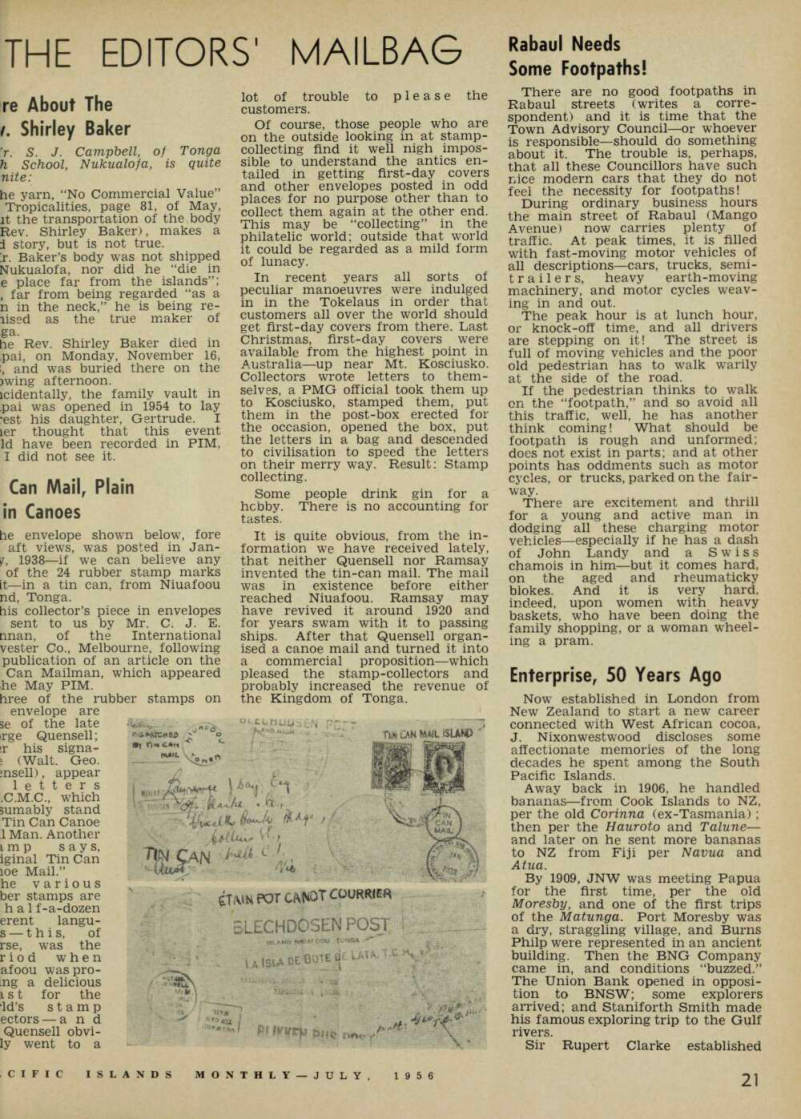
he envelope shown below, fore aft views, was posted in Jan /, 1938 —if we can believe any of the 24 rubber stamp marks it —in a tin can, from Niuafoou nd, Tonga. his collector’s piece in envelopes sent to us by Mr. C. J. E. nnan, of the International vester Co., Melbourne, following publication of an article on the Can Mailman, which appeared he May PIM. hree of the rubber stamps on
envelope are se of the late irge Quensell; ir his signa ; (Walt. Geo. msell), appear letters .C.M.C., which sumably stand Tin Can Canoe 1 Man. Another imp says, iginal Tin Can loe Mail.” he various ber stamps are h a 1 f-a-dozen erent langu s this, of rse, was the r i o d when afoou waspro mg a delicious is t for the Id’s stamp ectors a n d Quensell obvi ly went to a
lot of trouble to please the customers.
Of course, those people who are on the outside looking in at stamp collecting find it well nigh impos sible to understand the antics en tailed in getting first-day covers and other envelopes posted in odd places for no purpose other than to collect them again at the other end.
This may be “collecting” in the philatelic world; outside that world it could be regarded as a mild form of lunacy.
In recent years all sorts of peculiar manoeuvres were indulged in in the Tokelaus in order that customers all over the world should get first-day covers from there. Last Christmas, first-day covers were available from the highest point in Australia —up near Mt. Kosciusko.
Collectors wrote letters to them selves, a PMG official took them up to Kosciusko, stamped them, put them in the post-box erected for the occasion, opened the box, put the letters in a bag and descended to civilisation to speed the letters on their merry way. Result: Stamp collecting.
Some people drink gin for a hcbby. There is no accounting for tastes.
It is quite obvious, from the in formation we have received lately, that neither Quensell nor Ramsay invented the tin-can mail. The mail was in existence before either reached Niuafoou. Ramsay may have revived it around 1920 and for years swam with it to passing ships. After that Quensell organ ised a canoe mail and turned it into a commercial proposition—which pleased the stamp-collectors and probably increased the revenue of the Kingdom of Tonga.
Rabaul Needs
Some Footpaths!
There are no good footpaths in Rabaul streets (writes a corre spondent) and it is time that the Town Advisory Council —or whoever is responsible—should do something about it. The trouble is, perhaps, that all these Councillors have such nice modern cars that they do not feel the necessity for footpaths!
During ordinary business hours the main street of Rabaul (Mango Avenue) now carries plenty of traffic. At peak times, it is filled with fast-moving motor vehicles of all descriptions—cars, trucks, semi trailers, heavy earth-moving machinery, and motor cycles weav ing in and out.
The peak hour is at lunch hour, or knock-off time, and all drivers are stepping on it! The street is full of moving vehicles and the poor old pedestrian has to walk warily at the side of the road.
If the pedestrian thinks to walk on the “footpath,” and so avoid all this traffic, well, he has another think coming! What should be footpath is rough and unformed; does not exist in parts; and at other points has oddments such as motor cycles, or trucks, parked on the fair way.
There are excitement and thrill for a young and active man in dodging all these charging motor vehicles —especially if he has a dash of John Landy and a Swiss chamois in him —but it comes hard, on the aged and rheumaticky blokes. And it is very hard, indeed, upon women with heavy baskets, who have been doing the family shopping, or a woman wheel ing a pram.
Enterprise, 50 Years Ago
Now established in London from New Zealand to start a new career connected with West African cocoa, J. Nixonwestwood discloses some affectionate memories of the long decades he spent among the South Pacific Islands.
Away back in 1906, he handled bananas —from Cook Islands to NZ, per the old Corinna (ex-Tasmania); then per the Hauroto and Talune— and later on he sent more bananas to NZ from Fiji per Navua and Atua.
By 1909, JNW was meeting Papua for the first time, per the old Moresby, and one of the first trips of the Matunga. Port Moresby was a dry, straggling village, and Burns Philp were represented in an ancient building. Then the BNG Company came in, and conditions “buzzed.”
The Union Bank opened in opposi tion to BNSW; some explorers arrived; and Staniforth Smith made his famous exploring trip to the Gulf rivers.
Sir Rupert Clarke established
Kanosia; and Mr. Nixonwestwood, in 1913-14, helped establish the saw mill at the mouth of Galley Reach.
“The history of that timber enterprise is tragic,” comments JNW.
“If it had been given half a chance it would have put New Guinea right out in front as a supplier of good timber.”