Acific Shipping And Cruising Yachts
pp. 95-128 · Read in the full issue
[?] Month's News of—
Another On Way To
Tahiti
•om Balboa comes advice that 44 ft American yacht Meridian there headed for Galapagos, quesas, Tahiti and Honolulu on .1 15. Skipper Dick Stafford is mpanied by his wife Abbie, Carol Rice, whom we presume jmale—although one can never e accurately when it comes to irican Christian names, le yacht, which is “just cruising i schedule”, left its home port, apolis, Maryland, about two s ago. Some time was spent tie West Indies and six months tie Canal Zone.
Inn And Felicity Ann
r those who inquired—informa indicates that Ann Davidson her Felicity Ann have quit >ing, and that the former is living in California. More in tation is being sought.
Ships That Slip In
The Type
badly trained typewriter can e untold havoc, even amongst experts. A wool-gathering type ;r belonging to a PIM “expert”, December typed Inspire instead nhur Rogers and so created the
position where we had the former cruising around the New Hebrides with a crew of girls, instead of attending to its legitimate business in the Cook Islands. ( Inspire was recently bought by Mr. Dick Brown, of Rarotonga).
This has giv~n the editor of the Cook Islands Review, in March, opportunity to indulge in a little
deserved sarcasm.
The author of that item, J. P.
Shortall, is cur rently in the Cook Islands. He prob ably has that ignorant type writer still with him.
Neo Hebridais
Ii Sold
The Neo Heh ridais II will, after its present voyage to Aus tralia, cease ser vice in the South Pacific. The ship has been sold to Chinese interests
and will be delivered to the new owners almost immediately, Sale was arranged by owners, Societe Maritime Hagen, during a recent visit to Japan by M. Jean Hagen.
The ship loaded scrap metal in Sydney, then goes to Santo, New Hebrides, where more scrap metal will be loaded. The ship then will go direct to Hongkong, where she will be turned over to her new owners. The New Caledonian crew will be repatriated to Noumea.
The ship recently made a 28 days’ voyage to Wallis Is. and back
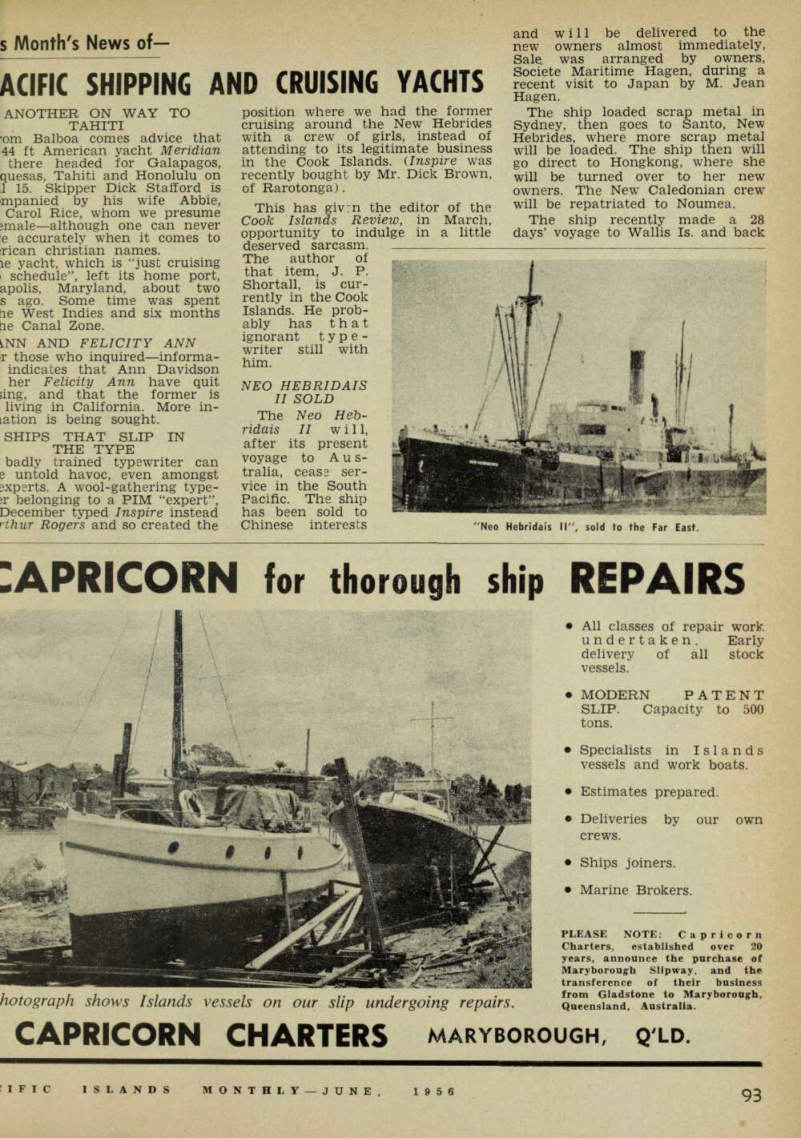
"Neo Hebridais 11", sold to the Far East.
to Noumea. She carried 252 passengers on the return trip seven of them Europeans and the rest natives. After leaving Wallis, 17 stowaways were discovered; their passages were paid on arrival in Noumea and they, with the majority of the native passengers, will go to work in the New Caledonian nickel industry.
Tres Damas Joins
Bambridge Empire
The small Chilean motor-vessel Tres Damns was sold to Mr.
Anthony Bambridge, of Papeete, recently for 400,000 Pac. fcs. (about £A2,850). It was previously owned by Mr. Auturo Prieto.
Mr. Bambridge will use her to take supplies to and bring back copra from Flint and Caroline Islands, the copra plantations on which he acquired when he bought out the S. R. Maxwell interests in Tahiti. At the time of the pur chase, there was still an unexpired portion of a 40 years’ lease to run out. Now, however, Bambridge in terests are running both Flint and Caroline. Mr. Lionel Bambridge (brother of Anthony) is managing Flint, which has a labour force of 25; a foreman runs Caroline where 15 men are working. The copra goes to Papeete for export to France.
Kaumoana Gets Priority
Gallois and Cie, of Papeete, who purchased the Chinese junk of
chequered history, Cheng Ho, tem porarily suspended expensive refit in April. The same company re cently bought Kaumoana, which has been lying in Papeete for over a year, and has switched work to her. She will re-enter the Tuamotu trade.
Two new engines are to be added to Cheng Ho eventually.
Sydney Yacht In Papeet|
The Sydney yacht Eolo arrived] Papeete, Tahiti, on April 25, afl a 27 days’ trip via Auckland. Hed seas and gales were experienc near the Kermadecs.
This 57 ft cutter has a 30 ] Vosper engine and 2,600 square of sail. L. A. Gulson, own skipper, has a crew of four —Pie
Derek Bayliss, L. Jphnson George Bateman. Destination ssau, British West Indies.
W Ships For Pacific
3,000 tons answer to air trans ion is being planned by the t company for its UK-Pacific i. Plans for the ship—when :—are for a speed of 27 knots, i of about 800 ft and five 5S a year to Australia includ :he round trip UK - Suez ilia - NZ - Pacific - Panama hip of 40,000 tons will be the ;t passenger ship in South c waters. Has Suva, for ex 1, ever accommodated a ship at size? h cost of shipbuilding in ean countries is emphasised he decision of the Union i Ship Company of NZ to have new T drawer a (which will go lslands fruit run with , Matua and Navua ) built in Kong where Taikoo Dockyard Engineering Co. has got the It is expected that the ship ie ready for delivery in 1958.
-Squeeze In The Pacific
ause they seem to be going to out on their salmon fishing i this year, Japanese fishing are likely to be seen more y than ever in those parts of acific where they are still free ive. atever might be our attitude janese, the great international se that is being put on these efficient of all fishermen, in traditional fishing grounds e Pacific, could affect us all r or later. ler Japan’s surrender agree with the US and Canada, it ebarred from a gigantic wedge :an—almost half of the North c—which is rich in salmon allibut. Jap-hating Rhee keeps 60 miles of the Korean coast; Communist China shoos them they approach nearer than liles from the Chinese main tralia, Fiji and most other c islands—who do nothing fishing grounds other than e close inshore—b e c o m e •ical whenever a Jap fishing
boat is sighted from afar. The Japs of their own accord avoid the US nuclear test areas as they would
a plague—and probably will soon be as anxious to avoid the British H-bomb areas near Christmas Is.
Bitterest pill of all, however, was the Russian reprisal when the Japanese broke off peace negotia tions with them in March —they closed to them parts of the North Pacific through which the salmon pass on their westward spawning migration. The Japs have already missed part of this four-months’ season.
The fishing industry is vital to 90 million Japanese; not so vital to the rest of us. The alternative to what we are doing does not have to be a free and open go. Probably the smartest thing is to do what Eastern Samoa is doing invite them in to do a job for us. But
Suva's smart pilot launch, which was in May and is now back in service [?]erhaul. There was recently some public on as to why this launch is painted Suva's harbourmaster ended the dis by stating that international regu-
lations stipulate that the hull be painted black and the word "Pilot" be painted in white letters.
RIGHT:The MV "Ovalau", which maintains a daily service between Levuka and Natovi, on the Suva-Levuka bus and launch service.
ar no other Pacific territory s disposed to follow Eastern aa’s example.
Us Fish Experts On
The Job
e United States Fish and Wild hips John R. Manning, Charles Gilbert, and Hugh M. Smith been on the job constantly h-May making their Spring c-up on the habits of tuna and Dceanographic matters gener both north and south of base onolulu. suits on the whole were poor the Service is now extending ivestigations so far up into the
North Pacific that observations of whales and fur seals have become almost routine.
Only surprise of the voyages was when the Gilbert caught four small salmon near Midway Island—which is a great deal further South than normal salmon fishing grounds.
Judging by the names of some of the key personnel on these ships, Japanese know-how is heavily en listed on Uncle Sam’s fish business.
Pacific Veteran Comes To
End In China
The ex-Polynesien, which since August, 1955, has been sailing under the Chinese flag, home-port Hong
Kong, has been lost off the Chinese coast.
This veteran entered Pacific waters in 1938 and saw service be tween Sydney-New Caledonia-New Hebrides until replaced last year by the new Polynesie.
She rendered superb service to the islands during the whole of the War and seemed to bear a charmed
phies won during ailing season were [?]ted at a social ng, on May 11, [?]e Aquatic Club, Moresby. In our graph Mr. W.
Ms hands a trophy Mr. W. Kennedy Judge Gore looks Photo by Papuan
life. She will be long remembered in New Caledonia and the New Hebrides.
Eridan For Breaking-Up
The MV E rid an of the Messageries Maritimes, well-known in France, New Caledonian, and Australian traffic, has been towed to the ship breakers in France.
Following her initial post-war voyage to Sydney with migrants when she was described by Sydney newspapers as a “hell-ship”, Eridan made her turn-around at Noumea and left uncivil Sydney alone.
Longest Way Home
Survivors of the Arakarimoa disaster were still in the Solomons early June, two months after their arrival.
Supplied with clothing by the local Red Cross organisation, they are at present being cared for by the Roman Catholic Mission at Tenagi, five miles west of Honiara.
They shortly return to the Gilberts with the High Com missioner when he tours that terri tory (scheduled for this month).
As the Gilbertese in question left Tarawa for (as they thought) their 20 miles voyage in December, probably they will consider it is none too soon.
In Honiara—To Slip
Or Float
Whether Honiara will have a slip-way or a floating-dock (or
maybe neither) is still a matter of argument in the BSI Protec torate.
The Government is at all events anxious to have something, so that BSIP and GEIC ships do not have to go outside the WPHC for re pairs. However, as the Protectorate appears to be away out on the end
of a limb as far as Colonial grani are concerned, local plans fre quently come to naught.
A former Marine Superintended was in favour of a floating-doci but this was howled down by soraj local residents who claimed that! slip-way would be cheaper to coni struct and maintain. Experts con|
d by the Government said that b is not a really suitable place a slip-way near Honiara and therefore the cost of a ing-dock would be very little ie Government has now to go d with preparations of detailed 3 and specifications for a float lock —but is still determined to a little each way: If cost of floating-dock is found to be i greater than anticipated, construction of a slip-way will i be considered. has, of course, been suggested ie past by certain cynics, that be BSIP drawing-up plans is md in itself.)
Rt Moresby Name For
New Scow
aposed name for the 56-ft i scow now being completed Steamships Trading Company Bjarne Halvorsen, Ltd., in ydney, is Koki. e original Koki is a few miles of Port Moresby where most le local lakatois have a more
;ss permanent anchorage.
C’s Koki should be launched be second week in June and go north in July.
Auckland-Suva Race
e Auckland cutter Wanderer 3uchanan) was first across the bing line in the 1,300-miles land to Suva yacht race on 24. Thirteen yachts set out Auckland on May 12, and par arly in the early stages he race, encountered heavy her. Wanderer was able to keep I while most of the other aits were hove-to. Matuku ed the finishing line second. mderer was later officially de d the winner (corrected time landicap 7 days, 14 hours, 34 ites); Nina, was second; iku, third. ur yachts withdrew during the and returned to NZ. . but one of the entries was New Zealand—the exception Daydream, a cutter owned by J. Fletcher, of Sydney. Day m had been some months in land. ptain J. A. Lawler, vice-com )re of the Royal Akarana Yacht , which organised the NZ end be race, left Auckland in his nile Ngaroma a couple of days the yachts, acted as an escort radio ship during the race, ral of the yachts had radio ver-transmitters and kept in ict with the Ngaroma. The rest ed Gibson Girl sets for emerg )S. ning and other arrangements he end of the race were in the Is of the Royal Suva Yacht While the yachts are in the full facilities of the Royal Yacht Club will be available lem. A number of the visitors to cruise within the group be returning home.
The complete list of entries follows: Matuku, cutter, L. Lidgard (Kawau Island) ; Aoma, kech, G. R.
Smith (Christchurch); Daydream, cutter, J. Fletcher (Sydney); Kehua, ketch, L. Clements (Whangarei); Taurangi, cutter, K. Mildon (Auckland); Lady Pat, ketch, Thomas brothers (Auckland), Eidlewiss, cutter, M. Goodman (Auckland), Nina, ketch, J. Moody (Auckland); Reliance, cutter, W. F.
Rushbrook (Auckland) ; Wanderer, cutter, T. Buchanan (Auckland); Kismet, cutter, W. Paterson (Auckland); Ranginui, ketch, M. Whitten (Auckland) ; Glennis, cutter, J.
White (Auckland).
Vixen, After Two Years
The 13-ton auxiliary cutter Vixen,. j n which American Jim Stark sails alone, arrived in Papeete on May 13, a ft e r two years’ cruising in the waters around Panama, the Gala pagos Islands and French Oceania, ■K'Tr r rr , ‘H - r hart
Ketch White Hart
The 15-tons ketch White Hart r from Vancouver, en route to New Zealand, was in Papeete in May,. after many months spent in cruis ing in French Oceania. With the owner-skipper, Tony Reeves, is his wife Bridget, their small son Michael (3), and Mrs. Peggy Shaw and her daughter Robin (7). They
led to spend at least a month ihiti.
Diane In
Suva
e 43-ft yacht Diane, from Eng is in Suva in the course of a I wander. The 64-years-old r, Mr. Norman E. Young, CB, , MC, retired in 1954 from the of Comptroller-General of the ;d Kingdom National Debt e. During his career in the 5h Treasury he travelled on cial duties to Buenos Aires,
Hongkong, Rangoon, Sydney, Tokyo, Singapore, Bangkok and New Delhi.
On his present voyage, Mr. Young has travelled by way of the West Indies, Galapagos, French Oceania and Tonga. He plans to go to New Zealand.
Mo An A Moves On
The small yacht manned by a French crew of skin divers and fishermen, Moana, left to continue its round-the-world trip late in May. It came to New Caledonia some months ago from Tahiti on
its way from France and now goes on to New Guinea.
Jellicle Meets Tons Of Tuna
Lieutenant-Commander “M ik e”
Bailes’s little English “Folkboat” type yacht, arrived in Rarotonga on May 16, eight days out of Moorea, and departed again for Auckland several days later.
This yacht cleared Balboa on December 24, and arrived at San Christobal, Galapagos, 11 days later. .There Gabriel de Sousa, of Madeira, signed off to join a local German owned fishing vessel and Bailes continued alone.
(Continued on Page 125)
accompanying photo he old AUSN SS [?]irra" was sent in [?]. Lew Priday. The of this ship's drift old by Mr. K. P. in April PIM. Mr. version is slightly [?]t to that of Mr.
He says: "The [?]ecasteaux Reefs of New Caledonia the successful out of a strange chase 05. The steamship ra', 2,664 tons, of
two days out from Noumea on the [?] Suva, lost the blades of her screw in weather. Drifting through the New es, by nightfall on March 7, she was so to the south-east point of Erromanga he crew took to the boats and pulled to Dillon Bay. Next morning the vessel [?]en drifting in another direction, where the crew pulled after her in two boats
and boarded her by noon of the 8th.
"The steamship Induna' had in the mean time called at Dillon Bay, and her Master decided to go in search. She came on the 'Pilbarra' on the 17th, off the d'Entrecasteaux Reefs, and managed just in time to take her in tow; and they reached Port Vila on the 21st."
This is the Norwegian motorship "Chris Bjelland", 341 tons, 150 ft long, which carried the Norwegian Archaeological expedition to Easter Island. The party is led by Professor Thor Heyerdahl, who drifted from South America to French Oceania on the raft "Kon Tiki", a few years ago, in an endeavour to prove that the Eastern Pacific Islands were populated from South America. This photograph was taken when the ship was in Papeete in May.
She is returning to Norway via the Marquesas Islands and Panama Canal.
etween the Galapagos and the :quesas the yacht was closely at ied by a huge shoal of tuna, raging 10 lbs in weight. They e ravenously hungry and easily m by hook or harpoon, and pro id unlimited fresh fish for half the 42 days which the passage *Juku Hiva occupied. The yacht ie a spendid 6i-day passage Papeete, arriving April 1. ieutenant-Commander B a i 1 e s Sneering branch of Royal Navy) to report back in London for i by August 1. The yacht will offered for sale in Auckland.
Re Radio Help Needed By
Smallships
IE safety and convenience of small ship mariners in the South Pacific will never be 3uately served until the various nd Administrations agree to blish one or more standard ing-frequencies on which all the n coastal radio stations keep :h—even if not continuous :h. t a London conference in 1952 i-shore radio frequencies were ;ated for use in each British th Pacific administrative area, ifferent frequencies were
assigned to each area so that communications in one region, e.g., Fiji, would not interfere with the ship-shore communications of another region, e.g., the Solomons.
This plan made no provision whatever for a vessel journeying between the various administrative areas. Not only is it impossible for such a vessel to contact all the main stations on a single calling frequency, but such a ship-master is forbidden to use the frequency of the area from which he hails while sailing through other areas.
As R T transmitters in small craft are required by law to be crystal-controlled in frequency, such a shipmaster would have to possess a large selection of crystals, plus full information on all the frequencies in use.
A separate standard channel for distress and for such itinerant vessels would avoid all this. The international distress frequency of 2182 kc/s is supposed to be such a channel. This flow frequency is unsatisfactory in tropical regions, due largely to heavy static at night.
What is desperately wanted is an agreed higher frequency—and a proper watch on it.
Even on the regional frequencies (Over)
there is no continuous watch i most areas.
However, it appears that this nd will be changed, as far as Fiji concerned. Under a new arrangj ment there, after Suva Post Offic station, which maintains coni munications with local vessels close down for the night at 4 p.n (0400 GMT), Suva Radio (whid provides a service for oversea vessels) will maintain watq throughout the night on th regional frequency—4o73.9 kc/sj until the Post Office station resume duty at 9 a.m. (2100 GMT).
Suva Radio and Post Office wi also between them maintain J continuous watch on the 2182 kcj distress channel —even though fel vessels in the Fiji local fleet ar equipped with that dist r e si frequency.
Noumea Radio Service I
Noumea Radio now listens fd R/T calls on 4100 and 8200 kcl until traffic is cleared, answerirf respectively on 4386 and 8776 kcj according to the following plan 4 mc/s watch at 2000, 2330, 033 and 0500 GMT, and 8 mc/s watci at 2300 and 0400 GMT. There 1 no 2182 kc/s watch.
Weather forecasts (in French are available over the Noumea broadcasting station on 3355/603 kc/s at 0000 GMT, a full weathe summary at 0115 GMT, and J further condensed report at 015
Gmt.
Many of James Salmon's friends assembl[?] in Papeete recently to witness the launchi of his new motor schooner "Cap des Palmes It is named after a converted cruiser on whi Mr. Salmon served in World War II. [?] photos show, top, the new vessel going do[?] the slipway and, below, Mr. Salmon greeti[?] his numerous well-wishers.