Territories Talk-Talk
pp. 32-136 · Read in the full issue
By Tolala
“So Many Gods;
So Many Creeds . .
Those words of Ella Wheeler Wilcox, wTitten well over half a century ago, are appropriate to the Mission situation in P-NG. Only recently there was a “feature article” in a Sydney paper, quoting Prof.
A P. Elkin as saying: “Very soon —and the sooner the better the Australian Govern ment will find it essential to take some action regarding the spiritual welfare of more than a million NG natives.”
The article goes on to emphasise the Professor’s apprehension of what eventually may arise from the “number of different religious de nominations grappling for the souls of the natives, with conflict ing teachings that left the native mind unsettled.”
“These missionaries,” said the Professor, “men of high and ad mirable purpose, are creating a serious problem by the warmth of their competition.”
The confusion caused in the minds of the natives by a multiplicity of sectarian enthusiasts is evident, and the benevolent Administration —ever so eager to safeguard the material interests of the natives—is carefully side-stepping any action to protect them from mental and spiritual confusion.
True, in earlier years, Sir Hubert Murray instituted a system of zon ing for mission activities. For a while it was successful; but in those years there were only three or four mission societies operating in Papua.
To-day there are over 20 different societies registered in P-NG, all competing for the souls of these primitive people.
It is over twenty years ago since I first advocated the zoning of missions in TNG. But nothing has ever been done, although official dom has agreed that “something” ought to be be done. It is time the gentlemen in the Homburg hats took off their kid gloves and started to get tough with the missions; as tough as they get with other sections of the non-official community.
The native is a realist; and when
he becomes a religious enthusiast! is chauvinistic in his actions. R ligious fervour takes the place] the old customs and rites he h been forced to abandon. Who kno whether these sporadic outbursts] so-called “cargo-cult” do not sU from over-zealous Christian co verts?
Mention of sectarian bitterm rife in 1936 in “Do You Remember (May, PIM, p. 22) recalls s memories of the war waged I tween two leading Christian c nominations in TNG.
Is this bitterness to be allow to go on, uncontrolled?
Possibly such criticism comi from a man of Prof. Elkin’s to nage will start something. Le hope so. ( See also page 47 t\ issue) .
Neo-Melanesian
This is an age of high-falut names. Rat-catchers are n “Rodent Exterminators,” servii stations become “Lubritorium and now our well-known “Pidgi is called “Neo-Melanesian,”
I read this in The Rabaul Ne (the Pidgin paper of the Dept.
Education roneo-ed in Rabai which, in its issue of May carries the heading, “Standard N< Melanesian (pidgin) Orthograph
article deals with the stand ing of Pidgin spelling, as »d by Dr. R. A. (“Hands Off n’ j Hall, Jr., and further in jated by Rev. L. J. Lutzbetak Vlr. T. A. Dietz. (And no puns ; “lamp walk-about,” please!) is well that some move is be lade to bring uniformity into he weird and wonderful at ts at Pidgin spelling. Some e variegated spellings of this 2 franca of late years have loxed me. add further to confusion, I iccording to a recent article, the Bible Society for Australia he SW Pacific has translated, s about to publish, St. Mark’s i\ in this “Neo-Melanesian,” issociate it from Pidgin Eng vhich has a master-slave taint it.” (Why all this shuddering “master-slave” business where i is concerned, I cannot stand). s means that the Bible Society lave established one style of ig before the official style has decided. i Bible Society translates the “Gospel” as “Quid Nius Bilong I cannot see all other fcian denominations agreeing to to start with. If unity could tained by all religious sects in natter half the battle would m. But then, if there were there would be no sects! n at Vaucluse * iydney columnist draws atten to a No Parking sign in ng Road, Vaucluse (Sydney), ven different languages, in ig pseudo-Pidgin, to wit: “Car ire bin sit down along here.” is suggested that this posh b is expecting an invasion New Guinea. ecting? , . . For some time Vaucluse has been the home veral NG folk to my know —off-hand I can name Tom ans, Tommy Zoffman, Tony 1, Jack Thurston and the Forsayths. But none in ng Road. is a Pioneer? n a P-NG outstation comes that Honour Rolls in memory meers in each district are to npiled. A worthy thought, in :or thus historical links in the ory’s chain of progress may implete. Few of the old ; still remain, and it may be of a headache to keep an
ir Roll all-embracing and
ntic. Many a pioneer is not it honour save in his own :t, and pioneering and honour leeds worthy of perpetuating >t always analogous, hese modern times standards
tries change, and one-time rs might now be termed aous exploiters” or even ialists.” Particularly in TNG, ames will be a cosmopolitan ion. Perhaps it would be to call it a Pioneer Roll.
And Why Not Peace Officers?
Apparently conditions are not too happy on large estates in P-NG, w r here divergence of opinion among
native employees cause some un happy incidents at times; and the situation is not improved on isolated estates where official visits are few and far between.
The trouble has always been there; but, as civilisation advances
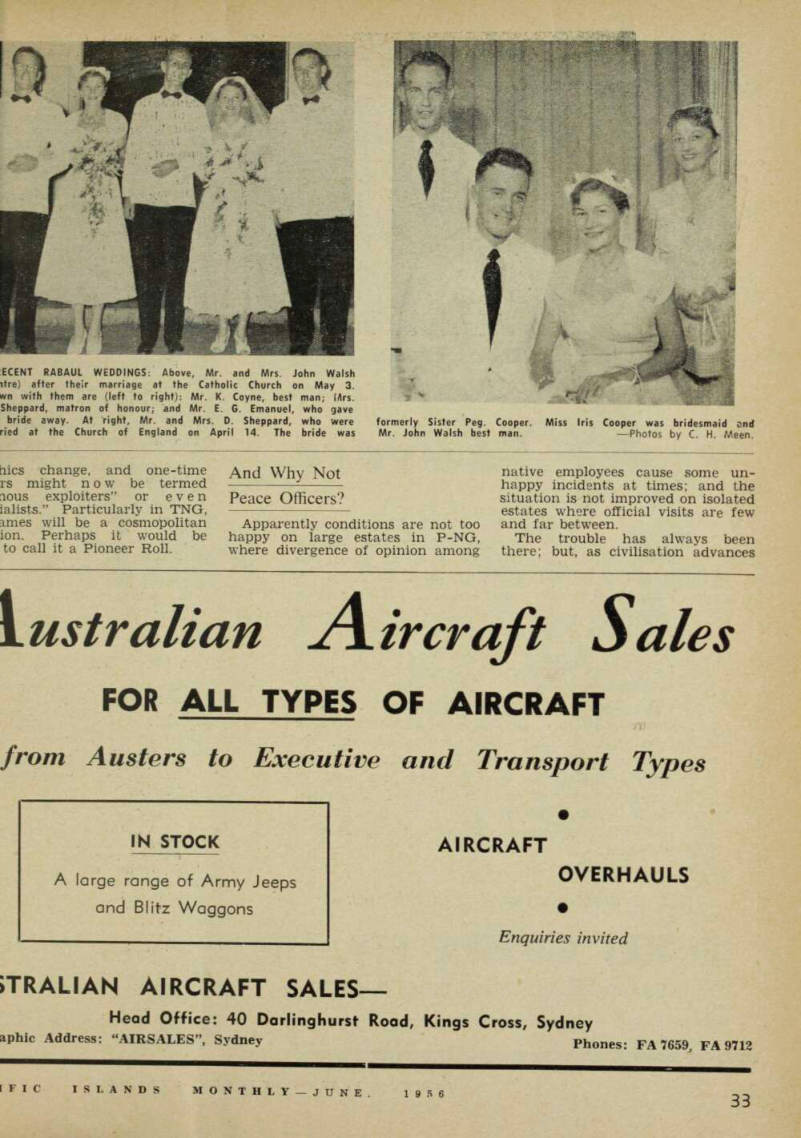
[?]ECENT RABAUL WEDDINGS: Above, Mr. and Mrs. John Walsh [?]tre) after their marriage at the Catholic Church on May 3. [?]wn with them are (left to right): Mr. K. Coyne, best man; Mrs.
Sheppard, matron of honour; and Mr. E. G. Emanuel, who gave bride away. At right, Mr. and Mrs. D. Sheppard, who were ried at the Church of England on April 14. The bride was
formerly Sister Peg. Cooper.
Mr. John Walsh best man.
Miss Iris Cooper was bridesmaid and Photos by C. H. Meen.
with such speed, the prestige a authority of the white diminish like ratio.
A suggestion has now been ma —and a very good one, under t circumstances—that certain plai ers of balance and good repi should be appointed Peace Offic and have the authority to d summarily with riots and such-1 when, and if, urgent action is i quired.
The suggestion so far has oi reached the “considering” stage the Administration, but it is to| hoped that it may be put into efh It would be a welcome gesture the part of the Administration show a friendly feeling towa; other whites placed in unenvia positions and create a better und standing and better team-work 1 tween two sections of the n( native community.
For Those in Need
The Rabaul Town Advisory Co mittee has decided to form a si committee to “deal with destit people”—which, I presume, mei rendering assistance to deserv cases.
Such an organisation is not r in Rabaul. Back in the mid ’Thirties there was a live-tn organisation (quite unofficial) up, and known as the TONG (Territory of New Guinea i Society). Freddie Schmahl, translator in the Lands De originated the idea and many good deed was done without bl of trumpets or beat of drum.
Good luck to the new Commit —with the hope, of course, that tl dc not have too much work to Two Minds With But . . .
From the ABC one learns t during the May session of the P-] Legislative Council suggestions w put forward by a nominated \ official Member—Simogun, of Sepik. He suggested: • That the indigenous people NG should not be call “natives.” • That pidgin English should abolished. • That native observers should allowed to attend Legislal Council meetings.
This, to one who has heard ; worthy Simogun Peta in action the floor of the Legislative Coun seems out of step with his us original ideas as expressed in Coi cil. Does this Member from Sepik have to borrow his ideas fr Canberra? It suggests that he firing Ministerial bullets. Surely can keep our native members f of political intrigues: or is pa lobbying to be part of their edu tion towards a civilised world?
Is it the Voice of Peta, but words of Paul?
C. 11l le outstanding feature of the h Pacific Conference, to me, ied to be the very natural de ition of Tuli L. Le’iato, from rican Samoa, who attended the erence. He was attired in a ionial lavalava (not laplap, ie) bare to the waist excepting i lei. ds appears to be the most ral attire for Islanders from r where in the Pacific and shows not every nation is anxious >ut the indigenes into Euro clothing. Why, why cannot example be followed by other tones? How much better d our natives in P-NG appear leir natural costume of a mere ava (with a lei, if you so de it) than togged up in stolid pean clothing? They lose more half their dignity apeing Euro s.
ial Islands (?)
b Third South Pacific Confer seemed to receive more city than its predecessors. The by of subjects discussed in ,ed me particularly. Problems le Ancient and the Modern
world were carefully discussed in detail. There was no doubt, a clash of cultures and some difficulties for these half-civilised people to under-
stand our western views of peace while exploding atom-bombs for warfare, and of pushing them
(Continued on Page 133)
Mr. K. Skyring, of Rabaul, was recently married there in the Church of England to Miss Pamela Roach. This photograph, taken after the ceremony, shows (left to right): Mr. B Roach, best man; Miss D. Willis, chief bridesmaid; Mr. and Mrs. Skyring; Lynley Woods, flower-girl; Mr.
Rex Brown; Miss Mary Johnston; Mr. and Mrs. E. Roach, parents of the bride.
Photo by C. H. Meen.
nd while we held nuclear ex nents. me Micronesians registered ssts against the explosion of ern bombs and war-heads on or their atoll homes. And who blame them? bat about changing the name . Marshall Islands to Martial ids? lat would the reaction of ;ern powers be if Communists ed out similar war-like tests ig a primitive people? lampre i to say we would call it ility.
ital Inflation
)m the modern proving-ground le Marshalls to the Marriage :et in Melanesia, ule one crowd of delegates was ssing H-bombs, another was ? its grievances about the pre day high cost of brides.
Papuan said that where previ £Aloo was paid the amount re d now was £A7SO, and the groom’s family had to pay for vedding feast as well, very similar example of in n was given by a delegate from few Hebrides. native woman delegate from
Rabaul (described in some reports as a blonde) told a different story: In her home, brides cost only £AIO, she said, and added, “everybody was happy.” Prince Tungi of Tonga said conditions were even better in Tonga where “brides are free and it costs nothing to marry them—but they are awfully expensive to keep.”
I could not help but think that these near-sophisticates from New Guinea were shouldering a big re sponsibility in speaking for the many thousands of their people who had not as yet reached such a standard of sophistication.
But it’s the same in Indonesia and these other near Northern neigh bours of ours: There are only a few who do the thinking and the masses have to follow. Self-government;
Nationalisation: Independence. . .
On with the dance! And, when you come to think of it, are we Westerners so very much different?
The Blonde Belle
From Rabaul
But the blonde from Rabaul wasn’t so dumb as some of her prototypes in the more civilised areas of the world. It was her hair which made the headlines, not her bust line.
A Sydney afternoon newspaper splashed her and her friend, a Papuan lass (Hildegarde Naime)
across their news pages under the caption, “Fuzzy Wuzzy Blonde is a Real Bottler!” It appears some energetic newshound had seen these two SPC delegates “shivering in the foyer of the Australia Hotel” (no less!) and high-lighted the Rabaul matron’s “blonde” hair, which was explained as “coming out of a bottle” —i.e., peroxide. Said the dark-haired Papuan lass: “The
Rabaul girls use it a lot. In Port Moresby, we don't touch it.”
Our old friend Keith McCarthy— in charge of the P-NG draft —explained that girls with blonde hair were the fashion.
Bleaching the hair in parts of New Britain, New Ireland, and NG mainland has been an age-old custom, but only in comparatively recent years has peroxide been used. Lime, or “kubang” (obtained by burning coral) was the original application and had as its purpose the cleansing of the hair from lice.
As civilisation progressed, many natives preferred fair hair and someone —I know not who —discovered that peroxide gave the same results as “kabang,” so far as bleaching was concerned, though perhaps not so efficacious in eradicating the "mus-mus.”
It w r as not long before trade stores realised the value of peroxide and placed it on the shelves with beads and mirrors.
Bits and Pieces
Congratulations to Matron Thor bum, Jack Ahearn and Clarrie Archer on their Birthday Honours’
OEE. All well deserved. . . . En gaged: Elizabeth Nettleship, popular daughter of Ken (late of the Rabaul Customs) to Robin Louth, of Lon don, England. . . And to Janet Gallagher, of the Moresby Hospital staff, and daughter of Mrs. Clarrie
Archer, engaged to Frank Campbell, of Victoria, but domiciled in Moresby. . . Passed on; Henry Eric Petterson, at Brisbane, on May 16. . . . Charles Leslie Baldock, at Kogarah, NSW, on May 25. . .
Arthur Henry Buckland, at Moresby, on May 26. . . Mena Hallett Kingsley, at Moresby, on April 11. . . Three Jap divers have received permission to survey wrecks in Rabaul Harbour
totalling 150,000 tons. English ai US firms were not interested. . 1 Petrol will be delivered in rubq bags to the NG Highlands by aj commencing next month. . . Wad ington professor of Anthropolojj Rev. Dr. Martin Gusinde, intends? four-month survey of pygmies j NE New Guinea. “Where no whi man has ever set foot.” (The hap] hunting ground!)