tropicalities
pp. 83-84 · Read in the full issue
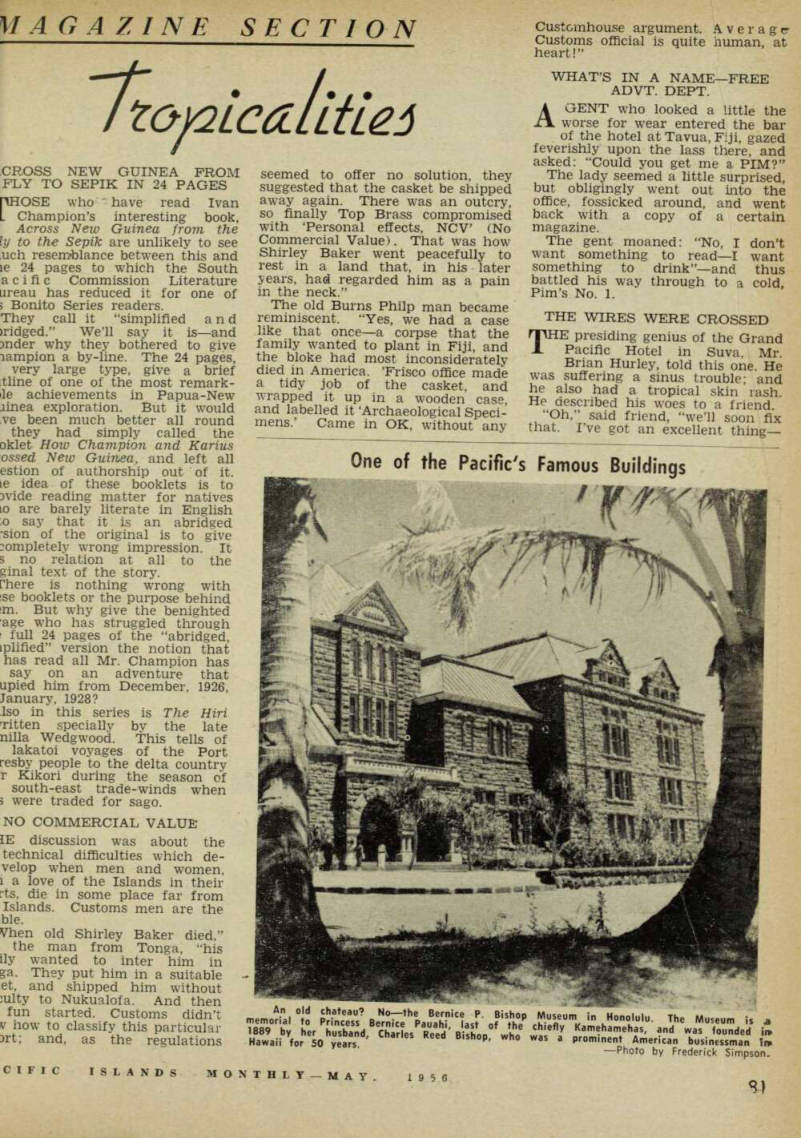
Magazine Section
Cross New Guinea From
Fly To Sepik In 24 Pages
[THOSE who have read Ivan L Champion’s interesting book, Across New Guinea from the ly to the Sepik are unlikely to see uch resemblance between this and le 24 pages to which the South acific Commission Literature iireau has reduced it for one of > Bonito Series readers.
They call it “simplified and >ridged.” We’ll say it is—and wider why they bothered to give lampion a by-line. The 24 pages, very large type, give a brief tline of one of the most remark ile achievements in Papua-New iinea exploration. But it would ,ve been much better all round they had simply called the oklet How Champion and Karius ossed New Guinea, and left all estion of authorship out of it. ic idea of these booklets is to ivide reading matter for natives lo are barely literate in English ;o say that it is an abridged 'Sion of the original is to give completely wrong impression. It s no relation at all to the ginal text of the story, rhere is nothing wrong with ;se booklets or the purpose behind im. But why give the benighted age who has struggled through i full 24 pages of the “abridged, iplified” version the notion that has read all Mr. Champion has say on an adventure that upied him from December, 1926, January, 1928?
Iso in this series is The Hiri Titten specially by the late nilla Wedgwood. This tells of lakatoi voyages of the Port resby people to the delta country r Kikori during the season of south-east trade-winds when 3 were traded for sago.
No Commercial Value
IE discussion was about the technical difficulties which de velop when men and women, i a love of the Islands in their rts, die in some place far from Islands. Customs men are the ble.
Vhen old Shirley Baker died,” the man from Tonga, “his ily wanted to inter him in ga. They put him in a suitable et, and shipped him without ‘ulty to Nukualofa. And then fun started. Customs didn’t v how to classify this particular crt; and, as the regulations
seemed to offer no solution, they suggested that the casket be shipped away again. There was an outcry, so finally Top Brass compromised with ‘Personal effects, NCV’ (No Commercial Value). That was how Shirley Baker went peacefully to rest in a land that, in his later years, had regarded him as a pain in the neck.”
The old Burns Philp man became reminiscent. “Yes, we had a case like that once—a corpse that the family wanted to plant in Fiji, and the bloke had most inconsiderately died in America. ’Frisco office made a tidy job of the casket, and wrapped it up in a wooden case, and labelled it ‘Archaeological Speci mens.’ Came in OK, without any
Customhouse argument. Average Customs official is quite human, at heart!”
What’S In A Name—Free
Advt. Dept.
AGENT who looked a little the worse for wear entered the bar of the hotel at Tavua, Fiji, gazed feverishly upon the lass there, and asked: “Could you get me a PIM?”
The lady seemed a little surprised, but obligingly went out into the office, fossicked around, and went back with a copy of a certain magazine.
The gent moaned: “No, I don’t want something to read—l want something to drink”—and thus battled his way through to a cold.
Pirn’s No. 1.
The Wires Were Crossed
THE presiding genius of the Grand Pacific Hotel in Suva, Mr.
Brian Hurley, told this one. He was suffering a sinus trouble; and he also had a tropical skin rash.
He described his woes to a friend.
“Oh,” said friend, “we’ll soon fix that. I’ve got an excellent thing—
Til send the boy with it.
The servant came along presently with a thin creamy substance. The miserable Brian poured some into his hand, and sniffed it vigorously ud his nostrils.
When he had finished turning handsprings and displaying other signs of agony, he went looking iot his friend, and told him about it in language plain and unadorned.
"Good God,” said the friend, “That was for your rash, not for your sinus.”
Solomon Islanders Who Are
"Europeans”
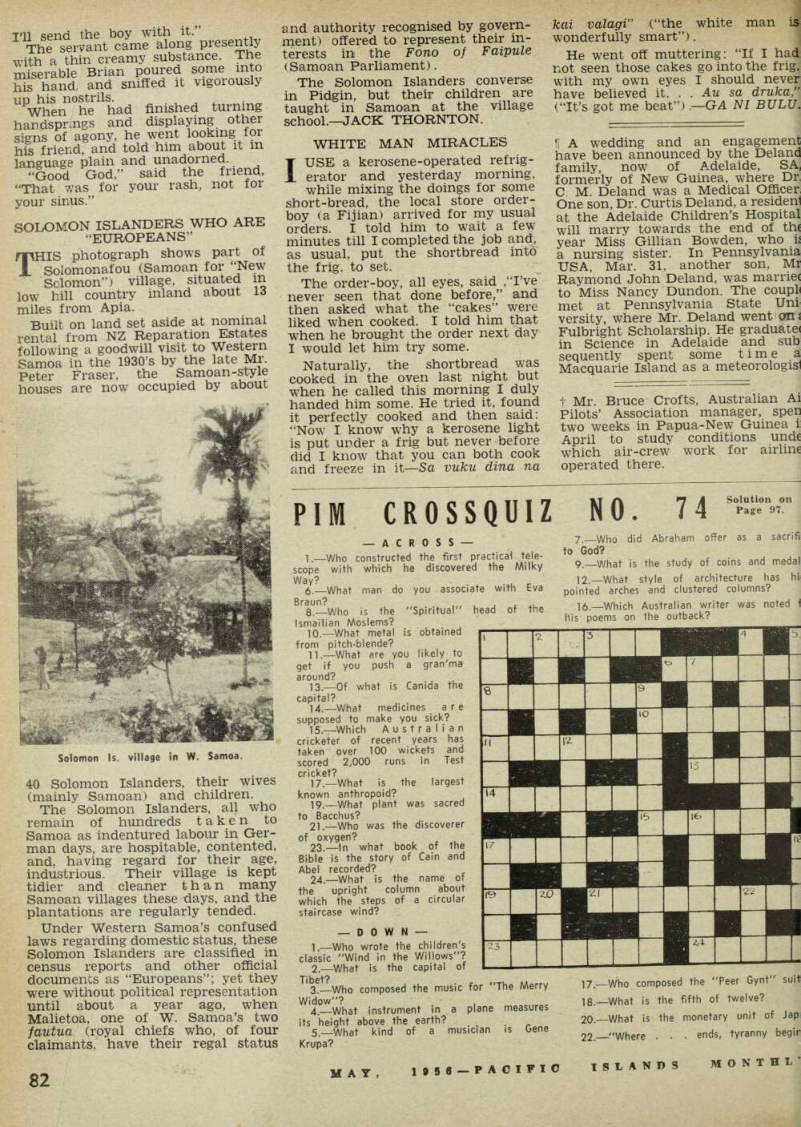
THIS photograph shows part of Solomonafou (Samoan for “New Solomon”) village, situated in low hill country inland about 1 6 miles from Apia.
Built on land set aside at nominal rental from NZ Reparation Estates following a goodwill visit to Western Samoa in the 1930’s by the late Mr.
Peter Fraser, the Samoan-style houses are now occupied by about
40 Solomon Islanders, their wives (mainly Samoan) and children.
The Solomon Islanders, all who remain of hundreds taken to Samoa as indentured labour in Ger man days, are hospitable, contented, and, having regard for their age, industrious. Their village is kept tidier and cleaner than many Samoan villages these days, and the plantations are regularly tended.
Under Western Samoa’s confused laws regarding domestic status, these Solomon Islanders are classified in census reports and other official documents as “Europeans”; yet they were without political representation until about a year ago, when Malietoa, one of W. Samoa’s two fautua (royal chiefs who, of four claimants, have their regal status
and authority recognised by govern ment) offered to represent their in terests in the Fono of Faipule (Samoan Parliament).
The Solomon Islanders converse in Pidgin, but their children are taught in Samoan at the village school. —JACK THORNTON.
White Man Miracles
I USE a kerosene-operated refrig erator and yesterday morning, while mixing the doings for some short-bread, the local store order boy (a Fijian) arrived for my usual orders. I told him to wait a few minutes till I completed the job and, as usual, put the shortbread into the frig, to set.
The order-boy, all eyes, said ,‘T’ve never seen that done before,” and then asked what the “cakes” were liked when cooked. I told him that when he brought the order next day I would let him try some.
Naturally, the shortbread was cooked in the oven last night but when he called this morning I duly handed him some. He tried it, found it perfectly cooked and then said: “Now I know why a kerosene light is put under a frig but never before did I know that you can both cook and freeze in it— Sa vuku dina na
kai valagi” ("the white man is wonderfully smart”).
He went off muttering: "If I had not seen those cakes go into the frig, with my own eyes I should never have believed it. . . Au sa drukaf'
("It’s got me beat”)
Ga Ni Bulu.
fi A wedding and an engagement have been announced by the Deland family, now of Adelaide, SA, formerly of New Guinea, where Dr.
C M. Deland was a Medical Officer.
One son, Dr. Curtis Deland, a resident at the Adelaide Children’s Hospital will marry towards the end of the year Miss Gillian Bowden, who is a nursing sister. In Pennsylvania USA, Mar. 31, another son, Mr Raymond John Deland, was marriec to Miss Nancy Dundon. The coupl( met at Pennsylvania State Uni versity, where Mr. Deland went on i Fulbright Scholarship. He graduate< in Science in Adelaide and sub sequently spent some time a Macquarie Island as a meteorologist t Mr. Bruce Crofts, Australian Ai Pilots’ Association manager, spen two weeks in Papua-New Guinea i] April to study conditions unde which air-crew work for airline
operated there.
Solomon Is. village in W. Samoa.