Pacific Shipping And Cruising Yachts
pp. 45-133 · Read in the full issue


[?]is Months News of—
The report of the Joyita Com ssion was released simultaneously Apia and in NZ on April 12 and kes interesting reading for all 0 followed this affair. The Com ssion consisted of Chief Judge C. Marsack, of W. Samoa, and pt. A. H. Prosser and Mr. C. G. R.
Kay, of New Zealand. A summary the report follows: oyita was described as a twin ew motor vessel of sturdy hull ign and built in 1931 by the Imington Boat Works in Los geles, California, with an overall gth of 69 feet, beam 17 feet and ft 7 ft 6 in, and a gross and net nage of 70 and 47 respectively, ’he vessel was used as a yacht for eral years and as a Patrol Vessel the US Navy during the Second rid War. a 1948, she was purchased by a fate firm for use as a fishing sel and refrigerated holds were ;alled in her. he was powered by 2 Gray fine Diesel engines of 225 hp, 1 driving independent shafts and pellers. She had, besides, two iliary diesel engines, made by leral Motors, each driving an trie generator of 20 kilowatts, i 120-volt output, to serve light and various other electrically en appliances. i September, 1952, the vessel was to her present owner, Dr. n Katherine Luomala, of Hono , who, in September, 1952, ited a bare-boat charter to mas Henry Miller, trading as the enix Island Fisheries. The US itime Administration, Washing approved the charter to Miller, was, as a British subject, an i under US law, for operation in commercial fisheries at Canton id, Central Pacific, and for sportation of frozen fish to an, returning to Canton Island supplies, le charter was on condition that vessel should not be sub tered to aliens without the prior ■oval of the Maritime Admin tion. This conditional approval red on April 1, 1956. iller commenced fishing in the nty of Canton and Christmas ids in October, 1952, and made 3 round trips to Honolulu. In l.May, 1954, Miller left Hono for the last time and went to oa. He arrived in Apia on July 954, with a cargo of frozen fish ale m Western Samoa. He made umber of trips between Pago • and Apia until he finally ed at Apia on March 23, 1955 een April 1, 1955, and May 1, he made one fishing trip to
the vicinity of the Tokelau Islands.
On this trip he was accompanied by Mr. R. D. Pearless, recently appointed District Officer of the Tokelau Islands. Mr. Pearless was interested in the employment of Joyita on a regular service to the Tokelau Islands, which could replace the irregular service by the Ameri can vessel Manuatele and other casual connections. Proposals to that effect proved abortive. Miller
was in straitened circumstances financially, and unable to under take additional fishing voyages, which in any case had proved un profitable previously. Joyita was laid up at anchor in Apia Harbour from May 1, 1955, for over five months.
By September, 1955, the situation in respect of food and medical sup plies in the Tokelaus had become serious. There was also some 70 tons of copra, the main export of the Islanders, waiting for shipment.
Mr. Pearless, anxious to obtain re lief for the Islanders, approached Messrs. E. A. Coxon & Co. Ltd., an Apia firm, with a proposal that they should charter the Joyita for trips to the TokelaUS. (Continued, Page 45)
if ter some negotiations, the irter was agreed upon and a go of foodstuffs and medical plies was loaded. A total of nine sengers was embarked for the
trip, of whom 3 were Europeans (R. D. Fearless, District Officer, A D. Parsons, Government Medical Officer, and H. Hodgkinson, Dis penser, Apia Hospital) , with 6
Tokelau Islanders, including one woman and a child. The crew numbered 16, including the mate, C. R. Simpson, an American citizen, 8 Tokelau Islanders, 2 Gilbertese, one Swain’s Islander and two mem bers of E. A. Coxon’s staff, Messrs.
G. K. Williams and J. Wallwork, who travelled as supercargoes.
Over 2,600 gallons of diesel fuel oil were put on board, sufficient to cover a range of about 3,000 miles.
Food and water was sufficient for a much longer trip than the Joyita was to undertake. Fakaofo, the port of call in the Tokelaus, is about 270 nautical miles from Apia.
Joyita left Apia at approximately 5 a.m. on Monday, October 3, 1955.
She was not seen again until she was found in a water-logged condi tion with no persons on board, north of Vanua Levu, Fiji, in latitude 14 deg. 42 minutes south, longitude 179 deg. 45 minutes east, in the early morning of November 10 by Cap tain Gerald Douglas, of the GEIC ship Tuvalu . (Qver)
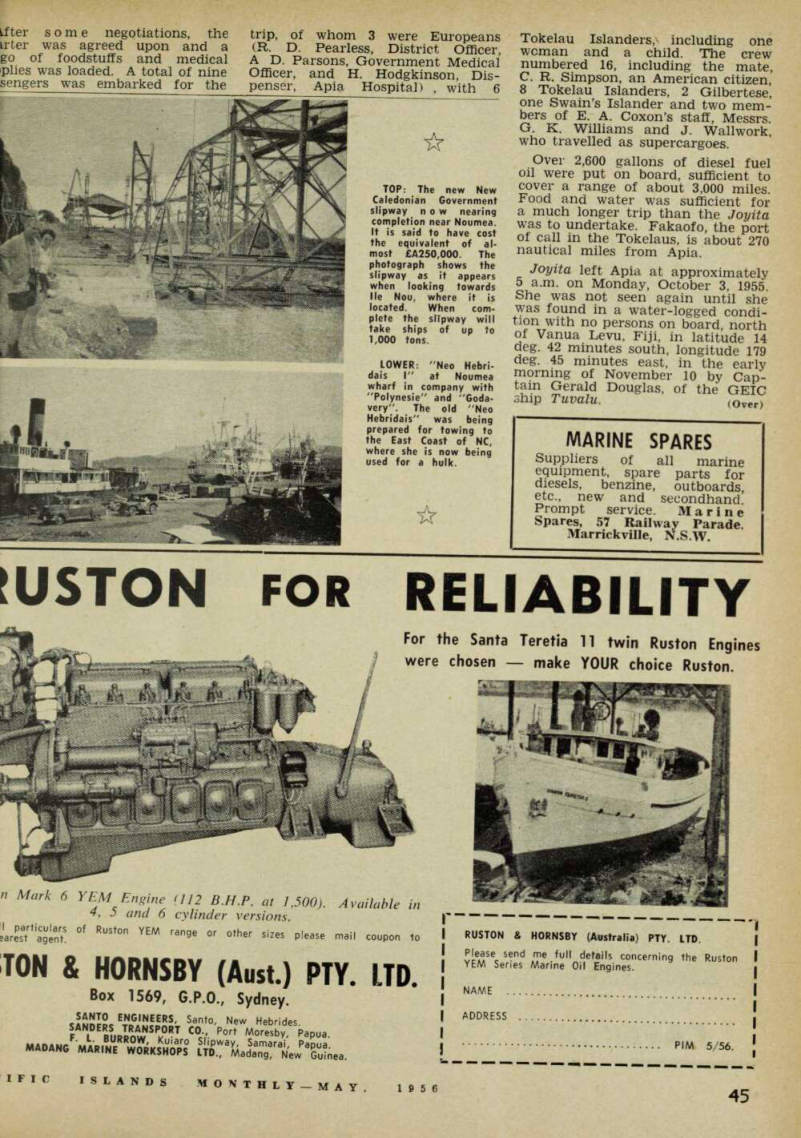
TOP: The new New Caledonian Government slipway now nearing completion near Noumea.
It is said to have cost the equivalent of al most £A250,000. The photograph shows the slipway as it appears when looking towards He Nou, where it is located. When com plete the slipway will take ships of up to 1,000 tons.
LOWER: "Neo Hebri dais I" at Noumea wharf in company with "Polynesia" and "Goda very". The old "Neo Hebridais" was being prepared for towing to the East Coast of NC, where she is now being used for a hulk.
THE report states that it was established without doubt by the evidence that the Joyita was exceptionally seaworthy in hull de sign and with a very high degree in buoyancy due to the cork insula tion of the refrigerated holds.
Technical witnesses were of opinion that Joyita was virtually unshakable. Before she sailed from Apia, Joyi'.a was well found in fuel, lubricating oil, water and food.
However, the Commission found that Joyita, as equipped in October, 1955, was definitely not suitable for the carriage of passengers.
Passenger accommodation was poor, though generally speaking, the carriage of passengers on small coastal vessels on deck even on voyages as long as that from Apia to the Tokelaus is an accepted practice.
Joyita had no passenger license.
The Harbourmaster of Apia, Cap tain J. W. Jones, when enquiring about this was informed by Captain Miller that the ship had a license to carry 25 passengers, issued by the Bureau of Shipping, Honolulu.
This was not true.
Under US law, a ship which is licensed merely for fishing and owner’s freight is not liable to regular survey; whereas a vessel holding a passenger license must be regularly surveyed.
The life-saving equipment carried on board was inadequate in view of the number of persons carried in the ship. There were only 3 oval floats of US Navy type, to gether with a sufficient supply of individual life-jackets. The floats and life-jackets would be only useful
to keep persons above water for few hours in expectation of ear] rescue, but insufficient to enable tt ship’s company to spend any tin at sea or to make for any land thj was visible. No lifeboat was carriec even the light work-boat belongir to the ship was left behind at Api
rocket or other form of echnics was held on board, antity of lumber was included le deck cargo but it is not n whether there was sufficient for lashing to fashion a raft.
Miller had previously experienced tiouble with the clutch of the starboard engine and the propelling equipment of the vessel was not in thorough and reliable order. The port engine was, according to expert opnnon, out of commission not long after the ship cleared harbour. The Scdt water circulating system contamed in at least one place 1-in. galvanised pipe threaded into a brass fitting under the floorboard of the engine room. This piping was verv liable to corrosion and defects would have been disclosed on a proper survey whpn u When subjected to engine vibration the pipe was liable to corrode and break at any time. The two
bilge pumps were not fitted with strainers and this had given trouble on previous voyages through block age of the pipes. The liability to blockage was increased by the Joyita having lain idle in port for months when a considerable quantity of cotton waste, dust and other rubbish must have accumulated in the bilges —~ , s + The Commission considered that i n orn L al Prudent routine had been followed and Joyita had been taken , sea K fc l r a J^ ial run of a few before the voyage to the Tokelaus was undertaken, some of £ hese machi nery defects would have been noticed and steps could have been taken to repair and correct them. (Continued on Page 4»>
[?] yachts recently in Papeete, top to "Diana", "Jellicle" and "Girl Isabel", [?]ory, page 129).
le Joyita had two receiving sets a transmitter on board, but effectiveness of the transmitter reduced to a negligible quantity use of a break in the aerial lead i. above the transmitter. This k was of long standing and 1 have been discovered by a Detent radio technician. The irintendent of Apia Radio made ffer of service to Captain Miller :e the ship sailed, but Miller not avail himself of the offer Joyita went to sea with the :t still existing and undis ed. e superstructure of the vessel flimsy and had considerably iorated over the years due to and tear and the entry of sea This fact probably con ;ed to the disaster. The deck ngs were not well protected st the entry of sea water. dence showed that Miller was bly competent Master Mariner, g served with the British lant Marine and during the vith British naval forces, last the rank of Lieutenant-Com er. Later he had sailed all the Pacific before taking the ;r of the Joyita. He thus had ed a very extensive knowledge cific waters. He was deeply led to his ship and had the t confidence in its seagoing
The report emphasised that the examinations disclosed no evidence whatever of damage by sudden and violent external means such as ram ming by another ship, fire, explosion, or contact of the hull with rock or reef.
The cause of the casualty to the ship could be explained without re course to any sensational and ex traordinary hypotheses and to the fantastic and imaginative stories published by the Press all over the world.
The cause of the Joyita disaster was to be found entirely in the mechanical and structural equip ment of the ship itself. The real cause was flooding of the vessel, due primarily to the corrosion and breaking of the 1-in. galvanised pipe which formed part of the cooling system of the port auxiliary engine.
When this pipe broke through and a section of it was carried away, water commenced to pour into the hull at a very rapid rate. The flooding was aggravated by the worn port propeller shaft and other leaks.
Expert evidence indicated that the total volume of water admitted through these sources of leakage would be in the region of 2,000 gallons an hour.
The failure to discover the fracture in the 1-in. pipe very soon after it took place lead to the conclusion
that no proper engine-room watch was kept, as such a watch would have noticed the rising water in the engine-room and a routine search would have disclosed the source of the leak as soon as the floor boards were raised. Once the water rose a few inches above the engine-room floor, the source of leak would be
difficult to discover. A resuit of the fracture of this pipe would be that the cooling water would be cut off from the port auxiliary engine, which would then be unable to operate.
The most important contributory cause of the engine breakdown was the failure of the bilge pumps which made it impossible to keep the in rush of water under control. The blockage of the intake pipes was probably caused by the presence of rubbish in the bilges and the absence of strainers.
If water were allowed to rise 18 in. above the engine room floor, then water would enter the blower of the starboard engine and stop the engine. With the pumps not work ing, the ship took in water at a very serious rate, water gradually finding its way throughout the whole ship. With the engine stopped and the ship losing steerage way, Joyita became unmanageable and fell broadside on to the seas.
There was no heavy weather in that part of the Pacific at the time, but there were choppy seas. Joyita would then start taking water in through her deck openings, and from that time onward complete flooding became inevitable.
ALTHOUGH the Commission found it possible to speak with a reasonable degree of conviction as to the cause of the casualty to the ship, they are quite unable to do so
with regard to that of the ship’s personnel.
The opinion that many members of the crew and passengers were washed overboard at once when the waves swept away the port side of the superstructure was unlikely.
It is more likely that the Master
and crew abandoned the ship their own act, but this was c ficult to explain. When the Jo% was discovered, an awning \ lashed down partly over the dama; superstructure. This indicated t there were survivors on board ai the hull was filled and the sup
*e swept away and that they le awning for shelter. Part :argo was jettisoned and re in the afterhold by empty apparently to improve the ;y of the vessel.
Joyita, listing heavily and
breaking over her, was at ioat and offered some de security, preferable to going 5 side and hanging on to a it or to a makeshift raft in m ocean, though such an would probably have been if, at the time of abandon he ship was passing some ich it was thought could be with the help of the life equipment available, in ; though it was. nly islands in range were nd Hoorn Islands; certain f wreckage identified as coming from Joyita were Futuna, one of the Hoorn her explanation of the nent of the vessel may be damage occurred at night, lat the ship might founder : and believing that land . the ship’s company might cided that it would be ' trust themselves to the g equipment available than i on board.
o( T curred on the night of October 4, at no great distp?nQpf 1 nf n fvr akaof °’ 1 ? n + 0f the main causes of the casualty to passengers and crew was the lack of efficient wireless transmitting apparatus on board which would have enabled communication to be established with Apia radio.
TN the opinion of the Commission, 1 the main responsibility for the disaster lay upon Captain Miller.
Many of the technical deficiencies of the vessel must have been known to him before he sailed. Particularly the lack of a well-found lifeboat, which may have been the main
cause of the loss of every person on board. The break in the wireless ae r ial lead was of long standing and Miller must have known that he was unable to make any radio trans mission, in spite of his statements to the contrary statements „ , , .f 16 was al so negligent in failing, after a 5-months’ lay-up, to give the of outside the waters lagoon.
The lack of judgment on Miller’s P ai ’t ma y have been caused by the circumstances he found himself in at the time. He was in debt in A P ia and Pago Pago and his fishing
(Continued on p age 117)
NORDMAN writes: "The above picture [?]le former American three masted bald schooner 'Lucy' renamed the 'Raita' [?]ed by the late Mr. Albert Leboucher,
ete.
picture was taken in 1925, when [?] ro Goldwyn Mayer Company was in Iming 'Never the Twain Shall Meet'. ita' was chartered by the company med in the story, and when the star, ita Stewart, refused to get into the and swim out to the ship lying in [?]am, the director, Mr. Walsh, picked [?]rgot Nordman to double for Miss When Margot was out in the water, was seen to come towards her. She he warning as she knew that a fake is to have been floated out and tied ng. She did not know it was a live util she got out to the 'Lucy'.'' [?]ys that the schooner subsequently near the US Pacific coast. He also photo shows Margot swimming and [?]s fin—but it is difficult to make [?]is old print.
itures had been financially un cessful. He had been unable to the Joyita with the owner’s hority at a comparatively high je. The charter, with a fair incial profit, offered some way of his difficulties and a chance ffear his debts and to return to lolulu. He was therefore ex nely anxious that the charter one or two trips to the Tokelaus aid be successfully completed, tiller was also aware that he had license to carry passengers. A dition of the charter by Dr. mala to Miller was that there aid be no sub-charter to other i US citizens without the con ; of the US Maritime Adminis ion, so the sub-charter to E. A. on & Co. Ltd. was therefore :al and rendered Miller liable to re penalties on his return to US sdiction. le question as to whether any onsibility lies at the door of the I authorities in Western Samoa not so easy to answer, le Harbourmaster of Apia, Cap- J. W. Jones, had doubts as to ther the ship was well found
and fully equipped for the voyage and made enquiries from Miller on the points as to which he felt doubtful. Captain Jones had no legal means by which he could test the truthfulness of Captain Miller’s statements. Therefore, the Com mission was unable to place any re sponsibility for omission or breach of duty on Captain Jones.
Mr. Pearless might have made it a condition of the negotiations for the charter that the vessel should be examined by a competent authority—in this case the Harbour master—but he was very anxious that nothing should stand in the way of the charter and was probably convinced from his own experience of one month’s voyage that the vessel was in all respects satisfactory. This conclusion is supported by the fact that Pearless himself was to be one of the passengers.
The burden of personal respon sibility thus falls almost entirely on Captain Miller, whose anxiety that there should be no hitch or delay in the carrying out of the charter led him consciously to deceive the shore authorities.
The Commission was satisfied that all possible steps were taken by air search to locate and assist the miss ing vessel. The lack of success of the air search was not in any sense due to faulty organisation or to lack of service and attention by the air crews, but to the fact that the Joyita was barely afloat and would make an extremely small target either for radar or for de tection by the human eye.
This was proved by the experi ment carried out by the RNZAF when Joyita was being towed by the Degei. The latter vessel showed up
clearly on the radar screen from a distance of 20 miles, whereas no image of Joyita appeared even when the aircraft had approached within an extremely short distance of the two vessels. The Joyita, as a wooden hulled vessel, would not respond sc sharply on radar as a metal-hulled vessel.
At the conclusion of its report, the Commission refers to the questior of the degree of control which, undei existing legislation can be exercised over ships leaving Apia for ports overseas. The only shipping law ir force in Western Samoa is the Pori Control Ordinance 1932, which makes provision for the survey and inspect tion of inter-island trade ships (owned in Western Samoa) and home trade ships of Western Samos as to sea-worthiness, certification ol Masters and Engineers, and life saving appliances but provides nc powers in respect of overseas ships which arrive in Samoa from outside the territorial limits of Samoa.
The International Convention fo] the safety of life at sea has nevei been applied to Western Samoa. Ir any event Joyita, because of he] small size and limited purposes would have been exempt from the provisions of the Safety Convention There is no provision for with holding the clearance of an over seas ship on the ground, for in stance, that the life-saving equip ment is inadequate, or that ar efficient radio transmitting set ii not carried. The Commission there fore stressed the desirability of in itiating legislation with a view tc achieving a greater measure of con trol over overseas vessels which proi pose to carry passengers fron Western Samoa to overseas ports. 1
Joyita For Sale.
Joyita w as put up for sale in Suve in April. She is at the Public Works Department shipyard ir Suva. She is being offered on be half of the owner, Dr. K. Luomala by the Suva legal firm of Wm. Scotl and Co.
The position with regard tc salvage rights has never been made clear. As a derelict, Joyita wa i found by the Gilbert and Ellice Islands ship Tuvalu, and later towee to Malau by the Fiji Government ship Degei.
Deutgan Floats Free
The ex-barge Deutgan, owned bj M. Marcel Marinacce, of Santo, Nev Hebrides, which was reported as “probably a total loss” at Port Resolution, Tanna, NH, was floated off on the equinoctial neap tide or March 21—apparently to the sur prise of everyone, including the owner. A report from Vila states: Deutgan was almost lost on the night of March 13-14, when, despite the fact that she was riding to twe anchors and running both engines; she was driven by a sudden near
lie over rocks at the entrance to )rt Resolution. The ship had ken shelter at Port Resolution the evious day because it had been ipossible to work at Whitesands, lout six miles north.
Fortunately, the weather subsided id the ship was left, almost dry at sv tide, in sheltered water.
A survey revealed that the ship is not holed and though several ates were badly buckled she was aking very little water. Both pro ffers were badly damaged. M. Mar acce went to Vila during the first arter of the moon and before he ;urned to Tanna for the fuff moon les of the 26th, he learned, to his rprise, that the ship had been ated off on the 21st.
Darnley was chartered to tow utgan, with one screw turning at iuced speed, to Vila, where the o ships arrived on the afternoon March 25.
Rocinante Homeward
Bound
rhe New Hebrides Condominium >sel Rocinante, which made ivspaper headlines in Australia in e February, when she lost : position off the New South lies coast in heavy gales, t Newcastle in the second week April, bound for home. rhe Rocinante, of 48 ft 1.0. a., was It last year by Wynne S. Breden
Pty. Ltd., of Newcastle, and went to NSW for minor repairs. While she was in the builder’s yard, she had a refrigerator fitted and additional bunk space put in.
Ons And Offs In French
Oceania
Reports from Papeete say that the motor-cutter Haupeeaterai, owned by F. Richmond, Jr., went on the reef on Rairoa Island on March 10.
It was not known whether she was a total loss or not.
A week later March 18 the schooner Florence C. Robinson dragged her anchor during a squall and drifted onto a shoal near Motu- Uta. Papeete’s Port Captain Bailly, assisted by Captain Louis Carlton, pilot at Papeete, succeeded in get ting her off.
Santa Teretia Li—
Christened, Blessed
Spick-and-span and much be fiagged, the new Sacred Heart Mission vessel for the Gilbert and Ellice Islands was, on April 12, at Bjarne Halvorsen’s shipyard, Syd ney, christened Santa Teretia II by Mrs. McKenna, wife of Australian Senator McKenna, and blessed by the Most Rev. R. Carboni, Aus tralasian Apostolic Delegate.
Speakers at this pleasant cere mony included the Lord Mayor of Sydney and the Consul-General for France. (Continued on Page 121)
lother speaker, Father Dalton, r attention to the peculiar navi mal problems with which the aer-priest, Brother F. Gautier, to contend in GEI home waters, fing to and fro in the vicinity Dth the equator and the inter mal date line, the Master has sep reminding himself whether s in north or south latitude, also which day of the week it spacious after deckhouse was d to this Nowra-built vessel at ey for the use of European mnel. e new vessel is 79 ft x 20 ft x and is powered by twin Ruston rnsby 90-hp engines. ;er leaving Berry’s Bay she was to Walsh Bay, Sydney, to load
cargo and it was expected that she would leave Sydney in early May.
Captain G. E. Langley will take her to Suva via Noumea, with Mr. B.
Norrie as engineer. There they will hand over to Brother F. Gautier. A crew of nine Gilbertese were brought to Sydney.
New Ship For Phosphate
Trade
Another order for a cargo passenger motor ship has been placed in the United Kingdom by the British Phosphate Commission ers, Melbourne.
The new vessel, to be built at Harland and Wolff’s Clyde yard, will be similar to the Triaster, com pleted at the same yard for the same owners last October. The
Triaster was of 12,000 tons dead weight. The new ship is to be named Tri Ellis, after the late Sir Albert Ellis, described as the “Father” of the Pacific phosphate industry. She will carry phosphate from Nauru and Ocean Islands to Australia and New Zealand.
She is intended for delivery at the end of 1958. (Over)
Left: The "Sirius" on the reef at Kar Kar Is. and, right, after she had been pulled clear. (See letterpress, page 122.)
Donalds Sell Mitiaro
Recently sold to Gallois et C Papeete, the old Mitiaro (named one of the Cook Islands) will en the Tuamotus trade as a feed ship collecting copra from sir islands.
Mitiaro has been owned by Eti lissements Donald Tahiti for past 30 years and the price at wh she changed hands is said to 750,000 Pacific francs (somewh around £5,000 Australian).
Meklong Saves Sirius
Time marches on, and catches with most of us in due course. He ever, when PIM received some C( this month in the form of a ta] recording, the editor was not mi pleased and cursed loudly while tape-recorder was dragged in by ( train and taxi from a remote ou suburb in order to find out wl mysteries the tape concealed.
Thereafter, of course, considera entertainment was had by the enl staff —albeit not a little toil by company’s most competent st ographer.
The recording was an on-the-s one made by Captain Laurie Thon of MV Meklong, in early Ap while he was in process of salv; ing MV Sirius from a reef off I Kar Island, which is about 25 m: from Madang, New Guinea.
Sirius was blown onto the r in a gale on April 2, after dragg both anchors; the Josey tried pull her off but gave up the atten on April 4.
On the morning of that day, Ci tain J. H. Evans, Madang Harbo master, flew over Sirius with Ci tain Thomas to decide whet!
Meklong could, with safety, get i; position between the outside £ inside reefs off Kar Kar.
Captain Thomas found when arrived at the scene, that he had little space to manoeuvre that wl the tow-line was secured with s ficient length to keep the stern Meklong clear of the reef, the t was only 40 ft off the reef on other side of the opening.
A strong current was running £ getting the heavy wires and ro across from Meklong to Sirius ( tailed hours of laborious toil. Matt were not improved by the roi coral bottom which fouled wires Sirius was sitting in a large h in the reef, which she had dug herself in the four days that , had been sitting there. Nothing i to be achieved by steady pulli but by making runs at the rc the vessel had been moved at end of the first day two or th feet. Then the wires carried aw Op the second day, after wi had again been got on Sirius w great difficulty, and more trou with the coral bottom, the vessel \ pulled out of her hole and even
moved about 15 ft across the It then seemed obvious that as useless to persevere with the available so it was decided that long return to Madang to get ire with a breaking strain of 30 0 tons. This had to be flown 1 Bulolo by a specially chartered , and on April 8, Meklong again ,rted from Madang for Kar Kar. k commenced at once, this time g oil drums to buoy the wire e the rough coral bottom; and ridle rig was put around the is. jch heavy work followed in h the bridle continually slipped finally carried away but the result of which was that Sirius moved a further 15 feet—3o feet 1 from her original resting place, half-way to deep water. Long '/s ensured while fresh gear was id and the tide fell and finally again. ptain Thomas then describes inal episode of the drama thus: vessel is now reasonably close to the water but the reef has got much ver towards the edge and "Sirius" is hard over on her port side at an angle out 45 deg. The seas are hitting the and breaking right up over the cabin nodation aft, and we are starting to gain. are allowing a lot of slack to get
into the wire and then making a run of full speed ahead to almost the maximum breaking strain of the wire. And each time "Sirius" moves five or six feet. We are keeping on repeating this manoeuvre and it is now about 4.04 p.m. and we are just about to make the final attempt and Ihe wire is lightening now.
The boys are cheering madly, the "Sirius" is moving! All the people on board are madly waving and cheering—you have no idea what a scene it is. The wire is as tight as it can be and now the ship is sliding off
the reef—she is sliding into the water!
She's Afloat!
That, of course, is not the end of the operation—as the Captain says, there was quite a lot of clean ing up to be done before Sirius could be taken in tow for Madang—some ing like 2,000 feet of wire lying around, and gear everywhere. Sirius had to be brought up close to Mek long and a jury rudder rigged. Her
der had been carried away. i the operation, the gear used, 5 the Captain, “runs into a lot noney.” Over 1,500 ft of 3-in. , .
ruined beyond ledemption,
120-fathom lengths of 2|-in. i also ruined and dozens Of ;kles worth £2 or £3 each. The 0 ft of wirp that pnmp from it it oi wire mat came from )10, however, was undamaged . 6 lo was due to this that success eventually achieved. Total time
;he operations was three days,
ng which about 15 tons Of fuel half a ton of lubricating oil u Sed. 3 finished up on a very human • j . , ...
Cre ,i dlt ' S due t 0 the excellent c °"Vf nt radl ° . communication provided with "them and been a e "big ... . B p ‘ this manoeuvring for hours and hours )ut the ("Meklong") engine room tem ire up to 139 deg. and much credit ! fnr d ?t a „ t H°:„n th % Chief n 9 inear . and bis for standing down and working under conditions—l won't say without a word implaint. He would ring up every 10 es and complain bitterly about the heat want to know when we were going to so that he could come up and get some air. But then again, he wouldn't be an ler unless he was complaining all the Id finniiv hoe o ” SrHA y ’ has 5 w , ords wlth
ff, who, we understand, is Capt.
G. Griffiths, owner of Sirius. The
conversation;
Captain Thomas: Now what do you think about the vessel being afloat again, Geoff.
Does she look any better than she does when she is sitting up on a coral reef?
Geoff: She looks very much better. I must say that the scenery around is much improved by the lack of the "Sirius" on a coral reef —she looks much better floating at sea with out the waves breaking over her.
Capt.: And does she appear to be damaged to any extent? Is she making water at all?
Or is the damage mostly superficial with the loss of the rudder and a few pieces of copper?
Geoff: The damage appears to be superficial except for the loss of quite a lot of copper and the rudder. The rest of the hull seems to be intact and she is not making much water.
Capt.: After this experience, Geoff, do you think you are going to continue in the ship ping business? Or are you going to buy a farm in Central Australia or settle down to a nice quiet life in the mountains?
Geoff (very firmly): I think I'll stick to the shipping business. I had a farm once and it's worse.
NB. Meklong was herself rescued from a New Britain reef by Capt.
J. H. Evans, in April, 1954.
New Navigation Lights In
Tahiti
A new navigation light at Point Venus, Tahiti, was to come into operation about April 10. The old fixed white light has been replaced
by an intermittant light (five
seconds). The position of this light
is latitude 17 deg. 29 min 8 sec. south; and longitude 149 deg. 29 min. W.
About April 20, new lead lights were to come into operation in the Grand Pass into Papeete—the two fixed red lights were to be replaced by a red upper light and a white lower light which will be synchronised to shine for three seconds and to be in eclipse for 1 second.
The two fixed red 87 deg. lights in the inner port have been replaced by two fixed green lights.
Tarawa Frequency
Thickening Plot
The paragraph which appeared in the February PIM concerning the new local frequency for Gilbert and Ellice Islands smallships has pro duced some confusion. The old frequency was 6280 kc/s, and we stated that it was to be changed, from February 1, to 4104.4 kc/s —or rather that Tarawa Radio-VSZ would listen on 4104.4 and reply on 4413.8.
The whole matter recently did some rebounding in Sydney when Pan Pacific Service were asked to organise the radio equipment on the new mission ship S. Teretia.
This they did through Amalgamated Wireless, one crystal being ground for the 4104.4 kc/s frequency. Then a message was received from the
Mission in Tarawa —the crystal was to be 4108.4. AWA was somehow able to get confirmation of this in Sydney—but when PIM tried, a fruitless hour was spent being passed from one person to another.
Finally OTC courteously suggested
that they “speak to Suva” abc it.
After an hour or so, back cai the information—Tarawa listens 6280 kc/s; replies on 4413 kc/s. j So it still seems to be anyon
.s—although ours is that the don is right. le original paragraph was ten by Mr. Jim Shortall, who not usually make mistakes of sort. Mr. Shortall at present round Manihiki, in the Cooks, too far away for a “please ex i.” All we can suggest is that was wrong, as seems likely, and ic Mission ever catches up with they extract from him the price lat 4104.4 crystal,
/Essel In Two Days Drift
New Guinea coastal vessel, the na Maris, owned by the Rai t Trading Company of Madang, towed into Wewak early April ter drifting for almost two days he Sepik coast. ortly after rounding Wewak b, at 5 p.m., April 14, the Regina s’ engine broke down. Three its were then fired from the but were not seen on shore. ;er drifting all night, the native sighted the MV Meklong on vay to Wewak and again fired imber of rockets, which also unnoticed, rly on Saturday morning, the 1 was drifting off Keul Island several crew members decided w to the mainland in a dinghy, i they reached 12 hours later from there walked to Wewak sported the matter to the Dis- Officer. 3 Administration vessel Thetis Vewak five hours later, located \egina Maris, which had drifted towards Cape Terebu and towed >ack to Wewak.
Htsman-Ham At Canton
Dannie Weil, a radio Ham, as as a cruising yachtsman, has ed Canton Island in his sloop e. s indicated in a letter written n from Canton early April that tends to stay some time—he is ashore with another Ham. il was previously in Tahiti, : he made many friends. He from Papeete to Canton in i.
R Nspire May Be Sold
• converted Brixham trawler 'e, which has been engaged in ig in the Cook Islands for il years, is reported in Auck for refit. is understood that Skipper Williams has put Inspire up lie and that “someone in the Islands” is interested.
I Cific Star —Another
Mishap
ex-landing craft Pacific Star, 'esuming normal trading activ n the New Hebrides following ebruary experience, when she erself in the Coral Sea (PIM, i), was reported stranded on 8.
Point of stranding was mouth of the South River, Erromanga Is., NH.
It is feared that the prevailing easterly winds in that area will make salvage operations difficult.
Pacific Star had on board a cargo of Islands produce.
A Copra-Scow For
“Steamies”
In May, Bjarne Halvorsen Ltd. was completing at the company’s Berry’s Bay establishment in North Sydney, another of their popular 56ft copra scows for Steamships Trad ing Company, Port Moersby.
The scow will be powered by a Gardner diesel engine.
Delivery is expected to be made about July, but it is not yet decided who will do the job.
Bitten By Dead Shark
A Japanese crewman, Takao Otiai, 19, of the Jap fishing vessel Shoichi Maru No. 11, lost a hand in a strange accident north of Eastern Samoa in March. He was helping to haul in a regular catch 500 miles north of Pago with fellow crew members, when a six-foot shark came on board, was disembowelled and pre
med dead. Otiai placed his right nd between the shark’s jaws and ;y closed on same. Luckily, his sp knife was in his hand and the ,de lay flat along the inner side his arm to give some protection; svever, the razor-sharp teeth of ; monster slashed into the un itected upper arm. r irst-aid of a crude sort was en and permission received by eless to enter Pago Pago. Three /s later a nearly dead seaman ived for transfusions and fast gical attention. Gangrenous in tion, however, set in and the it hand had to be amputated, leaman Otiai know knows that n a dead shark is still a bad rk.
Uising Yachts Gather In
Papeete
apeete, mecca of all world lling yachtsmen, has had a num of visitors recently, he 41-ft yawl Diana arrived re on March 7 and sailed for v Zealand via Fiji early April, ner-skipper is N. E. Young, with C. Palmer and F. C. Woodhouse irew. iana was built in Falmouth in 1 and arrived at Papeete via raltar, W. Indies, Panama, Gala os. She left Falmouth in June, L (Arrived Suva late April), he 25-ft sloop Jellicle, also on /oyage from the UK to NZ, ved in Papeete on April 3. R .M.
Bailes is owner-skipper. The vessel has no engine. Its home port is Plymouth and ports of call have been Vigo, Antigua, Panama and Nukuhiva.
Argentinian sloop Zonda 111 arrived Papeete, April 12 from Buenos Aires via Rio, Recife, Port of Spain, St. Vincent, Panama Canal, Galapagos, Marquesas and Tuamotus. Owner-skipper Hilary Chiswell has as crew Carlos M.
Paiva. Length is 33 ft and it is auxiliary powered by a 4-hp Stuart engine. Destination is said to be “round the world to Buenos Aires.”
Girl Isabel arrived April 5 on her way to New Zealand from Belfast via Madeira, Las Palmas, St. Lucia, Colon, Guayquil and Nukuhiva.
Girl Isabel has a length of 48 a Kelvin engine, a crew of four.
SinmM' D ° nald iS owner; J • Evans ’
The Arakarimoa Inquiry
A Commission of Inquiry on the AK Arakarimoa met in Honiara BSIP, on April 4. The Judicial Commissioner, BSIP, was chairman of the Commission, and the Marine Superintendent, Mr. J. W. Morris, and Mr. D. M. Thorsen, of the Marine Department, other Commis sioners for the Inquiry, The Commission had to inquire into the circumstances in which the AK Arakarimoa left her course while on passage from Tarawa to Maiana and finally went aground
on Poole (or Sagalu) Reef, near?
Lauvi Point on the weather coast? of Guadalcanal; and whether the loss of the Arakarimoa and the deaths of those who did not survive were due to neglect on the part oft any person or persons.
The first few days disclosed noth ing of any significance which had not already been recounted by the Master (Captain E. Hugill) and the other survivors on reaching Honiara. The real point of the Inquiry was to ascertain whether Arakarimoa was unseaworthy when she left Tarawa for the 20-mile voyage to Maiana and, if so, why and by whom she was permitted to sail, and it appears that these ques tion will have to be answered at the Tarawa end.
Kon Tiki In Reverse
New entrants in the raft-drifting business are at present busy in Papeete constructing a platform of bamboo and native wood for a drift from there to Chile and back again?
This drift is supposed to be going to prove that Polynesians firs'; migrated to South America abou; 500 AD.
In command of the drift will be Eric de Bischoff; Roland d’Assignie? and Jean Bres will also be on board: with the present first mate o< Oiseau des lies, M. Brun, and M. F Francis Cowan as crew.
Our Papeete correspondent say; l that they expect to “make a lot o< money” out of the venture and thaj radio and TV interests are already assisting.
Roland d’Assignies, who is a local radio operator, left Papeete in thu Tahitien in mid-March for France where it is believed he will line uj. further publicity. The raft will b< called Tahiti Nui.
De Bischoff has never done an;i raft-drifting before but he has ha*, experience of other odd craft. If the mid-thirties he sailed a canot from Hongkong to the Frencl Riviera and later traded in thf Pacific with the junk Cheng Ho
Arthur Rogers Makes
Money
The March issue of privately cin culated log of the Seven Seas Cruise ing Assn. (PO Box 163, Coronado California, USA) has been received Amongst many interesting letter, from cruising yachtsmen is one fror: Tom and Diana Hepworth, o Arthur Rogers, still in New HefcJ ridean waters.
In the Hebrides, AR has, of cours* temporarily left off being a cruisinr yacht, and has been doing a job o work. The owners state in then letter to other members of the Assit; that in their first three months o NH trading they took in nearl £A2,000.
They also record that Tom ha owned AR for 17 years and that hi and Diana have now lived aboan for 9 of them. They had intendes
‘lling the vessel but “are now Fanuary) not so anxious to sell.”
Nz Cutter For Tahiti
Pleasure
The former New Zealand cutter 2 Paloma was sold recently by Mr. . Lambert to Mr. Marc Darnois, of ipeete, for 100,000 Pacific fcs. srnois will use it as a pleasure aft.
Jk Yacht Visits American
Samoa
The 45-ft yacht Tzu Hang, of mdon, arrived in Pago Pago, nerican Samoa, April 20. On board ;re owner W. R. Smeeton, retired itish Army officer, his wife Beryle ice and 15-year-old daughter Clio, le Tzu Hang’s last port of call s Fanning Island. Owner Smeeton ited that the ship would remain in go Pago a week and then proceed Tonga. rhe ship has a lli-ft beam, seven draft, displacement of 15 tons d gross tonnage of 20.
The Geboso Story
tfore details of the Australasian troleum Co.’s steel-landing craft boso (spelled Koboso in April VI) have been received. she overturned in the Gulf of pua early in the morning of ril 5, and has been lost. Her Dper, Captain Hammerstrand, and other members of her crew had harrowing experience in a life t for nine hours before they were sued. it 6.10 a.m., Captain Hammar md radioed that the Geboso had eloped a 45 deg. list. He gave position as 32 miles south-east Cape Blackwood. ’hen the APC vessels Gimada, mli, Kibeni and Dobira were de tched to the rescue. The Geboso I been bound for the Company’s ;ion at Middletown on the them side of the Gulf laden ti heavy equipment, and it was lised that her situation was istrous.
Beaver aircraft despatched n the Company’s base at Middle n, had sighted the Geboso float upside down about 36 miles fch-east of Cape Blackwood at 11 . and, in a lifeboat in the vicinity, r Europeans and a number of ives were huddled together.
Within an hour, an APC Catalina n Port Moresby was flying cover the lone lifeboat, which tossed ut in the heavy sea. It found the re shipwrecked personnel of 16 safe, and took them aboard.
Mother Mishap Off Kar
Kar
he MV Henrietta, owned by erprise of New Guinea Ltd., was Dated on April 26 after 35 days a reef on the south-west corner £ar Kar Island, in the Madang be vessel went aground while ying an injured native to hos -1 from Bam Island.
Early attempts by the motorvessels Morna and Koro failed to refloat her although at one stage She had only six feet of her hull on the reef.
She was pulled free at high tide (April 26) by the Lutheran Mission vessel Simbang and the MV Josey.