[?]Ws Of Smallships And Cruising Yachts
pp. 115-129 · Read in the full issue
?G On Tragedy Recalled
ie recent spate of South Pacific tragedies has brought along a idiary crop of newspaper stories past marine disaster's and series, and the Sydney Sun, of :h 16, recalled the gruesome [instances surrounding the ill -1 American ketch Wing On. e are still fresh in the minds any Fiji residents as it happened ae early war years. late November, 1940, the nth Day Adventist mission 1 Loloma located a small craft all sail set pounding the shore near Undu Point, easternmost f Vanua Levu, Fiji. lashed on the sails in large 'S, from jib to mizzen, were the
S, “No Food, Help, Sos.”
nging weakly to the mainmast in the water-filled cabin was Imost demented American girl, Thompson, sole survivor of an uipped quartette that had ed Los Angeles 3J months ;r. the scum and swill that almost ;rsed the survivor, were found ecomposing bodies of a girl and n. hetic log entries revealed how nexperienced American seamen, m Arthur Conly and Chester
Arthur Thompson, had set sail with their wives for the Marquesas and slowly abandoned hope as their one month’s supply of provisions ran out and they became utterly lost in the immensity of the Pacific.
Two months out, Thompson died of starvation and was buried at sea.
Thereafter log entries were sparse as Conly—master and owner —and the two girls slowly gave up the struggle. Conly was the next to die.
No land, it appeared, was sighted throughout this interminable and hopeless voyage.
To the surprise of many, Mrs.
Thompson slowly regained normal mental and physical health and Pastor Walter Ferris, who located the Wing On, and was instrumental in saving her life, later visited Mrs.
Thompson and her two children in San Francisco.
The Pilbarra Drifted For
Weeks
Mr. K. P. Wright, of Quirindi, NSW, who was a banana planter at Maikorokoro, near Suva, early this century, recalls another singular drift —this time of the lost steamer Pilbarra: The strange disappearance of the Joyita a few months ago recalls
what was nearly a similar mystery, about Chrismas time, in the year (I think), 1906.
The AUSN Co.’s ship Pilbarra, which was then in the Fiji-Sydney service, left Sydney with a full com plement of passengers for Suva.
A day or so out of Sydney she lost her propellor; and she drifted helplessly for weeks.
There was no radio in those days.
After many days, she appeared in the New Hebrides area and, as it appeared to the Captain that she would inevitably drift onto a reef, he landed all passengers, save one, on an island—l cannot recall which —and landed also some food sup plies.
The captain himself, with one of the crew and one passenger, s ood off in a boat, to watch the ship pile up.
At the critical moment, however, the tide turned, and Pilharra drifted
away from the reef. The master and his two companions quickly re turned on board, and the ship con tinued to drift away into open ocean.
Eventually, it was sighted and towed to Suva.
The passengers had also been discovered, and rescued. Among
them was a friend of mine, a Mifj Howie, who was one of the men in Henry Marks & Co. ; s business* in Suva—and who, incidentally, soldo me a pair of parallel rulers a day,’ or two after his safe return. Thea. rulers are on my desk as I writ©: this, 50 years after the event.
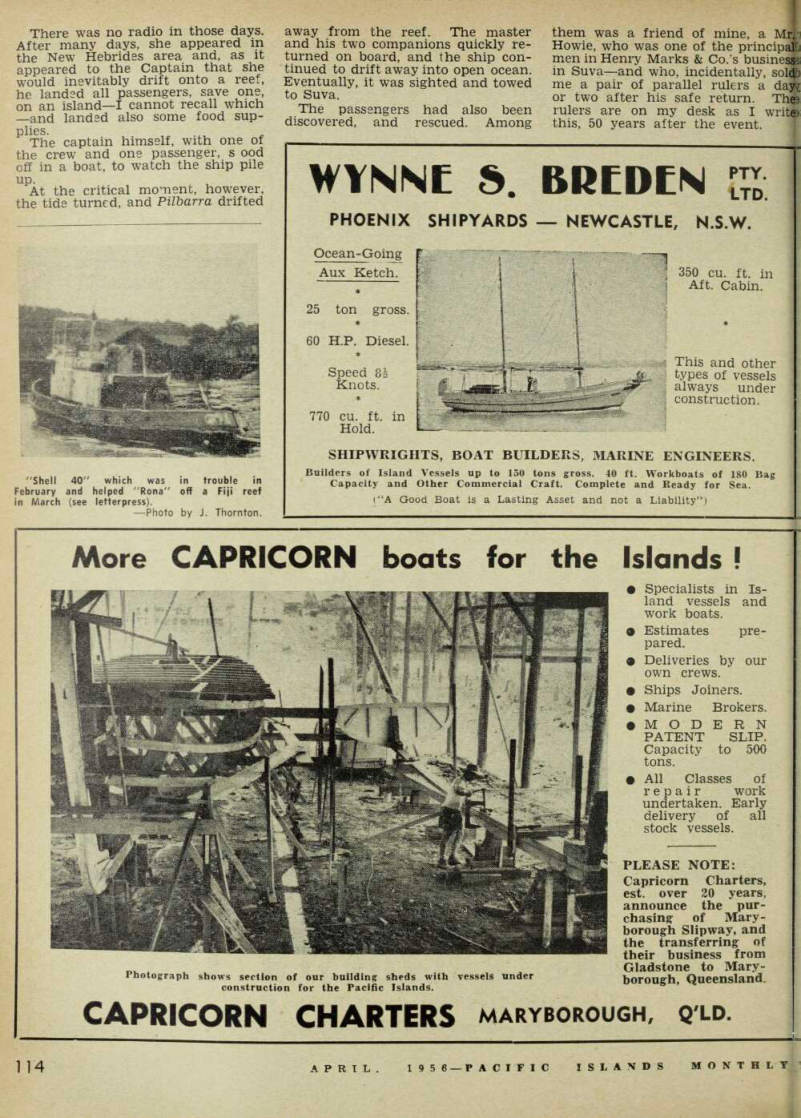
"Shell 40" which was in trouble in February and helped "Rona" off a Fiji reef in March (see letterpress).
Photo by J. Thornton.
lad the master noc regained his p but joined the others on the ind instead, the Pilbarra could /e been discovered drifting, and is would have set a problem ular to that of the Joyita.
Jaybe some of your readers will lember the Pilbarra incident. >bably some of those who were on ird are still alive.
?Wo-Fifths Of The Way
Home
’ hoenix, a 50-ft double-ended dliary ketch, mentioned in these umns previously, arrived in Syd r mid-March two years out and ee to go on a Hiroshima-and ;k circumnavigation. )esigner, part-builder, owner and viga t o r, Dr. Earle Reynolds, lerican anthropologist ex Hiro ma University, was accompanied Mrs. Reynolds, a professional 'er, son Ted, daughter Jessica, ee Japanese amateur yachties as w, and two cats. ’he financial headaches of world ising are largely met by literary nings, with Mrs. Reynolds as the instay. ’hoenix is a stout, shipshape craft mod fled Colin Archer design, It in Hiroshima of Japanese bers. To date she has circled the ;ific via Honolulu, Tahi i, Raro ga, Pago Pago, Auckland. ’he remaining three years will s all too quickly via East Indies, rban, Cape Town, the US east rd, Panama, Honolulu, Hiro ma. These people know what y are about; they spend an quate time in port preparing to to sea, and when they are at sea h emergencies as do arise are ctly of the sea’s making only.
Na-Type Vessel For Papua
. 50-ft tuna-fishing vessel, Trevor built in Sydney recently by Bill ie, has been purchas°d through m Barraclough Pty. Ltd., by Mr. >ert McCullough, cocoa planter of )ua, as a general freighter and •k-boat.
'revor W is a stout beamy cra*t yered with a 50-hp diesel and igned on Japanese tuna-vessel •S with round bilge forward fair to hard chine aft.
Mr. McCullough plans to deliver the vessel himself, departing Sydney April and collecting a Solastic
woven-glass sheathing in Queens land en route. Re-christening still to come. (Over)
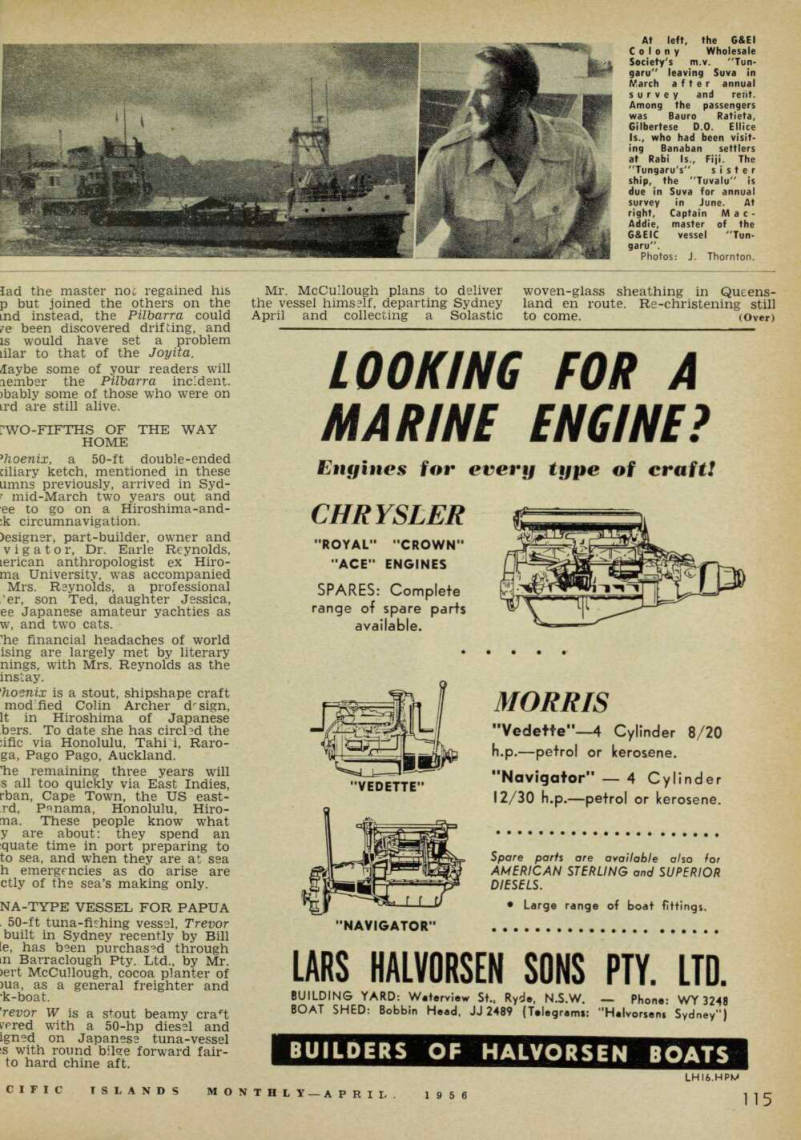
At left, the G&EI Colony Wholesale Society's m.v. "Tun garu" leaving Suva in March after annual survey and re[?]it.
Among the passengers was Bauro Ratieta, Gilbertese D.O. Ellice Is., who had been visit ing Banaban settlers at Rabi Is., Fiji. The "Tungaru's" sister ship, the "Tuvalu" is due in Suva for annual survey in June. At right, Captain Mac- Addie, master of the G&EIC vessel "Tun garu".
Photos: J. Thornton.
Jother Drift Voyage
unusual form of transport is used for the removal of 3,000
forty-four gallon drums from Gusap, eastern terminal of the New Guinea Highlands road, to Lae, on the coast.
The drums, which are Ameri can Army Dis posals, are in good condition and have been sorted by a party of men who reached Gusap late in March.
It is intended to move the drums by road to the Umi River, 20 miles from Gusap, where they will b e lashed into rafts and then floated down the river which eventually joins the Markham 'River.
Each raft will have a crew of two boys and the journey is ex pected to take three to four days.
The drums will be sold to Vacuum
Oil by Mr. Theo Mason, who holds the salvage rights and who is organising the project.
End Of A Junk But Not
Johnson
Ronald Johnson, Tovata drifter of 1947, who was wrecked and made the headlines on the NSW coasc near Broken Bay during March while trying to reach the Solomons in his Chinese junk (March PIM),is living with friends in Sydney and con sidering ways of regaining some of the money lost when the Pacific claimed his craft and its cargo.
Engines and costly deep-sea div ing gear were lost when the junk broke up after being battered onto rocks by the heavy seas.
Also lost were diaries and a scrap book containing a record of John son’s escapades in Islands waters during the past 20 years.
With his capital considerably re duced, Johnson is looking for some means of making, as he describes it, “quick money.” He is undecided whether: • To utilise his present capital by buying marine engines in Australia and having them shipped to Islands ports or New Zealand; • to buy a variety of goods, including clothing
[?]d Johnson (inset) and his junk in full sail as he left Sydney on March 15. A few hours later the junk was wrecked terpress).
Daily Telegraph photos.
and industrial equipment, and try to sell them in the Pacific terri tories or in NSW country areas; • or to return once more to the sea by building a motor-sailing vessel that he could take to the Pacific region and sell at a profit.
Failing these schemes, he can always fall back on the street photography business which he has conducted at odd periods during sojourns in Sydney.
Recalling the night of the junk disaster, Johnson says: “It was a wild night. I encountered seas as large as I have seen anywhere. Had I been able to start the motor I might have been able to pull clear, but when I saw the white water I knew the ship was done.”
With incredible luck, Johnson leaped from the wreck and after be ing almost crushed by the boat as she bore down on him on the crest of a wave, he reached the shore, climbed a 100-ft precipice and walked 10 miles to the nearest house for help.
As soon as it became known that Johnson had been wrecked, Sydney’s newspapers buried their teeth into the sensational story of his night of terror, and he became front-page news.
Johnson insists that his junk, which had been laughed at by Sydney’s yachtsmen as unseaworthy, did not sink on the night of the storm. The disaster occurred, he says, because a tremendously strong current in the mouth of the Hawkes
bury, where he attempted to shelter for the night, combined with the heavy seas to break his anchor warp and batter him against the jagged rocks.
Looking back on the incident, Johnson accepts it in his usual philosophical fashion.
However, he issues this warning to mariners shipwrecked on rocky shores: don’t take your clothes off!
Back in Sydney he displayed! badly-cut pair of shins, but insiste he would have been even moi severely cut in his scramble for lil if he had obeyed his first instiru and torn off the shorts and oil-ski: he was wearing, before leaping inti the sea.
The clothes he was wearing weir slashed beyond repair by marfii growths and jagged rocks and I
res the thickness of the cloth laved him from further injury. wever, he says that this prin is only applicable when ships wrecked close to shore; when a swim is contemplated he agrees the old theory of abandoning eavy, water-logged clothing.
Gibson Girls Minus
mson, incidentally, heeded s constan: warning and took him on his junk a Gibson Girl natic radio distress-signal mitter. This is interesting, not ise it was able to aid him in ort of strife in which he found 3lf, but because it was dis ed in buying it that a vital part e machine has been thought removed by the Australian rs-tha -be. 3 missing part is a plastic, ied wheel which, when set in m by turning the handte, causes correct sequence o x dots and ;s to be sent out as a distress I. ; wheel was removed for fear if it fell into unauthorised or ionsibie hands, the resultant dis signals would cause Authority of trouble. Which is fair :h as far as it goes. However, ?h f have been worth while if vheels had been given into doping where bona fide small owners could purchase them
the auxiliary ketch "Phoenix", which [?] Sydney in March. Below, "Trevor W", sed recently in Sydney by a Papuan (See stories, page 115.)
March 26, one of the squadron’s derlands picked up 12 Fijians i the wreck of the Tui Vunilagi flew them to safety.
Li Vunilagi, a 26 tons cutter, is ed by Mr. J. B. Turner, and on ch 25 went up on Navatu reef, ;h lies between the islands of la and Totoya, 130 miles east uva. venty-one of the people on d, including women and chil , managed to reach Moala in ship’s boat —28 miles of rowing sculling helped by the wind current. le 12 men left on board were ily crew members. When the g-boat arrived (with the owner,
a RAAF nursing sister, and the assistant harbour-master at Suva on board) they had improvised a raft and were ready to set out for Moala or the Viti Levu coast.
Tui Vunilagi was hard on the reef and beginning to break up but the owner still hopes to salvage the trochus shell the cutter was carry ing (Trochus is now over £ASOO per ton).
Cyclone Season Casualties
Cyclones and gales in the Coral Sea provided uncomfortable condi tions for ships in March.
The Philippines Trader, running between Australia and Manila, ran short of fuel near Thursday Island
and put into Port Moresby on March 15 to take on suf ficient to finish the voyage.
It was unfor tun a t e for the Trader that she was carrying cattle
and that the Philippines is a foot and-mouth disease country. The vessel was in strict quarantine during her stay in Moresby; she took on 170 tons of fuel.
The 853 head of cattle that were taken on in North Queensland ports did not weather the cyclone any too well —107, or 12 per cent., died be fore reaching Moresby.
At the same time as this was go
One result of the Australian shipping strike was that the Messageries Maritimes ship "Godavery" did not go further south than Noumea in February but landed this cargo (motor vehicles) at Noumea for trans shipment to Sydney later.
ing on, the NGA Line Sinkiang wac having its worst trip ever north from Sydney. During one of the wors periods a mirror in the bar wa shattered by flying furniture, ann a passenger, Mr. Harold Cooper, © Nelson and Robertson Ltd., across the dining saloon in the chaff in which he was sitting.
More Bad Luck For Apc|!
The Australasian Petroleum Conir pany had more ship trouble in thl Gulf of Papua at Easter when theis barge Kobosa overturned in heaw seas 40 miles S-E of Cape Black! wood.
Another vessel of the companp Gomada, directed by a Beaver air craft, rescued the crew of fou; Europeans and 12 natives.
Kobosa was recently towed or from the UK. Last information m that she was drifting somewhere f the Gulf, and had been posted as < hazard to shipping. * Two APC ships Davara and Pro' trero went up on a reef west I Moresby in January. Davara m subsequently towed to Port Mores!? by the Receiver of Wrecks.
Papuan Aptnaipi Buys
Launch
A 48-ft launch, the Jen, converts recently in Queensland for tl Apinaipi Petroleum Co. Ltd., w: scheduled to leave Brisbane for tt Vailala River, Papua, in March. J Four Brisbane men were doing tl delivery job—Mr. N. Tear, wl knows the tricky Vailala River ba; as skipper, with Messrs. H. I Vidgen (as mate), Cliff Ireland 0 engineer) and Bill Poole (as secojc engineer and radio operator). 1
American Research Vesss
In Search Of Crew
American schooner-yacht Glok Maris, which has appeared in thei columns many times, was expect!; to finish her work in Dutch Nr Guinea at end of March and arrive in Australian waters in Apic The vessel has been engaged 1 research, which is led and finanbj by Mr. A. J. Ostheimer, pres ; dent;l the Philadalphia Academy of Natmj Sciences. Master is Captain Ernta Chamberlain and she is manned!J amateur yachtsmen.
The schooner will refit in Ali tralia in April and then will ccv tinue marine research in the G : of Carpentaria, Indonesia and 1 Philippines. The skipper is anxui to recruit a crew in Australiji youngsters interested in the sea ai sailing. There has been one i member of the crew, so perhm females are not barred.
Sold And Resold
Maurice Bernard (ex Cap Tari\\ for many years coal and co carrier between NSW and Nouiii for the NC nickel mines, and j ported in February PIM as sold a Philippines firm, has now b purchased through Cap f ain W..
Kennedy, of Sydney, by the Teh-.
imship Co., Hongkong, and will i depart for Oriental waters from bane.
Bougainville Bound
•eventa, a new 56-ft plantation k-boat, was launched at Bris b early March from the yard of nan Wright & Son and departed ch 29 on delivery to her owner, R. Stuart, Tenakau Plantation, gainville. ■eventa was designed by Mr. ’. Westthorpe, of Sydney, and is ered by a 6-cylinder GM diesel died by Clae Engine Pty. Ltd., ley. ith a beam of 14 ft 6 in., and imum draft of 5 ft 2 in., she has used foredeck, covered cockpit accommoda ion aft, and is de ed to carry 35 tons at 9 knots.
Feral Post For Harbour
Masters
iring March there was a general ige-around of harbour-masters >apua and New Guinea ports. ;ain C. D. Foster, who had been )our-master at Port Moresby ; November, went to Rabaul, •e he will relieve Captain V. P. O’Donoghue, who goes on ;. Captain Riding, who has been iding the School of Pacific Ad stration in Sydney, returns to erritory as harbour-master Port ;sby. te is permitted to wonder, of >e, what practical value a course DPA has for a harbour-master. ses at this school are, as fil ed by its name, for training le who have the direct admin tion of the natives, mostly per el of the Native Affairs Depart -11. Government, geography, ry, anthropology and law are of the subjects on the cur im.
Parations Go Ahead For
5 Angeles-Papeete Race
mid-March there were seven entries in the 1956 Los Angeles ete Yacht race, and a few other lilities. The race, of 3,570 miles, e longest in the world and is o start about mid-June in order e in Tahiti for the July 14 lie Day celebrations, e yachts, which have entered, type and their owners are as vs: la, 56-ft yawl, Wm. T. Sturgis; :a, 73-ft schooner, Robert D. r; Celebes, 69-ft ketch, John H. en; Quest, 64-ft yawl, Dr. ird F. Murphy; Ramona, 109-ft mer, Wm. Pomeroy: Diablo, 60aooner, Frank S. Wade; Ariel, cutter, A. L. McCormick, is hoped that the Novia Del Mr. John Scripps’ 89-ft ketch, /am Sang, Mr. Lewis Statham’s ketch, will also decide to sail. b race is being organised by transpacific Yacht Club, pre t of which is Mr. Eugene ;on.
Howard Murphy is equipping - with powerful radio telephone
and this vessel will act as a radio mother-ship. Shore stations in Tahiti will also be equipped to receive on the yachts’ frequencies.
At Tahiti, elaborate preparations are being made. The Commodore of the Tahiti Yacht Club, Martial lorss, and the Vice-Commodore, C.
Van den Broek d’Obrenan, constitute the Tahiti Race Committee, in co-operation with Monsieur H.
Jacquier, President du Syndicat dTnitiative.
The Tahiti Race Committee plans to berth the yach s in Taunoa Harbour, a safe anchorage about a mile northeastward of Papeete Harbour, and clean for swimming. They believe Papeete Harbour will be too crowded during the Bastille Day
fete, which lasts from ten days to two weeks. It is planned to build at the new anchorage a club house, with fresh water showers, and arrange frequent transportation to Papeete.
They are also planning a racing tour of the leeward islands to take in Huahine, Raiatea, Borabora and Moorea.
Shell 40 Assists Ron A
in trouble herself in February, the Fiji tug Shell 40 vindicated herself in March when she went to the aid of the Colonial Sugar Refining Company’s vessel Rona, which went ashore on a reef near Lautoka.
Cargo was removed from Rona and with the assistance of two
hors astern, Shell 40 and two tugs m the CSR mill at Nausori, she s refloated on the high tide, n February, Shell 40 went to the istance of the Fijian Affairs at.’s Yatu Lau, which was in able. Shell 40 overshot the low 11 of Oni-i-Lau and became lost a few days until given position an RNZAF flying-boat.
Mh Offers A Cutter
[orris Hedstrom Ltd., Suva, an mced in March that the cutter Levuka was for sale, complete i a full set of sails and a ship’s t. Built in Suva in 1950 by lers Ltd., Tui Levuka is of 22.36 t tonnage, 54 ft in length with sam of 161 ft and a 7 ft draught, carries 32 tons of general cargo 450 racks of copra, and is re :ed to be in first-class order and dition.
Aonui Inquiry
r. Tom Cavendar, managing ;ner of United Engineers, Walu , left Suva for Nukualofa in ’ch in connection with an en y into the A. K. Aonui’s engine ikdown in Tongan waters late year. Her engines had been re ed in Suva.
Jf-Safe Reaches Bangkok
le world-girdling amphibious Half-Safe reached Bangkok i Rangoon during Easter. This of the route was overland and er Ben Carlin said on arrival at Thai capital that it was the >t section the jeep has travelled e it left Nova Scotia in 1950. rs. Carlin—Elinore—became ill Calcutta recently and a West ;ralian, Barry Hanley, took her e. le jeep was on show in Sydney be end of last year and a book he first part of the Carlins’ ad ure—across the Atlantic and by to London —appeared about the 3 time in a book, which was ;wed in PIM. le cumbersome Half Safe looked it as supremely uncomfortable 3de of travel as it was possible et, and no one yet, the Carlins of all, has been able to ex i what is the purpose of the e expedition. The amount of gy that has been expended in ing the vehicle-vessel over ny seas and dragging it through :ts and up mountains could y have been put to better pur-
Chbishop Carbon! Will
Ess New Santa Teretia
signed originally as a fishing 1, the recently launched Nowra- Santa Teretia II has been con ably modified for new duties as Sacred Heart Mission vessel be Gilbert Islands. She was ally blessed at a ceremony on ■ 12, by the Australasian tolic Delegate, His Excellency
the Most Rev. Romolo Carboni, at Bjarne Halvorsen’s shipyard, Syd ney.
The Gilbertese crew for this vessel is en route to Sydney and the delivery voyage is scheduled to commence late April.
It Happened In April. 1925
The April of 1925 saw the end of one of the last Islands schooners to trade in waters west of the Cooks —there are still some east of the Cooks. The disaster occurred at Nassau Island, Northern Cooks, which was then leased to Burns Philp & Co. as a copra plantation, and the vessel was their handsome 220-ton wooden schooner Samoa.
The vessel had cleared Apia on April 16, and had loaded 82 tons of copra at the time of the disaster.
There is no anchorage at Nassau and the schooner was forced to sail off and on through the night.
So that the captain could main tain a bearing a hurricane lamp was set up near the loading point. The subsequent inquiry seemed to show that this hurricane lamp went out during the night and that, un knowingly, bearings were taken of another shore light.
Whatever the cause, there was a crash at about 2 a.m. on April 29 and the passengers rushed on deck to find the vessel firmly on the shore reef. A boat was got away at dawn, but Samoa, pounding heavily, broke her back at 8 a.m. and
eventually broke completely in half.
The master, Captain Tschaun had the fore part set on fire as it showed signs of drifting away and becom ing a danger to navigation.
As there was no radio station on Nassau there was nothing to do but await a relieving vessel. The passengers included Mr. Gow, then manager for BP’s in the Gilberts; Mr. Swinbourne, then Resident
Agent in the Ellice Is. (and now better known in Sydney as Major Swinbourne, popular President of the Pacific Islands Society); Mr.
Allen, son of the late and well known Captain Allen, of Samoa Trading Co. • . . Assistance came in mid-June m the form of American millionaire Spaulding aboard his luxury yacht Goodwill “bound for Manihiki to buy a hat” —as he said. Goodwill radioed Apia and the Government vessel Lady Roberts was despatched and picked up the castaways, who by this time were fairly familiar with Nassau’s 300 coconut-covered aC res.
Samoa had been built at Whan garoa, NZ, in 1902 came under Ger man ownership and was captured in New Guinea waters in World War I and purchased from the Gov ernment by BP’s. She measured 106.8 ft x 25.3 ft. Some of her re mains still lie on Nassau’s shores to-day.
End Of Another Dream
The four men and one woman who set out from Peru on the raft La Cantuta for the Pacific Islands in December are now back in Peru, maybe richer in experience.
They were 90 days on the raft and finally got themselves into a position 1,000 miles west of the Galapagos, where the system of currents is such that they would likely have gone around in circles indefinitely.
They radioed for assistance in late February and were picked up by a US hydrographic ship, and complete with raft, were landed at Balboa, Panama Zone. They flew the rest of the way back to Peru. The raft was left at Balboa.
Anyone want a fine balsa raft?
Dick Brown Buys Another
The Cook’s inter-island fleet was added to late in March when, through the agency of Captain Kennedy, Sydney ship-broker, Mr.
D. C. Brown, of Rarotonga, pur chased the well known 128 tons Fiii auxiliary ketch Taveuni from BP (SS) Ltd.
Taveuni, and her sister-ship Macuata, were launched on the same day in 1946. Powered with 5cylinder Crossley direct-reversing diesels of 125 BHP, the ketches measure 83-2 ft x 22 ft by about 8 ft loaded draught and have 100 tons deadweight cargo capacity.
Built by Charles Whippy & Sons, of Suva, from selected local timbers, Taveuni and Macuata were the first of a series of very similar craft— Moala (now in BP’s New Hebrides trade), Koro (wrecked near New Caledonia a few years ago), A’oniu (operating for the Tonga Copra Board), and Te Ma'apula (in the GEIC trade) were the successors.
Shallow enough to go alongside the Avarua wharf at Rarotonga, and with cabin passenger accommo dation for 14, Taneuni should prove a useful vessel in the Cooks. Captain
Bnry Simpson, of Suva, flew home om a New Zealand coastal job to ke command for the delivery yage. The engineer was Mr. nori Waka, of Suva.
Mr. Brown has been given a ense to exploit the mother-of arl beds at Suwarrow atoll during 56, so Taveuni will be reopening mmunications with that currently serted atoll.