Trade But No Cannon
p. 83 · Read in the full issue
Ie “Bp” Was Royal
LETTER received by Burns . Philp & Co. in Sydney in Jan uary (see box) has produced ne interesting facts about early cific cannon from Mr. James bchell, General Manager of Burns ilp.
Jr. Mitchell suggests that the Co.” on Mrs. Baldwin’s cannon > been added with a chisel by neone carried away by the old hfic joke that BP stood for some ng else besides Burns Philp—as , Mitchell puts it, in respect of )ther cannon . . . “some mis evous, idle person who had little do cut the “& Co” with a chisel, sibly as a joke to link this cannon h the early operations of our npany trading in the Pacific.”
Ir. Mitchell tells how a similar non to that which Mr. Clark de bes was in the possession of the ; H. J. Moors, of Apia. Mr. chell reported this to the late James Burns, who had an ex nation for the initials; so far Mr. Mitchell can remember, it a connection with some of the med heads of Europe of the 19th tury, possibly the Royal House Spain. He thinks that the “P” id for Philippa, but cannot now ember what Sir James believed “B” represented.
The Apia cannon eventually passed into the possession of H. W. Moors, son of H.J., and a few years ago Mr.
Moors agreed to Mr. Mitchell’s pro posal that it should be sent to Burns Philp, in Sydney, for exhibition pur poses.
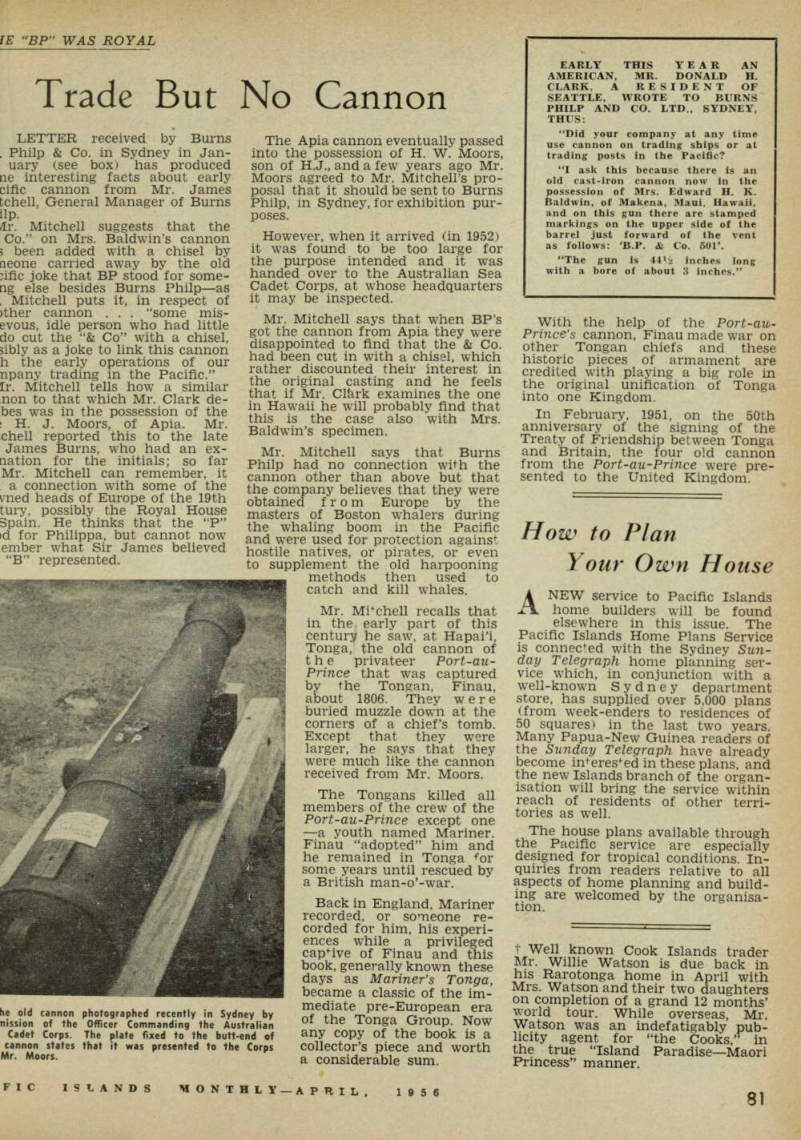
However, when it arrived (in 1952) it was found to be too large for the purpose intended and it was handed over to the Australian Sea Cadet Corps, at whose headquarters it may be inspected.
Mr. Mitchell says that when BP’s got the cannon from Apia they were disappointed to find that the & Co. had been cut in with a chisel, which rather discounted their interest in the original casting and he feels that if Mr. Clkrk examines the one in Hawaii he will probably find that this is the case also with Mrs.
Baldwin’s specimen.
Mr. Mitchell says that Burns Philp had no connection with the cannon other than above but that the company believes that they were obtained from Europe by the masters of Boston whalers during the whaling boom in the Pacific and were used for protection against hostile natives, or pirates, or even to supplement the old harpooning
methods then used to catch and kill whales.
Mr. MPchell recalls that in the early part of this century he saw, at Hapai’i, Tonga, the old cannon of the privateer Port-au- Prince that was captured by the Tongan, Finau, about 1806. They were buried muzzle down at the corners of a chief’s tomb.
Except that they were larger, he says that they were much like the cannon received from Mr. Moors.
The Tongans killed all members of the crew of the Port-au-Prince except one —a youth named Mariner.
Finau “adopted” him and he remained in Tonga f or some years until rescued by a British man-o’-war.
Back in England, Mariner recorded, or someone re corded for him, his experi ences while a privileged cap f ive of Finau and this book, generally known these days as Mariner’s Tonga, became a classic of the im mediate pre-European era of the Tonga Group. Now any copy of the book is a collector’s piece and worth a considerable sum.
With the help of the Port-au- Prince’s cannon, Finau made war on other Tongan chiefs and these historic pieces of armament are credited with playing a big role in the original unification of Tonga into one Kingdom.
In February, 1951, on the 50th anniversary of the signing of the Treaty of Friendship between Tonga and Britain, the four old cannon from the Port-au-Prince were pre sented to the United Kingdom.
he old cannon photographed recently in Sydney by [?]nission of the Officer Commanding the Australian Cadet Corps. The plate fixed to the butt-end of cannon states that it was presented to the Corps Mr. Moors.