[?]Is N. Britain Mat-Mat Speaks Of History
pp. 81-82 · Read in the full issue
[?]re of the Queen Emma Story
By R. W. Robson
HEN Gordon Thomas visited Rabaul in mid-1955, he kindly carried out a request that I had e to him that an effort be made ind the last resting place of ashes of “Queen Emma” (Mrs.
Kolbe formerly Mrs. Forsayth, ierly Emma Coe). eking details of how “Queen la” died at Monte Carlo, in 1913, :erviewed Mr. H. R. Wahlen at home in Hamburg, Germany; from him I learned that in 1913 firm in Hamburg, as agents of Forsayth firm in New Guinea, had the bodies of Mr. and Paul Kolbe cremated, and ashes sent in small urns to Guinea. It was believed that ashes still remained at the ly burial-ground in the Kokopo of New Guinea. ■. Thomas enlisted the help of A. H. Cresswell, and the ery of “Queen Emma’s Ashes” cleared up as far as possible, article in PIM, Dec., 1955). In ;ourse of that search, some in ting bits of German New ea history, and of the history •ueen Emma’s” family, were un ed. I am indebted for the fol ig material to a report made t. Cresswell. the halcyon days of the lyth family in German New ea, between 1880 and 1910, en Emma” lived at her famous s, Gunantambu, near Ralum; her sister Phoebe, who was ied to the famous R. H. R. inson, lived on an adjoining ation, Kuradui. Each of these ation homes maintained a y burying-ground, or mat-mat. ring World War 11, the Gun nbu plantation-h ou s e was y destroyed by the Japanese. plantation is now called pau. searching for “Queen Emma’s” , Mr. Cresswell decided he first d inspect the old mat-mats (or series). But, in the changes d by the war, the mat-mats lisappeared under a great mass jondary growth—Mr. Cresswell much difficulty in locating WEVER, the old headstones ere finally found, and the *ass and scrub cut away. He examined the Kuradui (Park i mat-mat. s once had been a well led place, well cared for. But
it had been wrecked during the Japanese occupation—“the beautiful tombstones and grave copings were damaged and scattered,” writes Mr.
Cresswell, “and we could recognise only six grave s—although, we thought, there had been more.”
Of the six graves, three were identified —those of R. H. R. Park inson, 13/11/1844-24/7/1907; Max Parkinson, 23/2/1889-5/10/1907; Helene B. R. Haddon, 1883-1931.
Parkinson was the son of an Englishman who had entered the service of a Royal house in Schles wig-Holstein, and later acquired German nationality. He had been well educated, and he went origin ally to the German administrative service in Western Samoa. He married Phoebe Coe, sister of Emma; joined Emma in New
Guinea; gained fame by writing a book (in Ger man) : “Thirty Years in the South Seas.” His widow, after World War I, went to live in the Kavieng dis trict of New Ire land; and was still there when World War II brought the Japs into New Guinea. She died near Nama tanai on May 28, 1944, during the Japanese occupa tion, aged 82.
Max Parkinson was their son—he died of tuber culosis while still in his ’teens.
Mrs. Helene Haddon was one of th e Parkinson children. She married, first, Carl Diercke; and, after his death, she married Had don, an Australian.
She died at Buka Passage; but sometime later her body was dis interred and taken to the old burial ground near Ralum. Her son, Rudolph Diercke, is now a member of the Roman Catholic Mission staff at Vunapope, Kokopo.
MR Cresswell reports that at Malapau (“Queen Emma’s” mat-mat) “desolation and vandalism showed everywhere, and again the Japanese were accused of this wreckage.” Here, they estab lished the outline of 12 graves, but there probably were many more.
Here, they were able to decipher the following inscriptions:— David Collings, 1878-1895.
W. Stanley More, 1899.
R. N. Stella Lynds, 24/4/1895- 19/8/1895.
Water Robert Anderson, of North Sydney. Died, Fead Islands, 25/11/1895, aged 28 years.
In memory of our beloved mother, Johanna Coe, died 1905, aged 78 years. (This was followed by an inscription in Samoan).
John Coe, 32 years, killed at Nuguria. Vengeance is mine says the Lord.
Capi Acostino Stalio, who was shot by the natives of Fead Islands whilst bravely assisting the Im perial Judge to arrest the King and his son for the Massacre of John Coe. Born Dalmatia, Dec.,
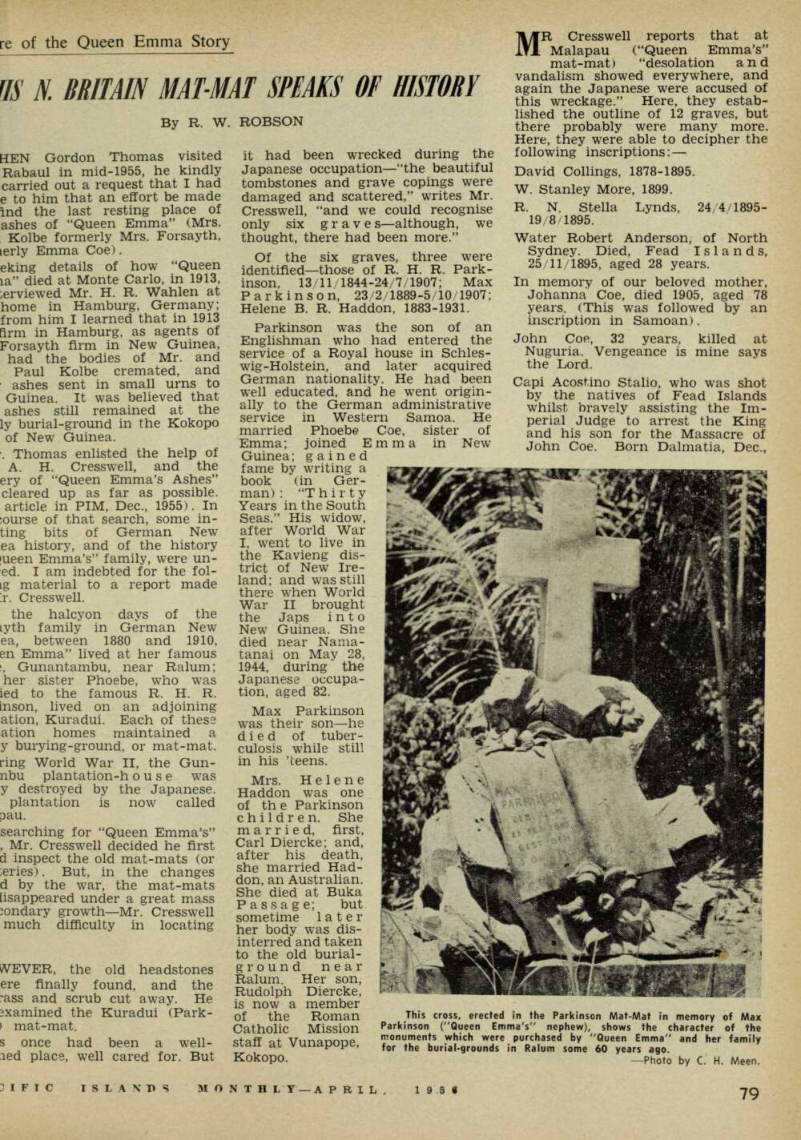
This cross, erected in the Parkinson Mat-Mat in memory of Max Parkinson ("Queen Emma's" nephew), shows the character of the monuments which were purchased by "Queen Emma" and her family for the burial-grounds in Ralum some 60 years ago.
Photo by C. H. Meen.
1854—Killed Fead Islands, 1892.
O for the touch of a vanished hand and the sound of a voice that is stilled. This Stone is erected as a mark of respect by his many friends in the Bismarck Archipelago. (At the back of this stone was an inscription in Ger man—apparently a version of the inscription in English.) J. F. Santo.
Peter W. Coe, 1884-1896. (This fol lowed by an inscription in Samoan.) In that list are the outlines of one of the major tragedies in the life of “Queen Emma” of New Guinea.
John Coe, Emma’s brother, and nine years her junior, joined her in New Guinea when a young man. He had been with her many years, and was aged 32 when she sent him to look after her plantations and trade stores in the Fead Islands, off the coast of New Ireland. There was trouble with the natives, and he was killed.
An expedition to avenge hi s death was organised and was led by Captain Stalio, a prominent mem ber of the European community in German New Guinea, and a very close associate of Mrs. Emma Forsayth (as she then was). There was a clash with the natives, and Stalio was killed.
That Emma was deeply grieved by these death s—of her favourite brother, and of her intimate friend —is shown by the memorials she placed in the little mat-mat.
Johanna Coe (Emma’s mother) was the first Samoan wife of Jonas M. Coe. They had eight children, all born in Samoa, of whom Emma was the second. In other records, Mrs. Coe’s name is spelled “Joana.”
Peter W. Coe was the sixth son of William Cos, full brother of Emma.
William joined her in New Guinea, and spent some years there before going on to the Philippine Islands, where he had a notable career.