Do You Remember ?
p. 26 · Read in the full issue
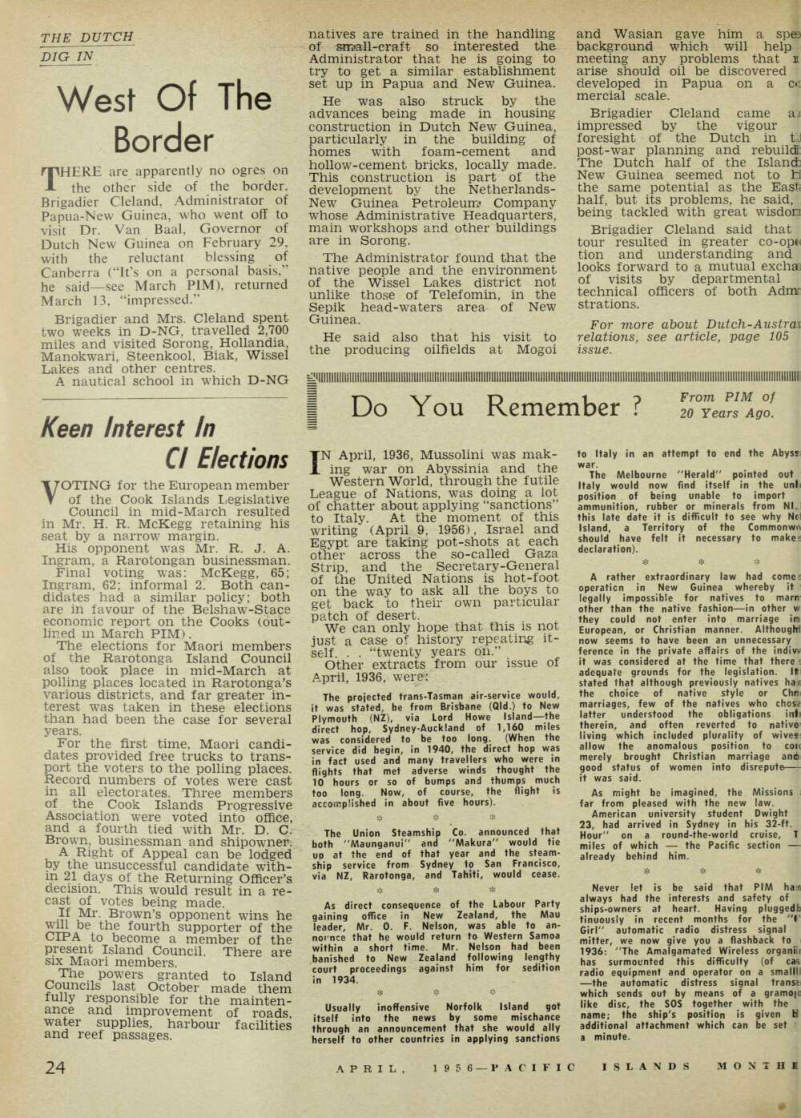
From PIM of 20 Years Ago.
IN April, 1936, Mussolini was mak
ing war on Abyssinia and the Western World, through the futile League of Nations, was doing a lot of chatter about applying “sanctions” to Italy. At the moment of this
writing (April 9, 1956), Israel and
Egypt are taking pot-shots at each
other across the so-called Gaza
Strip, and the Secretary-General
of the United Nations is hot-foot on the way to ask all the boys to get back to their own particular patch of desert.
We can only hope that this is not just a case of history repeating it
self. . . “twenty years on.”
Other extracts from our issue of
April, 1936, were:
The projected trans-Tasman air-service would, it was stated, be from Brisbane (Old.) to New Plymouth (NZ), via Lord Howe Island —the direct hop, Sydney-Auckland of 1,160 miles was considered to be too long. (When the service did begin, in 1940, the direct hop was in fact used and many travellers who were in flights that met adverse winds thought the 10 hours or so of bumps and thumps much too long. Now, of course, the flight is accomplished in about five hours).
The Union Steamship Co. announced that both "Maunganui" and "Makura" would tie up at the end of that year and the steam ship service from Sydney to San Francisco, via NZ, Rarotonga, and Tahiti, would cease. -M ❖ * As direct consequence of the Labour Party gaining office in New Zealand, the Mau leader, Mr. 0. F. Nelson, was able to an nounce that he would return to Western Samoa within a short time. Mr. Nelson had been banished to New Zealand following lengthy court proceedings against him for sedition in 1934.
Usually inoffensive Norfolk Island got itself into the news by some mischance through an announcement that she would ally herself to other countries in applying sanctions
to Italy in an attempt to end the Abyssi war.
The Melbourne "Herald" pointed out Italy would now find itself in the unl« position of being unable to import ammunition, rubber or minerals from N1..1 this late date it is difficult to see why Ncl Island, a Territory of the Commonwiv should have felt it necessary to makes declaration). sK * ❖ A rather extraordinary law had comes operation in New Guinea whereby it 1 legally impossible for natives to marrr other than the native fashion—in other w they could not enter into marriage im European, or Christian manner. Althoughl now seems to have been an unnecessary ference in the private affairs of the indivv it was considered at the time that there s adequate grounds for the legislation. Iffi stated that although previously natives has the choice of native style or Chm marriages, few of the natives who chose latter understood the obligations ini therein, and often reverted to native' living which included plurality of wives; allow the anomalous position to coic merely brought Christian marriage and) good status of women into disrepute it was said.
As might be imagined, the Missions ; far from pleased with the new law.
American university student Dwight 23, had arrived in Sydney in his 32-ft.
Hour" on a round-the-world cruise, T miles of which the Pacific section already behind him. ❖ ❖ * Never let is be said that PIM ha:e always had the interests and safety of ships-owners at heart. Having pluggedb tinuously in recent months for the "I Girl" automatic radio distress signal mitter, we now give you a flashback to i 1936: "The Amalgamated Wireless organiir has surmounted this difficulty (of cas radio equipment and operator on a small!: —the automatic distress signal transai which sends out by means of a gramojo like disc, the SOS together with the name; the ship's position is given U additional attachment which can be set a minute.