Christmas Atoll Likely To Become
p. 24 · Read in the full issue
Pacific H-Bomb
Death-Or-Glory Island
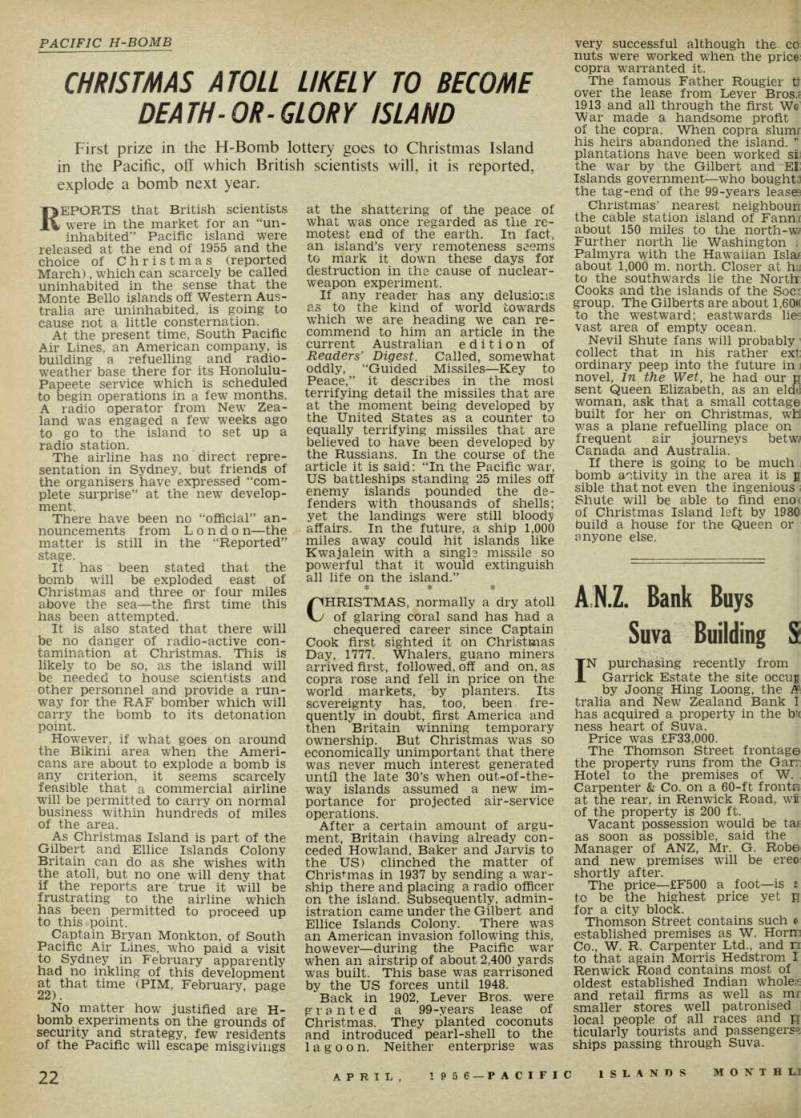
First prize in the H-Bomb lottery goes to Christmas Island in the Pacific, off which British scientists will, it is reported, explode a bomb next year.
REPORTS that British scientists were in the market for an “un inhabited” Pacific island were released at the end of 1955 and the choice of Christmas (reported March), which can scarcely be called uninhabited in the sense that the Monte Bello islands off Western Aus tralia are uninhabited, is going to cause not a little consternation.
At the present time, South Pacific Air Lines, an American company, is building a refuelling and radio weather base there for its Honolulu- Papeete service which is scheduled to begin operations in a few months.
A radio operator from New Zea land was engaged a few weeks ago to go to the island to set up a radio station.
The airline has no direct repre sentation in Sydney, but friends of the organisers have expressed “com plete surprise” at the new develop ment.
There have been no “official” an nouncements from Lon d o n—the matter is still in the “Reported” stage.
It has been stated that the bomb will be exploded east of Christmas and three or four miles above the sea—the first time this has been attempted.
It is also stated that there will be no danger of radio-active con tamination at Christmas. This is likely to be so, as the island will be needed to house scientists and other personnel and provide a run way for the RAF bomber which will carry the bomb to its detonation point.
However, if what goes on around the Bikini area when the Ameri cans are about to explode a bomb is any criterion, it seems scarcely feasible that a commercial airline will be permitted to carry on normal business within hundreds of miles of the area.
As Christmas Island is part of the Gilbert and Ellice Islands Colony Britain can do as she wishes with the atoll, but no one will deny that if the reports are true it will be frustrating to the airline which has been permitted to proceed up to this point.
Captain Bryan Monkton, of South Pacific Air Lines, who paid a visit to Sydney in February apparently had no inkling of this development that time (PIM, February, page No matter how justified are H bomb experiments on the grounds of security and strategy, few residents of the Pacific will escape misgivings
at the shattering of the peace of what was once regarded as the re motest end of the earth. In fact, an island’s very remoteness seems to mark it down these days for destruction in the cause of nuclear weapon experiment.
If any reader has any delusions as to the kind of world towards which we are heading we can re commend to him an article in the current Australian edition of Readers’ Digest. Called, somewhat oddly, “Guided Missiles —Key to Peace,” it describes in the most terrifying detail the missiles that are at the moment being developed by the United States as a counter to equally terrifying missiles that are believed to have been developed by the Russians. In the course of the article it is said: “In the Pacific war, US battleships standing 25 miles off enemy islands pounded the de fenders with thousands of shells; yet the landings were still bloody affairs. In the future, a ship 1,000 miles away could hit islands like Kwajalein with a single missile so powerful that it would extinguish all life on the island.”
CHRISTMAS, normally a dry atoll of glaring coral sand has had a chequered career since Captain Cook first sighted it on Christmas Day, 1777. Whalers, guano miners arrived first, followed, off and on, as copra rose and fell in price on the world markets, by planters. Its sovereignty has, too, been fre quently in doubt, first America and then Britain winning temporary ownership. But Christmas was so economically unimportant that there was never much interest generated until the late 30’s when out-of-the way islands assumed a new im portance for projected air-service operations.
After a certain amount of argu ment, Britain (having already con ceded Howland, Baker and Jarvis to the US) clinched the matter of Christmas in 1937 by sending a war ship there and placing a radio officer on the island. Subsequently, admin istration came under the Gilbert and Ellice Islands Colony. There was an American invasion following this, however —during the Pacific war when an airstrip of about 2,400 yards was built. This base was garrisoned by the US forces until 1948.
Back in 1902, Lever Bros, were granted a 99-years lease of Christmas. They planted coconuts and introduced pearl-shell to the lagoon. Neither enterprise was
very successful although the co nuts were worked when the price; copra warranted it.
The famous Father Rougier ti over the lease from Lever Bros.? 1913 and all through the first Wo War made a handsome profit of the copra. When copra slumr his heirs abandoned the island. " plantations have been worked si; the war by the Gilbert and El: Islands government—who boughtf the tag-end of the 99-years leases Christmas’ nearest neighboun the cable station island of Fanm about 150 miles to the north-w/ Further north lie Washington ; Palmyra with the Hawaiian Islac about 1,000 m. north. Closer at h:i to the southwards lie the Northr Cooks and the islands of the Soc:c group. The Gilberts are about 1,60»( to the westward; eastwards lies vast area of empty ocean.
Nevil Shute fans will probably 1 collect that in his rather ext: ordinary peep into the future ini novel, In the Wet, he had our p sent Queen Elizabeth, as an eldti woman, ask that a small cottage built for her on Christmas, wM was a plane refuelling place on frequent air journeys betw/ Canada and Australia.
If there is going to be much j bomb activity in the area it is n sible that not even the ingenious < Shute will be able to find enox of Christmas Island left by 1980; build a house for the Queen or anyone else.