Editorial. ..
pp. 19-20 · Read in the full issue
HAT THE REDS' DENUNCIATION OF STALIN MAY MEAN
IE Cold W T ar—upon the outcome of which the future of humanity depends—has changed in char ;r in the last few months. In le respects, the menace to the ;dom of the individual has be le greater, and world dominance Muscovite Communism seems rer. But, behind this bigger lace, we now can discern some ig that may defeat the Red con ators before they finally succeed their plans for hamstringing stern Civilisation. he form of Cold War which we w best is the ruthless, brutal, :rly unscrupulous drive towards world domination, as conceived directed by Stalin. Carried on hat fashion, there was only one to the Cold War—namely, the icaust of World War 111,, in 3h atomic power probably would roy most of humanity. It was or tame submission to the Reds. le Western world assumed, when in died, that the policies and s of the half-mad dictator would -inue —that Moscow eventually Id try to conquer the West by tary strength. But a vast and [pected change has occurred, the significance of which is not clear. le objective has not altered—the et leaders believe still that they achieve their ultimate plan by )sing the full Communist system i the whole world. But they ar to have convinced themselves they can do this, not by brute 3, but by slow infiltration, and ruction from within of the whole ’ture of Western Civilisation, there has been much in recent >ry, and developments in world rs, in the last few years, to sug that they are right. the nations of the world had sen left alone after World War [—as they were left alone after Id War I—to reorganise their mal economies to take care of terrific maladjustments caused ocial and economic affairs by ievastation of international war, night have been well. There it have been a general peace; United Nations Organisation it have worked. t, as everyone knows, Joseph n and his gang had a different They knew that revolution s out of poverty and injustice; they were clever enough to se that if they struck at the ;red and partly demoralised ;ern world with every weapon had, short of war, and pre -3d Western rehabilitation, they I so weaken the Western Powers either the West would suffer
economic collapse, or the West would be so distraught that it would offer only feeble resistance to the Reds, when they struck with their armed forces.
The rest is history. Only the possession by USA of the atom bomb, and the clear determination of USA to fight if the Muscovite Reds went too far, kept Stalin’s Com munist forces behind the Iron Curtain. The Reds went as far as they dared in the Berlin Blockade, in Korea, in the subversion of Persia, in over-running Southeast Asia—but they did not go completely to war.
Nonetheless, they have had stagger ing, incalculable successes.
China now is completely Com munist. A great section of Southern Asia is teetering on the edge of Communism. Ceaseless Red infiltra tion of British and French colonies in Asia, Africa and elsewhere has
paid enormous dividends to the Reds —France is so seriously embarrassed that she has abandoned Southeast Asia and is so embarrassed in hold ing and policing her Colonies that she has withdrawn most of her divisions from the Western guard on the Iron Curtain. Britain has end less, expensive trouble in maintain ing order in the Far East, the Middle East and some parts of Africa, and is correspondingly weak ened as a partner in NATO.
THE Middle East, under the leader ship and inspiration of a cheeky and arrogant Egypt, is on the verge of a war which will represent Russia’s counter to the pro-British Baghdad Pact, and which —if it comes —will represent a major dis aster to Anglo-American strategists, who must at all costs protect their Middle East oilfields and the great pipelines which carry the oil out through the Arab countries to the Mediterranean and the Persian Gulf.
Britain has not suffered as seri ously in a military sense as has France; but Britain’s economic strength has been declining for the last two years, and now poses a
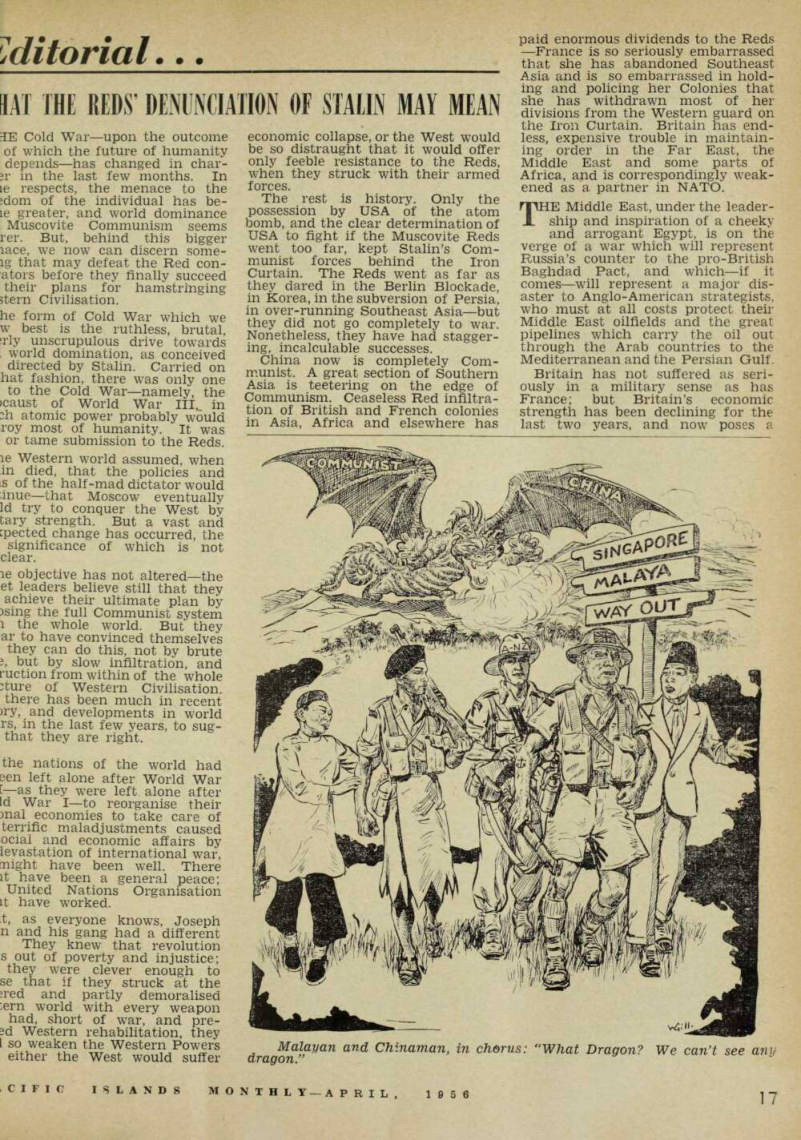
Malayan and Chinaman, in chorus: “What Dragon? We can’t see any dragon”
most serious problem for the Old Country. „ Practically the whole of these troubles may be traced back directly to growing, world-wide subversive activity directed through Communist and Fellow-Traveller channels by the Moscow Reds. The anti-British agitation in Zanzibar, the wharfies’ strikes in Australia, the stealthy murder of rubber planta tion workers in Malaya, the snarl ing refusal of British industrial masses to co-operate in holding the export markets, the dismissal of Glubb Pasha in Jordan and the in describable confusion in Cyprus—all have a common origin, and all are part of the one pattern.
Had these activities, and that pat tern, continued in 1956 as they were in 1954 and 1955, the end of the Cold War, and the beginning of the unimaginably horrible World War 111, could have been seen within a matter of months.
BUT suddenly, almost overnight, the outlook has changed, in an extraordinary way.
Stalin died three years ago. Georgi Malenkov (now being kissed by factory-girls in his goodwill visit to Britain) held the throne for a year, while Moscow’s policies became dis torted and confused. Malenkov was pushed aside, and the very strange Mr. Krushchev and the very bibul ous Mr. Bulganin took charge. The backslapping Summit Conference at Geneva came and went, with no more effect than a damp fire-cracker.
There was much intense Red prob ing of the Western world.
And then, in late February, it was disclosed to the stupefied West that the whole Communist world repudi ates and loathes Mr. Stalin, who was variously described by Krushchev and Company as a murderer, an assassin, a power drunk dictator, a liar, and a crazy paranoic. The name of the man whom Russia, for 20 years, exalted as a hero, patriot and demi-god is being wiped out of the Russian vocabulary, just as thoroughly as his portraits and statues are being re moved from public places.
“Stalin created in the minds of all peoples a totally wrong impression of Russia and. the Russians,” cry Stalin’s successors. “We desire to live in peace and amity with the rest of the world. Forget Stalin and all his works. Trust us. Let us open all our gates to each other. Let us disarm.”
The Westerners, surrounded by social and economic and political troubles of Moscow’s making, still are staring at Moscow as in a daze, wondering what to make of it all.
Never in all history was there such a volte face, with such potentialities.
It could mean so much—or so little. r[E more experienced and cynical—of world observers can not see much in all this to be happy about. They think that it
means only that the Muscovites are so sure now that the rest of the world is headed for economic dis integration that they can afford to sit back and wait for the collapse, thus ensuring by peaceful means what, a few years ago, they believed would have to be achieved by the sword. Probably, they are right.
But two factors give us ground for hope.
This change in Russian policy is far wider and goes far deeper than most of us yet realise. This re pudiation of Stalin cannot just take place overnight, on the word of a cunning underground-engineer like Nikita Krushchev. If it is to be effective, it must be accepted by a vast Soviet empire of over 200 million people, and by thousands of Communist organisations which now honeycomb the world —all of whom have been ruthlessly drilled, for at least 20 years, to place Stalin along with Lenin and Marx among the demi-gods of humanity.
In other words, it may be expected that the Krushchev Declaration of February 25, wherein he damned the memory of the man whom, only two
years before, he had publicly deifi. will cause in Russia a divisionr opinion so wide that it may s completely the Communist fao which has threatened the peace the world since 1945. If it does cripple the Muscovite dictatorss it at least should seriously i barrass the Reds, and remove mr of the menace from their 30-yeiJ old conspiracy. We can but v and hope.
The other factor lies in China* always has been a cardinal be; of British diplomacy that China never accept Communism, after Muscovite pattern; and Britain shaped her policies looks as if Whitehall will be justif For two years, the rift betv* Moscow and Peking has been gn ing wider. Recent events emphae that rift. Here, again—as betw Moscow and Peking—early ments may be interesting.
It is far too soon yet to cheer. —at long last —we may at 1J begin to hope. If the Muscoc structure is crumbling, the crumbc of the Western structure sho. cease, and begin to recover.