sisss
pp. 99-115 · Read in the full issue
News of the Small-Ships
It Happened In This Month:
-Presumably because of its history f wrecks, Oeno atoll, in the Pit urn administrative group, is marked ow and dangerous” on navigational aarts; and that was the way that le Boston clipper Wild Wave found le little atoll to be when she crashed i the reef there on March 5, 1858.
Commanded by Captain Josiah N. nowles, the vessel with a crew : 30 and ten New York and Boston isiness men as passengers, was 24 lys out of San Francisco on the ind-jammer route to New York, ben disaster struck. Earlier in the »yage a boy had been lost over >ard.
All managed to get ashore though ree were injured. The vessel did >t break up and in subsequent days 3res were landed, also 18,000 dollars gold from the master’s safe.
As there seemed little prospect of rly succour the captain, mate, id five seamen—and a number of sting seabirds to be used as rrier-pigeons—sailed for Pitcairn, miles to the south-east, where it is considered that a ship might intercepted. The lifeboat arrived ere safely on March 15, to find a tice posted in the village inform l callers that the Pitcairners had
quit the island and gone to Norfolk- Islana in April, 1856 This news was sent to Oeno hv a bird which hastened back to its eeis Under these circumstances it seemld unlikely that many vessels would be calling at Pitcairn, so Captain Knowles was planning to head eltp where when one of his seamen took the lifeboat and wrecked it—nos sibly to prevent any further nautiral excursions.
This man “went bush’’ and the ethers set about building a new boat Tne new DOcit, nß.med John, Addins Se re d „rLo J^en an fai!»r
da^phaTsigTtolnd^l l VaudahS
m port—first American vessel to call thTnoh/of Sh fv, Wa f S n Adams g when the John A % vSf o r i Ved ’
The boat was thereupon sold to a local missionary for $250 and the shipwrecked mariners were taken to Knowtes sailed for Honolulu French sloop Eurydice, and Vandalia,
with the others still aboard, pro ceeded to Oeno. One man there had died but the others were taken ab oard, also two more men at Pit cairn. What happened to the others at Pitcairn is not quite clear, Fourteen years later, as master of °f the Seas > Captain Knowles a f ai ? called at Pitcairn, where many the peo P le ha d meanwhile re turned from Norfolk Island. On their return they had found a letter from Captain Knowles telling of his , earlier visit in the Wild Wave’s life boat, LESSONS of repentt l tv/tatpt-nti?
Disasterv•
sisss
to h&ve m&dp verv plppit fpw
Stftl
evileSc^was 1 sub mitted on behalf of the RN7AF ■ hat ’ after the discover y of the drift* . vessel ’ tests carried out showed that no satisfactory reflections could be obtained from the vpccpl hv thp radar equipment fitted in Sunderland Aircraft. 1
"are
entirely dependent upon U the re-
flective properties of the objects which the radar waves strike.
Wooden objects have poor reflective properties, and the reflective pro perties of even metal objects depend largely on their shape, or more cor rectly, the angle at which radar waves strike them. There now are metal devices shaped to reflect radio
waves back to their source no matter fiom what angle they strike.
There is now better radar equip ment available than that fitted in the RNZAF Sunderlands, but in the S. Pacific it is the Sunderlands which will be doing the searching when ships go missing.
Every small ship engaged in epen-water voyages—and especially every wooden ship—should carry a satisfactory type of radar reflector for emergency use. Such commerci ally-made reflectors are inexpensive; or any tinsmith could make a highly efficient, collapsible type.
Plans will be given in a later PIM, but the RNZAF could supply same to all South Pacific shipping authorities.
The smaller the vessel, the more 1 urgent is the need for such a re-; fleeter.
Another point which cannot be toe strongly stressed is that a simples fool-proof, self-powered distress? transmitter like the Gibson Girl which has been described in receni PlM’s, is a far better insurance than depending upon location b:< means of radar equipment. Rada.i range is limited under the best ox circumstances.
A Gibson Girl using kite aerias has a proved daylight range of a* least 500 miles, and much further at night. The Gibson Girl operates on a frequency which is constantly monitored by many Pacific coass stations and by big ships. Signall
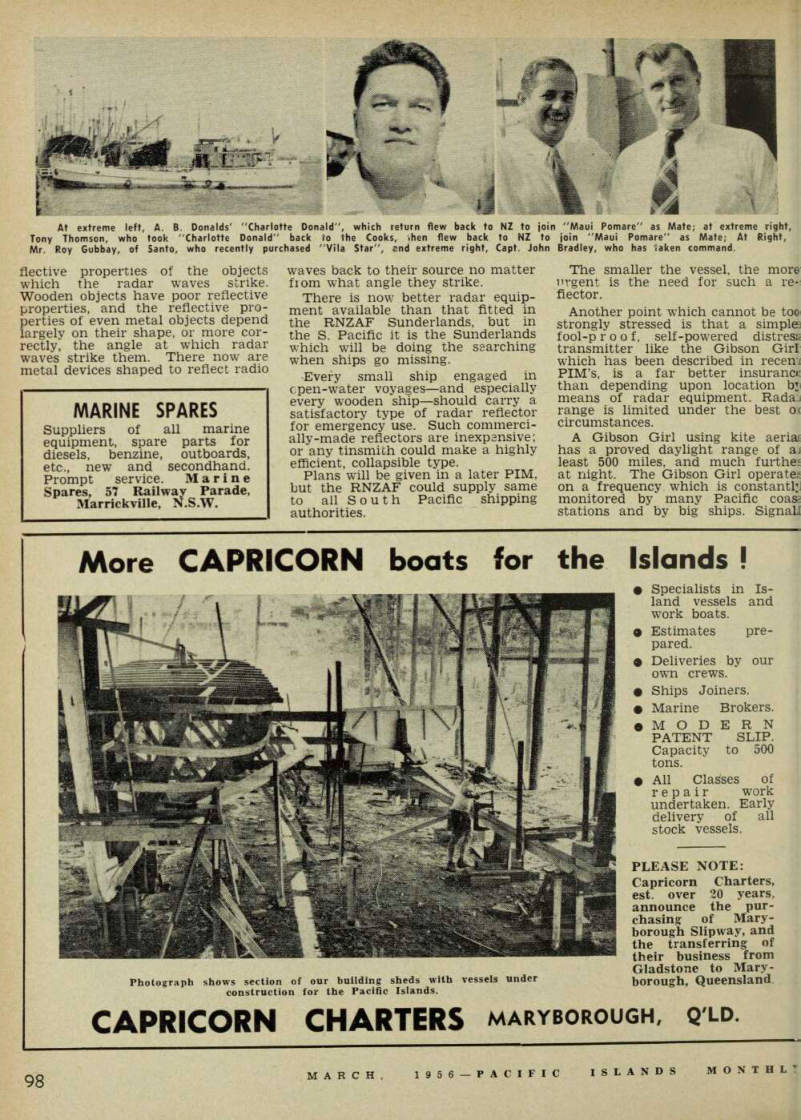
At extreme left, A. B. Donalds' "Charlotte Donald", which return flew back to NZ to join "Maui Pomare" as Mate; at extreme right, Tony Thomson, who took "Charlotte Donald" back to the Cooks, then flew back to NZ to join "Maui Pomare" as Mate; At Right, Mr. Roy Gubbay, of Santo, who recently purchased "Vila Star", and extreme right, Capt. John Bradley, who has taken command.
11 almost certainly be quickly eked up and—here is the import it point—having been picked up, is easy for a ship or aircraft to ome” onto those signals—that is, tune them in on a direction-find l receiver and steer straight to ,rds them. rherefore, every small ship should rry one of these sets. These are 3 immediate measures which DUld be taken.
Finally, it is essential that an cient continuous small-ships’ iio watch be kept on one univers y agreed frequency by the main inds coast stations —Port Moresby, imea, Suva, Apia, Rarotonga, and peete. Such a continuous watch y involve extra staff, though there ms to be no reason why these mds’ coast stations could not be lipped with automatic-alarm re fers such as are carried in most sign-going ships. In these, a ies of dashes transmitted will se alarm bells to ring in neigh ring ships where the operators off-watch. Such a system might rate on the 2182 kc/s small-ships’ e frequency, calling a coast ion operator onto watch, or, versa, calling other small-ships the aid of the one in distress, s an example of the present ation, something appears to have pened to the Gilbert Is. vessel karimoa between midnight and n. Tarawa is the only Pacific nds station which listens on the uency used by vessels in the lerts inter-island trade, and awa does not maintain watch /een 4.15 p.m. and 6.45 a.m. vessel can be right alongside awa screaming for assistance, nothing will be heard, because e is no means of bringing an ator onto watch, awever, if such a vessel used a ;on Girl transmitter at such a ; it would almost certainly be d in Suva, where continuous :h is kept on the Gibson Girl not on the small-ships R/T) aency, ast South Pacific shipping men currently asking the question: sufficient effort made by the C authorities to locate :arimoa? Failure by the RNZAF ocate Joyita may explain the re to call in the RNZAF on this sion. The fact remains, how that the RNZAF’s Lauthala headquarters is the Search and ue Organisation for this area, efore all missing vessels should eported to that cenire, and it Id be left to the trained air ;h men of that centre to decide her a search is warranted or :icable, and how it should be ed out. lat made this failure the more rkable was that another in it had only shortly preceded the arimoa incident. On November jo men failed to return from y’s fishing in a launch outside awa. As in the case of arimoa, a very limited search
was made by the Government vessel Nareau— then the men were written off with regrets.
Thirteen days later the Japanese fishing fleet mother- s h ip, Koyo Maru, re ported by radio that she had come across the men in their
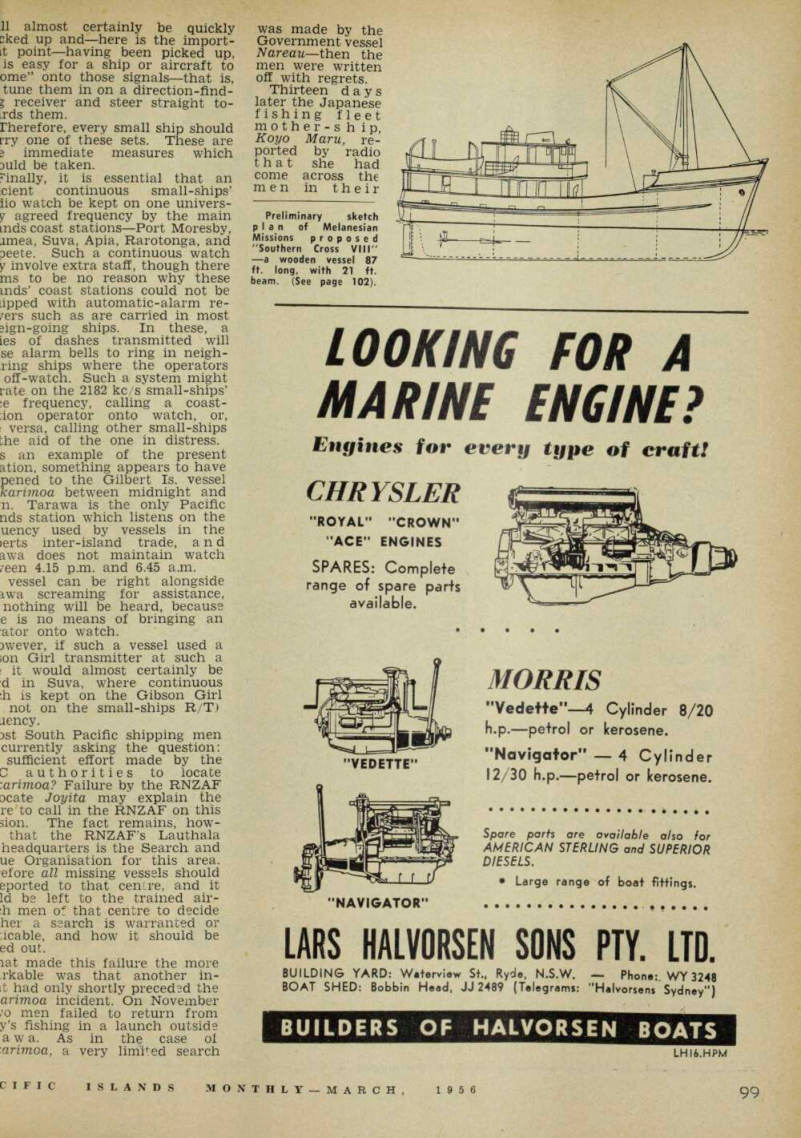
Preliminary sketch plan of Melanesian Missions proposed "Southern Cross VIII" —a wooden vessel 87 ft. long, with 21 ft. beam. (See page 102).
lunch alive and well, 200 miles est of Tarawa But for that Japnese ship they would probably have rifted until dead.
It may be argued that there would 3 fewer shipping incidents in the ilands if the vessels were manned y fully qualified mem Such men :e only available on Australian or ew Zealand conditions of pay and ;commodation. If such conditions ere enforced in the Islands most :ivately owned vessels would disipear. The men manning the land ships are equal to the task, ’ as certain minimum safety andards are enforced. The items entioned here seem to come at ■ e very head of any list of miniurn requirements, and they do not present any major financial outy *
The Little Things That
ATTER:—Before we get off the bject, we would like to put in a >rd for the humble heliograph hi c h saved more than one itched” airman’s life during the ,cific War.
A. flashing mirror has meant the ference between life and death in :h cases.
Fhe beam of reflected sunshine >m an ordinary mirror cannot be ned accurately. The RAF-type liograph, of which hundreds are rrently available in Auckland at • each, consists of a 4-in. square inless steel plate with a 3/16th :h sighting hole an inch from one
corner. Round this hole concentric rings, 8 in. apart, are “Sed Close to the same corner tiny hole with a 6-in length S cord, at the other end of which is
a 4-in. white-painted paddle!
shaped metal sighting-strin To use the device the sun has of course, to be at within 90 degrees of the target. The operatorholds the plate up to one eve looking through the hole towards the target —the searching plane or shin With his other hand he holds the little paddle-shaped sighting-strop which has a small hole near its upper end upright in front of the mir?or and in line with the target d Then by moving the mirror the sun’s reflected light is cast onto the
sighting-strip, with the concent?*
circles appearing as black lines and , mi J ror peephole appearing as a black dot When this black dot, the f lOl6 i n the sighting-strip, and the target, are all in line, the light beam dead on target. Complicated to describe, it is all very simple and effective. ...device is complete in a neat bttle canvas pocket container, lined with flannelette to prevent scratch ing of the mirror surface. These gadgets are cheap insurance at 2/-.
Santa Teretia Li—A Few
more details of the Sacred Heart Mission’s Santa Teretia II for the Gilbert Is. are available. The vessel lost in late 1954 measured 71 ft x 16J ft x 9 ft. The new one is 79 ft
x 20 ft x 6 ft. The lower draught will be a great advantage. The twin motors are Ruston & Hornsby 90 hp.
About half the cost was provided by Gilbert Is. Catholics and the re mainder by benefactors all over the world, the necessary funds coming to hand much quicker than could have been hoped.
The loss of the other vessel was
a blessing in disguise for Brother F.' Gautier, her skipper. He was able to have his first vacation from the Gilberts in 23 years. He arrived; back from France in time to take delivery of the new vessel and bring her up the NSW coast to Sydney for completion. If this work pro ceeds according to expectations Santa Teretia II should be seen inj the Gilberts soon after Easter.
Baddeley Is The Name:
Last month we reported that work is proceeding on the smaller of two vessels for the Anglican Melanesian Mission. The 50-ft cargo vessel willl be named Baddeley, after Bishop Baddeley, who was Bishop ol Melanesia from 1932 to 1946, later: Bishop of Whitby, England, ano now Bishop of Blackburn, England!
The larger 87-ft cargo and passenger vessel will carry on the name ok Southern Cross —number eight in the series.
Resuming Duties:—A. Be
Donald & Co.’s 300-tonner Charlotte Donald, under Captain Tony Thomp c son, and with Mr. Peter Hough ar mate, and Mr. Frank Murray? formerly of Vila Star, as chieK engineer, and Mr. Charlie Adams, o:c Rarotonga, as second, finally cleareo: Auckland on February 15 to resumu in the Cook Islands trade.
On her return, Skipper Hugli Williams is expected to take hii ketch Inspire south for refit. Ins spire has been kept particular!;! busy during the absence of Charlotte Donald.
Kurimarau Gets Away
From Sydney:—S. Berg & Co.”.
Kurimarau, with Captain James GI McCormick, late of Tonga Copra.
Board’s A’oniu, in command, am. with Captain Richard Gloster, weh known in Western Pacific waters, ar
The new "Santa Teretia" just prior to he[?] launching at Nowra, NSW, in February. She is now in Sydney having additional accommo dation built.
ite, cleared Sydney for Port iresby on February 21. Next day ; vessel was reported in Newcastle ;h engine trouble.
Safely Delivers Dmr.
ircel Marinacces New Hebrides ating trade-store Deutgan, was de jred to Noumea in February by ptain Haines, who there handed ir to Mr. Marinacce. Deutgan re ties after a lengthy period in 3ney. (See Feb. PIM). ’OUGH VOYAGE: —Mee t i n g ivy head weather on her delivery age from Sydney to Port Blair, daman Is., the hospital vessel ! 'austral —better remembered in Solomons as Ruena —reached gapore February 16, 20 days be d schedule and all but out of •es and fuel. Her radio was also of action. his vessel, it will be recalled, was chased by the Australian Gov ment from Fairymead Sugar Co., ipped as a hospital ship, and ;n to the Indian Government for ice in the Andaman and Nicobar nds under the Colombo Plan.
Ew Owners:—'The Geic Gov
nent despatch vessel Kiakia,, on r for some time past, was sold December to the Butaritari Co native Society Ltd. She will thus ain in the Gilbert Is. trade. :ain alterations were made to vessel following the sale.
E P A I R E D: — Suzanne, 56-ton eete trader, damaged by fire late ember, was reported back in ser in February.
\Dy With A Past:—Ernst
iberty, writing from Aore, New rides, has an interesting com t on the French sloop Francis nier, which has made an ex ive Pacific cruise in recent ths. Lamberty was attached to utch destroyer operating from comalee, Ceylon, during World II when he first met up with sloop—then flying the Italian and named Erytrea. She was ed by the Italians as a “Colonial D”-type.
May, 1940, when Italy declared Erytrea was in the Red Sea. could not get back home but "eded in running the gauntlet British warships stationed at i and reaching Japan, though ed all the way. len Japan entered the war in mber. 1941, Erytrea and a 3 of Italian submarines were hed to the Japanese navy. After fall of Singapore she operated submarine escort, serving Jap b, German, and Italian sub aes at different times, en when the Italians sur ged in 1944, Erytrea narrowly ied detention by the Japanese this time joined Allied naval >. becoming an escort to British, ican, and Dutch submarines, as is some Italian subs which had escaped from Japan, nberty again met Erytrea at
the Japanese surrender at Batavia in 1945. The war ended, andflvS years later, in the yacht Kroia he arrived at the Marquesas on an in tended world voyage. (Kroia was wrecked there.) One day, while at Atuona, a French naval sloop of faintly familiar profile steamed into the bay with the Governor of French Oceania aboard. Inquiries soon con firmed Lamberty’s suspicions—now flying the French flag and named Francis Gamier the vessel was the same Erytrea which had come into French hands as war reparations.
SUB-PANIC: —Like Flying Saucers, Mystery Submarines are invariably reported in batches, from widely dispersed areas, and this was
true of the February sub.-epidemic.
Thanks to Suva press efforts to link mystery subs with the Joyita- Arakarimoa-Pacific Star—Shell 40 incidents it was not long before these sinister craft were being sighted on the New Zealand coast.
While Naval authorities discounted the reports, neither they, nor the daily press, put forward the thought that it would surely not be in the least surprising if Russian, American, or British submarines were sighted.
Though the respective naval authorities may be reluctant to give public details of all their submarine cruises, it may be assumed that lengthy voyages to foreign shores are undertaken for training and
i for intelligence purposes, ier present international law a isian—or any other —submarine r linger in the vicinity of Solo it until doomsday if it wants to. sensationalists have not at pted to put forward any faintly able theories as to why such a narine should be assigned to ;, or merely pluck the crew from, e completely unimportant little r-island craft.
JO IN THE NIGHT:—While Fiji in goose-pimples over mystery ;, French Oceania was tingling i reports of a mystery surface t. There was plenty of evidence uggest that it was just another fisherman —someone made out suffix Maru (and someone else ight that the first word might ; been Bandit ), though the le was “mysteriously” smeared he bow. The report came from Walter Johnson, American yacht ilys, which having cleared sete, January 10, for the US via Marquesas, was followed by a 11 vessel near the Tuamotus. The irican flag was hoisted and the stery vessel” changed course. ?ete is now satisfied that this is craft which has been causing the trouble. If Jap fishing pers have any sense of humour read foreign newspapers they t enjoy a good deep belly-laugh imes. . mystery ship [only “a row of ;ed portholes” was visible] was
seen hanging around outside Suva in February, too. The only mystery that hasn’t been reported from the South Pacific recently is a flying saucer and little green men).
Japs Back In Ng, Too:—Jap
anese shell poachers are reported to be operating again in the New Guinea Western Islands.
A plantation operator, Mr. Cliff Batt, of Maron Island, said at Manus, on February 14, that during the previous ten days a Japanese vessel of approximately 130 tons had persistently closed the reef in the Hermit Group, obviously with the intention of poaching shell.
Its arrival from and departure for the South-East gave the impression that the uninhabited reefs to the SW of Manus were being poached.
The Hermit Island group has long been a popular hunting ground for Japanese poachers.
Wanted, The Facts:—The
Fiji press, which has been raising so many other mares’ nests, might have queried a Fiji Government an nouncement of late January. This was to the effect that the Secretary of State for the Colonies has granted the Japanese permission to salvage the fishing vessel Miye Maru, ashore on Ongea Driki reef, Southern Lau, since October 13, 1955.
The Fiji Government has never published full details on the circum stances surrounding this stranding
which had all the marks of having occurred while the vessel was poach ing within territorial waters. The present announcement suggests that investigations established that this was not the case—as it would be normal for the vessel to be con fiscated if proved poaching.
Had she been leaking, and de liberately beached to save her, the
situation would be different, and this was evidently the finding.
The Jap fishery research and training vessel Jinyi Maru, with a salvage party, was expected at Fiji late in February to commence work on Miya Maru.
ONE OFF, ONE ON: —Fairymead Sugar Co.’s Solomons trader Makila was scarcely salvaged from Rua Suia reef when Mr. R. Pearson’s small vessel Black Opal was reported a total loss on the reef near Lavoro, Guadalcanal, during the heavy weather of last December. No lives were lost.
Another Slipway: —So U T H
Pacific small-ships slipping facilities were considerably advanced during 1955. Slips were completed at Noumea and Madang, and good pro gress was made with a large one at Hollandia. Early January, Mr. J.
Chan Cheong put his new Tulagi slipway into service, the first vessel handled being the Solomons trader Biliki. Capable of handling most vessels in the Solomons trade, this slipway is an important addition to local marine facilities. Previously all but the smallest craft had to go to Samarai, Papua, or more distant points for slipping.
In Trouble Agalnfijian
Affairs Department’s 55 ft auxiliary vessel Yatu Lau was again in trouble in February. Bound for Tuvana-i-Ra to load copra for Suva the vessel
went up on the Oni-i-lau reef at 3 a.m. on February 8. The mishap was reported to Suva late that day and the following morning W. R.
Carpenter & Co.’s MV Tovata was despatched to render assistance, with Mr. Colin White, of Millers Ltd., builders of the vessel, aboard to
supervise salvage. Tovata was v able to haul Yatu Lau clear so pc mission was obtained to despa* the Shell Oil Co.’s tug Shell- While this was being arranged Fiji Government’s maid-of-all-wn Degei arrived on the scene, to co: bine efforts with Shell-40.
hell-40 cleared Suva but in the [ weather and poor visibility rshot Oni-i-lau, a low atoll, and ame lost. As usual, the RNZAF’s ,rch and Rescue flyingboat unit > called to aid and eventually ited Shell-40 a reported 260 es from her destination. Fortun ly the tug was in constant radio ch to aid the searchers. Mean le, alone and unaided, Degei lied Yatu Lau clear, and she was n Suva-bound for another ex sive and expensive refit, ut into service early 1953, Yatu i is, from a constructional and eral-finish viewpoint, possibly finest vessel ever launched in a. The vessel was built to serve Lau Group. There were some ial difficulties with the rudder ign. These were corrected, then le months later the vessel suf ;d damage which put her out of imission for some time. Return to sea, she promptly cast her peller and had to be towed back Suva.
Ime, Gentlemen, Please:
he contortions of the “popular” 5S in exploiting every sensational le to the Joyita tragedy, draw mtion to another sensational y under a Hamburg date-line ch appeared in PIM of June, I. The Hamburg resident had gedly received a letter with a lington, NZ, post mark, written a crew-member of a German U
boat which had slipped out of a Norwegian port in 1945 when Ger many was collapsing.
How the letter had been posted was not disclosed, but the seaman one of 40, said he wrote from an isolated Pacific island, where the U-boat had been scuttled and the men were then living with local native women in a little community completely cut off from the outside world. They did not intend to re veal themselves until 1955.
Well, 1955 has come and gone, and we’ve not heard of the men coming forward yet. Allowing that in the popular press “Pacific Island” can include Indonesia it’s difficult indeed to believe that the idyllic community would not have been ferretted out ere this.
PORT OF ENTRY:—A remit con sidered at the last session of the Cook Islands Legislative Council proposed permitting cruising yachts and sailing craft to enter the Group at Penrhyn if coming from the north. The proposal was rejected, the authorities considering that adequate facilities exist only at Rarotonga for customs and health control. Yachts wishing to visit the Northern atolls will therefore still have to enter at Rarotonga, whether coming south from Honolulu or not, then return the 600-700 miles along their course, as in the past.
RENAMED; The former Hawaiian Is. passenger vessel Hualalai, more recently known as Ngaio in the New Zealand inter-island passenger trade, has now been renamed Moiz.
[?]P: The 37-ft. auxiliary-ketch "Nani", of [?]lulu, which was recently in Papeete. [?]ER; The "Pacific Star" unloading cargo Noumea. This ex-landing craft lost her tion in the Coral Sea in February, (see 113).
ider that name the vessel cleared dlington, NZ, on delivery to her sv Pakistani owners in mid-Feb iry.
BAD START: —Loading her first •go of phosphate at Nauru for w Zealand, British Phosphate mmissioners’ new Triaster limped to Auckland in mid-February h a cracked cylinder.
Another Name Change:—
ten the necessary formalities have in completed, Mr. Roy Gubbay, of ito, plans to change the name his recently acquired Vila Star Tutuba —the name of a small nd off Santo. r ollowing purchase in Welling , NZ, the vessel went to Sydney February to load for Norfolk md, Noumea, Vila and Lugan e. She is now commanded by ?tain John Bradley, formerly of R. Carpenter & Co.’s Lautoka.
Dtain Bradley last year delivered amships Trading Co.’s Kia from ydney yard to Port Moresby. His te is Mr. Peter Mounsey, of Syd- Mr. Mounsey is planning an snsive cruise in his 38-ft ketch apinta, probably commencing t year.
Hrills And Spills: T H E
nch fisheries research and train craft Orsom 111, based on imea, caused a little excitement December. The vessel cleared for a to undergo refit. Prior to de ture a good deal of ballast, con
sisting of steel girders set in con crete, had been discharged.
The vessel’s sea performance with out the ballast apparently proved more exciting than reassuring. She put into Lifu, Loyalty Is., where some aboard expressed reluctance to proceed, whereupon Orsom 111 put back to Noumea. When the vessel gets to Suva she is to be fitted with a modern echo-sounder and radar equipment.
Retiring Again:—Cf & H’S
trim little Albert Bonneaud, recom missioned some months ago follow ing a lengthy lay up as the result of a hurricane stranding, is apparently soon io be laid up per manently. She is said to be now in poor hull condition. The owners are debating whether to purchase a new vessel or to charter tonnage for their New Hebrides require ments.
Trouble At Sea:—In De
cember we reported that Captain Max Stanton, well known Pacific Is. ship-delivery specialist, with Mr.
Willie Schutz, of Tarawa, as Second Officer, cleared Melbourne with the Australian coaster Iron Knob —renamed Clarisse —on delivery to Trieste. We now learn that as the result of a stabbing affray while the vessel was crossing the Australian Bight, a seaman later died. Clarisse arrived at Malta late in February.
Lost Position:—The New
Hebrides Condominium Govern
merit’s new Rocinante, delivered last June, was due back in Newcastle late in February for a hull check over.
Late on February 28, when she was nearing the Australian coast, faint distress signals were heard from her. RAAF Dakotas immedi ately took off to try to locate her; when darkness closed in radar and search-light equipped Neptunes took over. Rocinante had given her position as north of Newcastle.
The RAAF searched from New castle north to the Queensland border for two days in some of the worst weather the NSW coast has experienced for years. The search was then abandoned until the weather moderated but the vessel was believed lost.
Then late on the evening of March 1, Rocinante turned up out side of Ulladulla, about 200 miles south of Newcastle. The Captain thought that he was then near Bris bane.
An Italian fishing boat captain piloted the Rocinante into Ulla dulla. Xhe vessel had been 11 days on the way from Noumea, some of them hove-to. But in spite of the violent weather, there appeared to be not much wrong with the vessel —and although navigation might have been at fault there certainly was nothing wrong with the crew’s seamanship.
Rocinante, of 48 ft 1.0. a., was built last year by Wynne S. Breden Pty. Ltd. and designed by Arthur
Swinfield, Naval architect of Syd ney.
One-Way Voyage;—In De
cember we mentioned the Costa Rican banana vessel Rican Star, which called at Suva southbound from the US to Sydney, with a cargo of dynamite. The 495-tons steel ex yacht broke a crankshaft in one of her motors before arrival at Sydney.
This was to be repaired but the Australian navigation authorites de manded a hull survey following rumours that some plates were rather thin.
These matters, combined with crew troubles, apparently decided the Canadian owners to dispose of the ship at Sydney and she is currently for sale through Captain Kennedy. With two holds totalling 19,600 cubic ft. capable of being maintained at zero Fahrenheit, and a large deck house at 32 degrees, Fahrenheit, Rican Star seems an in teresting vessel. She has a service speed of about 11 knots.
Sydney’S New Sea Service
STATION:—Mr. John Barraclough, who conducts the shipbroking and marine service agency firm of John Barraclough Pty., Ltd., Rushcutters Bay, Sydney, intends sailing his 36ft ketch Nimrod up through the Islands later this year.
In spite of his association with the sea, he is perhaps better-known
in Australia as a crack road-racing driver.
At present Barraclough’s are building a modern sea service-station at their Rushcutters Bay establish ment. This will supply everything from oil to a “yacht-wash” from foam hoses.
Much of the firm’s ship-broking business comes from Islands clients.
And One For The Road:—
Ray Blaxland, ex-resident of
Bougainville, TNG, and now wv Sydney ship-brokers John Barr dough Pty. Ltd., recently signed as a crew member on a small-sH; being sent to the islands by firm. On the way, the crew spei a particularly hectic night in Bn bane and it was Ray’s luck to dn first watch next morning. It w with considerable difficulty as bleariness of eye, but he was mas aging to get by when the skipp came up on deck and asked: “Ho’( the head?”
“Not too bad, thanks,” Ray iswered modestly, “how’s yours?”
“Not your head, you blithering iot,” the skipper barked, “the head the ship!” rIAFT FEVER;—WhiIe radio yelps r assistance were coming from nowhere in mid-Pacific from the ruvian balsa-wood raft La Cantuta ;e in February, Captain Eric de sschop, former owner of the much blicised junk-yacht Cheng Ho, nounced from Papeete that he ins to make shortly a voyage im Tahiti to Peru and return on 10-ft by 16-ft green-bamboo raft. \t least Captain de Bisschop juld have a good idea of what is r olved. Back in the 1930’s he and companion set out in a Chinese ik from Hongkong. A while later ; junk was seized and confiscated, d Captain de Bisschop and his npanion acquired another —Fuo 'i ll —in which they called at New inea and other island ports, be e that vessel was wrecked in the waiian islands. Captain de schop then built a big out-rigger toe, naming it Kaimiloa, and sail it most, if not all, the way to ince from Honolulu. !aptain de Bisschop’s association h the junk-yacht Cheng Ho and involved legal entanglements re been covered very fully in PIM post-war years. After that craft ame legally immobilised in aeete harbour, Captain de schop was engaged to do certain d survey work in the Austral ,nds and has been there in recent rs. e now plans to build the raft he Fare Ute navy yard, Papeete, ct four companions, and sail for le possibly this year. The raft be called Tahiti Nui, and the jet of the voyage, according to itralian reports, will be to prove it the Polynesians originated in uti” and did not come from East West originally. It may appear lifficult thing to prove, and it i not be clear how a voyage on amboo raft will prove it—as the m currents of the area are lady well enough known to sfy everyone that a two-way age, east-bound by the southern ;e, and west-bound by the hern route, should be quite pos- Bu f that is the programme, it will receive plenty of news er support. atest news from La Can.uta was Feb. 22, when she was reported a whirlpool 25 miles wide, out as and water and with one crew iber, Rost. ill. She gave her tion as 3.37 N. and 108.20 W.— is about 1,000 miles west of the apagos islands. ae five on board were later picked by the US hydrographic ship ohoth and the drift has been idoned. Officers of the US ship 1 able to convince the drifters in the position in which the
raft was. adverse currents would prevent it ever reaching Polynesia.
Not So Happy:—When Mr.
Gaston Guilbert purchased the New Zealand-bound fishing vessel Happy Return as she lay wrecked on the reef near Papeete recently, he thought he had a bargain. Now he is not so sure.
The vessel was successfully salvaged and brought to a Papeete boatyard for alterations and repairs It is now reported that the Customs authorities have placed a much higher value on the vessel than that actually paid by Mr. Guilbert. Our correspondent says that duty alone will amount to 200,000 Pacific francs —so work on the boat has been halted.
Mr. Henri Lambert, who pur
chased the American yacht La Paloma, wrecked on Maiao Island recently, is in similar trouble—duty in this case is assessed at 120,000 .rancs.
Us Navy To Rescue:—Ameri
can submarine USS Caiman-E-323, which called at Papeete recently, towed the Papeete fishing vessel Nacirata to Makatea Island when she came across the vessel with dis abled engine. Later the submarine helped refloat the fishing vessel Hohio, stranded at Arutua. The owners of these vessels have asked that their thanks be expressed.
Nacirata is owned by Teari Tapu tuarai Fils, and Hohoio by Henri Nimau. (Over)
'Acific Star To Be Sold:—
:ific Star, 220-ton, Australian- It ex-army landing craft, recently ift in the Coral Sea and taken tow by the French naval sloop re is now safely at Noumea, I reports suggest that she is up sale. in February 1, Captain Davis, ster of the Pacific Star, short of I and uncertain of his position a result of heavy weather and a Ity compass, signalled Vila radio assistance. he vessel was located three days ir near the northern tip of New edonia by a Sunderland RNZAF rch and Rescue aircraft based Laucala Bay, Fiji, he French sloop Tiare was then tcted to the scene and towed the ific Star to Thio Bay in New sdonia. There the vessel was re lied and proceeded to Noumea ,er her own power.
Arely White:—The 1,000-
> Papuan Explorer, owned by the tralasian Petroleum Company, is ergoing extensive overhaul at State Dockyard at Newcastle, V. She has a crew of 17—ten of n natives and the rest European •, as one Newcastle newspaper it, six Europeans and one Aus ian.
Dyita For Fiji Trade:—A
lent of Whangarei, NZ, well wn in the Islands, has offered the Joyita.
He is Mr. T.
Sheehan, who formerly owned the New Golden Hind and, later, Lady Stirling.
The latter for a time was on loan to the Catholic Mission in Fiji.
Mr. Sheehan has radioed Dr. Kath eri n e Luomala, owner of Joyita, for an early de cision and if his offer is accepted he will probably refit the vessel in Suva and use her in the local trade.
It was reported earlier that Dr.
Loumala wished to retain Joyita.
The New Hebrides Condominium ship "Rocinante" which was missing off the NSW coast for a few days in February-March. (See page 109.)