Hurricanes Are Known
pp. 93-96 · Read in the full issue
They Are
Rare , But—
Hurricanes Are Known in Fr. Oceania
FRENCH Oceania in February recalled the last great hurricane to strike that area, just 50 years go.
There have been many occasions f heavy winds in these islands ince then, and damage from at ;ast one “tidal” wave not due to a urricane, but it
; believed that le blow of Feb iary 7-8, 1906 : as the last true urricane “with i the meaning of le act.”
The first re dded hurricane 1 strike these
islands with European knowledge was in 1795—a very serious blow indeed. Offhand, we know of another that hit the Leeward Group in early 1845, and of the great Tuamotu hurricane of 1903 in which many lives were lost, and upon which Jack London based his story, Mapuhi.
News of the 1906 hurricane did not reach the outside world until March 5, when the Matson liner Mariposa arrived in San Francisco from Papeete with wildly exaggerated stories of the number of lives and damage sustained.
However, the New Zealand Herald of the day records a more sober
account cabled to the Donald firm in Auckland from their San Fran cisco Agent on the basis of advice received from their Tahiti manager.
Later, when the Union Co. island vessel Taviuni arrived at Auckland on March 14, full details were pub lished.
In so far as Papeete was con cerned, the winds were only mod erate, but the heavy blow to the eastward caused big seas and an exceptionally high tide on the' night of February 7. The seas swept the quarantine island on the reef off Papeete and went on across the harbour flooding, to a depth of some feet, the lower part of the town as far as the market place and the famous Tiare Hotel, whose equally famous 20-stone hostess Lovaina (or Lovina as her name is also recorded) was some time later rescued floating down a main street on a section of her back fence.
Damage was greatest along the foreshore, reports mentioning especi ally the wharf and its buildings,
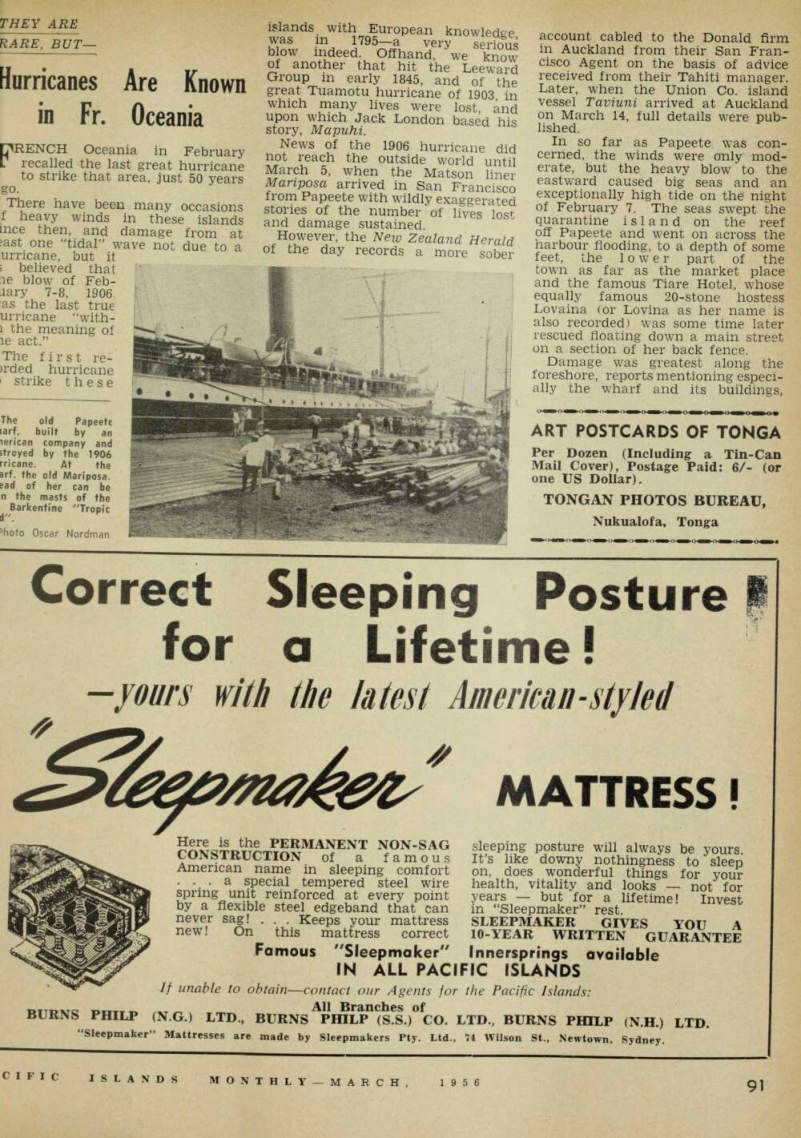
The old Papeete
[?]arf, built by an
[?]erican company and stroyed by the 1906 [?]ricane. At the [?]arf, the old Mariposa, [?]ead of her can be [?]n the masts of the
Barkentine "Tropic
d".
Photo Oscar Nordman
he Club Hotel, post office, American onsulate, Donald’s store, and the esidences of Captain Gamier, the arbour master. Most damage was ue to the sea sweeping under the uildings on their high piles, lifting tiem, then dumping them off the iles.
The only direct casualty in Papeete was Monsieur de Biloc cai’etaker on the quarantine islet' Lights were seen to be flashing dur ing the night but no help could be sent, and in the morning his bodv was found in the harbour. Madame de Biloc had saved herself by taking
to the top of a palm.
One Chinese merchant committed suicide on sight of the damage to his store.
In the Tuamotus it was a dif ferent story. Word of the disaster there was brought to Papeete by the schooners Papeete and Takarara on February 10. An official report eventually gave the casualties as 7 at Motutunga, 6 at Hikueru, and 95 drowned at Anaa, 7 at Marokau, 5 at Faaiti. In addition, heavy shipping losses were reported.
Vessels missing were the 120-ton schooner Eimco, Captain Narii Salmon, with some well-known people aboard, also the schooner Tahitienne, Captain George Dexter, and the schooner Tauturu. Another schooner, Moruroa, was cast up on Tikihau, but her crew survived.
Those lost at Faaite included the
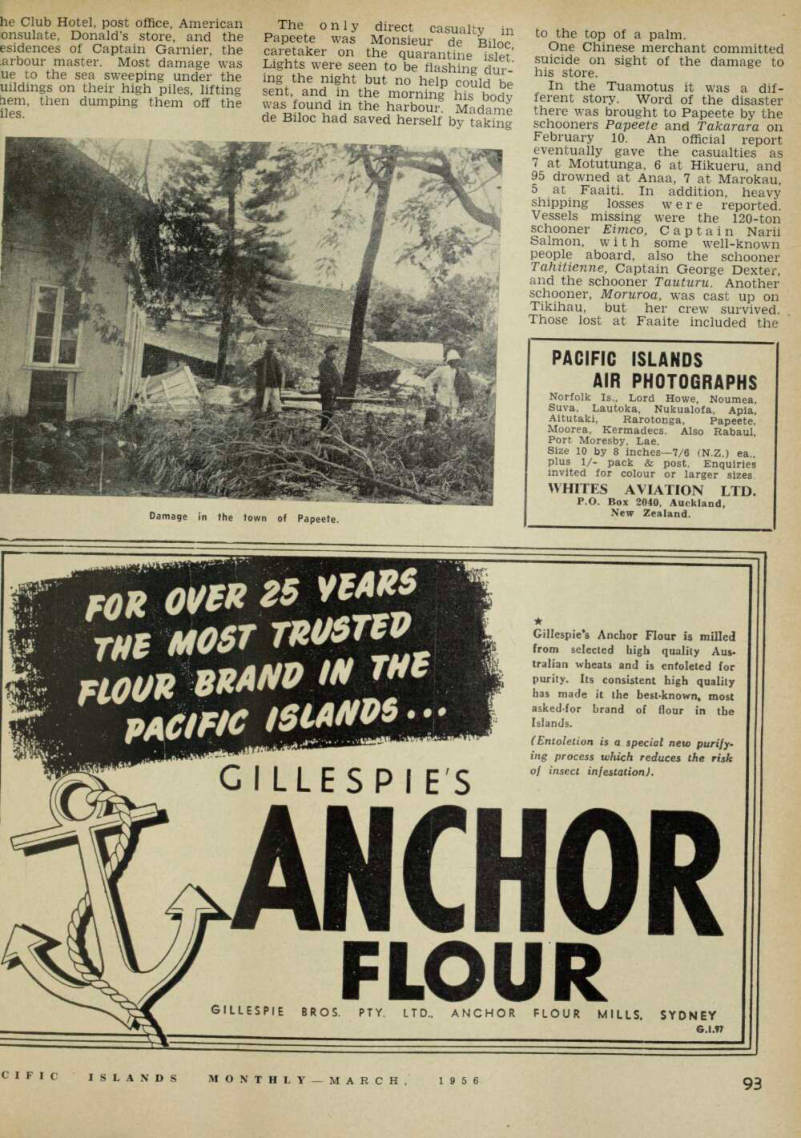
Damage in the town of Papeete.
Rev. Fr. Paul Terlin, Mrs. Louisa Johnson and her son Calmer, long time residents of French Oceania, and Louis G. Dexter, aged 4.
The British 4-masted barque County of Roxburgh was cast up on Takaroa, with the loss of 10 of her crew.
The Government promptly des patched the gunboat Zelee and three schooners from Papeete to render all aid.
These hurricanes of the past should be a reminder to wandering yachtsmen that French Oceania can, at times, be very much within the hurricane zone.