Territories Talk-Talk
pp. 29-34 · Read in the full issue

By Tolala
oathy in P-NG Politics
laving an interest in the delib itions of the P-NG Legislative uncil —to say nothing of a desire follow debates at the Council otings—l applied, enclosing a >tal note, for copies of Hansard i addressed my letter to the Gov iment Printer, Port Moresby, ifter the effluxion of time I re yed an answer from that gentle n informing me that “No Legis ive Council Debates have been nted since March 25, 1955.” t was only a few weeks before Council meeting held from rch 21 to 25, 1955, that Minister sluck issued his Press statement icerning the apathy of P-NG ;tors and the very slight chance y had of any change in the pre t Council. )ne can only surmise that an er terminating the publication of isard —that valuable record of incil Debate verbatim, and ch all good citizens enjoy read —was issued by some top-level hority. But with what motive? counteract European apathy? To ourage an interest of the voters the debates of their represent res? Of was it a pinch-penny isure? attended a Council meeting back June, 1955, and noticed the re ting staff flat out recording the feedings. Is the transcrintion of r notes only made available to tall poppies? It would seem so. t is possible that the P-NG Gov nent Printer is just that far be -1 with his printing.—Ed.)
yards Better
derstanding
irwin’s newspaper, The Northern ntory News, made a few com ets the middle of last month n J. C. Archer (“Clarrie” to his )ers), handed over the reins of ;rnment to Administrator F. J. S. 3 on the latter’s return from a months’ trip abroad. As rie has been an off-sider of the fltories Department Secretary remarks from the NT paper are iterest, and I quote: haps nowhere in Australia (except the NT) vate enterprise so frustrated, are Govern departments faced with such problems of ange control, lack of initiative in Can changing staffs and other difficulties. these things faced Mr. Archer. His task nade more difficult by virtue of the fact le was here in a temporary capacity only, salt with some tricky local and political m a manner which won him consider admiration from within and outside the service. re is a general feeling that Mr. Archer
learnt a great deal about the issues which retard development, about the problems of high costs, transport difficulties, shortages of labour and material . . . and the great red tape.
These things are not only common to the Territory, but here they are aggravated by lack of political influence and isolation.
It is one thing to see and comment in Darwin. Another thing to bring to the Minister and others in whom the control of the Territory is vested, a picture of the true position.
It is anticipated with confidence that the experience gained here by Mr. Archer will be put to good effect after his return to Canberra.
Let us hope that Mr. Archer’s ex perience in the NT may give him and his Department, as a whole, a more practical and realistic appre ciation of the requirements of Terri tories which come under the Can berra autocracy. (Over)
Murder in the
Solomons The above was a title more appro priate to a modern Whodunit than the tragic incident at Moravovo, but such was the heading on numerous letters addressed to the Editor of the Sydney Morning Herald in Feb ruary, in which many and varied cerrespondents took the opportunity of having a tilt at their favourite windmill. And, watching the column daily, I must confess I had some
fears of homosexual skeletons being tumbled out of cupboards. Fortun ately, this was not so. A knowing editor probably used his blue pencil with kindly effect.
One correspondent Anne P.
Nettleship (whom I remember liv ing in Salamaua and Rabaul at one time) —was more or less on the beam when she deplored the meagre salaries (or stipends if you prefer the word) paid to missionaries, though in more recent years my experience has been that missionaries live in comparative luxury to their predecessors.
There is, however, one corre spondent with whom I join issue and he is Canon M. A. Warren, Secretary of the Australian Board of Missions in Sydney.
In a letter appearing in the SMH (Feb. 20), he gives a blanket denial of homosexuality existing in New Guinea. I agree with him that in NG homosexual relations are “not the order of the day.” But I must
certainly disagree with him when M claims that “with other Islano. residents, for over a period of thirt' years, not a single case had evr come under my notice.”
I admit the phraseology is somej what ambiguous. He refers to It own seven years in Papua, but i general he is referring to Nea Guinea. And to say that homoj sexuality does not exist there is jut so much poppycock.
It is a well known fact that i most parts of the Sepik and Aitag districts many native men would nu recruit for work on plantations un less they were accompanied by thea “monkeys” (young boys). Homu sexuality was an accepted practid in those districts and there wr nothing anti-social in such activitt In some areas of NG it existed; : others it did not. Just the sam as cannibalism, head-hunting an the immolation of widows. Differed tribes, different customs.
A Sociologist
Has a Say
S. W. Reed, a well known Amen can student of sociology, who spe:£ some time in various parts of TW during the ’3o’s and wrote TV Making of Modern New Guinea,”' work accepted as an authority c such matters, has this to say: “Few indentured labourers har any normal outlet for their sexuj feelings. Some plantations as situated close to native villages, arj in such cases the boys may resort surreptitous prostitutes. Ordinarii however, homosexual practices as the easiest adjustment; all Eun peans agree that they are ves common and are increasing. T 1 natives have a growing awarenej of the growing revulsion with whit Europeans view such behaviour, an they know of the harsh pris<g sentences that frequently ini posed for it. In the aboriginal cu: tures, however, there existed no sui severe sanctions on this form conduct, and thus the native wj try to get away with it when can. . . .”
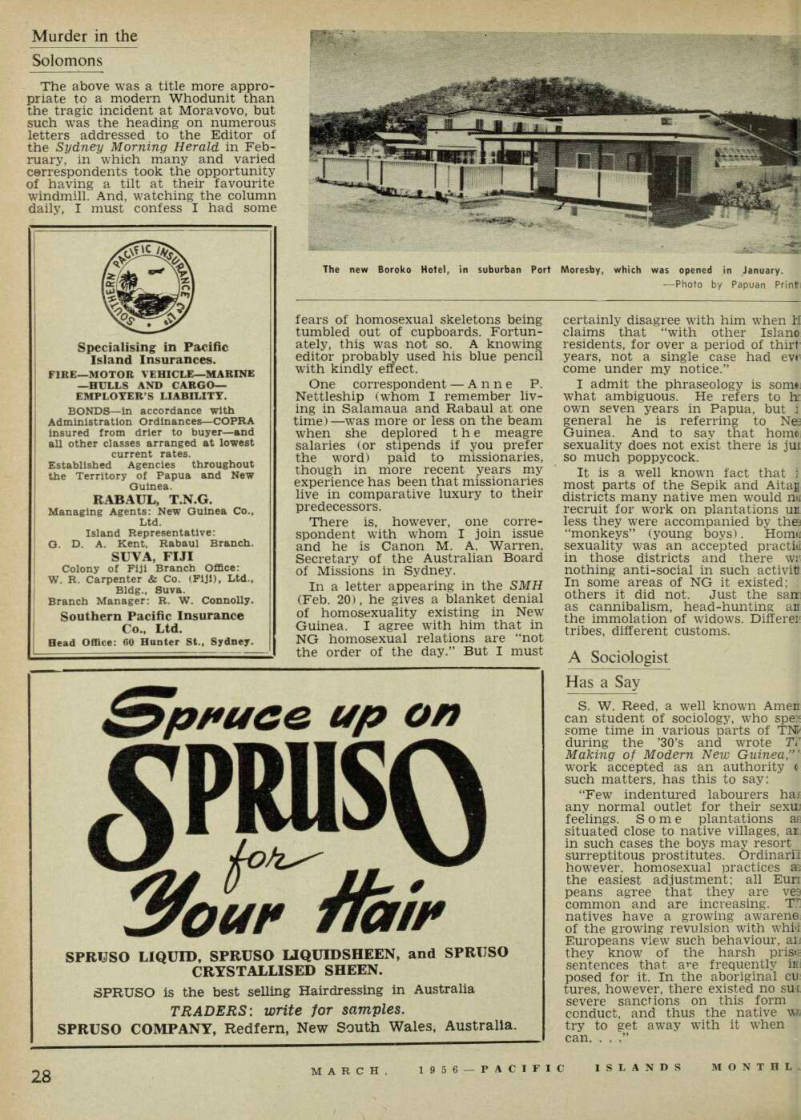
The new Boroko Hotel, in suburban Port Moresby, which was opened in January. —Photo by Papuan Print
>cal Government— -0 and Con ’he report of Mr. Winders, follow his survey of the possibilities introducing Local Government chinery into P-NG should make sresting reading. His survey imences this month and it is esti ted will occupy six weeks. Some vn Advisory Councils welcome suggestion of LG in the Terri 7, no doubt in the hope that h a set-up will abrogate the ;em of Absolutism now prevail and may short-circuit some of red-tape which is slowly ngling the country, cannot see how any relief can Dbtained from the present over ng autocracy from Canberra ledobu if LG, as implemented in tralia, is introduced and it will iably accelerate the introduction icome tax within the Territory, know naught of LG expert ders. He is probably quite a 1 cove; but I see no reason why, use he comes from Queensland, should be especially qualified to ;e P-NG conditions even if lority decrees “conditions in snsland are similar to the itory’.’ P-NG conditions are similar to conditions any 'e in Austr a 1 i a and the er that myth is exploded and 3 asserts its own individualism better for all concerned.
Third Anniversary
I write (February 29) my ghts go back to Rabaul on this in 1944 when the town really its bomb-bath and many a ing, which had escaped the ous extensive bombings in the ous years, were levelled. This the day on which Rabaul “got yorks.” e attack synchronised with the i landing at Manus and .ul’s strafe was merely a dis ion to the main coup de guerre. as on this day that the Jap ; troops abandoned the town went to earth in outside areas s elaborate tunnel systems had created. d yet actually it is only the anniversary! ... I often er how many of the present aean population realise to-day Rabaul and its people suffered ose grim years. ae is a great healer and little ilised by present-day residents e hell endured by those who ?d put” during the tragic days Nippon’s flag flew over Rabaul. ain did the conquerors en ur to break the Aussie spirit, ;e the indignities heaped upon and the menial tasks allotted " r y type of citizen. The “white s” did their iob with a laugh 3 face of bullying guards and g, dumb-founded native on 's - (Over)
An Incident of
Internment There comes to mind an incideß to serve as an illustration. A fes days after the occupation in Januan 1942, I was one of a work-pan detailed to unload the personr baggage of a ship-load of Korea; lassies imported for troop amenitie.
No degradation, in Nippon eye 1 could be imagined greater than tL carrying of such luggage. Among§ my co-workers were several high ranking Government officials, prom inent missionaries and commercr; executives.
On completing the job we w© lined up to be checked by swaggering three-star private au during the counting Father Barro* (pre-war Parish Priest in Rabai who later died of dysentry Kokopo) remarked to me in H Irish brogue: “I wonder what H Holiness would say if he knew I w/ a-portering for prostitutes?”
Bother Posterity!
It is sad indeed to read in tf South Pacific Post’s Drum colun that the Territory’s Historioi Society “is about to die in infancy Usually the present generation any young country is too busy the making of history to won about Posterity. And this is a gr©' pity for it only means so much mo research work has to be done lati on. There are many and varr long-haired experts on the P-H Administration staff now; sure room could be found on the ests lishment for the appointment of Official Historian.
It surprises me that Minis?
Hasluck, himself a recognisj historian of no mean tonnage, H not done something in this regan Perhaps the foreshadowed derm of the present Society is due the top-heavy burden of offioj bureaucrats. I heard some such sir; gestion last year when I was there from pioneer private dividuals who complained of irritd ing red-tape tactics —“too mu regimentation and not enou history,” as one old-timer explaim Where the Boys
Go in Sydney
An article in a Sydney weeh People, gave the New Guinea : at Usher’s quite a write up (see pic 80, this issue), and apart fn violating the sacredness of a ms. thirst-quenching habits the stt made good reading. However/ don’t know whether the fame Ethel will appreciate the statemn of being “big and fair” as descnii by one of her clients. Ethically fl without a doubt, but her “crowm glory” was undoubtedly da s.
No register of touring Islanders T kept in her day, for she was register and ever a fund of formation of Expected Arrivals 5
Departures of her clientele. But the number has grown since her day— over twenty years ago. Islanders’ rendezvous before War I was Bel- Reld’s and the lounge of the Metro pole. But there was only a handful Df lads in those days from Papua, Mew Guinea and the Solomons.
Many of them pretty tough babies, ;oo!
31d-Time Whoopee
There was no compulsory leave ;very 21 months in those days.
When Islanders arrived in town here was usually whoopee made in i big way. With some it may have ►een three, five or ten years since heir last visit to the Big Smoke, nd those years had literally been pent amongst the wild tribes of Jew Guinea, the Solomons or Papua.
You seldom read of their arrival a the daily Press —human interest tories were not a feature then and lany a good story was lost as these haps stepped ashore from the bblenz, the Moresby or Mindini. . . . here was old Peter Hansen—“ King” f the French Islands—who had rading rights in the Witu Group, nd after whom Peter Haven is amed. Attired in silk hat and frock Dat he turned it on without any ihibitions.
One night he entertained the hole chorus from the “Tivoli” to
a champagne supper at Paris House And then there was . . . But why rake up those nostalgic memories? ft was a different world then and a different people, opening up primitive country the hard way The word “amenity” was not ‘even known. They worked hard and they
played hard. So comparisons are odious.
Over the Air-Waves From past experience, I usually steer clear of New Guinea serials, sketches and what-have-you which come over the radio, but I was
pleasantly surprised last month hear the start—and later subseques instalments of Kiap O’Kane, Osmar White. Not only is it w'v written, but it is well produced, ap those responsible can certainly tae a bow —so far as I am concernej It is dedicated to members of ti) District Services; the pidgin realistic and the cast well selects It comes from 2UE. (Osmar Whitd reporting on NG in the Melboun Herald group of newspapers hi been missed recently).
Bits and Pieces
Among the nurses who graduat) from the Royal Prince Alfred Ho pital, Camperdown, last month w Mary Esson, of Rabaul. CongratuL tions... Victor Friedlander, of Rabsi has returned from a trip overse and expects to be joined soon his wife and daughter. He has so; his home in Rabaul. . . . Mrs. T.
Backhouse (wife of Rabaul’s w© known pathologist in pre-war yeai has retired after 15 years honorary director of the NSW RF Cross Library Services. She o lighted many a Rabaul audien with her piano recitals in the « days.