ARAKARIMOA —Latest in a Long List
pp. 22-140 · Read in the full issue
Are They Expendable?
ARAKARIMOA —Latest in a Long List of South Pacific Sea Tragedies
The sensational appearance of the Gilbert Islands auxiliary ketch Arakarimoa, off the Southern Guadalcanal coast, on Feb. 28, 1,000 miles from where she disappeared 64 days previously, emphasises once again the casual manner in which smallships operations in the Pacific is regarded.
DETAILS of the long drift and rescue of survivors is still sketchy as the area where the survivors got ashore is one of the most isolated in the Solomons. In addition, these waters were at that time be ing lashed by the gales that were prevailing over almost the whole of the South Pacific. However, this appears to be what happened: The Arakarimoa, a 60-ft auxiliary ketch, and one of two vessels owned by the Tangitang Society, a Tarawa Co-operative, with a crew of 12 and eight passengers including women and children, sailed in company of the Society’s other ship, Aratoba, from Tarawa on December 28. Their destination was Maiana, 19 miles away.
The vessels were in sight of one another till midnight, when Arakari moa increased speed and went ahead. In the morning it was neces sary to await the tide to enter the pass and Aratoha anchored at Tebikerai anchorage, entering in the afternoon to find that Arakarimoa had not arrived.
This was reported to Tarawa and The Govenment vessel Nareau commenced a search to the westward on the afternoon of December 30, returning on the evening of De cember 31, reporting that she had sighted nothing.
No request was made to the
RNZAF air-sea rescue organisation at Suva for an aerial search although the acting secretary of the Western Pacific High Commission is reported in a New Zealand paper as having said United States aircraft searched for the vessel on January 3.
Nothing was made public about the ketch’s disappearance until early February, by which time the vessel had been missing over a month.
It seems that then the ketch was written off and left to its fate.
Some details of the last chapter in Arakarimoa’s history are still not clear but the following details are taken from a statement made by Mr. J. C. Grover, Government Geologist, who was surveying in Southern Guadalcanal at the end of February.
ABOUT 8 a.m., on February 28, two native runners arrived at Avu Avu mission with news that the missing ketch was drifting off the steep-to coast of Guadalcanal and that 12 survivors had come ashore in a dinghy, weak from hunger. A message to this effect was sent to the nearest radio, at Marau, 24 hours walk away, for despatch to Honiara.
Father de Block, of the Mission, and Grover immediately set off to Malageti, the nearest mission to
where the sur vivors had landed, but an hour along the way, the ketch was sighted and while Fr. de Block went on to Malag e t i, Grover returned to Avu Avu, where parties were organised to watch the ship for sur vivors and then he walked to a village five hours away to the east to organise canoes to rescue the six still be lieved to be on board.
During the night a gale blew from the WSW which made cau rescue impossible and at the sas time blew the ketch out of sii; of those waiting at Avu Avu. Lax Arakarimoa was sighted 21 miles the south and was subsequen found to have gone on the Po' reef.
Heavy storms with winds of un 70 mph swept the area on Feb..
Early on the morning of Marctl runners arrived to report the arrh of two survivors ashore at Tab after a 12 hours swim in lifejacK from the ship. Four other peoc including a woman and a child, I left the ship with them to sw but nothing had been heard of tM and they are presumed lost. (Accounts from the first survivors to n Honiara show that the first 12 people to r the shore were in two 8 ft. dinghies belom to the ketch. Both dinghies turned over im surf, and a five year old boy was lost the first one—he was the son of a we (saved) who had given birth to a child om ship at the end of January. It lived om few days. Captain J. E. Hugill, of Arakarii had promised to go back for the other s people on board when he got his first I load ashore, but when the storm made impossible, they apparently got desperates six, including a 1 year old child, tries swim for it. The two survivors of this ( are the ones who came ashore at Talise.; Meanwhile, on the night of El ruary 29, two ships had been spatched from Honiara —they w the Myrtle, with Captain J. Max 1 : in command, and the medical s Betua. The Government had i asked New Guinea for a plan© search the area and drop supn to survivors. On March 1, bees of violent seas, the two small si; had to shelter. On March 2 ti again put to sea and swept a \r area. A Qantas plane from reached Vella Lavella with difficc on the night of March 2, and! the morning of March 3 loot; Arakarimoa on Poole reef, direis the ships to her and drop* medical and food supplies to .
Avu Mission.
Captain Maxwell succeeded in ; ting onto Arakarimoa by dinx where he found the ship’s bott ripped out and the body of am man on board. Because of approai ing squalls he could not remove j body. • • • Piecing together the story ofi English-speaking survivor, it appq that the engine broke down tld hours out of Tarawa, it could J be started because the “battery ’ cracked.” The sea was too deepq an anchor and a sea anchor fa to stop the drift. After two « they “put up a small sail” and fi to beat back to Tarawa, but ; wind drove them south for : days, after which they were calmed for three days. The c thereafter continued south, southwest to west.
A survivor is reported to I said, “We had no radio,” and no means of signalling. ThL contrary to what PIM has beem formed as to the equipment ofi
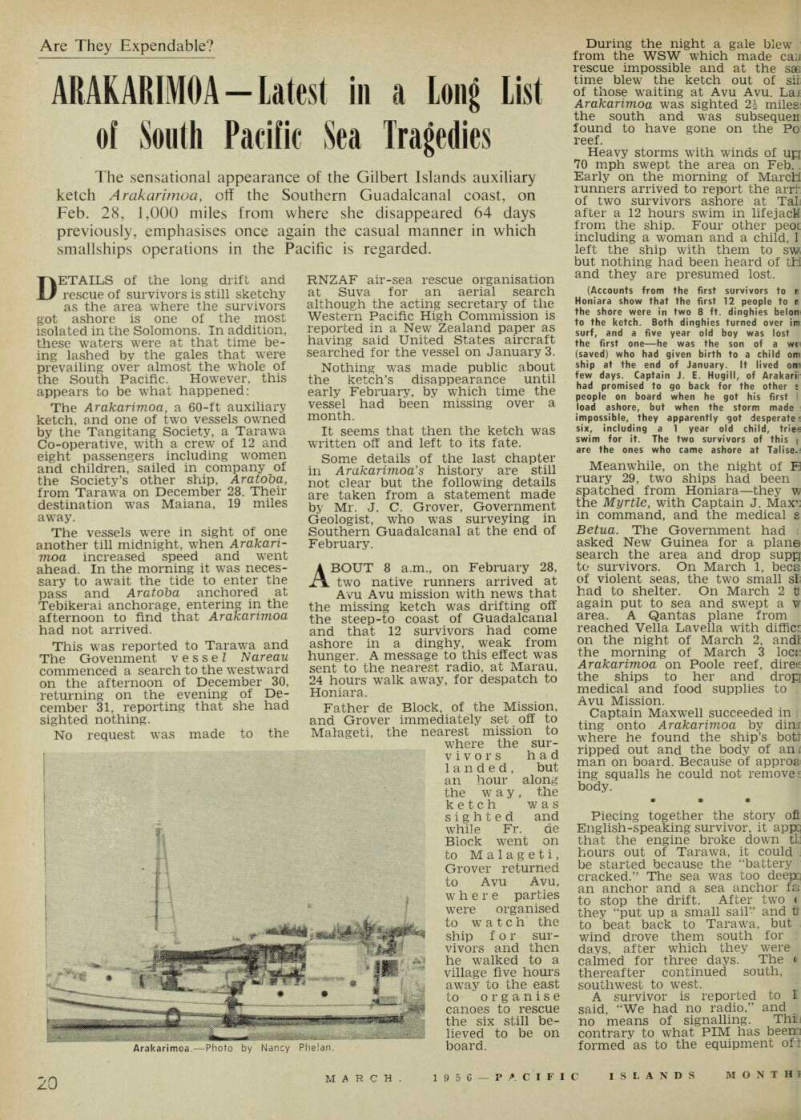
Arakarimoa.— Photo by Nancy Phelan.
;ssel. However, the radio may ave been taken out, or what is ore likely, been useless once the igine was out of action, or the uteries “cracked.” PIM informa m is that Arakarimoa was [uipped with radio, using the phan Gilbert and Ellice Is. fre lency upon which Tarawa keeps itch two or three times per day, id which is unheard by any other ation.
The ship carried no maps or
irts (the italics are ours) lough a compass is said to have owed us where we were going ” n he meagre supply of food on i'd was rationed after the first ee weeks but long before she :hed the end of her freak voyage, d consisted only of what few l were caught, plus rain water. |wo ships were sighted, both at ht; oil flares were lit to try to 'act the ships but they were ter unseen or misunderstood, istralian newspapers have tried make something out of this— )S Ignored by two ships” is how yas put, and it was alleged that ships put out their lights and ippeared. The ships are believed lave been Japanese fishing boats , after the crimes, ranging from rder and piracy downwards, of ch the Japs have been accused ecent months, it is small wonder :hey cut and run at the first l of anything unusual). 1 much for the story of Arakari moa—the ends results of which were apparently much better i were expected in so far as at t 14 people were saved. But karimoa is just one incident in mg line of South Pacific sea :edies of recent years which
(Continued on Page 137)
ht not have happened if lentary precautions for the safety mall ships at sea were enforced. is quite obvious that while the ority of small ships in the .fic are run with every regard afety, the minority are not, and people who entrust their lives hese latter take the same risks ay as were taken 100 years ago, that modern technical advances ; availed them nothing. It might i be said that more risks are n as sole reliance is sometimes in engines that fail to work or adios whose batteries are run i, or whose frequencies are und beyond their own home bases. hat might be done to make ges by small ships safer is ;ed fully in “News of the Small- 5” in this issue of PIM. But at stage it is a fair question to what is the official attitude to ? small sea disasters. Can it be n that the official and public is that anyone who goes out small ship in the South Pacific be regarded as expendable? e case of the Arakarimoa seems idicate that this is so. . attempts to locate Arakarimoa abandoned within a week of iisappearance. The G & E. Govlent ship Nareau searched for for two days—then gave up— because Arakarimoa was not
around any more—as has been proved by the fact that she has now turned up—but because Nureau apparently looked in the wrong places. A search is said to have been made by a US plane—presum ably one of the planes being used to set up the new US meteorological station at Tarawa, which would come in from the north, After this, Arakarimoa was callously left to her own fate. Some one now is likely to be asked why, although if the vessel had not incon veniently turned up again, sleeping dogs would no doubt have been allowed to lie.
Arakarimoa is just one of a dozen small ships which in recent years have been involved in incidents that ended in tragedy or nearly missed tragedy.
The Joyita affair is of so recent a date details need not be repeated here. Two other vessels whose fate is even more of a complete mystery are Awahou and Monique.
Awahou, well known in G & E and Fiji waters, disappeared on a voyage in rough weather, between Sydney and Lord Howe Island in Sep tember, 1952. What appeared to be a distress signal had been received from her on September 10 but after that there was complete silence, Because she was registered in Suva, the Australian Navigation De
partment could not hold an in quiry without Suva approval. This inquiry was held in Sydney seven months later. The Court found that she had been given a certificate of seaworthiness before leaving Sydney and that the cargo had been properly stowed. Awahou had been involved in an incident in Suva
waters some years before, when she had had to be towed into port by the Government vessel Degei and it had been suggested that under some circumstances she was unstable.
Eighteen lives were lost on her.
The biggest tragedy of recent years was, however, when the French 240-tons motor vessel Monique dis appeared on July 31, 1953, on a 75 miles voyage between Mare, in the Loyalty Group, and Noumea.
About 120 people, including 20 Europeans, disappeared with her.
An extensive air search was made for this ship without result and the general opinion was that she had simply turned turtle and sunk, im prisoning her crew and passengers.
It was alleged that sacks of copra were stacked on the bridge four or five feet above the rail, that the life boats Monique carried were piled high with luggage as were also the passageways so that passengers were unable to move about the ship at all.
One thing is certain about these sea “mysteries”—they are not caused by submarines, Red, White, Blue or any other hue, or by Flying- Saucers, Little Green Men, Space Ships or any other un-natural phenomenon. They are caused by either the natural hazards of the sea, or the failure of the human element to take precautions some where along the line —and, it seems, it is too frequently the latter.