Editorial...
pp. 19-20 · Read in the full issue
[?]0D TIMES —AND A WORD OF WARNING
RODUCERS and merchants and traders in the South Pacific, while benefiting from and enjoy the high prices of all South hfic products—copra, gold, sugar, oa, coffee, bananas, oranges—and quite generous gifts of the ruling ntries, should not accustom mselves to the idea that these ;ors form the basis of their future manent economy, conomic conditions in the South Ific to-day provide a pleasant I stimulating picture; but an ex ination of the background sug :s some elements of uncertainty, fter World War 11, all the South ific countries got away to a ?nificent start. The Territories wards of New Guinea and )mons and especially New 3donia and New Hebrides, lerto rather poor—received a tiendous injection of United tes dollars; and turned back ards normal life with a “stock ’ that in many instances still is :ing. apua and New Guinea, despite taged plantations, wrecked towns general devastation, also were d most substantially to a new t by £12,000,000 of Australian 1 Damage Compensation, liber spread around. other words, when World War /as over, and the South Pacific itries made up their balance ts, it was found that most of i (the war-battered Solomons, derella of the Pacific,” being table exception) had been deeply permanently enriched. This was wed by important rises in the values of practically all Islands ucts. Ever since, a good time been had by all.
I classes have benefited. Living dards have been raised. Many ines have been made. The good ; have lasted so consistently and ng that they now are regarded some places, with inexcusable )lacency—as a permanent con n. ere has been a big, permanent, forward, but the step is not ly . so big as many people ine.
E factor which is of importance in maintaining economic stability in the South Pacific is protection given by Britain to i and sugar. The price of each uaranteed by Britain under standing contracts, the case of copra, the price i all British countries receive at fixed by the British Min of Food Contract (until the 3f 1957); and, thus, all British are receiving a rate is substantially above that of world’s open market. After South Pacific copra will sell
in direct competition with the pro ducts of Indonesia, Malaya, Philip pines, etc.—and growers will have neither the same profits nor the same certainty of profits that they have known since 1949.
As other evidence of what can happen it should be noted that the really remarkable prices which growers of coffee and cocoa received up until the end of 1954 have fallen substantially.
Cocoa now is half what it was 18-24 months ago. There was a period when the Western Samoans, for example, were getting about £stg.soo a ton for their product—and living conditions throughout Samoa were perceptibly sweetened as a con sequence. Cocoa, at between £2OO and £250 Stg. a ton, at present, still is quite a profitable crop; but some pepple and some countries who had built a sort of permanent economy around £4OO-£5OO Stg. a ton, have suffered considerable embarrassment.
Similar embarrassment almost certainly will be felt by unwise copra-growers who have adjusted
their lives to the comfortable rates provided under the MOF contract.
A similar word of warning should go out to the people of Papua and New Guinea who, while enjoying high prices for copra, coffee and cocoa, have also got the happy back wash from the annual expenditure of the Australian grant of from £6 to £8 million pounds per annum, and the £2 million per annum spent on the search for oil.
There is no indication that these lavish supplies will be cut off with out ample warning—but it could happen.
THERE is no sign of a recession— nothing to be alarmed about.
But there is a very real danger inherent in the tendency of people to accept the conditions which have ruled since World War II as per manent, and to build their lives around them, when anyone can see that an international disturbance could reduce Islands incomes sud denly and substantially.
With more and more people striving steadily towards higher standards of life, the tendency is for world demands generally to grow, and the prices of commodities m demand to at least, stay steady.
But the levels thereby ensured are above the levels which somewhat extraordinary conditions have estab-
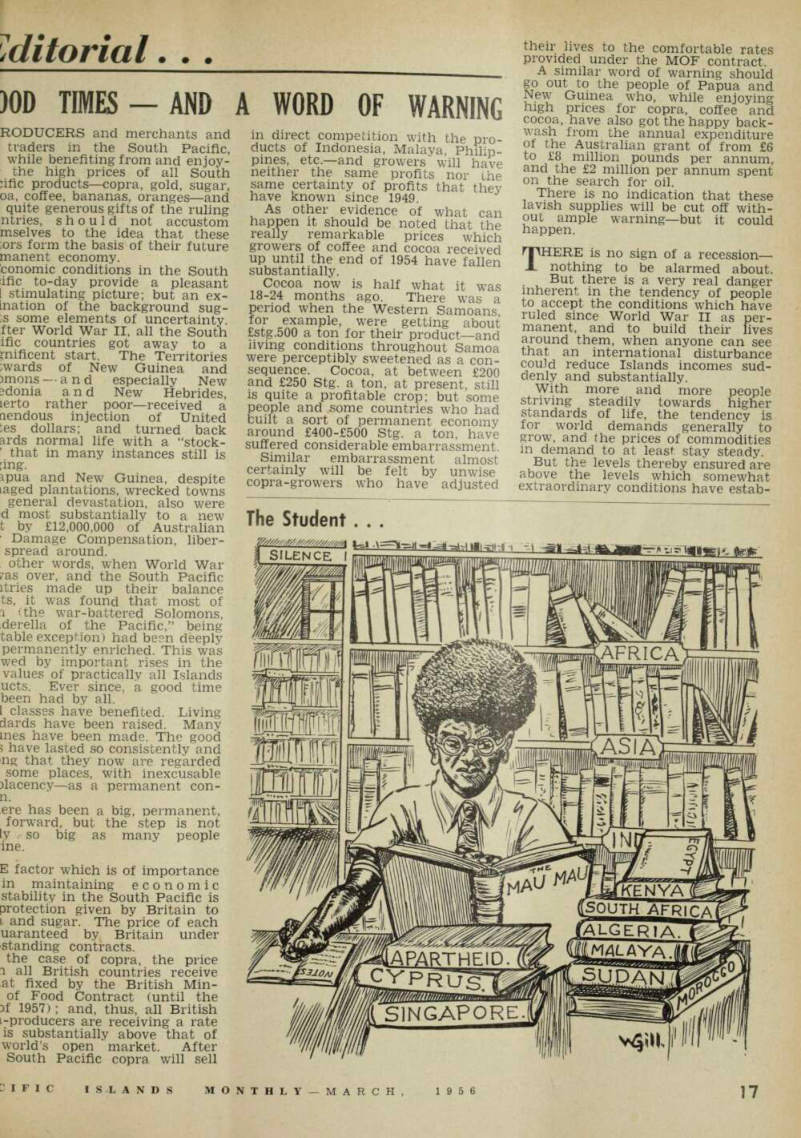
The Student...
lished throughout the Islands. All traders, from the small planter or sheller or miner, to the healthy co operative society and the big cor poration, would be very wise to assess for themselves the proportion of their income which may be re garded as extraordinary or imper manent, and to place that margin sternly away in a reserve account, and build their regular economy around what is left —and which may be regarded as reasonably normal income. If no serious readjustment of Islands revenues comes along they will have that much tucked away safely in their savings. If •it does come, then they have a set-up that will take care of the new con ditions, plus a reserve to cushion the shock if the change is more severe than expected.
New Guinea —with huge revenues and no income taxation —especially should be careful, and build up re serves for the future.