News of the Small-Ships
pp. 100-116 · Read in the full issue
It Happened In February :
Just 50 years ago this February, Lever Brothers’ 1,141-ton steamer Upolu arrived at Suwarrow atoll, Cook Is., on one of the most in teresting commercial operations ever to be carried out in the South Pacific.
The story is told in PIM for No vember, 1935, in a report from Captain Charles Menmuir, former master of Upolu.
The vessel left Sydney in January to transfer a cargo of live gold-lip pearl shell from Torres Strait to Suwarrow atoll. On arrival at Sun day Island (Torres Strait) 30,000 shells were gathered and placed in barrels, holding roughly a dozen shells each. The barrels were mounted on frames arranged in tiers in the ’tween decks, and were so arranged that a constant flow of pumped sea water percolated
through them. Only gold-lip shell was taken, black-lip shell being already plentiful at Suwarrow where Lever’s Pacific Plantations Pty. Ltd. maintained a pearling station.
The price difference between gold lip and black-lip shell at that time was £A9O per ton, and the com mercial cultivation of gold-lip shell at Suwarrow seemed a sound busi ness proposition.
A successful passage was made via Suva, with negligible loss of shell. At Suwarrow the shells were placed in wire frames and lowered into the lagoon. Upolu then de parted, leaving an English con chologist, Mr. (later Sir) Seville Kent, in charge of the experiments.
His assistant was Mr. James Huddy, of Torres Strait, who afterwards became manager for Levers, at Gavutu, Solomons.
Subsequently, said Captain Men muir, the shells spatted and pro duced young shells, but they were not quite the success hoped for. Un fortunately, before further necessary experiments could be undertaken, Lever’s lease of Suwarrow expired and the New Zealand Government declined to renew it. After the New Zealand authorities took over the Island, Captain Menmuir reported,
very little was done to continue tic experiments, and eventually thf were abandoned.
To-day, after years of idleness, t]d lagoon is being looked at with n newed interest by the Cook Islam Administration, especially as tJ Manihiki lagoon has now be€ closed for a rest period.
The operation by Upolu is believe to be the only one of its kind, ( such a scale, ever undertaken the South Pacific.
Fire Down Below: —Papee
was aroused at 1 a.m. on Decemfcl 28 when a fire broke out in ti fo’csle of the 56-ton MV Suzam . lying at the waterfront. The Po Captain and his Assistant, the F: r Department, Army, and Police unr were quickly on the scene and J good save was made.
Fortunately, there was no wind J the schooner Tiare Taporo lyii close alongside might also have be involved. Suzanne was originaE built for M. Emile Martin, wj known Tahiti business man, ae named after his daughter, now Mn Massal wife of Dr. Massal, of tr South Pacific Commission. TI vessel is now listed as belonging; the Palmer Estate.
STRANDED:—According to s vice from Honolulu, the fish:i schooner Commonwealth wr ashore on Palmyra atoll in n
vember or December and is apparently considered a total loss Owned by the Kahler-Dahl fishing company of the US Pacific Coast Commonwealth, based on Honolulu’ has been carrying out a tuna survey of Line Islands waters over the oast several years without notable suc cess. About a year ago the com pany’s other vessel, The Brothers engaged in this work, was lost with all hands between French Frigate Shoals and Honolulu.
The crew of the stranded Com monwealth was picked up in De cember by Fish and Wildlife Ser vice research vessels. The John R Manning picked up five men, and about the same time the Hugh M Smith called and picked up the
other four, both vessels arriving back at Pearl -Harbour on December 17.
Details of the disaster are unknown.
They Come And Go:—Com
pleting her contract term, the Jap anese tuna-fleet tender Saipan Maru sailed for Japan in December after servicing the Pago Pago-based tuna fleet for the past six months. The vessel had 115 tons of sundry un cannable fish aboard.. She was accompanied by the fishing vessels Koshitata Maru and Yoshu Maru To replace one of the latter, the Kyowa Maru No. 8, 90 ft x 18 ft x 9 ft, with a fish storage capacity of ol tons and a crew of 25, arrived Another vessel, Nikko Maru, not attached to the Pago Pago fleet
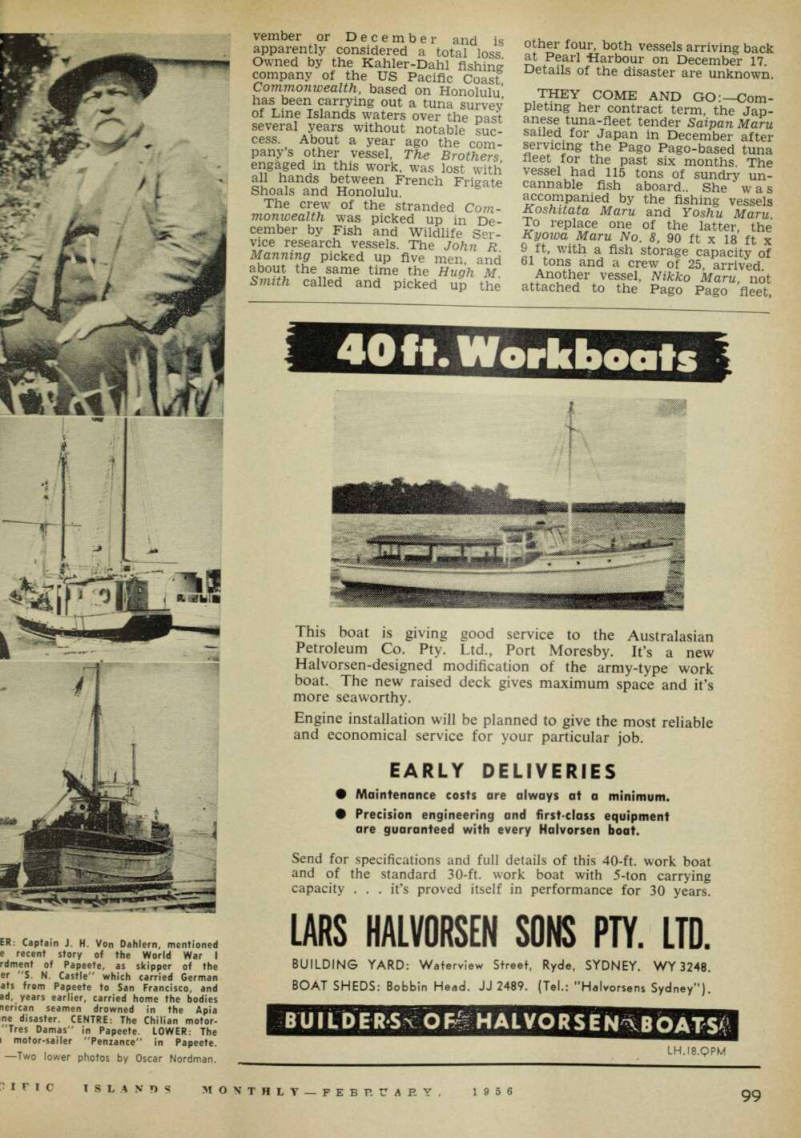
[?]ER: Captain J. H. Von Dahlern, mentioned [?]e recent story of the World War I [?]rdment of Papeete, as skipper of the [?]er "S. N. Castle" which carried German [?]ats from Papeete to San Francisco, and [?]ad, years earlier, carried home the bodies [?]nerican seamen drowned in the Apia [?]ne disaster. CENTRE: The Chilian motor "Tres Damas" in Papeete. LOWER: The [?] motor-sailer "Penzance" in Papeete.
Two lower photos by Oscar Nordman.
ne in there for urgent engine airs, after the necessary per »sion had been obtained* from irl Harbour by radio. Such per ision applies to all Japanese fish vessels not attached to the Pago jo operations.
■Ap T Arif A Sold:—A Chart
d aircraft was expected to arrive New Caledonia from Manila in mary bringing a crew to take very of the 2,177-ton Cap Tarifa, ch has been sold to a Philippines i. Cap Tarifa was built in France 1920 as the Depute Maurice nard. She was later renamed !trice Bernard, and, under Societe Nickel ownership has traded be en Noumea and NSW, bringing I and coke to the smelters in imea over the past 15 years. She be used for a cattle transport
between Philip
pines and Aus tralia.
With her dis posal, the Societe Le Nickel now has an entirely up-to date fleet of two 3.000- motor vessels, and a 5.000- steamer recently acquired.
Vila Star
Sold: N E W
Hebrides Trading & Shipping Co.’s 465-ton Vila Star
was reported during January to have been sold to Mr. Roy Gubbay, of Santo, as the vessel lay at Welling ton, NZ.
A veteran of the New Zealand coast, she was considered one of the ugliest yet most seaworthy vessels in the South Pacific. Built as Argus, in 1928, she became the Holmglen, in 1932, when purchased by the Holm Shipping Co., of Well ington.
NHT & S Co. purchased her several years ago and she has operated between Santo and Syd ney, and latterly on the trans- Tasman timber trade. It is believed that she will now return to the Sydney-New Hebrides trade. (In Sydney, on February 1, Mr.
Gubbay said he has no fixed plans for the vessel as yet, except for
“usual Pacific trading.” He has been freighting with other ships in the New Hebrides area and his last ship, Bateman’s Bay, was recently sold to the New Caledonian Gov ernment for use as a research vessel).
CREW TROUBLE:—Following her lengthy refit in Suva, the Noumea 209-tonner Lorraine apparently acquired a substantially Fiji crew
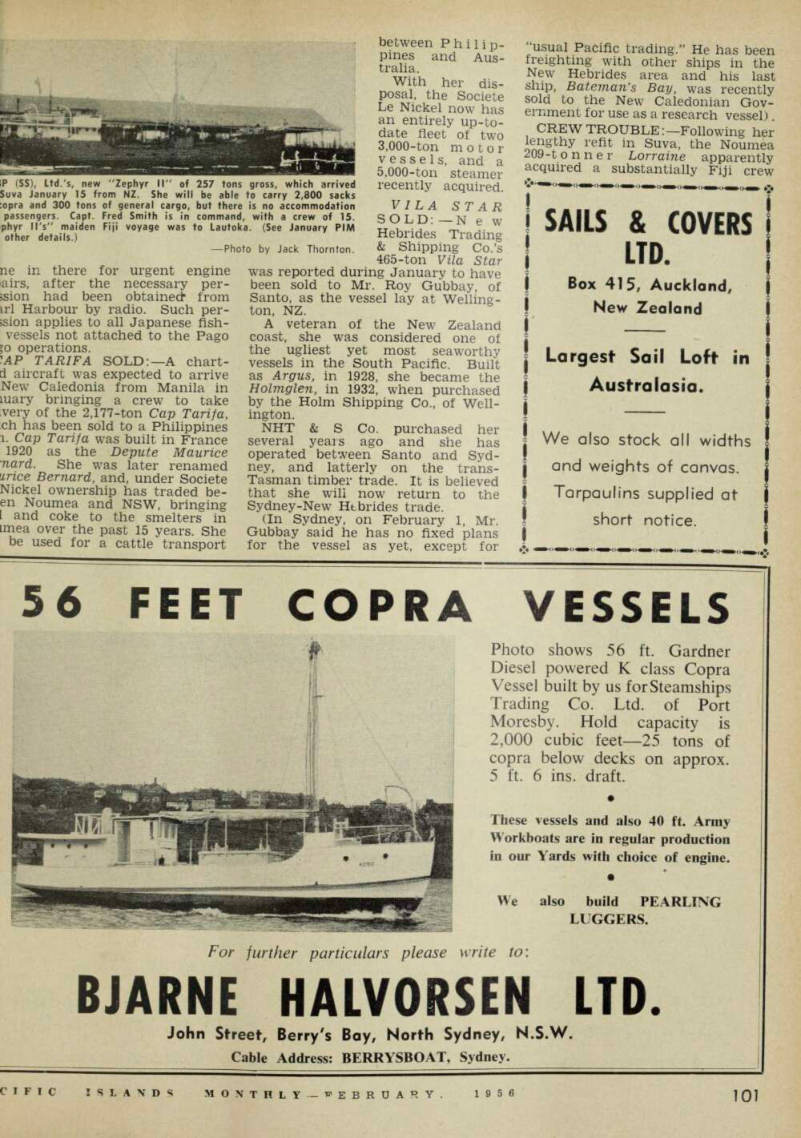
[?] P (SS), Ltd.'s, new "Zephyr II" of 257 tons gross, which arrived Suva January 15 from NZ. She will be able to carry 2,800 sacks [?] opra and 300 tons of general cargo, but there is no accommodation passengers. Capt. Fred Smith is in command, with a crew of 15. phyr ll's" maiden Fiji voyage was to Lautoka. (See January PIM other details.) —Photo by Jack Thornton.
(not necessarily Fijian) before re turning to her normal New Caledonia coastal run.
In December it was reported that these men walked off the vessel at a northern port and travelled back to Noumea by land to protest against the working conditions on board.
Solomons Mishap: —Fai R Y
mead Sugar Co.’s auxiliary vessel Makila was reported on a reef at Rua Sura Island, off Guadalcanal, late in November. RSC Kovala and the trading craft Cape Torrens and Monokai rendered aid. In first at tempt to refloat Makila, the towing hawser parted. Cape Torrens made a hurried voyage to Honiara for another tow-line and the vessel was finally pulled clear without serious damage. Luckily, the weather was good.
LEAVING PACIFIC:—The Anchor Shipping & Foundry Co., of Nelson, NZ, has sold the 3,566-ton turbine passenger vessel Ngaio, well known for many years in the Hawaiian inter-island trade as the Hualalai.
She was built in San Francisco, in 1929, and acquired for the Nelson- Wellington run in 1950, but proved too large and expensive to operate, for the traffic offering.
She has been sold to Gulf Steam ships Ltd., of Karachi, Pakistan, and was to leave Wellington under a Pakistani crew in January.
More Wreckage Found:—
Wreckage which could possibly have come from Joyita was brought to Suva late in January by the local vessel Ai Sokula. The wreckage—re mains of a skylight, painted green, and a small cushion filled with kapok—was found on Yanuca Island north of Taveuni, Fiji.
OOPS!:—With most of Thursdt Island’s Christmas cheer aboard ti LST Wewak, in recent years in tJ North Queensland cattle trade, wes up on a mud-bank 300 miles non of Cairns on December 5, and w/ unlikely to get clear before the n© Spring Tides, making it unlike that she would reach the island
The stranding occurred when vessel was discharging stores at mely station in a tidal river.
3Me Were Lucky:—Over
lowed by the disappearance of ta, another sea drama took place Gilbert Islands waters in No ber. On November 5, AMP none and a companion, Te aere, went fishing off Tarawa he MV Aratoba’s launch. They ;d to return. Presumably a ch was made, but the missing ich was not located until on smber 18, the Japanese fishing el Koyo Maru reported that the had been picked up 200 miles of Tarawa, ley were to be landed at Ebon, shall Islands, on November 23.
American vessel was to return men to Tarawa in mid-De- Der. The launch drifted at oximately 15 miles per day from of breakdown.
Slays & Troubles:—Work
refitting A. B. Donald & Co.’s : Islands trader Charlotte aid, at Auckland, is taking er than anticipated and the ;1 is not expected to clear Auck before late January, sanwhile, during January, the
£m and conic
following lll a hvl^ ded One%T g memhPr nf tho breakd °w n - Sen hi K h to the mast be our?te n snot earh h?v LIS J? S fav : oiling Tal old SLn T ? and
who !s wlfl into Tangaroa -
In chaSe of thP o * Tonv Thomnsoi^ h %nn nt nf S ap^n iony inompson, son of Captain "XcclS 0 ? , and Tony wT then go Site o? K Pomare, under Captain Hare when that vessel resumes the running in late March or April.
Ttomtttmtmn Nn. „
~r G radually, following marine disasters, smallship regulations are being tightened
up by the various South Pacific Administrations. In the Cooks, the number of passengers which may b t carried is now regulated Thls was seen in a recent announce ™ent that the Brixham trawler Inspire is limited to 35 passengers m the Southern Group trade, and Jf 0 15 passengers when on Rarotonga- Northern Group voyages The vessel has also beenZte/with an efflcS rad ‘° transmltter - CALLED TO AlD:—With Char lotte Donal d called away to Auck land for early refit this season, the Cook Group has been left with an acute shipping shortage, only In spire and John Harrington’s small being afloat <£„>
per, the Falmouth yawl "Diana", lately papeete; and lower, the English cutter me" in which Danny Weil is bound round world on a one - man radio amateur dition (see section "For Pacific Radio [?]eurs).
o ease the situation, the D. C. wn firm came to an arrange it with the Honolulu 48-ton )oner-yacht Fiesta, which has ly made two voyages to the th and was expected to make a them Group voyage. The yacht
brought 20 tons of MOP shell south on the first voyage.
Twomeys:
According to an Auckland report, the Lepers’ Trust Board would like to name the three new medical vessels
now building
in Auckland Twomey I, Two mey 11, and Two mey 111, after Mr.
P. J. Twomey, soon retiring fol lowing 30 years Secretaryship o f the Board.
Mr. Twomey, however, would like them to be called Rata (NZ), Rimu (NZ) Matai (NZ) —and these may be the names which they eventually receive, although at least
two of the names, less the (NZ) portion, are already held by vessels on the New Zealand Register —Rata and Matai.
Viti Movements: — Viti, One
time Fiji Government vessel, lately acting as stand-in for Maui Pomare
request of the "Joyita" owner's legal representative in Suva, "Joyita's" engines were recently taken out and stripped at the Bay workshops of United Engineers. The firm's managing partners, [?]rs. Tom Cavendar (left) and Tom Pickering (right), shown here the dismantled engines, have reported that they could find no [?]anical cause for an engine breakdown on the "Joyita". At the Inquiry Counsel said he would prove that "engine and cooling [?]m were defective and parts missing". (See elsewhere.—Ed.).
Photo: Jack Thornton.
on the Cook Islands run from Au<j land, has completed her charter' the Government and will returnt the trans-Tasman quick-frozen f« trade in which very high freight! about 4d per lb—are offering. T vessel, which has just undergone partial survey, may go to Hongko for the next major survey.
As the owners, Tasman Steamst Co., are insolvent, the vessel meanwhile for sale, but it is hoi that the company may become established if the ship is able to main in her present lucrative tree
Isabel Rose Arrives: —/Sa
Rose, former Army Patrol Crs type, 103.3 ft x 21.3 ft x 8.4 ft, 8 more recently a fishing ves arrived at her new home port, P* Pago, on December 4 under co mand of Captain Robert C. Pa;.
Pago Pago’s Harbour Master s also master of Marm’s Tele.
The vessel cleared Sausalito. C on November 8, after refitting thi Owned by Joseph and Willi.
Stephany, who also own the Samoa, Isabel Rose is powered! a 500-hp diesel and has a cruis range of 3,000 miles at a ser' speed of 91 knots. The purch price was reported to be ah $35,000 (£A15,500).
Shortly after the vessel’s arn at Pago Pago she was chartered New Zealand authorities to m an urgent trip to the Tokelaus v medical assistance for a polio o b rea k Captain J. Jones, Harbour Mat at Apia, was apparently in commr for the voyage, which was the : made to the Group since the fated Joyita voyage.
Mothballs Ashore!: —T
1,050-ton reserve cable-ship M\ dusted out her mothballs at W ington, NZ, and departed that ; on January 19 with a team of perts aboard to repair a cable ft near Norfolk Island.
The fault had developed dm the heavy weather of December a point on the Norfolk-Suva ses of the trans-Pacific cable a few rr: off-shore.
Latest addition to the Eastern Samoa fleet, John and William Steffany's "Isabel Rose", and, right, the crew which delivered her from the
Pacific Coast to Pago Pago. From left to right, Captain Payes, who is also harbourmaster at Pago Pago, owner William Steffany, Bernard
Russmussen, Bosn. Faotua, Faatauva'a Talam Maea T ago, Tosina, Ripine Ripine, Peter and engineer James Sword. —Photos by Pan American Pri [?]
Collecting Molluscs:—The
looner-yacht Gloria Maris, named er one of the world’s rarest shell 1, is about to commence a sntific investigation of the sea tom in the Geelvink Bay area of :herlands New Guinea. l photo of the schooner appeared December PIM and details of her ”k appeared in earlier issues, npleting a refit at Koror, Palaus, schooner proceeded to Biak md, where she took aboard Mr.
W. B. Powell, assistant director the Auckland War Memorial seum, to head the team of eight :ine biologists. he expedition is led and financed Mr. A. J. Ostheimer, of the ladelphia Academy of Natural mces, and the schooner is nn e d by some well known ate u r yachtsmen, including est Chamberlain and William dock, also Miss Mickey Douglas she will be remembered in iti—now married to the chief neer of the schooner. She was lerly in Arthur Rogers and te Heron. i completion of the scientific gmg programme at the end of ch, Gloria Maris will be avail for charter to any scientific or lar party. She is not a cargo d. Mr. Ostheimer can be con ;d care of the vessel at Biak, mt base for operations. rWANTED TRADE:—Fruit Dis tors Ltd., the company handling importation of citrus and nas into New Zealand, is seek i ship-owner with a fast refrig d vessel suitable to enter this nding trade. ch a vessel would probably need ! 3,000-4,000 gross tons. Indicat hat the company is urging the n Steam Ship Co. to build such ssel, Mr. Harvey Turner, head ruit Distributors, recently said there was an opportunity for shipping companies to provide he Island fruit trade, though had shown little interest, the contrary, more than one company has shown interest ie trade, and the reason that have not entered it is found ipally in the Union Steam Ship ability to strangle such opera oy pressure in many quarters.
MIR AGAIN:—The three *r barques Pamir and Passat, known in Pacific waters, were over by a German Trust in try from the bank which has bly owned the vessels. j Trust has been formed by 40 West German shipping anies who will operate the ammers in their present >e-South American trade as ng ships for German mercan larine cadets. il REFIT:—The Tonga Gov mt despatch vessel Hifofua was
expected in Auckland for refit in February.
Mission Fleet Ne^A^S:—As Re
ported last year, the Melanesian Mission decided to replace its Southern Cross VII, still for sale in Sydney, with two smaller vessels The first, and smaller, of these is now under construction with the Bailina Slipway & Engineering Co northern New South Wales. This is a wooden 50 ft x 16 J ft x ft moulded depth, single-screw vessel, with foc’sle accommodation for native crew and two-berth chart room wheel-house aft. A 4-cylinder Gardner diesel will supply the power Delivery date should be about mid -1956.
The larger vessel, 87 ft overall, is being designed by Sydney naval architect Arthur Swinfield, who specialises in Islands craft and has been associated with some South Pacific government vessels. Plans for this vessel were to be completed by late January, whereon tenders will be let in Sydney and Auckland.
This, too, will be a single-screw wooden vessel but she will have more accommodation, including accommodation for the Bishop.
The present Bishop, a master mariner, will himself command her.
Disposal Of Hannah:— Some
months ago Mr. F. A. Wells, of Wells Brothers, Pelorus Sound, New Zea land, arrived at Rarotonga after
basing the wreck of MV Rannah. ie 300-ton Rannah went on ua’s reef on November 16, 1954, ig a northerly gale. Acting on Wells’ instructions, a local ng company auctioned the iah’s hull and equipment on mber 10, 1955. e complete set of refrigerating )ment, masts, booms, water and tanks, and a considerable mt of other gear were sold. The was purchased by a syndicate ive, headed by a Rarotonga r.
SU WAS OK:—Suva’s bush
telegraph was definitely out of order in January, when, for a couple of days, it was rumoured that the Vasu had met with trouble on a voyage from Tarawa to Suva.
Speculations began after the Fiji Broadcasting Commission had broad cast messages to the Vasu request ing the ship to call Suva on a specified wavelength at a certain hour, and continued till the Vasu sailed into port one Sunday morn ing.
Enquiries showed that the Vasu had failed to keep pre-arranged radio schedules, and this had caused
authorities ashore to broadcast messages seeking news of the ship’s position. However, all’s well that ends well, and some of the crew seemed surprise, on arrival in Suva, to discover that people had been wondering about the safety of the ship.
Tarawa Radio Watches:
Advice was received from the Chief Wireless Officer, GEIC, early in January reporting that Tarawa Radio-VSZ will cease to listen for R/T calls on 6280 kc/s after Feb ruary 1. The local smallships fleet will fall into line with international
[?]ft: The men who [?] your frequencies! [?]u Radio's staff. We [?]unable to read the [?]s as supplied, but [?]men are, left to [?]senior tele [?]ist, telegraphist, [?]Les Wright (Officer [?]arge), telegraphist, [?]echnician. (Photos [?]ther Island coast [?]n staffs are ac [?]ile.) [?]ht: The little [?]h yacht "Jellicle", westbound from [?]. PIM's corres [?]nt, M. R. Hart of [?]a, is standing at [?]ow in this snap.
arrangements by transferring 4104.4 kc/s, VSZ replying on 441 kc/s. There will be watch on 410 kc/s from 1745 to 0015 GMT daf including holidays, with traffic c tt at 2000 GMT, and also at 0400 GM At the latter schedule watch v only be maintained on the ft quency until traffic is cleared w/ vessels checking in.
TRI ELLIS: —Still expanding Pacific phosphate fleet the Brit Phosphate Commissioners have i ordered another 14,000-ton vessel the Nauru-O ce a n-Australia-N Zealand trade. With the agreemr of Lady Ellis, the vessel will named Triellis in memory of the I Sir Albert Ellis, New Zealand Co missioner for 31 years and fati of the Nauru-Ocean phosplr industry. The vessel should be co pleted in 1958 and will have acco modation for 12 passengers.
Government Schoon
URGED;—The Belshaw-Stace n for the economic development of Cook Islands urges the New Z land Government to acquire ; base at Penrhyn atoll a schoo with “accommodation of a reas able standard for six to eight ceg passengers” and room for a sn quantity of cargo. The vessel wo be used for general administrat purposes and “to counter any te= ency to undesirable monoj practices on the part of trad concerns.” The Belshaw-Stace port cites a case of such “practiu which is hindering the developm of the Northern Group islands.
Another S. Teretia F
G & E:—The Sacred Heart mis? in the Gilbert and Ellice Isis Colony has purchased, through C tain W. L. Kennedy, Sydney si; broker, a replacement for So Teretia, which was lost just a : ago.
The new ship—present name R although it is believed that mission will change her name Santa Teretia —was launched!
Nowra, NSW, on January 28, : She was built by W. Cram Sons there and her keel was some years ago. Although ah. complete, work stopped on hee 1949 while her builders awaite buyer. She will go to Sydney mid-February to the Berry’s establishment of Bjarne Halve Ltd., where she will be sheat have extra cabins built and be plied with a launch. This craft is already powered by Ruston & Hornsby diesel engine This should be Santa Teretia — Santa Teretia 11, which was be onto the reef at Nikunau, Gii Islands, in January, 1955, was ce Halgard when she was purchl in Australia in 1949, and was renamed Santa Teretia afteit earlier mission craft.
Operation Yaws Com
iETED:—The Papua-New Guinea alth Department’s patrol vessel duru was beached at Daru, »stern Papua, early January. A ating log in the Fly River is be /ed to have damaged the vessel’s jine shaft. rhe ship had just completed a dical patrol to Lake Murray and the Fly to Kiunga. During the days patrol the entire native mlation of the Lake Murray area i been given a penicillin injec i as part of the PHD’s anti-yaws apaign. Dr. Harmos, Medical icer at Daru, was in charge. ’he P-NG Health Dept, has two er patrol-vessels— Hekaha, which ; being used for mass X-ray in Trobriands in January, and we, which is based at Rabaul.
Wo Apc Ships Wrecked:
) Australasian Petroleum Com y lost two ships in the bad mid uary weather that affected large is of Papua-New Guinea. The is were the 400 tons Davara and 40-tons Protrero. They went up a reef off Bari Bari, about 25 js from Port Moresby, he ships had been sailing to ter in heavy weather with a ;o of machinery for Moresby n the Davara broke down.
Protrero then took it in tow. ;n about 25 miles from Moresby ierce gale blew both ships on reef. le crews of both ships consisted our Europeans and 21 natives.
Ive passengers were landed on beach while the crews fought ave the ships. i the night of January 17 heavy pounded Protrero into Davara Protrero had to be abandoned, i both crews now on Davara the t went on to save the vessel another 24 hours, Davara was abandoned and the crews set l camp on the beach, lother APC vessel picked up the on January 20; the passengers previously been sent on to jsby in another vessel. 18. 3.—Under the direction of Receiver of Wrecks, P. Moresby, ira was refloated and towed to Moresby, end of January.
Jrimarau Still In Syd
’•—S. Berg and Co.’s Kuri iu (formerly BSIP Government ; D was still in Sydney early nary. It was expected that she d be out of dock, where she has undergoing hull survey, by the week in the month and when iey’s current wharf-labourers’ b permitted, would begin load er Port Moresby. . Berg would not confirm that nil work for APC in Papua (as ted in December PIM) ; he says “she will enter the P-NG al service.” ven Kwato mission boys went
down to Sydney in December Malaita to crew the vessel on her first north-bound voyage.
Deutgan Gets Away —The
211 tons ex barge Deutgan, owned by Mr. Marcel Marinacce, of Santo New Hebrides, got away for home in early January after something like nine months in dock in Sydney She went to Sydney last March and PIM reported at the time that she “expected to be there for several months”—which turned out to be unduly optimistic.
Deutgan was bought in Sydney about four years ago and converted for trading round the Hebrides group. She traded there for three years before coming to Sydney for
docking, and in view of the delay experienced it seems likely that it will be another three before Mr.
Marinacce risks it again.
News of Cruising Yachts
• LA CANTUTA continues to push towards French Oceania from the Galapagos; mean while some further details of this balsa raft and the early stages of the voyage have come to hand from our Balboa correspondent.
A photo in a Panama newspaper shows the raft surging along under what appears to be a big nylon square-sail. On the sail is a cleverly painted spray of the Cantuta flower with a line of music superimposed. Unlike its predecessors, this 30 ft. x 13 ft. raft appears to have a sawn-timber house, with glass windows like the wheel-house of a launch on the fore side. The voyage is variously reported
commencing from Talara and Paita on mber 4 or 5, and the name is given as
Ruta, La Cantuta, And Cantuta D?T
Instant R/T radio contact was being maind with amateur radio stations in Panama, , Guayaquil, and with the only one in Galapagos, up to December 26 when the was 50 miles southeast of Simta Isabella i, Galapagos. earlier reported, due to the woman aboard, Natalia Muzuelo, becoming ill, a call was at Villamil, Isabella Island, over the fmas period. On December 26 CANTUTA towed to sea for 18 hours by the fruititer TROPIC TRADER and left in an area vourable currents well clear of the island, ntinoe on westward. The crew then said might reach French Oceania within a .. . ... ;■ bu ' bls w ,°“ see,n '"’F””' l ’ l '- . ,a "SL ,ro 7 Galapagos to Marquesas ts 3,000 miles and to the Toamotu over miles. KON-TIKI averaged 42,58 miles Jay. This would mean about 72 days e Marquesas and about 81 days to the itu—March 7 and March 16 approximately, ding on direction, (see also FOR PACIFIC i AMATEURS this issue) uaddv dctiidu ... .
HAPPY RETURN which should perhaps iave been classified as a yacht in this n, has apparently ended her voyage in . Landing up on a reef 2 miles from e Pass after clearing that port December New Zealand, the fishing vessel was jd by owner Acland and sold to Mr. i Guilbert of that port for a reported 10 Pacific francs. Mr. Acland departed IZ per WAIKAWA on December 18.
I thereafter the damaged vessel was re- 1 a " d ta .n en V° ■ Papeete s,ipwa V for . She will probably soon enter the local fASME, English Morecombe Bay prawner, arrived at Papeete westbound on ber 9, was still there late in December ikely to remain some time (see Radio
Notes elsewhere). Owner Daniel Weil flies the Blue Ensign. ZONDA 111, 30 ft. Argentinian sloop of Yacht Club Argentine, Buenos Aires, cleared Balboa westbound December 5. Aboard with owner Miliary Chiswell was Carlos Paiva. The voyage commenced June, 1953, two years being spen t in Rio de Janeiro. The yacht is heading for NZ and Australia via Island ports. She weathered a hurricane last year in West Indies waters, then provided important communications in the Windward Islands following much damage ashore. • DIANA of Falmouth, 43-footer, cleared Balboa westbound December 6. With owner Norman E. Young, 63, were retired 68-year °*d ban k er C. Palmer, and F. C. Woodhouse, RN . a, l‘ l , 56 . , These companions
’'"'T- Di , Ana
left England in June, 1954. Later advice from the Galapagos indicated that this yacht and ZOND4 Ml c eared therc aarl Ja j f „, French Oceania lc , , x , * JELLICLE ' 25 ft - 0.a., and 20 ft. w. 1., claimed to ba the shortest waterline vessel *° a J' tem P t the Pacific crossing, cleared Balboa westbound December 24 on a voyage from Plymouth, England, to Auckland. With owner Lieutenant-Commander "Mike" Bailes, RN is Gabrie de S ousa of Madeira. _. , owner has a Year's leave from the R° ya * Navy to make the voyage. He plans *° 0 . the Y ac "t tor sale in Auckland and return ' mm e diaf e' y to England, JELLICLE is a sloop of English FOLK BOAT design, with no motor. She is identical to NOVA ESPERO which crossed the Atlantic both ways several years ago. The voyage commenced ,ast August 16. • VIXEN ' 35 ft. Atkin-designed gaff-rigged cutter of Miami, Fal., cleared Balboa westbound in December. The yacht is owned and manned by -lames and Jean Stark, "each about 30 years age". They are out on a 4-years circum navigation. • FIESTA, Honolulu 72-footer, returning west
from Papeete, has tarried a while in the to assist in running urgent cargoes as a of a temporary acute shipping situation • PHOENIX of Honolulu, resting in Aucb had to cancel a coastwise cruise in Ja when it was discovered that the foremasj been seriously drilled by a large boring which had apparently been in the spar it was rigged in Japan. A new mast isi being readied. • OMOO of Belgium, which cruisec; Pacific in 1952, is recalled with publicatil a book on the cruise, "The West in My 1 by Annie van der Wiele. • ABRAXAS, 16 footer, bound from 2 to Thursday Island, appears to have disastrously near Double Island Point, 100 C north of Brisbane, late December. Thes was sailed by lone-hander German artist Sponholz, 26. Wreckage with the nan the yacht was found, but no sign of Spoj • English yachtsman and writer E 3 Allcard is to sail in March on a lone-H circumnavigation in a ton, 43-year-old t which he has completely refitted. • KORRIGAN, it will be recalled,,! wrecked in mid-1955 in the New Hek American owner. Bob Grant, is still now manager of Mr. Graziani's plan at Hog Harbour, Santo. There is a link with another famous yacht and yachr ISLANDER and American owner the late i Pidgeon. The yacht was wrecked ati Harbour shortly after the war when P« was on his second world cruise, amt Graziani has in his possession a ven ship's clotk from that wreck.