Women Were His Tabu
pp. 82-83 · Read in the full issue
By Alice Allen Innes
DURING my twenty-odd years in New Guinea, my husband and I employed a varied collection of native staff. Most of them served a number of indentured periods with us and then departed with mutual regrets. But only a war could have separated us from others, such as my beloved but notorious wench Anah, the “Kaeweing Mary.”
We still mourn our faithful but roguish nurse girl. “Kaeweing Marys” are supposed to possess a secret charm which no man can withstand, but there was one who was unmoved even by Anah’s obvious attractions.
I alone won the goodwill of that woman-proof Black Adonis from the Solomon Islands, only to lose it eventually, and with it the best native carpenter my husband ever employed—just because I forgot to Speak to the Saw.
I was in England when our Buka Boss-boy brought his one-talk (fellow-villager) to my husband to sign on as assistant to the Euro-
pean building foreman. The new comer’s one emphatic condition was that he would work for men only— women were his tabu.
His friend explained that he was not born of woman; he had come to the North Solomon village in a drifting canoe, was cared for by the old men of the village and during his baby days was fed on banana and yam.
As he grew up he was given only “men” fish, fowl, and pig. Anyway, it must have suited him for he certainly did grow up.
This huge smiling Buka boy proved a pride and joy as he skilfully re placed white-anted timbers and built to cope with the rapidly increasing business of a goldfields port.
Returning to Salamaua to find my new home built, I murmured things about cupboards, shelves and such things—suggesting that if only I could have the services of the native carpenter. . .
“Woman,” said my husband, “you keep right off that idea. That Buka
boy made paper on one condition: No woman may call his name or speak to him.” He added an unneces sary comment that every builder should have a similar clause in ms contract.
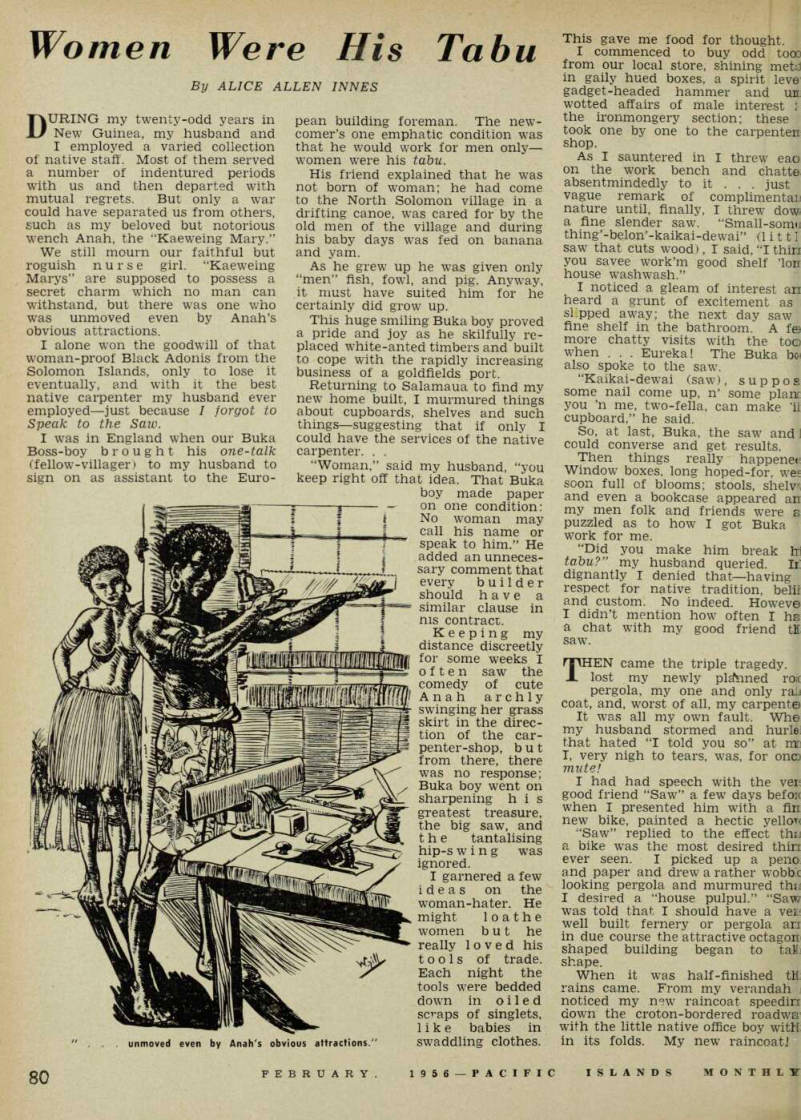
Keeping my distance discreetly for some weeks I often saw the comedy of cute Anah archly swinging her grass skirt in the direc tion of the car penter-shop, but from there, there was no response; Buka boy went on sharpening h i s greatest treasure, the big saw, and the tantalising hip-s wing was ignored.
I garnered a few ideas on the woman-hater. He might loathe women but he really loved his tools of trade.
Each night the tools were bedded down in oiled scraps of singlets, like babies in swaddling clothes.
This gave me food for thought.
I commenced to buy odd tooo from our local store, shining met:f in gaily hued boxes, a spirit leve 1 gadget-headed hammer and un; wotted affairs of male interest i the ironmongery section; these took one by one to the carpenten shop.
As I sauntered in I threw eao on the work bench and chatte absentmindedly to it . . . just vague remark of complimentau nature until, finally, I threw dowv a fine slender saw. “Small-soma thing’-belon’-kaikai-dewai” (1 i 111 saw that cuts wood), I said, “I thin you savee work’m good shelf ’lon house washwash.”
I noticed a gleam of interest an heard a grunt of excitement as sipped away; the next day saw fine shelf in the bathroom. A f© more chatty visits with the too when . . . Eureka! The Buka bo< also spoke to the saw.
“Kaikai-dewai (saw), sup p o s some nail come up, n’ some plane you ’n me, two-fella, can make ’ii cupboard,” he said.
So, at last, Buka, the saw and j could converse and get results.
Then things really happened Window boxes, long hoped-for, wee soon full of blooms; stools, shelve and even a bookcase appeared an my men folk and friends were s puzzled as to how I got Buka work for me.
“Did you make him break hi tabu?” my husband queried. Ii dignantly I denied that—having respect for native tradition, belii and custom. No indeed. Howev© I didn’t mention how often I hs a chat with my good friend tM saw.
THEN came the triple tragedy, lost my newly planned roic pergola, my one and only raii coat, and, worst of all, my carpent© It was all my own fault. Whe my husband stormed and hurleJ that hated “I told you so” at mn I, very nigh to tears, was, for ono mute!
I had had speech with the ven good friend “Saw” a few days befox when I presented him with a fin new bike, painted a hectic yellow “Saw” replied to the effect thn a bike was the most desired thin ever seen. I picked up a peno. and paper and drew a rather wobhc looking pergola and murmured thu I desired a “house pulpul.” “Saw was told that I should have a veie well built fernery or pergola an in due course the attractive octagoni shaped building began to taHj shape.
When it was half-finished til; rains came. From my verandah j noticed my new raincoat speedin down the croton-bordered roadws with the little native office boy with: in its folds. My new raincoat!
unmoved even by Anah's obvious attractions."
jailed sharply to Anah, then to ome loitering houseboys under the Kirch. They didn’t, or wouldn’t, leed.
Just then a yellow bike passed roudly by bearing my valued friend, he carpenter. I forgot the tabu nd uttered for the first—and last— ime the sacred name.
“Halil,” I called, “Tell monkey small boy) he no can take ’im oat-rain belong Missus.”
I called in vain! The new yellow ike lay in the mud and the car enter Buka boy sped away to the ash. Next day the Boss-boy came ir his one-talk’s money. Halil, laving his mute saw and a very id “Missus” had fled back to his omanless world.