[?]ay Parer... Still Pioneering
p. 81 · Read in the full issue
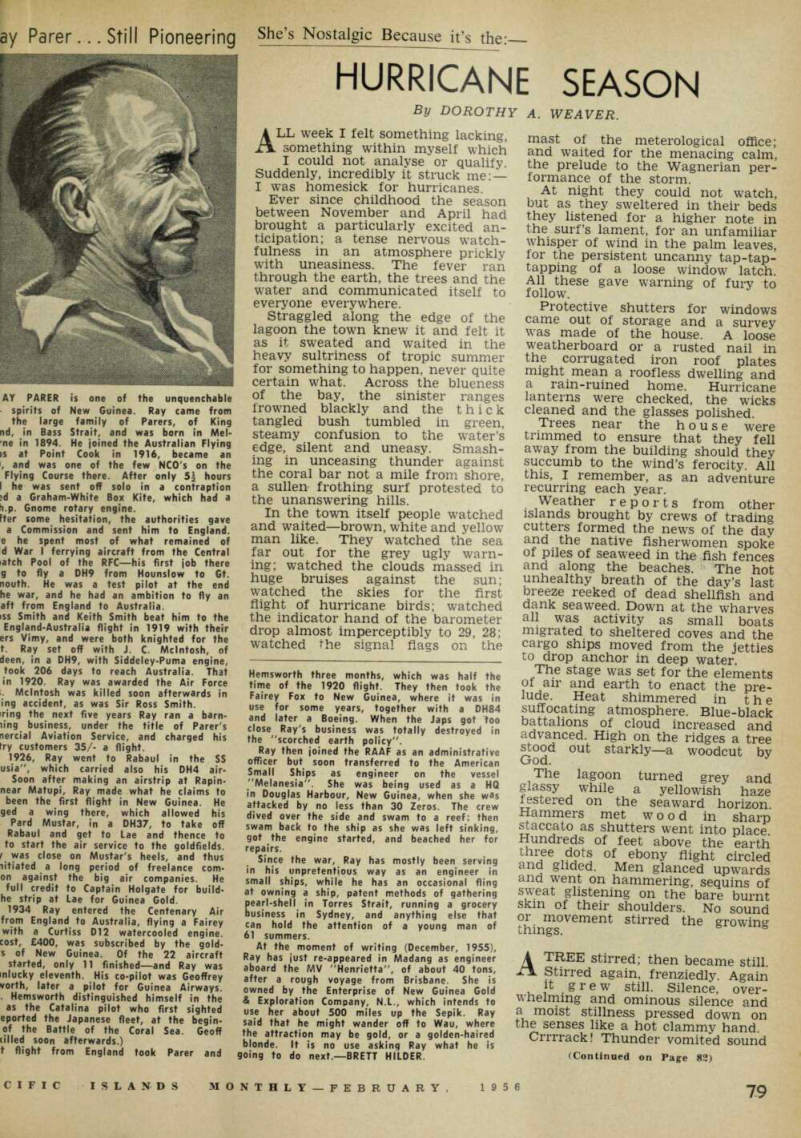
AY PARER is one of the unquenchable spirits of New Guinea. Ray came from the large family of Parers, of King nd, in Bass Strait, and was born in Mel ne in 1894. He joined the Australian Flying is at Point Cook in 1916, became an , and was one of the few NCO's on the Flying Course there. After only 5£ hours I he was sent off solo in a contraption >d a Graham-White Box Kite, which had a i.p. Gnome rotary engine.
Pter some hesitation, the authorities gave a Commission and sent him to England, e he spent most of what remained of d War I ferrying aircraft from the Central iatch Pool of the RFC —his first job there g to fly a DH9 from Hounslow to Gt. nouth. He was a test pilot at the end he war, and he had an ambition to fly an aft from England to Australia, iss Smith and Keith Smith beat him to the England-Australia flight in 1919 with their ers Vimy, and were both knighted for the t. Ray set off with J. C. Mclntosh, of deen, in a DH9, with Siddeley-Puma engine, took 206 days to reach Australia. That in 1920. Ray was awarded the Air Force Mclntosh was killed soon afterwards in ing accident, as was Sir Ross Smith.
Ting the next five years Ray ran a barn ling business, under the title of Parer's nercial Aviation Service, and charged his fry customers 35/- a flight. 1926, Ray went to Rabaul in the SS usia", which carried also his DH4 air- Soon after making an airstrip at Rapin near Matupi, Ray made what he claims to been the first flight in New Guinea. He ged a wing there, which allowed his Pard Mustar, in a DH37, to take off Rabaul and get to Lae and thence to to start the air service to the goldfields. i was close on Mustar's heels, and thus litiated a long period of freelance com on against the big air companies. He full credit to Captain Holgate for build he strip at Lae for Guinea Gold. 1934 Ray entered the Centenary Air from England to Australia, flying a Fairey with a Curtiss 012 watercooled engine, cost, £4OO, was subscribed by the gold s of New Guinea. Of the 22 aircraft started, only 11 finished—and Ray was mlucky eleventh. His co-pilot was Geoffrey vorth, later a pilot for Guinea Airways. . Hemsworth distinguished himself in the as the Catalina pilot who first sighted eported the Japanese fleet, at the begin of the Battle of the Coral Sea. Geoff
tilled soon afterwards.)
t flight from England took Parer and
Hemsworth three months, which was half the time of the 1920 flight. They then took the Fairey Fox to New Guinea, where it was in use for some years, together with a DHB4 and later a Boeing. When the Japs got too close Ray's business was totally destroyed in the "scorched earth policy".
Ray then joined the RAAF as an administrative officer but soon transferred to the American Small Ships as engineer on the vessel "Melanesia". She was being used as a HQ in Douglas Harbour, New Guinea, when she was attacked by no less than 30 Zeros. The crew dived over the side and swam to a reef; then swam back to the ship as she was left sinking, got the engine started, and beached her for repairs.
Since the war, Ray has mostly been serving in his unpretentious way as an engineer in small ships, while he has an occasional fling at owning a ship, patent methods of gathering pearl-shell in Torres Strait, running a grocery business in Sydney, and anything else that can hold the attention of a young man of 61 summers.
At the moment of writing (December, 1955), Ray has just re-appeared in Madang as engineer aboard the MV "Henrietta", of about 40 tons, after a rough voyage from Brisbane. She is owned by the Enterprise of New Guinea Gold & Exploration Company, N.L., which intends to use her about 500 miles up the Sepik. Ray said that he might wander off to Wau, where the attraction may be gold, or a golden-haired blonde. It is no use asking Ray what he is going to do next —BRETT HILDER.