Tropicalities
pp. 79-80 · Read in the full issue
Magazine Section
[Red Of Johnny Pineapple
L SYDNEY newspaper’s broad casting critic recently had this to say on the subject of music om local stations: Tune in to Radio Noumea and you t first-class Tahitian and Wallis land dances. Dial VRH4, Suva, id hear their fascinating tapes of jian taralalas and Samoan sivas.
Yet all that the local stations lich offer Pacific music can give is the tired old commercialised iff of Johnny Pineapple and his ite, Billy Coconut.
Of Australia’S
Gift To P-Ng
* the current year, Australia is making a gift of no less than £8,943,900 to the Territories of pua and New Guinea—in other rds, every man, woman and child the Commonwealth is giving DUt £l/2/- to P-NG.
Australia’s national debt is 749,444,347 —almost equally divided :ween Federal and States’ Gov iments. Of the Commonwealth’s bt of £1,923,717,000, £584,000,000 s incurred for war purposes r orld War I, £134,078,000; World tr 11, 1,444,831,000).
Every resident of Australia there e is in debt for £407 16/2. Of i total debt of £3,749,000,000, no 5 than £3,314,000,000 is owed hin Australia —and most of the ance of £435,000,000 is owed in idon.
Vhat Think You Of This
Writing?
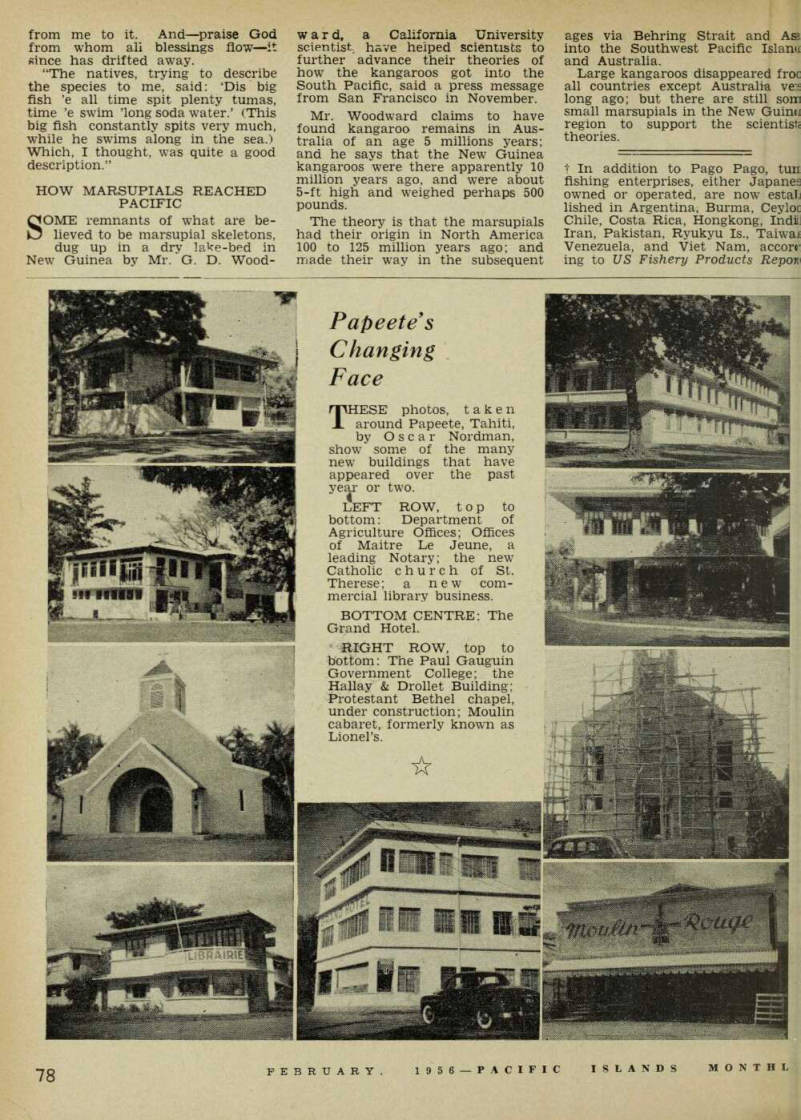
may be remembered that Mitchener, in Return to Paradise, ?ave some space to the work and ds of Fred' Archer, of Buka sage, New Guinea, man named Merle Smedley, of in, Illinois, USA, read the book noted the name of FPA. Next ig, Fred Archer received a letter n Smedley, and thus a corre idence was started. Here is a tographed extract from one of Smedley’s letters:
Nothing remarkable about that, you say—except that the handwrit ing is so neat that it resembles typewriting.
But you are wrong. Merle Smedley is one of those unfortunates smitten by polio, and his arms and hands are paralysed. With indomitable spirit, he has taught himself to write with a pencil held in his teeth!
Thus, he helps pass the weary weeks in discussions with pen friends. Feel like dropping him a note? His address is: Merle Smedley, 803 Park Avenue. Pekin.
Illinois, USA.
The Clock That Chimes
Twice
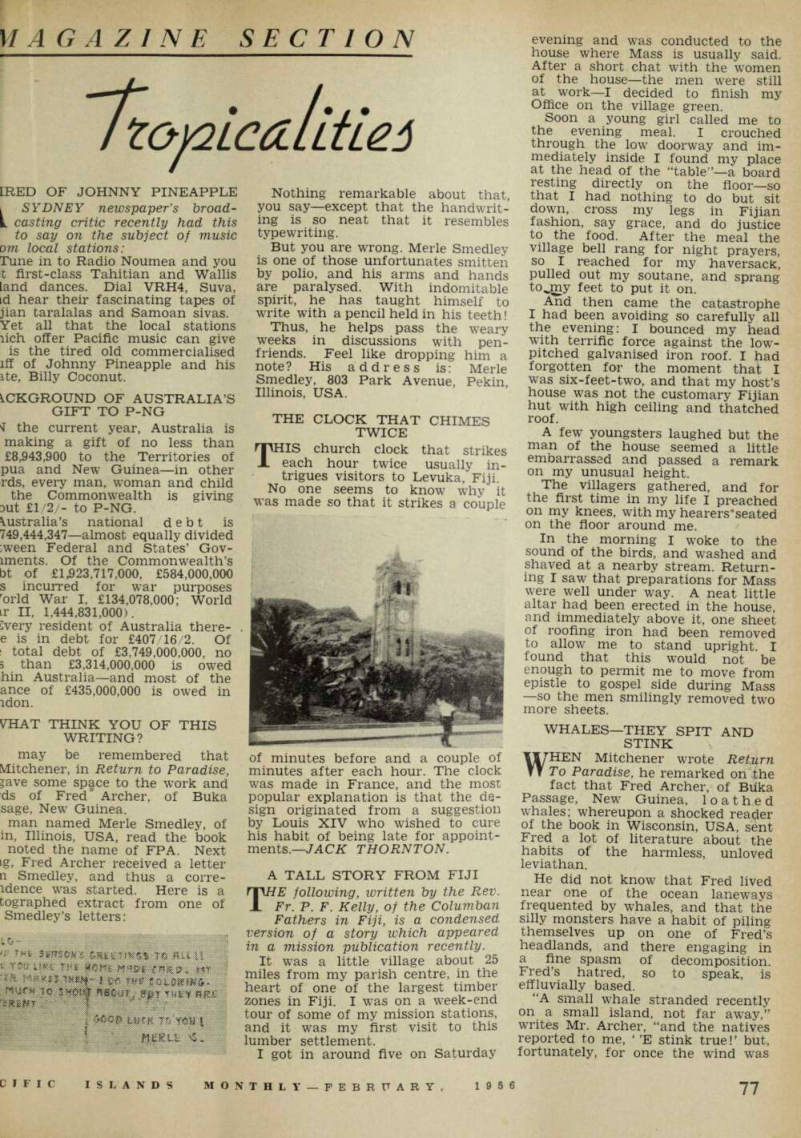
r:iS church clock that strikes each hour twice usually in trigues visitors to Levuka, Fiji.
No one seems to know why it was made so that it strikes a couple
of minutes before and a couple of minutes after each hour. The clock was made in France, and the most popular explanation is that the de sign originated from a suggestion by Louis XIV who wished to cure his habit of being late for appoint
Ments.—Jack Thornton.
A Tall Story From Fiji
riT HE following, written by the Rev.
J. Fr. P. F. Kelly, of the Columban Fathers in Fiji, is a condensed version of a story which appeared in a mission publication recently.
It was a little village about 25 miles from my parish centre, in the heart of one of the largest timber zones in Fiji. I was on a week-end tour of some of my mission stations, and it was my first visit to this lumber settlement.
I got in around five on Saturday
evening and was conducted to the house where Mass is usually said.
After a short chat with the women of the house —the men were still at work—l decided to finish my Office on the village green.
Soon a young girl called me to the evening meal. I crouched through the low doorway and im mediately inside I found my place at the head of the “table”—a board resting directly on the floor—so that I had nothing to do but sit down, cross my legs in Fijian fashion, say grace, and do justice to the food. After the meal the village bell rang for night prayers, so I reached for my haversack, pulled out my soutane, and sprang feet to put it on.
And then came the catastrophe I had been avoiding so carefully all the evening: I bounced my head with terrific force against the low pitched galvanised iron roof. I had forgotten for the moment that I was six-feet-two, and that my host’s house was not the customary Fijian hut with high ceiling and thatched roof.
A few youngsters laughed but the man of the house seemed a little embarrassed and passed a remark on my unusual height.
The villagers gathered, and for the first time in my life I preached on my knees, with my hearers*seated on the floor around me.
In the morning I woke to the sound of the birds, and washed and shaved at a nearby stream. Return ing I saw that preparations for Mass were well under way. A neat little altar had been erected in the house, and immediately above it, one sheet of roofing iron had been removed to allow me to stand upright. I found that this would not be enough to permit me to move from epistle to gospel side during Mass —so the men smilingly removed two more sheets.
Whales—They Spit And
Stink
WHEN Mitchener wrote Return To Paradise, he remarked on the fact that Fred Archer, of Buka Passage, New Guinea, loathed whales; whereupon a shocked reader of the book in Wisconsin, USA, sent Fred a lot of literature about the habits of the harmless, unloved leviathan.
He did not know that Fred lived near one of the ocean laneways frequented by whales, and that the silly monsters have a habit of piling themselves up on one of Fred’s headlands, and there engaging in a fine spasm of decomposition.
Fred’s hatred, so to speak, is effluvially based.
“A small whale stranded recently on a small island, not far away,” writes Mr. Archer, “and the natives reported to me, ‘ ’E stink true!’ but, fortunately, for once the wind was
from me to it. And —praise God from whom all blessings flow —it since has drifted away.
“The natives, trying to describe the species to me, said; ‘Dis big fish ’e all time spit plenty tumas, time ’e swim ’long soda water.’ (This big fish constantly spits very much, while he swims along in the sea.) Which, I thought, was quite a good description.”
How Marsupials Reached
Pacific
SOME remnants of what are be lieved to be marsupial skeletons, dug up in a dry lake-bed in New Guinea by Mr. G. D. Wood
ward, a California University scientist have helped scientists to further advance their theories of how the kangaroos got into the South Pacific, said a press message from San Francisco in November.
Mr. Woodward claims to have found kangaroo remains in Aus tralia of an age 5 millions years; and he says that the New Guinea kangaroos were there apparently 10 million years ago, and were about 5-ft high and weighed perhaps 500 pounds.
The theory is that the marsupials had their origin in North America 100 to 125 million years ago; and made their way in the subsequent
ages via Behring Strait and Asa into the Southwest Pacific Islami and Australia.
Large kangaroos disappeared froc all countries except Australia ve:s long ago; but there are still som small marsupials in the New Guinn region to support the scientist theories. t In addition to Pago Pago, tun, fishing enterprises, either Japanea owned or operated, are now estab lished in Argentina, Burma, Ceyloc Chile, Costa Rica, Hongkong, IndiJ Iran, Pakistan, Ryukyu Is., Taiwan Venezuela, and Viet Nam, accorr ing to US Fishery Products Report*