In Papua-New Guinea
pp. 43-122 · Read in the full issue
[?]renl News Items From Our Correspondents In Papua-New Guinea
Ises For Swimming Pool
)out £1,200 went to the fund for ling an Olympic Swimming Pool Port Moresby as the result of a essful race meeting held at »ko Reserve on January 2. ie meeting, at which 30 horses was conducted by a committee nised by the Port Moresby ich of the RSL. ie meeting, started late and a small crowd saw the first one vo races. Early it seemed that meeting might be a “flop” but temperature dropped a little the crowd started turning up g numbers. tote operated on all six races small dividends on the first two hree races encouraged most le to invest on a 5/- sweep con ;d on each race. It paid £2l ie first race and prizes increased the last race, when £lOO went e holder of the winning ticket, e organisers may conduct a id meeting.
[Ve Boy Dies From Snake
Bite
Dplies of anti-venom serum rushed to Rigo from Port sby during the New Year holi but arrived too late to save
the life of a native who was bitten by a Tiger snake.
An urgent request for the serum was made to Port Moresby when the entire supply at Rigo had been used on the native. This was sent by boat to the area but the native died before it arrived.
T*e P-NG Acting Director of Health, Dr. Alec May, said this week that supplies of the newly-developed serum to counteract Taipan venom had been ordered by the Depart ment.
Testing Buka Natives For
TB The entire native population of Buka Island has now been tested for TB as part of the P-NG Health Department’s campaign against the disease.
Other sections of Bougainville district where tests have been carried out include the Southern part of that island and the Kunuai District.
A Departmental Medical Officer, Dr. Randmae, who carried out earlier tests at Buka, is expected to visit Central Bougainville shortly.
All native children under the age of five giving positive reactions are to be given active TB treatment.
A large X-ray plant is to be in stalled at Sohano and the plant at present at Sohano will be trans ferred to Buin.
Village Councils For
Bougainville?
Natives on Bougainville are being prepared for local Government. It will be established first at Buka.
Before the Local Councils are in augurated, a Native Local Govern ment officer and native leaders from
Rabaul will visit the district.
Native leaders at Buka will later go to Rabaul to study Local Gov ernment at that centre. (Presumably our correspondent means Village Councils —w hi c h Tolala (PIM, January, 1956, page 28) said were not regarded favour ably by the Bukas).
Epidemics At Samarai Aj
Morobe
A measles epidemic broke oin Samarai, in January, and 8 cd had been reported up to the mil of the month. Authorities on .
Island are considering enforn Quarantine restrictions if the six tion becomes -any worse.
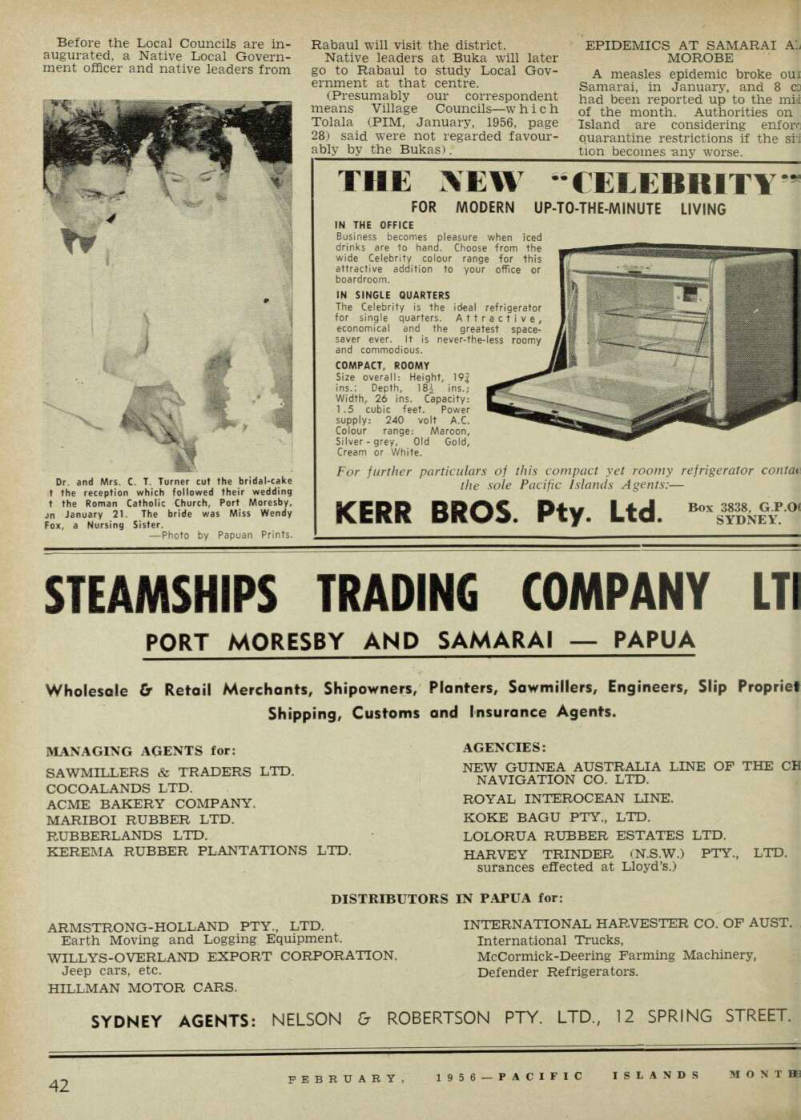
Dr. and Mrs. C. T. Turner cut the bridal-cake [?] the reception which followed their wedding [?] the Roman Catholic Church, Port Moresby, [?] January 21. The bride was Miss Wendy Fox, a Nursing Sister. —Photo by Papuan Prints.
IVbout the same time an outbreak whooping cough and measles was jorted from the Sio area of New linea, in the Morobg district. ;t is known there are at least 47 jitive cases of whooping cough i 7 cases of German measles, [he whole area has been quaran ed and Administration officials ve taken charge.
\Bour From The Western
Highlands
in extension of the existing stern Highlands labour scheme to Western Highlands of New inea was announced on January y the Director of Native Affairs, A. Roberts.
Ir. Roberts said that preliminary angements were nearly finished. ien the scheme started, natives ng in the Western Highlands who hed to work under agreements areas outside the Highlands ild be given the necessary iical examination in their own ricts. If they were found fit, Administration would arrange their air-transport to Goroka, ;re they would become part of Labour Pool available to em bers throughout the Territory. [r. Roberts said that employers ild be required to meet the cost transporting Western Highlands >ur to Goroka and later back to r villages and must also pay the nal handling fee.
Inefficient Medical
Lamination Of Recruits
eanwhile, more thorough medical nination of recruited native »ur was being sought by the r Britain District Advisory Coun it its January meeting, ne member of the Council said ; carelessness on the part of Leal officers who examined native ur, and officers who issued the ves with equipment, were caus unjustified expense to New ain plantation owners. He ed a recent case where a native was passed as fit by an Admin ition Medical Examiner on the Guinea mainland, was found ave leprosy when he arrived at ew Britain plantation. Planta owners must pay recruitment mses in such cases although the t lay with the MO. milar situations occurred with ament issued on the New Guinea aland. In some cases, it was ed by authorised officers there condemned on reaching New ain. he Administrator said on Jan. hat claims for reimbursement d “certainly be considered.”)
Tensions To Lae School,
At Last
ork started—and not before
—in mid-January on extensions
le primary school at Lae. iere will be two new badly ed classrooms and a storeroom,
n is nopea.
Native Pastor Goes To
India
For the first time, the Lutheran Mission of New Guinea has sent a P-NG native delegace co an important overseas conference—in South India.
The native is Pastor Mileng Sei of Madang, and he will represent the Lutheran Church of New Guinea at the 250th anniversary of the arrival of the first Protestant Missionary in India.
In addition, Pastor Mileng Sei. in company with the Rev. Gerhard Rheitz, of Lae, will attend the All-
of the first Indian Lutheran Bishop.
Inspection Of War Graves
The Vice-Chairman of the Im- P er . ial War Graves Commission, Air Chief Marshal Sir Arthur Long- H lol ’ 6 - will make an official inspec tion of War Cemeteries in Papua- New Guinea late February.
The . Secretary-General of the Commission, Brigadier A. E. Brown, will accompany him. 0 T h o y ar e due in Lae on February ir \ Rabaul - on 22nd, and Port Moresby on February 23.
More Peeping Toms In
Rabaul
Police in Rabaul have been asked
intensify night patrols in the m and to restrict the unauthor d movement of natives after •few.
This follows a complaint to the tvn Advisory Council by the haul Parents’ and Citizens’ Asso
ciation, claiming that natives were disturbing Euro pean women and that there have also been numer ous cases of “Peeping Toms.”
The Association also complained about delays in contacting " the Police Station by ’phone.
A letter for warded by the Ad visory Council to the District Com missioner asked for strong repre sentations to be made to have
more European police officers posted to Rabaul.
Lae Must Stick To Town
Plan
The P-NG Administrator, Brig.
D. M. Cleland, on January 12, re
affirmed the intention of the Ad ministration to proceed with the town planning of Lae along the lines announced previously.
These plans call for development
Miss Helen Wan, of Lae, New Guinea was married at the Rabaul Methodist Church on January 14, to Mr.
Donald Chow, of Rabaul.
Bridesmaid was Miss Betty Lee; best man, Mr. Joseph Chow. —Photo by C. H.
Meen.
on “The Terrace” and abandonment of the “Flat” area so far as residential and business premises are concerned, except for existing tenures.
Brigadier Cleland said that new administration offices appropriate to the town’s importance would be erected on The Terrace as soon as possible. When the old European Hospital went out of use, the site would be re-designed and made available to the public for com mercial undertakings.
He continued: “Existing licences on The Flat will be renewed when necessary but the erection of any further buildings or extensions to existing buildings will not be per mitted. No transfers of licences will be allowed and no new licences will be issued. When a licencee per manently vacates the site he holds, the Administration, as an act of grace, will pay compensation based on the knock-down value of any improvements. This compensation will be assessed according to the value to the Administration of the materials on a second-hand basis.”
The Administrator said that Old Chinatown would not be re-designed, and instead, the Administration in tended to develop the Didyman’s Creek area.
He added that when the present aerodrome facilities were removed to Malahang, the existing aerodrome site would be used for parks and
green areas and for recreation grounds.
In the meantime, in order to enable effective building and other controls, all areas within the town not as yet zoned would be declared “residential.”
Meanwhile, Lae’s new business
and shipping area is expandii. rapidly.
Most of the building sites in t!: firea now have buildings in variox stages of construction, and a ne road from Ninth Street to Fourj Street is nearing completion.
Last year saw many of the Eurj
ean and Chinese stores move from le old shopping area up to the ew centre.
Lae’s residential area is also de eloping rapidly, both on the plateau rerlooking the old town area and in le sub-division near the Golf curse. (The implication of the above sems to be that if, for example, [rs. F. Steward, owner of the new otel Cecil on the Flat, wishes to 11 out, she cannot. Lae’s town lan, with which the community has ;en burdened since directly after le war, has caused a great deal ' heart-burning. The idea of mov g the town—the old town of Lae as completely wiped out during the ar —to the plateau above the fore mre was a good one. But there as so much delay and argument the early post-war years that any people, in desperation and a ?sire to get on with something, lilt in their previous locations »wn on the Flat. Mrs. Stewart was le of these—and is said to have ent about £lOO,OOO on her estab ihment; there are also many hers, including some charming »mes down towards the wharf area, metheless, the tendency has been r even those who went back to e Flat right after the war to re ave to the Terrace in later years.
Ed.)
Ant To Buy A Plantation?
Tha Territory Custodian of Ex- Property is currently in :ing applications from ex-service sn only, for the purchase of some freehold plantation properties in ;w Guinea.
Pen of the properties are in the Jw Ireland district, seven at anus, one at Morobe and one at idang. (See advertisement this ue).
Prices range from £4,300 to nearly 5,000.
The plantations are all former ;rman properties which were sold der contract by the Custodian :er the first World War but which :er reverted to him.
Phe P-NG Director of Lands, Mr.
Tnnes, said on January 12, that rticulars as to the conditions of e of the properties could be tained at District Offices at ivieng, Rabaul, Lorengan, Madang d Lae and at the Lands Office Port Moresby. loweyer, would-be planters should reminded that this is not just a aight-out property buying deal, ey will have to state on their plications that they are willing to 3ept the properties with all faults, any; and appear before the Land ard and prove that they have the cessary financial resources and table planting experience. [n addition, 5 per cent, of the ping price must go with the appli ;ion. If successful, another 5 per it. must be paid within a month
of'-the Custodian’s acceptance: and the balance paid off before June 30 1975.
Native Apprenticeship
Scheme Gets Going
The P-NG Native Apprenticeship Board was told at a meeting in Port Moresby on January 10 that one Territory Company with headquart ers in Port Moresby was planning to train up to one hundred apprentices. Most of the apprentices would be for the various engineering trades.
At its meeting, the Board stressed that although it welcomed such large applications from the bigger employers, the smaller firms and in dividuals requiring only one or two
apprentices received the same at tention and assistance from the Officers implementing the Scheme.
Local Councils—Taxes And
All
To the pleasure of some Advisory Councils in Papua and New Guinea, it was announced in Mid-January that a local Government survey would be made in the Territory later this year by a former Officer of the Queensland Local Government De partment, Mr. J. R. Winders.
Mr. Winders is now secretary of the Queensland Sugar Board.
He will examine conditions in the larger towns of the Territory to pre pare submissions on proposals for and against the introduction of
Local Government, and secondly, tic type of Administrative machines essential if it was thought that som form of local Government shouu be introduced.
During the survey, Mr. Windea will visit Port Moresby, Rabaml, Ls Madang and Wau.
Until recently Mr. Winders wv chief clerk of the Queensland Loo Government Department and base wide and practical knowledge Local Government organisation.
Making the announcement til week, the P-NG Administrate Brigadier D. M. Cleland, said M Winders was selected for the as it was thought that the condi tions in the coastal towns of Queenr land provided the nearest compan son with those in Territory centres; Brigadier Cleland said the quests of establishing some form of Loo Government had been raised ( several occasions by certain Terr tory Advisory Councils, and thf the survey to be made by M Winders will give the Administr* tion and Territory residents con prehensive information on which judge the advisability or otherwii of introducing Local Government the larger Territory centres.
Following this announcement, tic Chairman of the Port Mores!; Town Advisory Council, Mr, E.
James, said he believed Local Got ernment would mean better service to the public of the Territory ths those currently provided.
However, Local Government worn mean rates and taxes in lieu of tl charges currently made for wate. electricity, sanitary and other see vices. These would be taken ovv and controlled by an elected Muir cipal Council instead of at preseK by the Administration.
Bringing Them Under
Control
The Director of Native Affair Mr. A. A. Roberts, says he believe that there are no natives in tic Territory who do not know of tl; existence of the Administration, dt spite the fact that there is nean 26 thousand square-miles in Papr and New Guinea still regarded restricted country.
Mr. Roberts said on January that the whole of the Territory hr been penetrated by patrols with tic exception of some small pockets.; The Department’s future pn gramme would be one of expansio and consolidation of Administrate influence of the areas penetrateo Mr. Roberts pointed out that tld vast portion of the remaining n stricted areas was either in populated or sparsely populate Practically the whole of it w> mountainous.
He said Administration patre would visit these areas as soon an as often as possible. In due coun
(Continued on Page 115)
they would be regarded as being under full administration influence.
This was when an unarmed native Police constable could be sent into the area to arrest an offender and return safely to base.
He added: “In some cases, you can’t do this in parts of Australia.’"
Mr. Roberts said that in the re stricted areas it was necessary for a non-native to have a permit to enter. This was to protect the per son himself as well as the natives of the area.
Natives Build Roads And
Bridges
A 120-ft bridge on the road from Finschhafen to Lae was officially opened this week.
The bri d g e—built by Wabim natives—crosses the Kwalamsam river and opens up the Busiga area.
Meanwhile the primitive Kuku
Mr. Colin Sefton, of Koitaki, accepts a trophy (letter-box or cuckoo-clock?) from P-NG Assistant Administrator Wilson at the conclusion of the race-meeting held in Port Moresby on January 2. Proceeds went to the local swimming-pool fund. —Photo by Papuan Prints.
kuku natives in the Menyamya area of the Morobe District have con structed 20 miles of roads in the vicinity of the Menyamya patrol post.
The long range plan is for the construction of a road to go through to Bulolo, a distance of about 50 miles.
Giving Their Blood
More than 200 Europeans and 250 natives were registered as blood donors with the Red Cross Blood Transfusion Service in Port Moresby at the beginning of January, but more were urgently wanted. Following this appeal, more than two hundred people, the majority of them natives, registered
with the Red Cross in Port Moit on two days in mid-January.
Steamships Trading Comp? made part of their main showroc available to the Red Cross to reo donors.
Figures show that 220 calls ; blood were made by doctors at c European and Native Hospitals!
Port Moresby last year. In Decern alone, 38 calls were received.
Ambitious Plans Of Rse
Three important resolutions pai by the Rabaul Branch of the I will be on the agenda at the SE Congress meeting of the Les which will take place in Lae es this year.
The resolutions were passed] the Annual General Meeting of: Branch in mid-January.
They deal with the recently nounced sale of expropriated ] perties in the Territory; land set; ment; and a request to the C: monwealth Government to an the Territory of New Guinea. n resolution also asks the Comnr wealth Government to approach!
Dutch on the question of Austn taking over the development administration of Dutch New Gui
Acting Ps Commissioned
A former Chief Electoral Oft and Commonwealth Public Sen Inspector, Mr. Eric Dwyer, reao Port Moresby in January as Ac: Public Service Commissioner, relieves Mr. T. A. Huxley, whi at present on leave.
The Acting Public Commisshi is 38, and has spent 19 years inj Commonwealth Public Service.
Clan Cameron Welcome ()
Style) For Lord Rowall.
Native troops of the Paf Islands Regiment drawn up onj apron of Jackson’s Airstrip in I Moresby on January 17 provide colourful start to a 12-days’ tout Papua and New Guinea by Empire Chief Scout Lord Rowal The tall, erect Chief Scout welcomed to the Territory, asa stepped from the Qantas airc:: by the Administrator, the Assist Administrator and Scouting office Lord Rowallan was pleasantly ; prised when he noticed that the H pipes of the PIR Pipe Band v draped In the tartans of his els the Cameron clan.
Lord Rowallan had only about] hour in Port Moresby before fI:J on to Lae. He went to RabauL 18th and later to Madang Goroka before returning to I Moresby, where he spent some dfc
Daru’S Successful Socii
Club
Some idea of the general progi of the non-European population Daru is seen in a report to-day t natives there are taking dami lessons—European style.
Classes are held twice weekly the recently formed Western 6
3aru and there is a formal dance e a week. Europeans may at d.
The Club was formed principally for non-Europeans (natives and people of mixed descent) and
already has a membership of nearly 200. Plans are In hand to raise £l,OOO to put up a club-house. At present, dances and dancing lessons and other recreational activities are being held in the new school build ing at Daru.
From membership fees, the Club has already purchased a radiogram and is now buying an additional stock of records. (Over)
Miss Tereasa Ng, of Rabaul, was married recently at Rabaul to Mr. Robert Ngan The [?]al party is shown here, with bride and groom in centre, Mr. Thomas Chow, the best man, [?]hown standing next to the bridegroom; and Miss Alice Shan, the bridesmaid, is next to the [?] The Rev. Father Dwyer officiated at the ceremony in the Rabaul Catholic Church —Photo by C. H. Meen.
fhe Acting District Commissioner, . A. C. Jeffries, and the Education Eicer, Mr. H. Bitmead, assisted in j formation of the club, which is >orted to have aroused great in est among the non-European iple in the area.
Die general progress of the non ropean population of Daru is iwn by the fact that four students m that area have secured Native lolarships for secondary school ication in Australia. Two were arded this year, another student now starting his third year of lolarship study in Australia, and fourth is commencing his second ar. The third-year student, trick Samson, who is a member the Charters Towers Thornburge liege school cadet unit, was ected for an NCO course, and is v in an army camp in the Bris le area undergoing this training.
Club for natives was recently med in Goroka, Eastern High ds. Its primary purpose is to pro e a social meeting place for ;ives from other parts of the terri y who work in the Eastern High ids —Papua and New Guinea car iters, drivers, medical orderlies, reman, policeboys, etc. There are present 270 members and member p is expected to increase rapidly.
Tie club house is a European-type Iding, equipped with kitchen, nmonroom and canteen. Members ct their own president, secretary, asurer and 10 committee mem s, who work under the guidance Assistant District Officer Mathie i.
Ustees For The
New Art Gallery
Die names of the Trustees of the pua and New Guinea Public seum and Art Gallery were an mced in Port Moresby on mary 20.
Tiey are Mr. Justice Bignold and
Mr. E. A. James, both of Port Moresby; Mr.
Robert Bunting, 0 f L ae • George Greathead, of Goro k a; Mr.
Ronald Galloway, 0 f Rabaul; Mr.
Charles Julius the A d m i n i s tration a n t h r o pologist,
At Left: Miss Maria Gorogo, a prominent Girl Guide leader in Port Moresby, was married at the IMS Church, Pari, on January 14, to Mr. Morea Pako. - Photo by Papuan Prints .
Below: Natives of Rabaul too, like European-style weddings. This photograph was taken in December when M. P. Paulias married Lavima. The two bridesmaids are L. Luia and M. Yakurai. —Photo by C. H. Meen.
and Miss Ruth Carter, the Principal Librarian of the Administration.
The appointments are for five years.
A President will be appointed by the Administrator after the first meeting of the Trustees, which is to be held shortly. (So far, of course, there is no building for the Museum- Art Gallery.
Foreign Mission May
Become Church
The Lutheran Mission in Papua- New Guinea might soon cease being a foreign mission and assume the status of an independent unit of the Lutheran Church. . It is estimated that there are 130,000 native adherents of the Lutheran Church in P-NG and some Lutherans believe that the time has come for the natives to run their own religious aaffirs.
A Theological Seminary in the Territory for training native clergy w : ould follow the establishment of a church.
The President of the American Lutheran Church, Dr. Henry Shoe, and the Director of Finance, Dr.
George Schultz, are at present visit ing the Territory for discussions with local Lutheran Missionaries.
2,000 Sydney-Siders Rang
Moresby
In the 12 months to the 31st of March, 1955, 2,000 radio-telephone
calls from Sydney were received in Port Moresby; in the same period, 1,033 calls were made from Port Moresby.
As a result, an evening session, from 7 to 8 p.m., Mondays to Satur days, has been added to the after noon and morning schedules, A radio-telephone service from Rabaul to Sydney also operates— but it will not have the extra even ing service.
Native Miners In The
Money
Several hundred pounds worth of gold is being mined each month by natives working in the Watut River, in Morobe. This was a well-known alluvial area for European mining before World War 11.
Native miners in the Kainantu area of the Eastern Highlands won about £lO,OOO worth of gold last year.
There was no native mining before the war. Possibly, they (as were the Chinese) were specifically excluded from the industry except as labourers.
In any event, they appeared not to be in the slightest degree interested.
Miners Against Paper Work
The recent regulation that requires all miners in P-NG to make monthly returns was heatedly debated at the January meeting of the Morobe Dis trict Advisory Council.
It was declared to be quite inl
necessary and a burden on the smsj mining community. The Cournr passed a resolution asking thr monthly returns be discontinued favour of yearly returns.
A Second Radio Station
The Administrator of Papua an.
New Guinea will recommend to CaiJ berra that a second Governme:s Broadcasting station be establish*! in the Territory.
However, this does not mean thr the station —if Canberra can briu itself to agree—will be in Rabaul : suggested by the New Britain Ao visory Council which brought tl: matter to the Administrator’s notio.
But the Administrator thinks thr it should “be in New Guinea.”