Editorial. ..
pp. 19-20 · Read in the full issue
The Tax-Gatherer’S Eye On New Guinea?
HERE is no perceptible ground for it —but the feeling is grow ing stronger that the Australian mmonwealth Government is giv : serious thought to the possibility imposing taxation on Papuan and vv Guinea incomes as from ly 1, 1956. rhere are some powerful reasons y the present system should not disturbed. Probably, the most :ent is the position of the Public ■vice. It scarcely would be pos le to tax the incomes of the non cial classes, while letting the )lic servants run free; yet any im upon public servants by the -gatherer would make even more rny the now very thorny blems connected with Public vice salaries. laybe, the Australian overlords 1 go after the “tall poppies” only le incomes of some individual nters who have done very well eed since the war, and who are used of not putting back into the ntry a fair proportion of what y have taken out, and the profits the companies—and leave un shed the incomes of the smaller i and the salaries of the public r ants. ; would not be easy to draw a of demarcation, however. All , and other practical difficulties ch come to mind, probably will lit in the cruel decision being :poned. But, in this time of n and prosperity, the people of Dual Territory always are in ger.
E often are told that, human nature being what it is, the human being generally will act l certain way, in given circum ces. That is even more true of ticians. scently, in Australia, eight pro lonal economists issued a state t, urging higher and higher tion as one means of curing the itionary ills from which Aus a is suffering. The simple souls med apparently that the huge anal funds thus created would aved up—used for the reduction ae national debt, presumably. A sand jeering critics immediately lenged the eight professors: Did really think that any gang of icians would have the strength ind to hold on to surplus funds, not spend them on vote-catch enterprises! le huge sums circulating in la and New Guinea—from Aus a’s £9,000,000 grant, from the 3arch companies’ expenditures,
and from the sale of the Territories’
ow ? are being
watched with liveliest interest by the politicians, and by the Govern mental bureaucrats.
The politicians always are happy to see a new field of taxation open mg up; and the judgment of most bureaucrats often is coloured by their instinctive dislike of the pri vate enterprise man who is making k ‘lom ”f° re mone y than the ouieauciai.
NON-official Territorians, since the war, have divided themselves into two classes—those who are making good profits, and are stay-
S"" Ss
part of their profits into the country; and those who have simply thanked the high gods for fortune’s favours and taken up their residence in a softer clime, and carefully removed all their surplus income from the Territories.
Canberra takes a dim view of the latter class. Canberra, for examnle points somewhat viciously at times at the- wealth-producing coconSt plantations which have undergone little or no new planting for a couple of decades, while the funds which should have gone into new
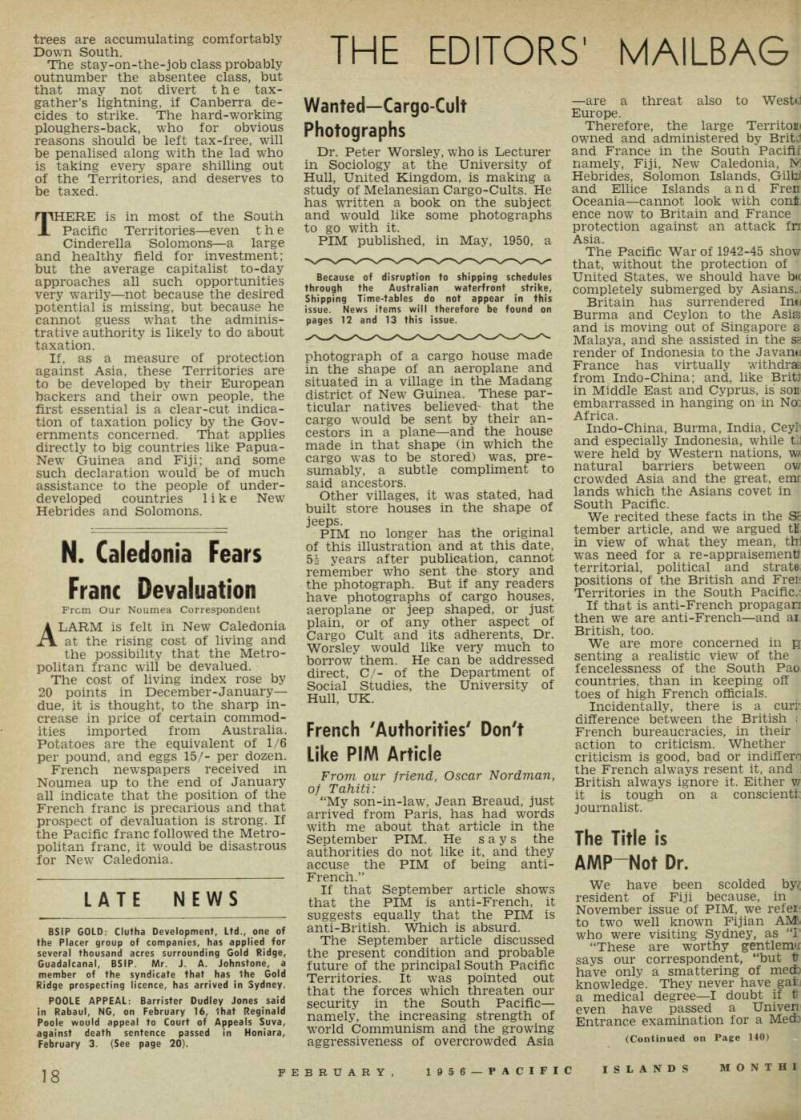
THE DUTCH BOY: Look, Aussie, if you really want to play in his backyard, please say so. But I’ve been holding on here all this time because we thought you wanted someone dependable at your back door. Why don’t you make up your mind! (Consternation has been expressed in Dutch newspapers—while Communists and Indonesians chortled openly—because Australian Minister Casey has been exchanging messages of goodwill, friendship, mutual confidence, etc., with the same Indonesian Government that is howling con stantly for possession of Western New Guinea ... However, The Netherlands lately has been showing an eagerness to hold West New Guinea as much for its own sake as for Australia's.
It is reported that "new and promising supplies of oil, nickel and uranium have been discovered in Dutch New Guinea".)
trees are accumulating comfortably Down South.
The stay-on-the-job class probably outnumber the absentee class, but that may not divert the tax gather’s lightning, if Canberra de cides to strike. The hard-working ploughers-back, who for obvious reasons should be left tax-free, will be penalised along with the lad who is taking every spare shilling out of the Territories, and deserves to be taxed.
THERE is in most of the South Pacific Territories —even the Cinderella Solomons —a large and healthy field for investment; but the average capitalist to-day approaches all such opportunities very warily—not because the desired potential is missing, but because he cannot guess what the adminis trative authority is likely to do about taxation.
If, as a measure of protection against Asia, these Territories are to be developed by their European backers and their own people, the first essential is a clear-cut indica tion of taxation policy by the Gov ernments concerned. That applies directly to big countries like Papua- New Guinea and Fiji; and some such declaration would be of much assistance to the people of under developed countries like New Hebrides and Solomons.