[?]Llagers Money-Conscious
pp. 109-113 · Read in the full issue
[?]But Necessary Development
[?]Ey Are Making The Fijian
By R. W. Robson
NTIL recent years, the European administrators of Fiji left the Fijian natives alone in their ages. he Fijians were perfectly happy leir bountiful land gave them anuts and fish, fowls and vege les and pigs; and they could tnselves manufacture by hand all y needed in the way of shelter , clothing. here was no place in their age economy for money—the tokens ised by Westerners for the ing and distribution and use of ngs, or accumulated credit, ow, under the urgent drive of :ialdom, all that is being nged. The Fijians are being ?ht to save and borrow, to work jer and harder so that they r earn the money wherewith to the goods which represent an nsion of their domestic needs. 11 idealists ask savagely why has been done. Why not leave Fijians—and other happy, Die folk —undisturbed in their tges? So far as Fiji is con ied, here is the answer, in five 3! iar Fijians Indians 01 .. .. 94,937 17,105 21 .. .. 84,475 60,634 38 .. .. 99,595 89,333 46 .. .. 118,083 120,414 55 .. .. 130,000 150,000 le Indians, active individualists, outbreeding and outnumbering Fijians; and, if the latter inue to live together in itionless communities under lal chiefs, they inevitably will ;übmerged and exploited. ) save the Fijians, the Govern t has prescribed less feudalism more individualism. Instead of ng in the shade of the village dfruit tree, the Fijians must iut and work. mce —among other things—the Credit Union. i RONALD GARVEY—likely to become notable as the first Governor to tackle the Fiji munal problem in a practical, a-to-earth fashion —introduced idea of village saving and ding. hile Governor of British duras, he had noticed the irkable success of the work of atholic missionary, Father M. ey, who had introduced the nanic-American Credit Union and thus had created among ble village folk an organisation
for financing the needs of individual villagers through funds created by the villagers’ own thrift and savings. Thus, he had raised their standard of living.
The Governor thought that such a system, applied to Fijian villages, might hasten not only a greater measure of individualism, but also a psychological change and a new standard of living. He wrote forth
with to the Roman Catholic Bishop in British Honduras.
“Sorry,” replied the Bishop.
Father Ganey’s work here is too valuable—he can’t be spared.”
But His Excellency is a tenacious man. No one knows how or why —but in November, 1953, Father Ganey arrived unobtrusively in Fiji, and quietly settled down to work.
Little was said about him, because this Union is not a Government instrumentality. I do not know how he is sustained—but, after an inspection, I think the Fiji Govern ment would regard him as cheap at £lO,OOO a year.
He was assisted, in an effective and practical way, by a local com mittee, which included Messrs. J.
N. Falvey, R. M. Major, B. J.
Smith, L. Whysall, R. Steele, Connolly, J. Amputch, R. L. Gribtfi F. E. M. Warner and Ratu Jose Naisara.
Up to September 30, 1955—t1: is, within 18 months —Father Gan. has formed 135 Fiji village Cr© Unions (with a membership of oc 15,000) which have saved £50,0 and have loaned out a total £92,267. About £51,000 has bee repaid, and loaned out again.
A BACK-STREET shop in Svl has been converted into i Credit Unions’ head offl Here, Father Ganey introduced to a half-dozen educated you Fijians, keeping a formidable seti ledgers. I was allowed to inspq the accounts of a dozen villsJ Credit Unions.
And there was the story, in pH figures. That £50,085 was built i of sums contributed weekly by Unions’ members sums rang* from 1/- to 5/- per week, 1 mostly 1/- and 2/-.
Each village retains its own fui Each fund is managed by a sra committee of villagers. Each co mittee deals with applications loans; makes the decision to leij and then sternly polices the rep: ments. Only members can loans. r[OSE records of loans s repayments told of the Fijiss changing way of life, and full of significance. The follows are the notes I took as I ran quits through the ledgers. • A woman borrowed £2B whe with to buy a sewing machine. S has mostly repaid the loan charging small fees for villi sewing. • Villager Jesse borrowed S 3 that he could buy iron gardenr implements, which replaced err wooden things. • A man in one village t financed into the purchase of 1 oxen; and another, in the rr village, was helped to buy a fishr boat. Both loans were repaid frt increased earnings. • One ambitious man borrov £5O so that he might purchase; banana plantation. He repaid: within one year. • Some loans assist the villi house builders; others go into purchase of domestic animals, are being repaid. • An £lB loan for a radio brout new life into one village—repc ment is a united effort.
“I did this kind of work many years in Honduras,” s Father Ganey, “but I never i anything like this. The movemn is spreading rapidly all over country. It is made for themr fits their way of life like a glcrc I WAS most interested in repayment records. The Fij:i notoriously, has no prope< sense and no sense of repayment or gation. In village life, for thousar of years, what’s yours has bd
le. A man howling because he i been eaten out of house and den by a horde of visiting itions would be regarded as an
indescribable vulgarian.
That is why so many people laughed at the idea of a Credit Union.
But somehow, it works —and it
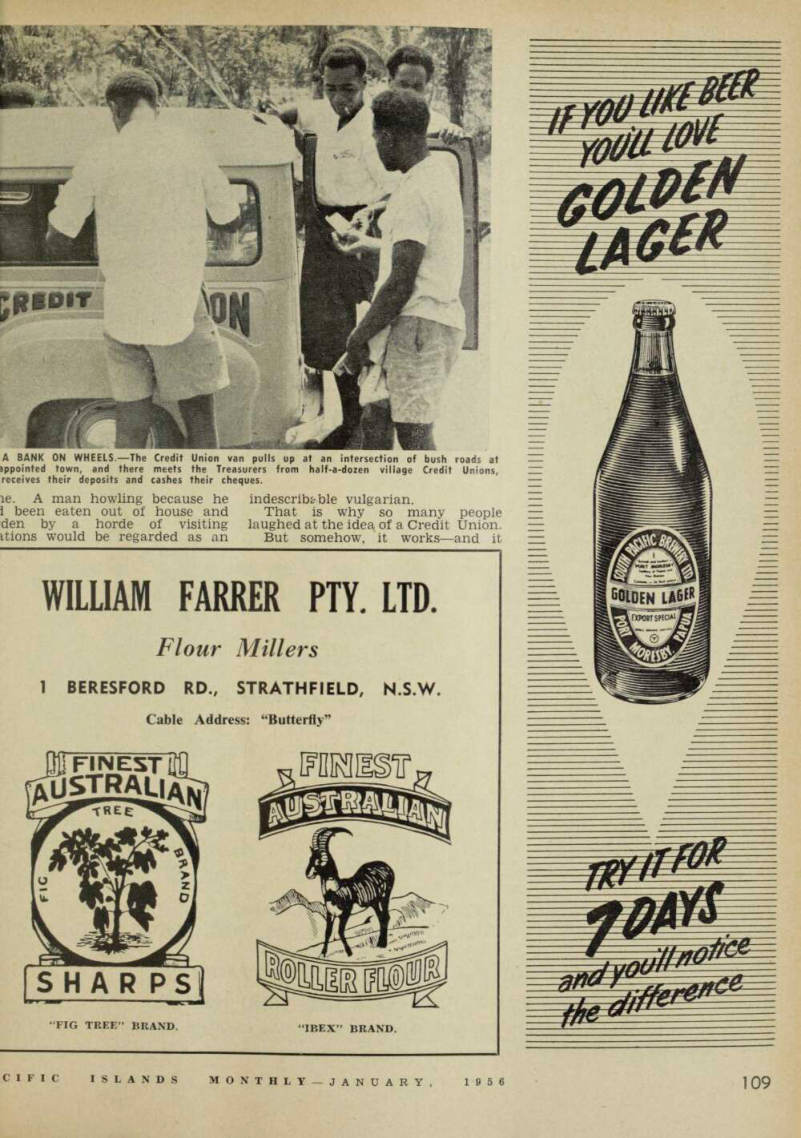
A BANK ON WHEELS. —The Credit Union van pulls up at an intersection of bush roads at [?]ppointed town, and there meets the Treasurers from half-a-dozen village Credit Unions, receives their deposits and cashes their cheques.
works because those village man agement committees are like hawks in their supervision of loan repay ments. I think an important factor is Father Ganey’s insistence that there shall be a village wife or two on the management com mittees. Among Fijians, as else where, women are tougher than men in these things.
MOST Fijians are Methodists, and Father Ganey is a Roman Catholic priest. But there is no sign of sectarianism in this movement —all Church folk are supporting it with enthusiasm. The strength of the movement, and its success, is one of the most remark able developments of latterday Fiji.
The South Pacific Commission has manifested a lively interest in it.
As the movement spread into the more distant and isolated villages, a real problem developed—how promptly to bank the cash collected from members, and how promptly to cash the cheques given to successful applicants for a loan.
The bank deposit is an essential section of a Credit Union. No village money-box!
The Unions’ managers solved it by purchasing a small and powerful motor-van, designed to travel over rough tracks. It works to a timetable; and the village unions’ treasurers, instead of having to walk endless miles to a bank agency,
now meet the van at pre-arranged places and put in their cash, and cash their borrowers’ cheques.
Peni, driver and manager of the van, and expert accountant, probably is now one of the country’s bestknown young Fijians. (Sydney and Melbourne gangsters who grab pay-rolls and who might
see in this some sweet picking) are hereby warned that the Fijiai in charge of the Credit Union are armed, and good marksmenr and, being typical Fijians, thri don’t run when trouble starts).
The weekly contribution made 16,000 members is not a gift—it a loan, earning a very modest rs'
interest, and repayable to the ider on demand. The borrower io pays a small rate of interest, st enough to cover administration penses.
STo one connected with the Credit lion likes the idea of interest ing charged for profit. What they nt is self-help—those with ac mulated credit to help those who sh to use credit temporarily, to nr mutual advantage, rhus there is being introduced o village life the simplest con >tion of community economics. >n that conception rests the ucture of Western civilisation.