In Papua-New Guinea
pp. 37-119 · Read in the full issue

[?]urrent News Items From Our Correspondents In Papua-New Guinea
3Ristmas Was Gay In The
Territory
Papua-New Guinea had perhaps I gayest Christmas on record, with ainly fine weather, numerous rties, Father Christmas on time, id best of all, no serious accidents.
Several towns, including Port wesby, had heavy showers on iristmas afternoon; Boxing Day d somewhat cooler weather. Big jwds, however, were on beaches at sports events.
But for the majority, Boxing Day sant a day at home recovering »m December 25, or entertaining ests. For the children, as for ildren throughout the world, it s another day to play with their w toys.
Father Christmas in the Terri y put in appearances at all the jn centres and at many of the posts. rhe weather being a trifle too hot reindeers, he left them behind i arrived in alternate transport, iging from Dakota aircraft to bive canoes and small dinghies.
Port Moresby, he arrived astride (rilliant red fire-engine, fcetail traders reported record ristmas business. The emphasis, y said, was on semi-luxury goods.
Qk officials said that the bank le for the Territory was also a ord.
Jhurches throughout P-NG were ked with worshippers at mid ht services and at all services on ristmas Day. For many natives the interior, 1955 was their first ristmas in the Christian spirit, were the people to whom isionaries came only this year.
Ifith Christmas over, Boxing y and the following day were m over to sports and native 5-sings —the biggest being at roka, where the P-NG Admin ator and Mrs, Cleland were nding three weeks local leave, wards of 12,000 gaily-dressed ives took part, and some later fived prizes from Mr. Cleland. roroka and Wau were by far the st popular places for tourists dur the holidays—there was not a ant bed available in either tre. i Lae, police and the master of motor-vessel Buka spent part of :ing Day afternoon rescuing r native adults and two children n an overturned canoe two miles n shore. The rescuers managed save all the natives’ possessions the canoe, on the way from Lae Labu, was lost. hristmas did not go unnoticed Mount Hagen (Western High is) either, but the Big Celebra i there was a dance on New
Year’s Eve. It was the inaugural function at the newly-formed Mount Hagen Country Club.
New Guinea Newsprint?
The Australian Government is re ported to be looking into the pos sibility of using certain New Guinea timbers for paper pulp—a suggestion made by the PIM in dependently in December.
The Federal Minister for National Development, Senator Spooner, told reporters in early December that the need to increase the Australian out
put of pulp, paper and paper-board represented a challenge of national Importance.
Senator Spooner was commenting on a review of the industry which disclosed that imports of pulp and paper were one of the biggest single items on Australia’s Import Bill in 1964/55.
He said that in view of Australia’s limited forest resources, the ex pansion of newsprint production might depend on certain New Guinea timbers and a variety of Australian eucalypts.
The Un-Mobile Clinics
The mu c h-discussed Outpost question of “what’s happening to the Mobile Clinics we bought” was
kly answered by the P-NG Ad istrator early December. [*hey will go out on the first lable ship,” he said, territory residents subscribed y thousand pounds to the Queen abeth Coronation Trust Fund, it was later decided that six ile clinics would be bought with money. Since their arrival in Moresby six months ago, they ; been standing idle awaiting e interior modifications). •igadier Cleland, during his re
cent Rabaul trip, called at Madang on the way back to Port Moresby and obviously was told at first hand that “people are talking, especially the natives who put in about £3,000 to the Fund.” (Madang is to get one of the Clinics).
Typical of the comments at a recent Madang Town Advisory Council meeting, when the subject of the Clinics arose, came from the P-NG Regional Agricultural Officer, Mr. Vicary.
He said: “One of the worst things
that could be done in a native country is to make promises and not fulfill them.”
On arrival back in Port Moresby, the Administrator agreed that “something was wrong.” He said, “The Clinic for Madang will go there on the first available ship.
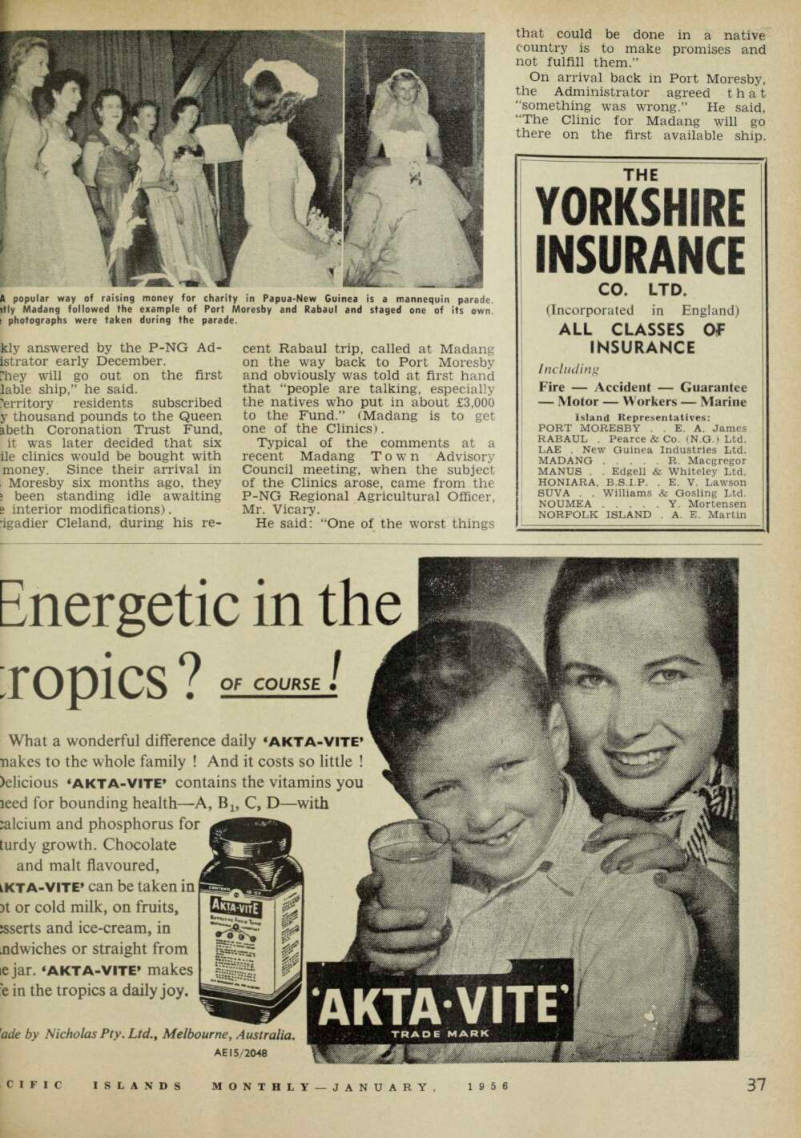
A popular way of raising money for charity in Papua-New Guinea is a mannequin parade, [?]tly Madang followed the example of Port Moresby and Rabaul and staged one of its own photographs were taken during the parade.
The others will go as soon as pos -sible.”
Mission In Rabaul
A varied programme marked the 'visit to Rabaul of the Leader of the Australian Mission to the Nation, the Rev. Alan Walker, on the week end of December 3-4.
On December 3 he travelled into the mountains to speak to the most primitive people of New Britain— the natives of the Baining area.
Hundreds sat under the trees of a Mission Station and heard an address of welcome given by their native minister before the Methodist missionary spoke.
People of many racial groups in Rabaul heard the message of the Mission to the Nation on Sunday, December 4. In the morning, Euro peans assembled at the Kokopo Club, and in the afternoon, Mr.
Walker visited natives at the Dr.
George Brown Training Centre.
Young Chinese and Malay people heard Mr. Walker at a tea-time session, in the Rabaul Methodist Church.
The final meeting was held in the Palms Theatre in Rabaul, where a large crowd from every racial group in the town took part.
Down With Demon Drink
A policy of total prohibition was suggested by Mr. Walker before re turning to Australia, as the only sensible liquor policy for Papua and
New Guinea. No other form of o trol, he said, could protect the nas peoples from the ravages t H alcohol had released in every oh society.
Ax. Walker said everyone in the rritory should be ready to accept ihibition as a personal contri tion to the native welfare, le continued “It is unworthy and -Christian for us Europeans to nand liquor when it is obvious it it will carry great destructive >s to the native society.” le added that the Australian Ad nistration in the Territory had a lat opportunity of saving the iive people from evils which had ne to every other native society ere liquor had been permitted, tal prohibition, he said, can be more effectively administered in any form of liquor control.
It is a pity that Mr. Walker had ; something more constructive to r on the native liquor question, ropean self-sacrifice in P-NG is rer likely to go to those lengths the sake of native welfare or anything else. It would be un 3ly to do much good even if it 1. Most Pacific Islanders have me Brew of one sort or another; 1, according to statistics, NG ;ives’ favourite tipple has a thylated spirit base. —Ed. PIM).
Aerial-Mapping P-Ng
in aerial mapping survey being ried out in various parts of Papua i New Guinea by Adastra Air ys has now covered an area of irly 8,000 square miles. ’rom Madang, a survey over the roka, Ramu and Wahgi Valleys > been completed for the Depart nt of Interior, and from Lae, a vey of the Bulolo area has been npleted for the Territory Forestry partment. All photographs were ;en from 25,000 feet, it present, the survey team, fly a Lockheed Hudson, is working Kikori area from Lake Kutubu vn to the Fly River, and south of sori itself, on behalf of Aus lasian Petroleum Company.
Cloud conditions
are hampering
progress on this survey which de mands bright clear days for successful photography.
Other problems, such as previous inaccurate map ping and vast changes in the height of the terrain are slow ing-up the job.
And, as the air craft is based at Lae, the lack of suitable airstrips, particularly in the Kutubu area, means that the plane has to be flown 200 miles to
the operation area and then a further 200 miles back to Lae.
The photographs taken of each survey are eventually interpreted by the Australian Mapping Council.
Medals For Loyal Service
A Woodlark Island Village Con stable with 50 years service in the P-NG Administration is among a group of 36 natives who have been awarded the Loyal Service Medal, Civil Division.
The awards, which were an nounced on December 27, go to 31 natives with at least 25 years Ad ministration service and to five other natives who have rendered outstanding service to the Admin istration or in the interests of the native people.
These natives include the Senior Clerk of the Department of Educa tion, a New Guinea interpreter, a
[?]olf Club Associates held their Annual Dinner at the Hotel Moresby, [?]Moresby, on December 7. Photo shows Mrs. Davison, secretary, [?]ding a trophy to Mrs. Heather Johns, who won also, a number of [?]ers, whilst the captain, Mrs. L. Allen, looks on. —Papuan Prints photo.
Ired member of the New Guinea ice Force who was awarded the itinguished Conduct Medal dur ! the Pacific War, and a Native [age Headman in the Tari Basin a who assisted early patrols ough the district. mmonwealth bank helps
Native Co-Ops
Tie Commonwealth Bank has de a second grant of £3,500 to p promote native Co-operative cation in Papua-New Guinea, his Bank last year made a similar nt to assist a proposal that ive co-operative societies finance I maintain their own training 001. At that time, the training natives in bookkeeping and co rative principles was financed by Administration but the shortage accommodation for pupils made ecessary to consider the erection i permanent centre with board ■school facilities for 40 students, he Commonwealth Bank made initial grant of £3,500 from its al Credit Development Fund to ■t the scheme. Native Societies nselves donated £3,000 and will in another £5,000. s well, native building societies e undertaken all construction k at a nominal fee. Two dorm- Les and another building are rly finished, and great credit it go to the natives for the ex ;nt work they carried out.
Everything, including the designing, was done by the natives.
The latest bank grant, together with additional donations from the native societies, will enable work on the actual school and mess build ings to be completed in 1956 at a total cost of £12,000.
The Registrar of Co-operative said on December 27, that the education centre, when completed, would pro vide lectures in basic agricultural principles, copra production, co operative bookkeeping and com mercial subjects.
The prime object of the training, he said, was to enable natives to utilise more fully their existing agricultural potential through better processing equipment, more highly organised production and improved marketing facilities.
Two On And Two Off
Two passengers on the MV Bulolo reached Lae by air on December 28
after missing the boat at Samarai.
The ship’s departure without the tourists, however, made no differ
An art exhibition was held at the Catholic Mission House, Port Moresby, on November 26.
Our photograph shows Mrs. D. M. Cleland, wife of P-NG's Administrator, and Mr. J. Ahearn examining (Mr. Ahearn somewhat critically) the work of French artist Paul Roqueplo. Mrs.
Cleland opened the exhibition. —Photo by Papuan Prints.
ence to catering or accommodation arrangements—two Samarai people forgot to leave the boat at Samarai and were carried on to Lae.
The Five-Days Week Begins
Public Servants in Port Moresby, Lae and Rabaul will start a quarter of an hour earlier and have only an hour for lunch when the 5-day week comes into operation in the New Year, A spokesman for the Public Ser vice Commissioner’s office said on December 28 that the 5-days week would apply to departments or branches located in the three centres except certain sections which the Public Service Commissioner decided were “essential services.”
These are the European and Native Hospitals, Post Offices, Transport Pools, Police Stations, Public Libraries and Public Schools at Port Moresby, Lae and Rabaul.
Officers attached to these sections would continue to observe their normal hours of duty.
Arrangements have been made to roster a duty officer or officers in the Departments of Agriculture and Customs on Saturday mornings, as required. This is apart from roster ing a duty officer in most depart ments to supervise Native Staff, who will continue to work a five-and-a half days week.
Suki—For A Protein-Rich
Diet
An area described as a “sports man’s paradise” has been located in the Upper Moorehead and Suki River area of the Papuan Western District, between the Fly River and the Dutch Border.
In a report to headquarters, Patrol Officer C. C. Giffard said fish and ducks abounded in the area and swarms of geese were a common sight. Wallabies, wild pigs and
cassowaries were also plentiful as were hunted by the small nati population who, he added, appeau to enjoy one of the most prote;£ rich diets of any native group the Territory.
Mr. Giffard said that domes pigs were not bred by the natri but wild piglets were captured as fattened in small bamboo cagj which were extended as the pc grew.
He reported that the native peo;c
i very few fowls and it appeared it this was partly due to the large tnber of hunting dogs owned by ; people and to the prevalence hawks and snakes.
It one Patrol site, native carriers led and ate a python 131 ft long i 10 in. in girth.
Jr. Gilfard added that crocodiles re supposed to be numerous in i area, but none were seen by i patrol.
Cinderella In Lae
i pantomime is to be presented Lae for the benefit of school Idren during their long Christmas idays. ?he production, “Cinderella,” will presented by the Lae Musical and amatic Society on two consecutive hts towards the end of January, in enthusiastic cast has re irsed twice weekly, and the ;iety has the services of an ex ienced producer, ballet mistress, ge manager, wardrobe designer, sicians and scenic artists all de mined to make the show the nax to the children’s vacation.
Praise From On Top
)ecember marked the last day in ! Territory Public Service of Mr. i Downs, District Commissioner the Eastern Highlands.
Jr. Downs, who entered the ser e in 1936 as a Cadel Patrol icer, became the third District tnmissioner of the Eastern High ids to resign and enter private £rprise in the area. Mr. Downs
was posted to the Highlands in 1952 and has guided its growth from practically nothing to one of the most thriving areas of the Territory.
In Port Moresby, the Assistant Administrator, Mr. Wilson, said the Administration greatly appreciated the work Mr. Downs had done and the great contribution he had made to the development of the Territory, particularly the Eastern Highlands.
Mr. Wilson said the Administration was happy, however, that Mr Downs had seen fit to remain in the Territory so that his valuable experience would still be available.
Mr. Wilson said, “Mr. Downs typifies the fine type of officer of
the Administration work of dlveloping th e g Ter?itorv
and advancfng plople
pcupie -
Fire At Oil Site
Fire early on December 9 de stroyed the clubrooms and Mess building at the APC drilling site at Bar akiwa, north-west of Kikori, Pa P ua - T* l6 buildings had only been up two or three weeks, An APC official in Port Moresby said that it was not yet known how the “ re sorted. Inquiries were be ing made -
East Coast Road Soon All
Weather Highway
Work is proceeding steadily on making an all-weather road out of
photograph at the reception which followed wedding at St. John's Church, Port Moresby, December 10, of Miss Debie Holt to Mr. [?]ony Normoyle. The bridegroom is the son [?]Police Commissioner and Mrs. C. Normoyle. young couple will live in Lae. —Photo by Papuan Prints.
old German road from Kavieng Namatanai, on New Ireland, he Department of Works has ;ady constructed about 40 bridges ag the 166-mile road, and about
another 20 bridges have yet to be built.
Three of these will be more than 100 ft long, and the rest range from 20 to 75 ft.
The New Ireland East Coast road was constructed in German days, but it was constructed for carriage traffic. War-time neglect and post war increase in heavy motor traffic has often made it impassable dur ing the wet season in recent years.
And A Road For Manus
Meanwhile, work has started on the construction of a much-needed road across the Eastern portion of Manus Island. It will link Lorengau with M’Bunai, on the south coast side, which at present is accessible only by sea.
The road will be 40 miles long and will be constructed by voluntary village labour.
It is hoped that the road will stimulate native agricultural pro duction and at the same time stop population drift from the inland villages down to the infertile M’Bunai coastal strip.
Anti-Taipan
The P-NG Acting Director of Health, Dr. Alec May, says supplies of the newly-developed serum to counteract Taipan venom will be obtained for the Territory as soon as they become available. (Over)
[?]e marriage took place at the Catholic [?]ch, Port Moresby, on December 10, of Pat Norton, formerly a Sister at the local [?]pean hospital, to Mr. R. Thurecht, of the [?]th Pacific Post". —Photo by Papuan Prints.
The serum had been used suc cessfully on a young boy in Cairns who was bitten by a Taipan some weeks ago. The Taipan is regarded as one of the world’s deadliest snakes and a number of natives in the Territory have died in recent years from its bite.
Dr. May says supplies of the new serum will be sent to outposts as soon as possible,
Trouble Near Popondetta
Arrangements have been made to build a permanent infant Maternal Welfare Clinic building at Saiho, near Popondetta, Papua, to replace one destroped by fire on Christmas Day.
The fire broke out when a kero sene refrigerator exploded and although no one was hurt, the building was gutted and all equip ment destroyed.
About 30 babies were in the build ing when the fire started.
44,000 Gals. Of Fuel For
Highlands
A Mandated Airlines Dakota re turned to Lae on December 11 after five weeks in Australia for overhaul
and certificate of airworthiness.
The Dakota’s first job will be a record air-lift of one thousand 44gallon drums of fuel which were to
be flown into Goroka before tid end of this December. MAL e£ pects to complete the job in separate flights.
Ltive Councils And Educa
Tion In N. Britain
fhe results of conferences held in haul early December between the NG Administrator, Administra n officials and each of the Bsions operating in the Gazelle ninsula were announced in Port iresby December 13. i Press statement issued by the ministrator said the conferences ulted in what could be termed le Rabaul Agreement,” which tvided a formula for relationships ween Native Local Government incils and Council and Mission ools in any part of the Terri y- ’he Agreement maintains the it of Native Local Government incils to build and maintain incil Schools; but it preserves the vious decision that no funds will allocated by a Council for the Iding of Mission Schools. It pre ss for the establishment of a :al Education Committee which [ advise the Council on the need I location of schools in the incil area and it stipulates that h a Committee will consist of resentatives of the Administra i, the Council and each Mission rating in the area, nder the Agreement, if in any ticular area there is a registered ision school conforming to the idards of a Council School, then Council school need be estab ed in that area. A Council may st any Mission school by way ervices rendered or by the supply naterials and equipment, but, in case can an actual cash grant made. he Administrator emphasised in statement he was satisfied that situation in the Gazelle Pen ila, with particular reference to increasing tempo of native de pment, was basically sound and ire. he following day the Roman holic Priest of Rabaul, Father les Dwyer, commenting on the ninistrator’s statement, said that Agreement reached was the out e of several months of negotia s between the Administration the Mission, and was acceptable he Roman Catholic Mission.
En The Kukukukus Now
Work
group of Kukukuku natives hed Lae on their way home on ember 13, after working for 18 iths as general labourers at )10. he experiment in taking the ;ukuku’s to Bulolo is reported to l complete success. All of them speak Pidgin. In the early days the Morobe goldfields, Xuku ii’s were regarded as useless as urers.
New Met. Aid To Ng Weather
Men
A new meteorological device to determine winds and conditions in the upper atmosphere in adverse weather is to be added to existing facilities at Lae.
The equipment is expected to be installed early in the New Year. A building to accommodate it is now almost complete.
The equipment will enable meteorological officials to plot a large balloon to a height of 100,000 feet.
A small transmitter is attached to the balloon and radio signals from it are modulated by temperature, pressure and humidity elements as
the balloon climbs into the upper atmosphere.
An ABC correspondent at Lae says the American armed services had a large network of these aids during the war years, but this is the first the Civil Meteorological Bureau has erected in the Territory.
Others are planned for P-NG, but it is expected that the next will be erected at Honiara, BSIP.
Cruise Ships For P-Ng
P. and O. and Orient Shipping Companies will be running three major holiday cruises from Aus tralia this year. Two of them are of interest to the Territory.
The Oronsay will run from Sydney
(Continued on Page 113)
Rabaul for the first time since war in a cruise starting at the of June and lasting 12 days, he P. and O. Line will run the lalaya on a 15-day cruise from ney to Suva and Port Moresby June. oth ships will return to Sydney ivay of the Great Barrier Reef.
Stralian Students Work
In New Guinea
hile many medical students in tralia are working as counter ds, railway porters and postal cs during their Christmas tions, a group of 11 students are the Territory getting some tical work. le students—from Sydney, Mel ne, Brisbane and Adelaide Uni fies—were selected from a large ber of applicants to work with Lerritory Department of Health ig their holidays. iey will work as European cal Assistants, and be paid at same rate. is money will off-set their fares nd from the Territory, which must pay themselves, as well ve them a little to spare, e male students among the ) will probably go on a medical 1 while in the Territory.
Adam In Yellow Clay
A recent patrol of the Upper Turama area of Papua located a small group of natives who had not previously had any contact with Europeans.
The Patrol, led by Acting ADO Leen, found the group at Iwatubu and reported that they were re ceived peacefully.
Mr. Leen said he found 21 people in the group but estimated that there were another 15 or 16 hiding in the bush. All were of powerful physique with massive legs indicat ing that they had at some time migrated from the mountains. They were fairly light skinned and the men all smeared their bodies with a yellow clay.
The patrol, which set out from Kikon, planned to get through to Lake Campbell but was unable to do so because of extremely dif ficult terrain and torrential rain.
Agricultural Dept Aid
Wanted
The Madang District Advisory Council is seeking the appointment of a travelling agricultural officer to advise and assist both Europeans and natives on cocoa planting.
One Council member, C. E. Bliss,
the world that had not been affected at some time or other, A mission representative, the Rev.
Father Misik, said he agreed but pointed out at the December meet ing that there was a tremendous amount of native cocoa planting go ing on in the district but very little qualified supervision.
He said cocoa was a crop liable to disease and that there was not a major cooca-growing country in
thought the Department of Agri culture should provide particularly for supervision of native planting.
He said that in the event of an out break of disease, natives would be liable to neglect their crops beyond the stage where the disease could be checked.
Another Council member, Mr.
Perkins, said he also agreed, but that European planting should also
be supervised.
Mr. Perkins explained that some plantation managers were required by their employers to plant crops with which they had not previously had any experience. A visiting agricultural officer would therefore be of great help to them.
Two-Way Radio For
Timber-Getters
Two-way radio is to be installed to improve communications between the South Pacific Lumber Company Mill, at Lae, and its timber lease 11 miles away in the Trans-Busu area.
A Company official said on De cember 19 that it was planned to have the main transmitter at the Mill and a mobile set in a vehicle to be stationed permanently in the lease area.
The official explained that Lae was in process of having its annual rain fall of about 180 inches and it was to be expected that the road to the lease area w'ould be impassable on
a number of days during the year.
Two-way radio would warn cart ing contractors of road conditions, and mean quicker assistance in cases of injury or accidents.
The Fleet Was In Samarai
Samarai in mid-December had one of its busiest periods for some time, when the MV Sinkiang, MV
Soochow, MV Malekula and W.
Malaita, as well as two Catalixi flights, arrived at the Island i within four days.
A total of 450 tons of cargo m discharged together with 152 bs of mail.
Normally, about 80 bags of maili month are delivered to Samarai. .
jECTION of tag members?
Election of Ward members to pua-New Guinea Advisory Coun -5 is being sought by members of ‘ present Port Moresby Town Ad ory Council. rhe Council also wants Public wants to be eligible for election. it present, Ward members are minted by the Administrator, and rules governing Town Advisory mcils exclude Public Servants m representing the Wards in ich they live. meeting on December 20 adopted •esolution put forward by Mr. er Fox, and supported by Dr. ite, both of whom claimed that mere fact that members were ted by the people would give e strength to Advisory Councils, r. Fox suggested that the elec of Ward representatives could the forerunner of fully-elected ncils, re Chairman, Mr. E. A. James, >orting the proposal that Public ants should be eligible for elec said he had always maintained because a Public Servant was üblic Servant he did not stop ? a citizen. s only a small portion of P-NG ents bother to vote for the j Legislative Council, it seems tful if there would be any in t at all in local Advisory Coun lections.—Ed. PIM).
Power’S On Again
rt Moresby’s power rationing nded—at least, for the time be announcement on December the Department of Civil Affairs that No. 4 Generating set at dobu Powerhouse had been re -1 and the power restrictions im about a month ago would no r be necessary.
Departmental spokesman said o-operation of the public dur the restrictions was greatly ciated by the Administration.
'he public failed to co-operate, >uld have been impossible to ;ain supplies.
Postal Facilities Still
Off
/ever, just to prove that Port by is not yet Arcadia, an an ement about the same time tes that Port Moresby will ;° keep on suffering bad postal les.
Director of Posts and Tele- Mr - W. Carter, said there ttle chance of additional pri nail boxes being provided at )rt Moresby Post Office before iresent, only a few boxes are ed— most people, unless they 'heir mail addressed to their of employment, have to ask ?irl behind the counter” if any mail for them. They
then wait until the clerk sorts through a pile of letters. Behind them are other people waiting to buy stamps, or perhaps, to find out if there is mail for them, too.
Mr. Carter explained that extra mail boxes depended on the re modelling of the present antiquated Post Office building. Plans and de signs for this had been prepared, he said, but “due to more important Administration works for other De partments, it was not placed on the works programme for the current financial year.”
Therefore, he added, there’s not much chance of more boxes before the start of the 1956-57 financial year.
Mr. Carter is not alone when he
said he regarded the remodelling of e ,^ Moresby Post Office as one of the Department’s most pressing needs. The general public—that class of people for whom the P-NG Administration seems to have little regard—is. right behind him.
P-Ng Native Teachers
To See Qld.
Ten native teachers from Papua and New Guinea will pay a 6-weeks’ visit to Queensland in April, 1956.
The teachers, drawn from Papua and the New Guinea Islands and accompanied by the Assistant Director of Education, Mr. Roscoe will visit Townsville, Cairns, Mount Mount Morgan, Brisbane, Warwick and Stanthorpe. (Over)
They will go by plane to Towns lle and the remainder of their ivels will be by train.
Ihe purpose of the tour is to jrease the native teacher’s know- Ige of Australia and her primary d secondary industries.
Follow The Band—In
Kavieng
newly-formed brass band at vieng marched through the town the first time on December 22, lowed by the Kavieng detach nt of the Royal Papua-New
inea Constabulary.
Tie band was made up of local ;ives of all ages, trained by ice-Sgt. Rubens. Their bugles, mpets, cornets and other instru cts cost £6OO, raised by donations jne shilling or less from natives Dughout New Ireland.
Admitted To The Bar
or the first time, all four judges ;he Papua-New Guinea Supreme rt were on the Bench when two ■isters were admitted to the Bar he Territory Supreme Court on ember 19. tie barristers were Mr. Frederick n Winkle, who will join the staff he P-NG Crown Law office, and Douglas Hugh Morris, th e istrar of the Supreme Court, leir admission was moved by the vn Law Officer, Mr. W W kins.