Notes Made in and Around Fiji
pp. 27-131 · Read in the full issue
FROM R. W. ROBSON , IN SUVA, DEC. IS
Political Conditions
; More Tranquil
all the 25 years since first I established the PIM, and began to look over the Central Pacific dd intervals, I never have known more tranquil. lere is plenty of politically ex ive material there. Five com lities—European, part-European, m, Indian, Chinese —are liable, irritate each other with their ;h edges in any country where have to live together; and Fiji known plenty of community in. le Indians have been the worst ble-makers. “Well here we are, ■we are as good as any Euro 1, and entitled to European irs and privileges here,” seemed im up their attitude, over many s. it, since the war, and since an -larger proportion of Fiji-born ans have come to the fore, the an community seems to have a ;r appreciation of Fiji’s peculiar lems, and of the definite obliga ; of the British towards the ns. They see the Fiji situation agh the eyes of the responsible Lnistration, rather than through iwisted spectacles of old India — nsion distorted by age-old idices and an inferiority com-
This better outlook among Indians has been encouraged and assisted by the present Governor. Unlike his predecessors, Sir Ronald Garvey, out of his long experience in this region, has a clearer understanding of Fiji’s background, and of the psychology of the different races he has to control.
Also, unlike some high officials, he has no prejudice against Indians.
While accepting Fijian welfare as his primary responsibility, he seems to find much to admire in Indian culture and Indian character. He has not forgotten that Britain’s finest achievements in India would not have been possible without the loyal and very capable help of many famous Indians.
All communities give the present Governor much of the credit for the present peaceful condition of the Colony. If his work is not sub jected to overseas interference, he may do much to provide a solution for Fiji’s fundamental problem— namely, how Indians and Fijians may live together in comparative calm and security.
Bau Now is of The Past AN interesting and important de parture from native custom and tradition was made recently in Fiji.
When Lieut.-Colonel Edward Cakobau took over Development and other administrative duties in South East Viti Levu, it was assumed that his headquarters would be out on the islet of Bau, regarded as the focal point of native administration ever since the first King of Bau established himself there.
But Bau is very small, and some what inaccessible: and the Governor (Sir Ronald Garvey) and the Fiji leaders had a talk about it. As a result, the South East native head quarters were placed in Tailevu (northeast of Suva, beyond Nausori) —from which point most of the big and important district is accessible by road—and Edward Cakobau has taken up residence there.
Bau, of course, will be maintained as a place of great historic interest; but its administrative and economic importance is gone.
Ten Fiji Cigarettes
For 8d! 1 NOTICED many of Fiji’s gentle ladies using cigarettes out of a neat red-and-white packet marked “Star”; and when I dis played interest in something new, they coyly presented me with some of them.
They are the new cigarettes being made in Fiji by a Fiji Company formed by the W. D. and H. O. Wills interests to cater for the local market. They are made of imported tobacco, and are somewhat loosely packed to take care of certain local
(Continued on Page 125)
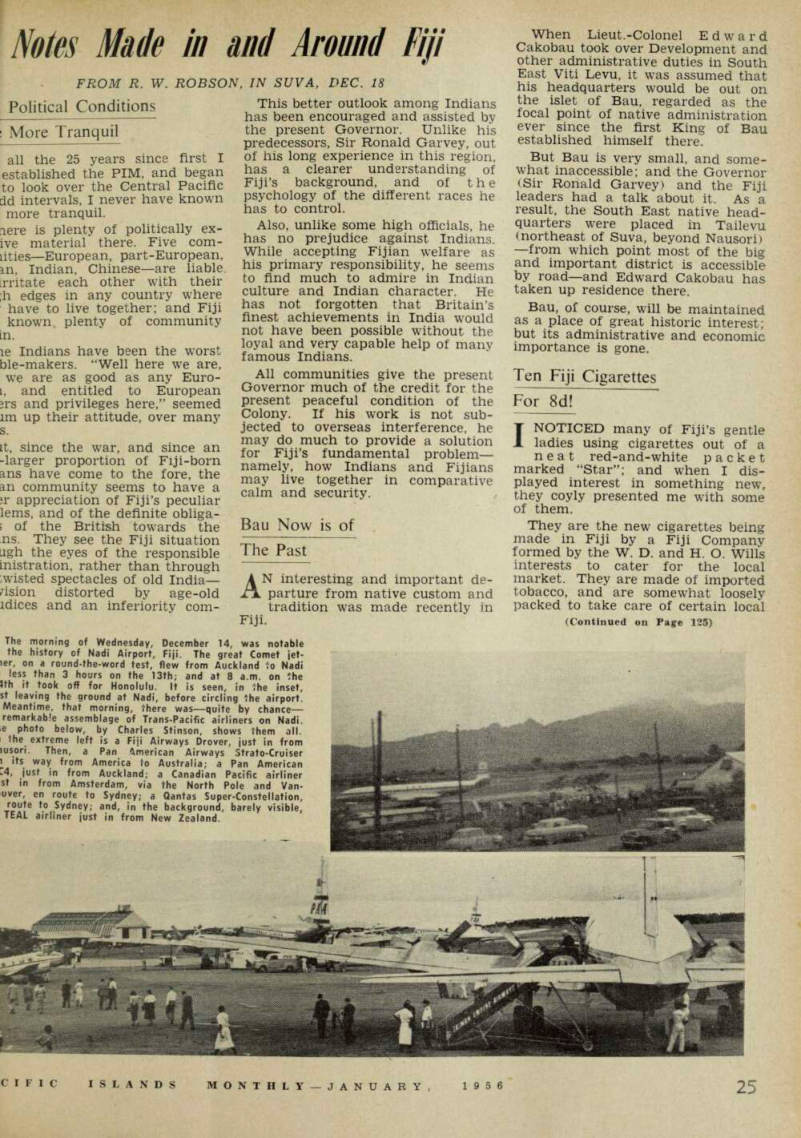
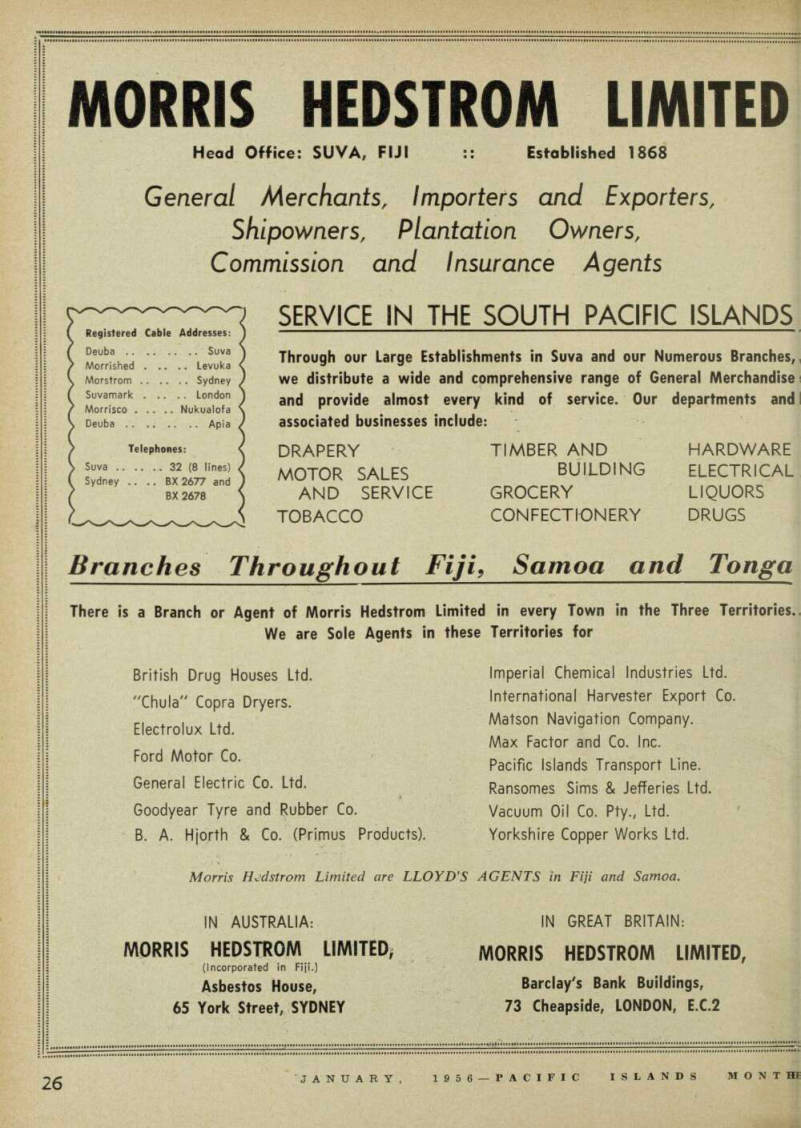
The morning of Wednesday, December 14, was notable the history of Nadi Airport, Fiji. The great Comet jet [?]er, on a round-the-word test, flew from Auckland to Nadi [?] less than 3 hours on the 13th; and at 8 a.m. on the [?]th it took off for Honolulu. It is seen, in the inset, [?]st leaving the ground at Nadi, before circling the airport.
Meantime, that morning, there was—quite by chance— [?] remarkable assemblage of Trans-Pacific airliners on Nadi, [?]e photo below, by Charles Stinson, shows them all. [?] the extreme left is a Fiji Airways Drover, just in from [?]usori. Then, a Pan American Airways Strato-Cruiser [?] its way from America to Australia; a Pan American [?]4, just in from Auckland; a Canadian Pacific airliner [?]st in from Amsterdam, via the North Pole and Van [?]uver, en route to Sydney; a Qantas Super-Constellation, [?] route to Sydney; and, in the background, barely visible, TEAL airliner just in from New Zealand.
natic conditions. I smoked some, 1 their quality is excellent.
'he Government approved the n because it represents a local Bring for Fijian and Indian con lers. I do not think that either pernor or manufacturers an pated the European reaction. ; European women have taken to m because they are good, and ause they sell at 10 for Bd—a reduction on the imported lines. hat evening, I sat in on a little 3 party where I met a bright interesting Londoner who is a elling representative of Carreras, ous makers of cigarettes. He he had been “looking round.’' ,” said I brightly. “And where when do Carreras start manu uring?” He said indignantly Carreras had no such plan. He in a minority—most of the illy well-informed people in Fiji led sure there will be a Carreras 3ry there before dawn of 1957. r all, Wills cannot be allowed et away with a successful and itable enterprise like that.
Comet Looks In RRIVED in Nadi on the heels F the big new Comet, which ad flown from New Zealand in • absurd number of minutes. e whole district made it a fete sion —well-known district folk, Lautoka right around to Siga came in to see England’s ler-machine, and the large mbo lounge was crowded to the es. Merriment grew, the cash ter sang tunefully, and Barry >’s famous smile spelled borne” in all languages. e Comet boys were abstemious; ;he uninhibited sightseers saw reason for early retirement, lolically shaken, I got behind Cadi Hotel’s hospitable mosquito in at 12.30 a.m.—and was red forth at 6 a.m. by a very mined Rex Steele, who insisted I see the Comet off at 7.30 a.m. 3 take-off was impressive. One run—Zoom!—and she was in tir and doing a dip overhead 'OO feet before we had time to ie twist out of our necks. at was even more impressive the unrehearsed assembly of -Pacific air-liners at that mt on the Nadi airfield—big s from ’Frisco, Vancouver, and, Sydney—and even the iian Pacific airliner in from jrdam via the North Pole, had chosen that morning for 1. (See photo, page 25.)
More and More
Suva Buildings
SUVA’S lines of shops and offices, from the reclaimed Walu Bay area (west of the docks) right along the lagoon-side to the Grand Pacific Hotel, are changing.
Right in the centre of the city, there is a substantial addition being made to the Bank of New Zealand.
Any day now, the new Burns Philp Arcade, to cover the site of hurricane - wrecked McDonald’s Hotel, opposite the Triangle, will get under way.
Further east, facing Victoria Parade, the big and impressive building being constructed for the Fiji Native Land Trust is half built.
But, near it, the impressive lower storey of the South Seas Hotel is still at the stage where it stopped after the earthquake two years ago, and tropical creepers are beginning to cover the concrete pile. Suva, however, expects that the new Morris Hedstrom-Carpenter alliance will re sume building.
At the other corner of Gordon Street, mainly facing the Parade, the large, new two-storey building for the Barker Estate is under rapid construction.
There are long waiting lists of
eager tenants, mostly Indian, for all these forthcoming new shops and offices.
Managing-Director Helson showed me the plans of the fine, four storey building which Burns Philp (South Seas) Co. Ltd. will shortly erect on the large area of vacant land directly opposite the present BP building. It will fill the whole area from Rodwell Road to the waterside, and up to Scott Street, and will be used mainly by BP de partments. They have just extended their main store, in modern styles, from the back westwards —but that does not meet all requirements.
There are additional buildings in the docks area, around Malcolm Brodie’s enterprises; and over in the Walu Bay reclamation there is an absolute welter of new construction.
I prophesy more vigorous new con struction when the Carpenter- Hedstrom alliance gets into its stride.
Suva surely is growing up.
Elizabeth Hennings of
Naitauba
IT was a pleasure in Suva to meet Mrs. Elizabeth Hennings, of Naitauba —one of Fiji’s well-loved
and gracious matrons of the old school.
I had known her over many years, as an occasional PIM contributer.
I had met her daughter, Mara, in Sydney (wife of Banker “Dusty”
Miller), and her daughter, Bobo, in London (wife of Cinema-Director Pennington Richards), and her daughter, Elizabeth, in Suva, when she was working on the O’Keefe film, but had not previously seen Mrs. Hennings herself.
Friends try to persuade her that she should now live in Suva or Aus tralia, or Europe; but I saw her go with obvious pleasure aboard the little ship, home to the Lau Islands.
She has a deep sentimental regard for Naitauba, to which lovely isolated island she was taken by the late Gus Hennings from Germany about 1912.
Her hair is white, but she retains still the fine complexion and slim figure of the German girl who cap tured Gus Hennings in Germany in the days before World War I.
He Carries Around Plans for W. Samoa MET unexpectedly in the GPH, my old friend (and PIM corre spondent of 25 years standing)
Hon. A. M. Gurau, MLC, of WesM Samoa. He was en route on Tofua to New Zealand, for a ha day, accompanied by his smilL wife and their lovely little grau daughter.
I tried to hold him to persoc gossip about mutual friends Samoa —but it was no use. Ew so often he would break away T , discuss the politico-economic affj of the Western Samoans (n 100,000 and increasing steadiJ which are his chief preoccupatio Cocoa is down to half of whai was a year or two ago; but evern £St>g.2so per ton, the Samoans main passing rich.
Mr. Gurau wants someone to vestigate the possibility of establi. ing the cattle industry in Samco he says that selected breeds sho flourish on the high country at eastern end of Upolu.
Local Paper Makes
War on the PRO SUVA’S Top Brass, official and official, has been observing, v cynical amusement, the attenr of the Fijian Times to administe public caning to the Public Relati: Office.
When Suva, in November, was i
,ded by a swarm of reporters, avid r sensational stories about the njita affair, the Times tried to in ice PRO to let down its back hair so, and join in the sensation mgering. When PRO insisted on eping to the sober truth, and tting cold water on some of the ight boys’ more absurd stories, the mes declared war on the PRO, d lectured the Government ntifically on the shortcomings of 5 Department. fhen Len Usher, head of PRO d on holiday in NZ, talked to an ckland newspaper about the fita reports emanating from Suva, 3 —with commendable restraint— d they were “ridiculous.”
Vhereupon the Fiji Times, on De riber 12, expressed its very great loyance with Mr. Usher, and the O, and the Government, and re dded them of what it considered •e their duties and obligations. It 3 that the reporters who were ponsible for the stories at which Usher had jeered were very nous correspondents indeed, jreas Mr. Usher is not even “a fessional journalist.”
' sa id that the PRO should cease :oncern itself with the collection presentation of news, and de ; itself to explaining the Gov nent to the people, iva really was amused. It has a ly memory of the long and barren ’S when Fiji was without a real spaper service, and the need filled by the PRO’S weekly news the Joyita stories represent the * of real news Paper-men and PROs weekly Bulletin is the luct of a non-professional nahst, then Suva is quite sure the class of service it would er. ji folk may not know it—but e are no Territories in the fic, and few British Colonies in world, better served in the field übhc Relations than is Fiji.
Usher, deservedly, has an inter )nal reputation—not only as a but as a journalist. ing Old But
ig Strong
is 20 years since I first sat in the Suva Rotary Club’s Thurs iy luncheon, on the GPH idah. Old friends have gone, there now are many new faces ie getting sterner, with the of the ageing years. But the now under the presidency of Elliott, goes on its useful way. ule we sat there chuckling, eant-Major” Claude Israel, merciless ingenuity, imposed i upon a wide variety of ished members, for hitherto crimes. The culmination he extraction of 3/- each from
o worthy citizens ’’for imagining at they would not be fined.” rhe total was added to the fund der which this healthy little fanisation gives its Christmas at annually to children in hos als and other institutions. :e from Oversea!
OCAL merchants and traders in form me, with a suitable display or irritation, that “a lot of rice m India is coming into the Fiji rket.” ’he picture is enough to annoy r economist. Fiji has the rice d, the rice mills, the know-how, the market, and should be grow every ounce of rice consumed the Colony. It is absurd that d Fiji money should be going rseas for such a commodity, he explanation probably lies in ’s increasing purchases of goods n India, and the consequent culty of arranging exchange in ment therefor. ension into N. Guinea JOVIAL face, surmounting a schoolboy figure, had me baffled, momentarily. It was the face of Lawlor but where was magnificent 17-stone body, so known in the happy caravan is of Sydney, London and Paris? appears that under doctors’ rs he went on a diet; and five
or six stone of good Fijian brawn and muscle, and maybe a little fat has gone into thin air, to the great benefit of our genial friend.
He tells me that his well-known Suva firm, Pearce and Company has extended into New Guinea, where as Pearce and Co (New Guinea) Ltd It. is being managed in Rabaul by Mr. Eric Lawson.
Why Not a Cool Station for Suva?
DRINKING tea on a hospitable verandah, I noticed that even old-timers were perspiring. Me I was frankly sweating—l couldn’t keep the rivulets off my spectacles.
Facing me, across Suva Harbour, I noticed some small mountains I asked, “Were they accessible, and how high were they? Why did not Suva folk, like Europeans in similar countries, maintain hot-season cool ing-off places in the nearby hills?”
Pat Costello smiled wryly. “That is Mount Rorobaba,” he said, point ing to the highest peak. “It is 1,408 feet above sea-level, and seven miles from the Post Office, and I own the country thereabouts. In Governor Mitchell’s time I donated 250 acres covering the top of that mountain,’ which is quite accessible, to the Fiii public.
“I thought it would be appreci ated by those people in Suva who,
otherwise, must stay down here at sea-level and swelter.
“The Government accepted it, and called it the Costello National Park.
I thought they would have put a road in, with all the spare bull dozers around after the war, so that people could have got up there in 30 minutes. But nothing was done."
I said I would write a nasty note about it. This is it. Facts speak louder than comments.
Fiji Pineapple
Cannery Closes
This is the last week of pineapple canning. The CSR Co. is closing down what, at one time, appeared to be a sound and profit able secondary industry for Fiji.
There was nothing wrong with the Fiji pineapple, or with the pack, or with the prices the Co. could sell at in the available markets. It is just that there are not enough pine apples produced in Fiji to keep the industry going on a scale which would keep It economic.
The Co. has been growing its own pineapples. No other planters have come along in sufficient numbers; and CSR cannot increase its pine apple acreage without sacrificing good sugar lands. It considered a plan to establish large pineapple plantations in the Labase area - but a survey showed the soil there’ was unsuitable.