P. Moresby Brewery Under
p. 22 · Read in the full issue
Swift Moves on the Beer Front
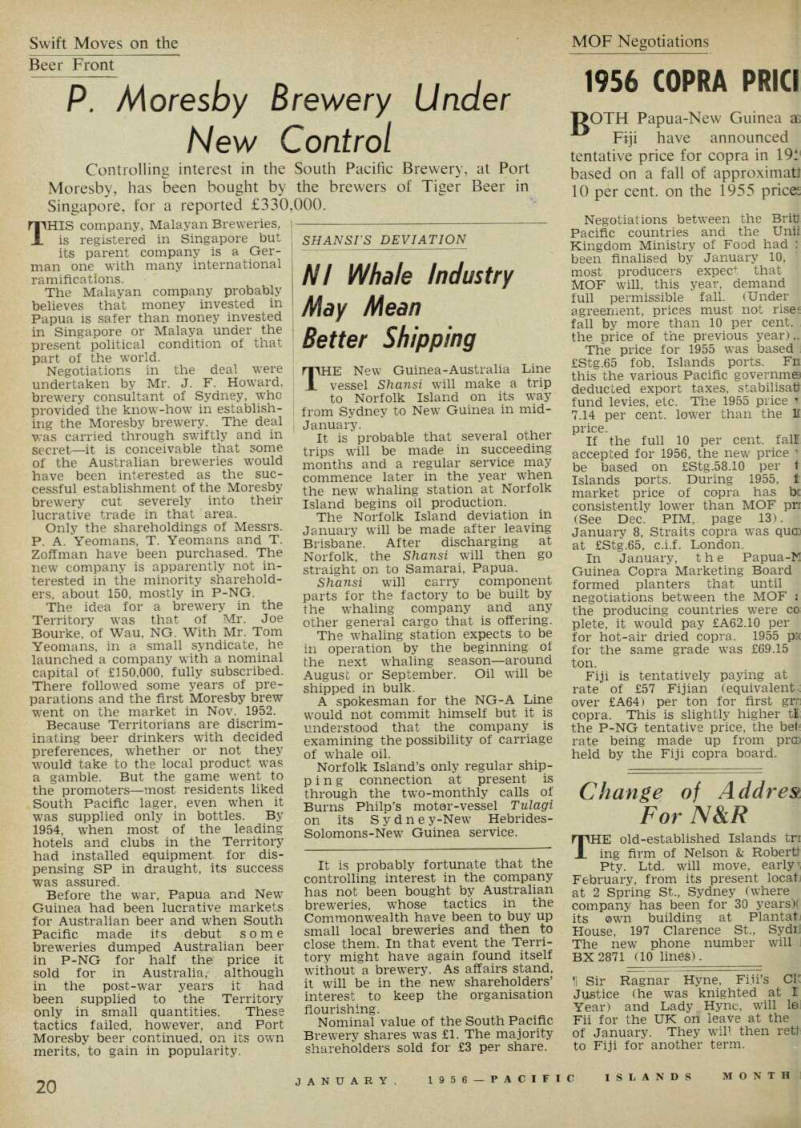
P. Moresby Brewery Under New Control
Controlling interest in the South Pacific Brewery, at Port Moresby, has been bought by the brewers of Tiger Beer in Singapore, for a reported £330,000.
THIS company, Malayan Breweries, is registered in Singapore but its parent company is a Ger man one with many international ramifications.
The Malayan company probably believes that money invested in Papua is safer than money invested in Singapore or Malaya under the present political condition of that part of the world.
Negotiations in the deal were undertaken by Mr. J. F. Howard, brewery consultant of Sydney, who provided the know-how in establish ing the Moresby brewery. The deal was carried through swiftly and in secret —it is conceivable that some of the Australian breweries would have been interested as the suc cessful establishment of the Moresby brewery cut severely into their lucrative trade in that area.
Only the shareholdings of Messrs.
P. A. Yeomans, T. Yeomans and T.
Zoffman have been purchased. The new company is apparently not in terested in the minority sharehold ers, about 150, mostly in P-NG.
The idea for a brewery in the Territory was that of Mr. Joe Bourke, of Wau, NG. With Mr. Tom Yeomans, in a small syndicate, he launched a company with a nominal capital of £150,000, fully subscribed.
There followed some years of pre parations and the first Moresby brew went on the market in Nov. 1952.
Because Territorians are discrim inating beer drinkers with decided preferences, whether or not they would take to the local product was a gamble. But the game went to the promoters—most residents liked South Pacific lager, even when it was supplied only in bottles. By 1954, when most of the leading hotels and clubs in the Territory had installed equipment, for dis pensing SP in draught, its success was assured.
Before the war, Papua and New Guinea had been lucrative markets for Australian beer and when South Pacific made its debut some breweries dumped Australian beer in P-NG for half the price it sold for in Australia, although in the post-war years it had been supplied to the Territory only in small quantities. These tactics failed, however, and Port Moresby beer continued, on its own merits, to gain in popularity.
It is probably fortunate that the controlling interest in the company has not been bought by Australian breweries, whose tactics in the Commonwealth have been to buy up small local breweries and then to close them. In that event the Terri tory might have again found itself without a brewery. As affairs stand, it will be in the new shareholders’ interest to keep the organisation flourishing.
Nominal value of the South Pacihc Brewery shares was £l. The majority shareholders sold for £3 per share.