[?]ecame Big
pp. 125-127 · Read in the full issue
anton Island [?]ow Barren Atoll [?]ecame Big [?]irways Station
L THOUGH Canton Island, in [ the Central Pacific, is an Anglo [ American Condominium, it would pear from a brochure just issued the Pacific Science Board of ishington, DC, that most of the rk of improvement and develop nt there is being done by the lericans. ’he brochure, called an Atoll Ke rch Bulletin, is entitled Canton ind, South Pacific, by Otto jener and Edwin Gillaspy. The ;er were given the task (by the erican Civil Aeronautics Admin ation, of Honolulu) of introduc to Canton Island a variety of nts which would take hold of the ‘ting sands of that almost barren )ical atoll, so as to prevent wind >ion, encourage afforestation and ice the almost unendurable glare, arge numbers of trans-Pacific sellers have seen Canton Island is now the well-equipped fuel -place on the equator, between and Hawaii, for the air-liners hree large aviation companies— all will agree that it is a ;ularly uninviting sandbank, ch could be much improved by station. Otto Degener, of Hono , is well known to Pacific nds people as an economic mist. tie brochure shows that there been careful research over ral years by botanists on Can and indicates that there are ly plants which might be imatised and established on dry atoll—if the swarming ait-crabs will permit. There are ions of the crabs there and they anything, animal or vegetable, sh comes along, either by ffh or as flotsam. will be remembered that in the Dhirties, when the possibility of ■ans-Pacific air services was first , there was a lively contest be m Britain and United States the ownership of Canton and mbury atolls (two of the mix Group) midway between Dlulu and Fij, and apparently ible as air-stations. Canton got erence, because it has an ex ive lagoon, and it seemed then flyingboats might be more im mt than land-planes, itil then the scattered equatorial s of the Central Pacific had regarded as of no economic 5. There was a period when Lo-hunters occupied them; and her period when one or two mnies planted them up with auts. But after World War I
no one wanted them—until the pos sibilities of the Air Age were seen by men of vision.
At different times, from 1800 onwards, the flags of both United States and Britain had been raised on the various atolls by whalers, guano gatherers, copra merchants,’ etc., and bored clerks somewhere in the respective capitals had made records in the archives. No one bothered to point out that these claims were in conflict. The maps, for 50 years, had shown the Phoenix Islands (of which Canton was nominally a part) as British.
BUT when the argument started, in the mid "Thirties, both USA and UK disclosed a good claim
to Canton atoll; and both rushed landing-parties to the island to erect hags and construct concrete “Stay Out” signs.
While the Chancelleries exchanged snarling notes, and the landing parties officially made faces at each other, the two groups unofficially settled down together in amity, fished and exchanged cold beer and reading material, and made the most of a lazy sojourn on the barren sand-bank.
Finally, after three years of inter national spitting (May, 1936-April, 1939) the situation was resolved by the creation of a Condominium: both nations accepted joint owner ship. And thus it has been ever S * nce - (Next Page)
For servicing the planes, main fning the airfield, radio and •ather bureaus, and serving the ssengers during the usually brief nods that the planes of the three [companies (Qantas, Pan Ameri o, and Canadian Pacific) are jre, between 300 and 400 people e on the island—half British, half iericans. But the brochure, giving
a complete history of the atoll from the time it was first seen, up to 1950, shows that most of the work of establishing the airfield on Can ton, and making it fit for habita tion, has been done by the Ameri cans.
Incidentally, until this century Canton was usually called Mary Island. Then it was named Canton
after an American whaling ship of that name which was wrecked there on March 4, 1854.
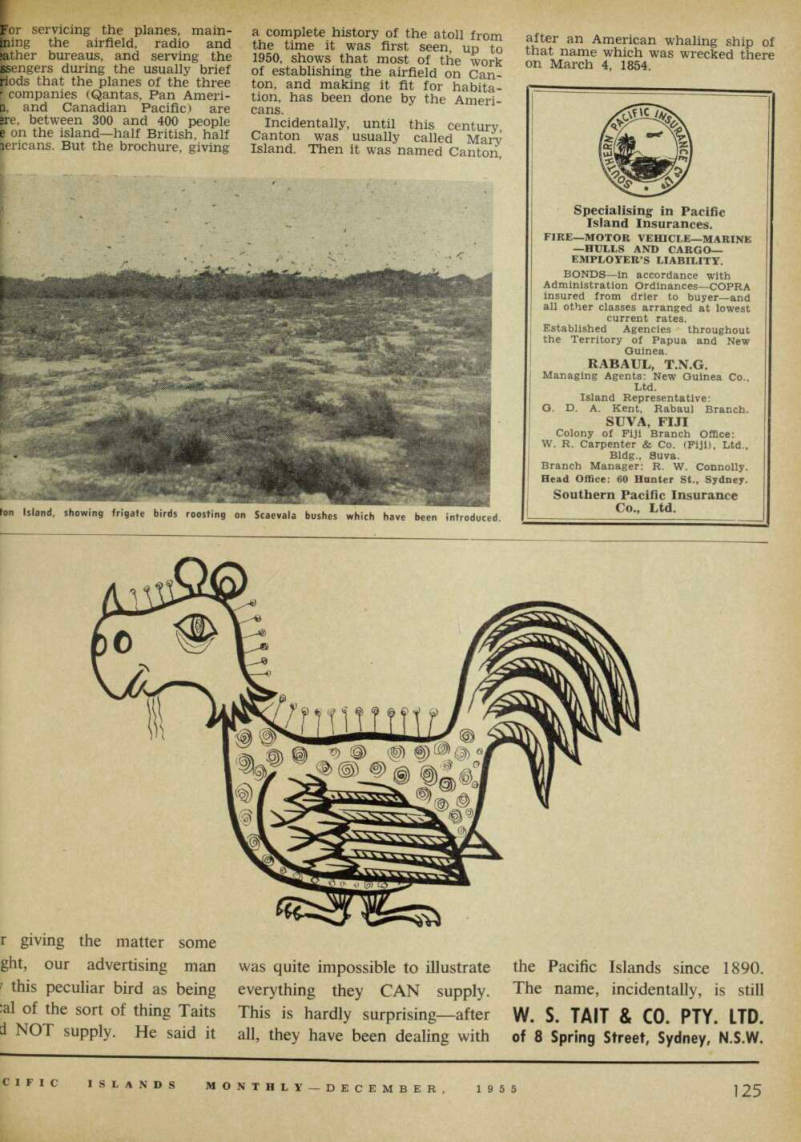
ton Island, showing frigate birds roosting on Scaevala bushes which have been introduced,