News Of The Small-Ships
pp. 99-112 · Read in the full issue

It Happened In December:
Sixty-one years ago this month, I the result of a hurricane, an rtraordinary chapter in the ship ng history of the Cook Islands ,me to an end with the total de ruction of the 97-tons Takitumu in e now unused Ngatangiia harbour, irotonga.
Takitumu had been built in a eat community effort by the people Ngatangiia three years earlier, ider the supervision of an Austral lander named Rapu. Rigging and leel had come from a wreck on angaia, anchor and cable from a liooner owned by Captain Good n, which was wrecked outside ;atangiia as she arrived from New aland with a cargo of timber for e enterprise.
Launched, rigged, but still only rtly decked and not complete, the looner was despatched for Auck id with cargoes of island produce, lich were there exchanged for ;king, copper sheathing, and other ms. rhen, in July, 1894, Takitumu was spatched for Penrhyn atoll, 700 les to the north, on what was to 3ve her last long voyage. The looner had no motor, and already r sails which, Island style, had ver been properly aired or cared , were in very poor condition. ill went well until within 80 miles
of Penrhyn, when a squall blew the sails to tatters. There were no spares, so Captain Tuaua took the only possibile course, a down-wind run for Samoa under the remain ing tatters. Navigation in Taki tumu was less than precise so it was not surprising when, instead of the mountains of Samoa appearing, a low atoll eventually showed up a couple of weeks later. As the schooner drifted closer, canoes came off and Captain Tuaua was able to pin-point hfs position—Nuku nono, the middle of the three Tokelau atolls. Deep water pre vented anchoring, and absence of sails prevented manoeuvring, so Takitumu’s skipper did some brisk trading with the canoes as the island slid slowly by. Much of the Penrhyn cargo had by then been eaten, but some was delivered to the canoes of a Portuguese trader in exchange for a bale of copra sacks and some twine. As Nuku nono disappeared astern all hands were put to making sails from the heavy sacking, while the strange drift voyage continued.
Takitumu truly sailed under a lucky star, for when it was clear that one bale of sacks would not provide sufficient sail area to make the long windward slug back to the Cooks, the wind and drift proved
such that Fakaofo, the south eastern most Tokelau atoll, was next approached.
Here again, in deep water, there was no possibility of anchoring, or of otherwise halting the ship, short of casting her onto the reef, which by this time all hands would have liked to do. So again trading was opened, a few more sacks were obtained, and many pandanus mats, the schooner already being well away from the atoll as the trans action was completed by the canoes from shore.
So the strange rig of sacks and matting, delicate and unwieldy, was completed and the long hard beat to Penrhyn began—and ended just
five months out from Ngatangiia.
By then all the Penrhyn cargo had been eaten or traded away. After a brief rest and refit in Penrhyn lagoon the course was laid for Rarotonga.
With that island in sight only five days later after a quick run, the last of the food was shared out and eaten. Then the wind dropped.
There followed almost six weeks of calms and contrary winds, with Takitumu sometimes in sight of Rarotonga, sometimes set far away to the north again. Fortunately, a passing sailing ship, bound for Aus tralia, supplied the schooner with desperately needed food during this exasperating period. Finally, exactly seven months after her departure, Takitumu arrived home from her last and least-profitable voyage.
Two weeks later she was pounded to pieces by a hurricane within a stone’s throw of where she was built.
The Joyita Mystery:—To
late November the wordy despatches from Suva in regard to this vessel were remarkable mainly for their lack of firm facts. Possibly because the Western Samoa Government may be faced with damage claims from relatives of the missing, there appeared to be a close-down on all factual information from Apia as to the exact number of persons, life saving equipment, nature of cargo
aboard, and state of engines and radio, pending an inquiry which was to take place there soon.
Some reports spoke of charred woodwork and evidence of an ex plosion; others denied this.
Explanation of the mystery of the missing personnel seemed to centre on three big questions: were they separated from the ship at the time the visible damage occurred, at an earlier time, or at a later time?
The extent of damage suffered suggests that it was unlikely that every person was thrown overboard.
The time and place of discovery by Tuvalu shows a drift of about 37
miles per day, and agrees wii published data on speed and diree tion of drift in these waters. Curres charts would suggest that the drh began nearer Samoa than Fakaofo' Clearly Joyita passed within sigg of Wallis, visible about 20 mili at 20 ft height of eye, on aboo October 10-11, and within sight Futuna, visible over 50 miles, i about October 14-15. If there wv some early sudden disaster, whid some or all aboard survived, the may have abandoned Joyita to sb tempt a raft landing on one or othd of these islands. The landing mx have been unsuccessful for all hanoi
the raft might have been set leeward, and never reached the re. uch a raft, drifting probably a e faster chan Joyita, might reach southern New Hebrides by late member or early December. :elauans and Gilbertese might I survive such a drift. f charred wreckage reported on n Wallis and Futuna proved to from Joyita it would show that damage was suffered east of
those islands, and would suggest a sudden disaster. Some, viewing the published photos, consider that all the visible damage could have been caused by the sea and by cargo, drums of oil, etc., smashing about,’ floating but trapped in the slowly sinking and gradually listing vessel's deck structures after the vessel had been abandoned.
Abandonment might well have been initiated merely through both motors being broken down and the radio unrepairable.
Undoubtedly, searching RNZAF aircraft must have been visible or audible. When eventually it seemed clear that the search had been abandoned, and with perhaps Wallis
or Futuna in sight and good prospects of a landing, the master may have made that decision.
Apparently absence of sextant and chronomoter might strengthen such a theory, as the master would certainly take these.
There seemed to be no evidence of any attempt to rig sails, made, say, from scraps of canvas, copra sacks, or bedding, which must have been available in Joyita. This fact might strengthen a sudden-disaster theory, unlikely as it would seem that all could have been tossed or washed overboard at the same moment.
A cargo of empty drums from Apia to the Tokelaus seemed strange
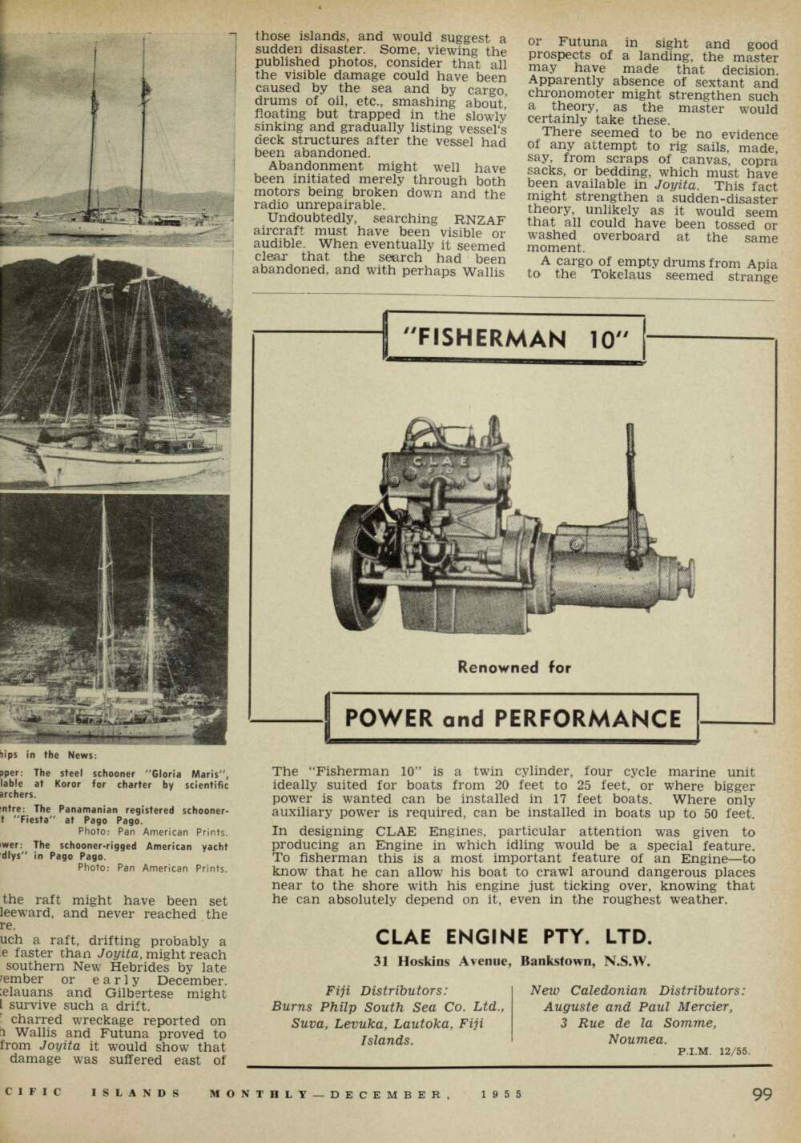
hips in the News: [?]per: The steel schooner "Gloria Maris", [?]able at Koror for charter by scientific archers. [?]ntre: The Panamanian registered schooner [?]t "Fiesta" at Pago Pago.
Photo: Pan American Prints, wer: The schooner-rigged American yacht dlys" in Pago Pago.
Photo: Pan American Prints.
rgo. The explanation, we believe, that a re-settlement scheme is in ogress there and the drums were : fresh water storage in a new lage pending establishment of rmanent tanks.
Reports suggested that Joyita’s msmitter was not unserviceable t had merely been put out of (ustment. There was a radio hnician aboard, but he may well ve been sea-sick up to the time any sudden disaster. It must also remembered that a transmitter useless without a power supply. nta’s 100-watt set would have a y heavy power drain.
'he set did not operate on the itinuously monitored 500 kc/s tress channel. It possibly could rate on the 2182 kc/s voice disss channel, on which Apia keeps watch, but on which Pago Pago ps a speaker watch. Fruitless s would very quickly run down accumulators. If the charging was out of action the set ild then be useless. here is another, perhaps very ikely, suggestion for a possible ippearance of all aboard. The iel was fully refrigerated in all ?e holds. If the system employed noma, a fracture or explosion ht have released a flood of that k i ng , chemical , the bilges, hands may have been forced poranly into a raft or boat (if ' ■
It is conceivable that a squall could have separated raft from ship at such a time. Unlikely—but pos sible! A similar event almost occurred during the Kon-Tiki voyage.
From the photos (see elsewhere) it seems clear that a collision was not the initial disaster. The hull is quite unmarked. It would still have been possible for the damage to have been done by another vessel Japanese fisherman possibly col liding with, or going alongside after the ship had adopted her heavy list Any collision then would have in volved the superstructure, and not the hull, on the port side and would explain the visible damage, Presumably the master, crew, and owners of Tuvalu forfeited any salvage claim when they handed over to the Fiji Government’s Degei
For Your Safety • —While
pim is of the firm belief that the inexpensive Gibson Girl 500 kc/s emergency transmitter, described last month, is the present primary answer to many Island shipping in cidents. Islands seamen should also be aware of the principles upon which air-search radar equipment operates and how their chances of location may be greatly improved, The effective range of a radar set is very much dependent upon the reflective properties of the object be ing sought. The set emits pulses of radio waves. Such waves, on strik
ing distant objects, are reflected back. The time taken on the return journey is automatically measured by the set. As the speed of the waves is known, the distance can be measured from the time interval.
But here is the important factor; Metal objects are much more re flective than objects like a wooden ship’s boat, raft, or rubber dinghy.
Therefore, every such life-boat or raft should carry a metal radar reflector.
Reflectors of collapsible type are now being issued to ship’s lifeboats and are hoisted to the masthead when in use. A piece of copper or galvanised iron sheeting even a foot square, hung by one corner, free to spin, is quite effective and may mean the difference between an air craft locating or missing a boat.
The larger the metal plate, the more effective it will be —but it must be free and not nailed to the mast, or an aircraft in the plane of the plate will not detect it effectively.
A plate bent at right angles is better, though not so readily stowed.
The higher the reflector is hoisted the more effective it will be. A tail of light metal foil attached to the Gibson Girl kite is a highly effec tive reflector. The aerial wire which forms the kite string is over 300 ft long, and the kite, in a normal trade breeze, will fly at about 100 ft above the sea.
These inexpensive safety measures
may save your life and the tax payer thousands of pounds.
NNG SURVEY:—Due to arrive in Netherlands New Guinea waters from Holland before Christmas is the survey vessel HMNS Snellius with a complement of 100 men. The vessel will joint HMNS Luymes in a big charting project, which at present is being concentrated on the
south coast from the Papi border to Princess Marianne Strn near Marauke.
An interesting feature of the s vey is that DECCA navigatun equipment, now widely used in Euj pean waters, is being used. DEO shore transmitters will soon be ; up by technicians from Hollas Their exact geographical positii:
id, they will provide the “trigs” n which all work will be based.
Ook Islands Fleet:—A. B.
laid & Co.’s 300-tonner Charlotte laid, larger of the two present ;els in the Cooks inter-island ie—the other is the hard work- Brixham trawler Inspire —came
i to Auckland for survey in No )er following a touch on the :aki reef. Formerly the Kina ngan, and built at Fremantle, was the first visit to Auckland 1950. Normally, the vessel re n Papeete during the hurricane »n.
Rarotonga correspondent reports Mr. D. C. Brown (whose last 1, the 300-tonner Rannah, was ided at Avarua, Rarotonga, on mber 16, 1954, and was recently on the reef by the insurance >any), may soon take delivery of fin-screw vessel with a cargo flty of 80 tons. A company of ti Mr. D. C. Brown is senior ler, was recently registered in land as Island Merchants Ltd., tonga. 4. BEL ROSE: —To join the ;rn Samoa fleet, as reported in Der PIM, the former US Army )1 Craft Isabel Rose was to l r Sausulito, California, on aer 23, for Pago Pago via Hono-
With Captain Robert C. Payes, normally skipper of Manu’a Tele is Chief Engineer James W. Sword,’ of the same vessel, and six Samoan crew men, and William Steffany with his brother, Joe, purchased the vessel for the Pago Pago-Apia trade.
FOR SALE:— Manu’a Tele, the 258-ton ex-US Navy Yard Mine Sweeper, which, in addition to pro viding communications with the Manu’a Group, has provided the main sea link between Apia and the Tokelaus in recent years, under charter, will soon be offered for sale by the Eastern Samoa Government as agent for the Manu’a people who own the vessel.
Manu’a Tele is almost identical with
the French naval patrol craft Tiare based at Noumea and well known in Polynesia, except that the former has been stripped of all armament and modified for cargo handling Powered by two 400-hp GM diesels, the American vessel measures 124.3 ft x 24.8 ft x 11.1 ft. Her present duties will be taken over by Isabel Rose, mentioned above, as well as MV Samoa, a smaller vessel owned by the Steffanys.
Nukualofa Improvements:
—New Zealand Ministry of Works engineers were recently in Tonga discussing final details of recon struction and extensions to the Nukualofa wharf. Plans will soon be prepared and it is expected that
[?]er: Captain W. J. Buckley, mentioned in [?]onth's notes. [?]er: The yacht "La Paloma", salvaged, [?]ed, and for sale in Papeete.
iders will be let within a few mths.
\Nother Ocean Letter:—
nstable Makira, of Rakahanga md, Northern Cooks, picked up a tie at the south-east corner- of atoll on October 23, containing following message: “My name Edwin M. Watson. I am 14 years . I live at 110 Broad Ave., Naples, A. I am aboard the SS Pioneer, route to Tahiti. We are about )0 miles WSW of Panama Canal. 11 you please write and let me )w where you found this.’’ Only ng missing was date of launching, e drift was about 2,600 miles, jarently through the Marquesas, a course a good deal north of ,t indicated by Admiralty life ,t charts.
R Eteran Visitor:—A Novem
visitor to PIM Sydney office was itain W. J. Buckley, whose itical memories of the Solomons back to 1904. Now retired and ng near Sydney, Captain Buckley Sydney in 1904 in Captain mson’s new 45-ton schooner dsay. He remained with the ss e 1 when Levers bought out )tain Swenson’s Gavutu property n after, then returned briefly to Iney. >ut the Islands were still calling [ he shipped out for Samoa in then Southern Cross to work for Germans for a time. Then back ;he Solomons via Sydney to join s small schooner Alcyone, which [ been shipped up from Sydney ard the Moresby. Next shift was 3P’s larger Sideia, recruiting, and r to the firm’s Rogeia for a le. fter that Captain Buckley joined mership with Sam Atkinson, tak command of the 19-ton schooner i on recruiting work. Then came First World War, and Captain ;kley, back in BP’s Rogeia, found self under naval control, patrol a 400-mile stretch of Solomon ers on the look-out for Von kner, who was then loose in the ific with Seeadler. After that he ame master of the Mascot until loss in the Santa Cruz Is. as in recent issues of PIM. fter a spell ashore in those nds, trading, Captain Buckley ie back to Sydney in the de ;sion of 1935, and was with the ney pilot service for a time, ed when he planned to ship out the islands again, the old ►per’s eyes sparkled and he hi nted that he could be interested ny delivery job that was offering.
Cientists Take Note:—In
issue is a photo of the 110-ft 1 American schooner Gloria us, currently lying at Koror, ronesia, and available for charter icientific institutions or research rkers. Owned by Alfred J. tieimer-111, of Philadelphia, and rtered on a long-term basis to ural Science Foundation of that
city, the vessel can be sub-chartered on a bare-boat basis with her present crew.
Bargain charter rates are offered to scientific groups to help off-set expenses. Groups interested in research in the Netherland New Gumea-Indonesia area would be welcomed, to work in with Foundation plans in those waters. Contact T. 8 P l . e wl th Captain Ernest Chamberlain, at Koror or with the Natural Science Foundation, 1510 Chestnut Street, Philadelphia 2, Pphti tjc a n TOIL and TROUBLE:—T he P-NG Administration’s new medical patrol vessel Heduru has had her share of adventure since entering
service. The vessel arrived in time to take part in the search for sur vivors of Elsie-B in Papuan Gulf waters late August, suffering some heavy-weather damage in the pro cess. Early in November, with the Chief Medical Officer aboard, patrol ling all stations from Daru to Kairuku, the vessel suffered an engine break-down and had to be sailed 40 miles to Daru. En route she struck several tidal bores in the Gulf and finally went aground but was got off undamaged.
Want A Tanker?:—The 8,000-
ton former Jap tanker Naruta, lying half submerged in Rabaul Harbour, is again offered for sale by her owners, Anderson’s (Pacific) Trad
ing Co. Ltd. Offered in May, 1953, Naruta failed to attract bids above the reserve. She was later allowed to sink, but has recently been partly salvaged and is now higher in the water than ever before. Measuring 525 ft x 58 ft, with a moulded depth of about 50 ft, the tanker has 12 tanks each of about 650 tons capacity. She was damaged by bombs aft in the engine room.
FOR REEF WORK:—Designed by Mr. Ronald Powell and built by Kareroa Brothers, of Rarotonga, a specially designed motor surf boat has recently been proving its value in cargo-handling operations across the Mangaia reef. The propeller, located in a tunnelled recess, cannot foul if the craft grounds. In the past all cargo handling has been by craft propelled by paddle or oar.
THE AUSSIE WAY: W h e n foreigners buy Australian-registered ships they do not just put their crews aboard and sail away—as was amply demonstrated in Sydney re cently. Either an Australian crew takes the vessel to a foreign port and is sent home first-class at the purchaser’s expense, or, at the dis cretion of the maritime unions, the equivalent of what all this would cost is paid to the unions, who may then permit the foreign crew to take the vessel away.
In one case recently the vessel was bound for Hongkong and a Chinese crew did the job after the
financial formalities had been at tended to; and in the other case an Australian crew took the vessel to Noumea, where an Italian crew took over for the voyage to the Mediterranean.
For Fiji Fleet?:—The Jap
anese fishing vessel Mie Maru was still sitting on a reef 2 miles from
Ongea Driki in mid-November.. was reported from Suva that a II firm had quoted the Japa:* owners a “substantial sum” to cs out a survey of salvage possibilil Oyr guess is that Mie Maru, uu a new name, will be trading rco the Fijis within another tw* months. Damage is believed toe only minor, but two Japanese t
1 vessels could not pull her clear, hands were taken off on October including certain equipment.
Vhat’S In A Name:—It Has
n previously pointed out in this amn that many Japanese vessels registered under the same name, ugh with a different number tended, and that the name means hing without the number, n November, when completely bunded accusations of murder of Joyita personnel by Japanese e being freely headlined in the stralian press, one Melbourne >er pinned the crime to the koku Maru. When the charge i referred to Japan, the reply le back —“Which one? There are least thirty!” he charge in this case seemed lave been based on the fact that vessel variously identified as koku Maru No. 10, and Baikoku ru No. 10, had put into Pago :o for treatment to a seaman i a dislocated right wrist and of three fingers, said to have i sustained in handling fishing ipment. his vessel was not one of the 0 Pago-based fleet, but belonged 1 fleet working the Samoa-Fiji >erts area from Japan. It may ’ecalled that at least a year ago Japanese Fisheries Department ounced that Jap tuna vessels Id fish in the Cooks-Tahiti area year.
Efit Completed:— La
raine, Agence Reuter’s 209ler, refit completed in Suva, red that port November 5 on re l to Noumea.
Fartling The Natives:
orts from New Hebrides waters cate that the English Brixham fler Inspire, currently running ;oes in that area, has been caus some distraction and excitement ig the beaches. seems to centre round the less i voluminous dress adopted by three attractive lady members of five-strong crew. Some observers, lying the ketch through powerful ses when quite far at sea, so ’tis , have rushed orders to Sydney l-order houses for still better ses!
Ec Qmmissioned: Albert
neaud, Compagnie Francais Hebrides’ 240-ton New Hebrides er, out of commission through lage in July, 1954, is on the run n. A new propeller was flown ay the last Qantas flight. It is wed, however, that the company seeking a replacement to this ;o-and-passenger vessel.
Nc An Celled Distress
jL: —lnterception of an R/T ress call by an Australian coast ion on October 31 lead at first the belief that Captain Emile Die’s Maria del Mar, somewhat due from Noumea, was in ble in heavy weather.
Some time later, when the Savoie 1 had checked in by radio with all in order, it was discovered that the cause of the excitement had been a small craft in New Guinea waters. The name of the vessel was not released to the press but the master had sent out a MAYDAY but C was“ h The b ?essef n alai d n by d afr search" P ° Wer ’ W&S located oy a i sea c .
For Customs Control;—To
help combat cargo pillaging and illegal removal of cargo from the waterfront, two control posts are bemg built at the Suva wharf exits.
Special Delivery:—Captain
Max Stanton, well known in the
Islands for his delivery of many new —and old—vessels to Island owners, was to have taken the hospital ship and former BSIP trader Ruena to the Andaman Islands in the Indian Ocean in December, but because of delays he was off on a more press ing task
Ss Sj
Melbourne to Trteste. SfL/weU
fOT°m”rly°as ttfe “rare
Knob (ex Euwarra ), was recently sold to Italian buyers and registered in Panama. she was to clear in early De cember with a cargo of wheat for Malta via Suez. Aboard as Third Mate and Radio Officer was Mr.
W. Schutz, of Tarawa, released for
i task by the Australian Shipping ard. It seemed possible that Cap n Stanton and Mr. Schultz might iver another vessel from Europe Australia on completion of the sent job.
Leady To Roll:—S. Berg &
’s Kurimarau, former BSIP Gov iment vessel, after a long period idleness, arrived in Sydney from Hina, northern NSW, on No iber 23, spick and span in white, h blue-topped buff funnel, buff >er works, and blue and green nmings. :urimarau’s cargo handling facil s have now been greatly im ved. Previously the after hatch, ited beneath a permanent upper k, could not be worked except by nhandling of cargo across the in deck. Now this upper deck been broken, a large section in way of the hatch lifting clear, he former after-mast has been laced by a shorter steel mast ited further forward. With two ricks and two new electric ches the after-hold is now well r ed. mongst other new equipment is Vaughan 4-channel radio-tele ne transmitter covering the 2-6 s band, with added broadcast nnel in the receiver, fter slipping and undergoing hull rey Kurimarau will enter the
New Guinea coastal service. With her considerable covered deck space this Hongkong-built 288-ton vessel is particularly well suited to the carriage of deck passengers. She has a hold capacity of 16,000 ft. It is understood that the vessel is available for charter. A New Guinea crew was being brought south in December to man her.
HANDED OVER: —Renamed In daustral, the former Fairymead Sugar Co. Army GPV-type vessel Ruena, now a smart hospital ship, was handed over to the Indian Gov ernment in Sydney on November 29. By the time this appears the vessel should be well on her way up the Queensland coast bound Torres Strait, Singapore, and her new home port of Port Blair in the Andaman slands. Cost of purchase and refit was about £60,000. The ship now has accommodation for 20 patients, a medical officer and staff, and the crew. There is an operating theatre.
Attractive Stranger;—An
unusual caller at Suva and Sydney in November-December was the 495- GT Rican Star flying the Costa Rican flag. A steel vessel measur ing 180-ft x 24 ft x 13 ft moulded depth, she was built at Newport, News, USA, in 1922 as the yacht Eleanor.
Captain Julius Jensen, now in
command, had little information on her early history, but knew that she was acquired by the US Hydro graphic Survey Department, and later by the US Navy, in which ser vice she served as a patrol craft on the East Coast during the war.
She was acquired as the Mazana
Queen by her present Canadfc owners in 1948 and renamed Rm Star. Registered in Porto Line she is now normally on the Cenlfj America-Canada West Coast bans; trade, being fully refrigerated that purpose. She is powered b:c pair of 8-cylinder Wilton dieis which give her a service speed! 10-11 knots and a top speed of abc 14 knots.
Equipment includes a record!; type of echo sounder and a channel radio-telephone transmits Her yachty lines, long overhangs counter, white hull with blue-topn buff funnel and blue star, catch eye. There are 14 all told aboard when they are not deserting, several did in Honolulu and Si on the run south, and some mr did in Sydney, where crew y sought. The island deserters w/ to be picked up on the run Ikd to Vancouver, or possibly Longbeas Cal.
Normally, it would not pay to i a vessel of this size down to S;< ney but in this case it did — cargo was dynamite, on which hr freights are received. The ownn Canvica Trading Co., had an terest in another small wooo( vessel which brought a sim:i cargo south recently. This was Mina-C, whose cost was paid the freight of a single voyage.