Tropicalities
pp. 79-80 · Read in the full issue
Magazine Section
Bop In W. Indies
rHE United Kingdom Informa tion Service recently reported that a Bird of Paradise sanctuary s to be developed on Little Tobago gland, West Indies.
It appears that in 1909, Sir William ngram, a bird-lover, fearing that tie then prosperous trade in Bird f-Paradise feathers would spell oom to the species in its natural abitat of New Guinea and neigh ouring islands, had 47 birds trans ited to Little Tobago.
To-day, only 11 birds survive there, nd the Government is taking ction for their preservation. Sir William’s heirs gave the 450-acre ittle Tobago to the Government as permanent sanctuary in 1929.
Kinda Homespun!
i N American reader, calling at \ PIM office recently, said that what he most likes about the iblication is that it’s “kinda jmespun.”
The same could be applied, per ips more so, to the Cook Islands ficial daily news-sheet, a miscel tieous collection of news items, an luncements, and advertisements, tie following morsel in the issue of ctober 4 must have raised some eculation from Mangaia to Puka ika; “LOST: One Wedding and One igagement Ring in Public Con nience last Friday. Would finder ease ring Further Education Office Reward.”
Machine Age In The
(Islands) Kitchen
SAD little note recently re- L ceived from a Port Moresby housewife: “We have now installed a wash g-machine to solve the laundry oblem since recent building opera ins have eliminated what little id we did have. Gae-Gae Uhe neral factotum) and I have fun id games each wash-day in the ;chen. It takes him twice as long do the washing now—what with . the knobs and switches and mgs.”
Ghty Men And One Woman
FO names, no pack drill—but it’s lon again. The city fathers of the German city of Bremen re rt that they are inundated by quests from men in remote parts Australia, New Zealand or distant
Pacific Islands “like New Hebrides or Fiji,” to find them German wives.
One PI resident has offered to pay the fare of any Fraulein who is prepared to “give it a go,” and to pay her return fare to Germany if, after three months, she cannot take the loneliness.
Sounds fair enough. By way of encouragement he says that there are 80 men (colour unspecified) to every white woman in his neck of the woods.
Case Of The Vanishing
Ladies
AN Australian newspaper declared recently, with the usual amount
of journalistic ex uberance, that a hula-dancer was going to Wewak, New Guinea, to be come a missionary.
The hula-dancing missionary is an American, Mrs.
Frances D i 1 Is, who has been do ing radio work in Sydney but has already done some Roman Catholic missionary work in Hawaii.
Says the news paper: Except for a few Roman Catholic nuns, Mrs. Dills will be the only white woman in Wewak.
When I first saw Wewak in early 1936, I was by no means the first or only Euro pean female, and things have im proved consider ably since then.
So come out, wherever you are, you women of Wewak, and show yourselves.—J.T.
Gentlemen,
Please!
SUCH is the present ship ping situation in the Cook Is. that mail written there in Jifiv reached Sydney only in November.
One communica
tion reported the visit of the Min ister of Island Territories in July.
During what was described as a complacent and overawed meet ing with the Island Council, there was more than one moment of em barrassment for the official trans lator. On one occasion, when every one seemed to be saying the right things, one sturdy Councillor arose and said in Maori, “Tell the Min ister that when the Americans went to Aitutaki they built a good reef passage in three and a half months.
We in Mangaia have been asking New Zealand to do a similar job for the past 55 years. What is his reply?”
The question was translated.
There was a somewhat tense silence in the Chamber, before the next item of business proceeded. The Councillor still awaits a satisfactory reply.
Battle Of The Redcaps
RIVAL clans of porters met in combat on the gangway of the Messageries Maritimes liner
Eridan in Papeete early in No vember, A Papeete correspondent, arriving at the wharf shortly after the vessel berthed, said that he was amazed to see what appeared to be some kind of a juggling act in progress on the vessel’s gangway, with hat boxes, hand-bags, and sundry other items of passenger luggage flying high.
Police Chief Waksmouth and a flying squad were quickly on the scene and put an end to the act, after a good many shirts had been torn and some bruises sustained.
When the Southern Cross came in some days later a large police squad stood by to prevent any recurrence of the affair.
Missing; Two-And-A-Half
Hockey Teams
A PLOT for an O. Henry story sees to lie behind the cryptic if intriguing advertisement in a recent Papua and New Guinea Gov ernment Gazette calling for tenders for “Thirty (30) only Hockey Sticks in new and unused condition ... offered on a basis of as is where is.”
Would-be purchasers are sternly remimled that, if successful, they w r ill be expected to remove the 30 hockey sticks from their present location within thirty (30) days.
What dark plot lurks behind the advertisement? The possibilities are endless. . . . perhaps some Planner’s dream of weaning some far-flung Brown Brothers from the age-old game of head-hunting. Perhaps a subversive plot to arm infuriated Public Servants against any future visiting team of cost-of-living ad judicators. (Tenderers must mark their sealed bids, “Hockey Sticks,” and have them in the hands of Mr.
T. Grahamslaw before December 8).
Queen Salote And The
Chauffeur
A SYDNEY Sunday newspaper, The Sun-Herald which apparently has joined most other metropolitan Anglo-American newspapers in a policy of leaving truth at the bottom of a well — allowed a former Buckingham Palace chauffeur, named Gill, to say this, on November 20: During the Coronation in 1953, Mr. Gill was seconded to the Sultan of Zanzibar as chauffeur.
“He was a real toff,” said Mr. Gill.
“He and Queen Salote, of Tonga, were the gallery favourites during the Coronation.
“A mate of mine drove Queen Salote around while she was in London.
“When she was leaving the country, she picked him up bodily end gave him a smacking kiss and said: ‘Thanks, chum.’”
It is re-published here to show the
kind of absurd rubbish that is printed nowadays in journals which cater for the mob.
Also, we who know and esteem the charming and dignified Queen of Tonga will be intrigued by the fanciful picture of Her Majesty seizing and kissing her chauffeur, and thanking him in broad Cockney.
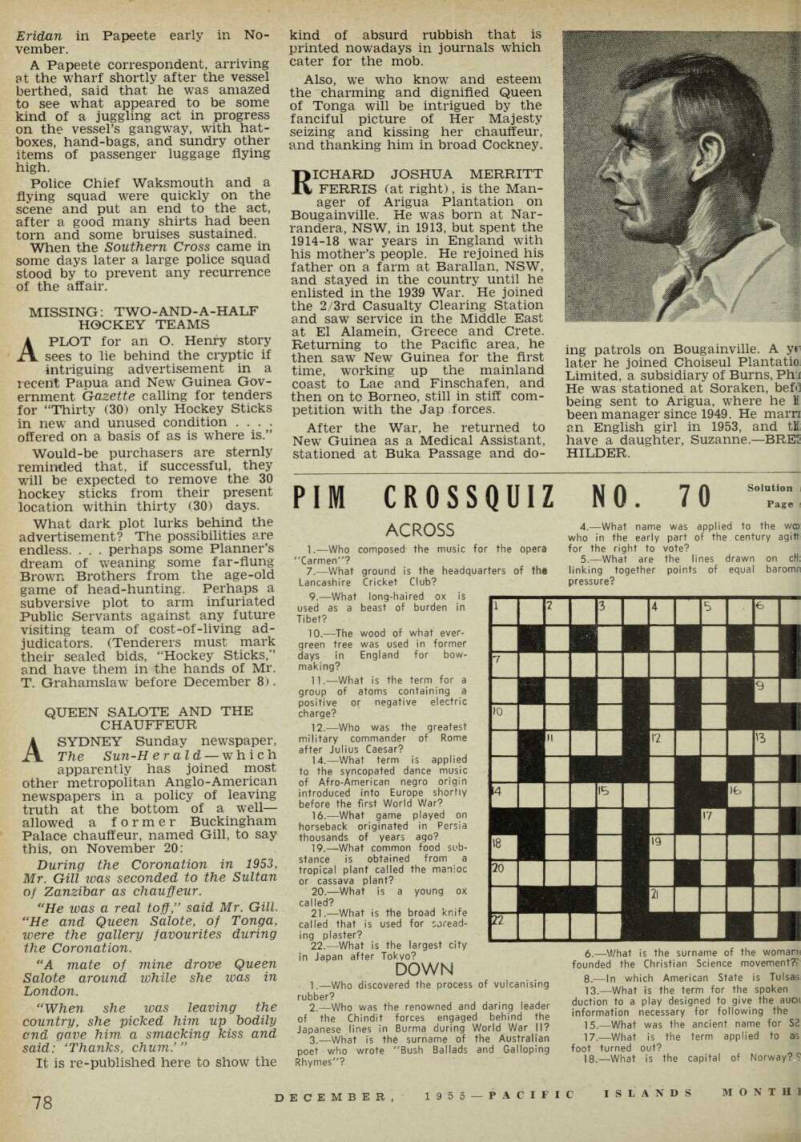
Richard joshua merritt FERRIS (at right), is the Man ager of Arigua Plantation on Bougainville. He was born at Nar randera, NSW, in 1913, but spent the 1914-18 war years in England with his mother’s people. He rejoined his father on a farm at Barallan, NSW, and stayed in the country until he enlisted in the 1939 War. He joined the 2/3rd Casualty Clearing Station and saw service in the Middle East at El Alamein, Greece and Crete.
Returning to the Pacific area, he then saw New Guinea for the first time, working up the mainland coast to Lae and Finschafen, and then on to Borneo, still in stiff com petition with the Jap forces.
After the War, he returned to New Guinea as a Medical Assistant, stationed at Buka Passage and do-
ing patrols on Bougainville. A yr later he joined Choiseul Plantatioj Limited, a subsidiary of Burns, Ph:x He was stationed at Soraken, bef'l being sent to Arigua, where he M been manager since 1949. He marn an English girl in 1953, and tH;
have a daughter, Suzanne.-