Territories Talk-Tal[?]
pp. 24-31 · Read in the full issue
By Tolala
Happy Christmas!
And I don’t mean that present day commercialised “XMAS” which we see so much these days and which means so little insofar as the true Christmas spirit is concerned.
Let’s put Christ back into Christmas —not “X”, the unknown quantity.
To all my friends: Peace and Happi ness; Goodwill to all mankind.
Intersectional Snarl To me it has always been a matter for regret that the non-native section of the P-NG population has not been more co-operative, one with the other, and done everything pos sible to avoid sectional jealousies and animosities. Life in P-NG would be so much easier and more pleasant if every section was more tolerant of the “other fellow.”
An example of this—in reverse — claimed public attention recently when the Acting Director of Educa tion —a Mr. G. T. Roscoe—presum ably in his official capacity, made some outspoken remarks anent Mission educational methods before the Arbitration Court when it was hearing PSA claims for more dough and what-have-you. Though exactly what relevance there was between PSA claims and Mission operations I’m afraid I was unable to under stand.
Anyway, the ADE was reported as having suggested possible irregular ities in some mission returns; figures upon which were based government subsidies to the Missions. This
occasioned an animated reply f;l the Rev. Percy Chatterton, of London Missionary Society who < equivocally went gunning for G. T. Roscoe.
I don’t want to comment om right or wrongs of eithen these gents., but it does s unnecessary to wash their linr whether dirty or not—within view of the public; and it certs does not reflect much credit! either party. Especially now, w many of our dark-skinned chss are quite competent to unders* the printed English language.
Is it so impossible for the EE pean community, at least, to s a united front to the native pe of P-NG? (On November 17, the Administrate P-NG, Brigadier D. M. Cleland. issra Press statement in which he said that Roscoe had never claimed that Misi had acted dishonestly in compiling re» relating to educational grants-in-aid 6 claimed that Mr. Roscoe had either • misreported, or that his meaning was interpreted. Mr. Roscoe, he said, , stated that some missions did noti sufficient detail in their reports, on they included in their reports detat schools that fell short of the nece; requirements for the payment of sidies. Some of the missions also ino on their returns details of activitiese could not be regarded as educational t ing within the meaning of the Eduo Ordinance. Brigadier Cleland alsoc something to say about Mr. Chattels outburst that missions objected to ‘ schools being judged by inexperii young patrol-officers” (‘‘South Pacific s of November 16). The Administrator that patrol-officers’ reports are limit* idvising the Department of Education! the schools are functioning and asces ing the number of pupils. They di report on the educational work oa mission concerned. —Editor, PIM.) Some Statistics on
P.NG Education
The argument between the Eo: tion man and the Missio prompted me to look up some figJ on Government subsidies for mi activities. Unfortunately, thee statistics I had on hand were 1 for 1951-52 in Papua, but, neves less, they were somewhat illurm ing.
For instance, there was mission, according to the statid which had a total of 5,001 digenous adherents, with 16 sch and was receiving a subsidy off £6OO. While Mr. Chatterton’sa mission society, at that periodfc receiving a Government subsioi £4,521 for the maintenance oc schools, most of which wen villages, and was expendingg education from its own funds,,; £97 more than that received the Government. Another mix society, however, was receivif
rernment grant of £2,609 and was ending from its own funds for cation no more than £2,144. For (year, Government paid out some 000 as educational aid to all pions in Papua for some 40,000pupils and, if my sums are right, t works out something like 147- Bad. byway, can you reduce native pation to a matter of £SD?
ie Real P-NG Money
Government financiers are on 'look-out for more revenue—and Bems they should be with exes, ing all the time—what about ting their own money for the rttory. The Postage Stamp ;ure must be proving a lucrative ertaking and old New Guinea |e a very nice profit out of its
[ coinage.
t 1939, with coins valued at ,534 in circulation, the Coinage »t Fund was already in credit he extent of £77,397 —but was ble to transfer any of it to nue account until the figures eded £lOO,OOO. With greater ent-day spending that should ent no difficulty, hy not give it a go, Mr. Money -59
ipeless” Labour System
ie remarks of Dr. Young on 3- labour conditions (Nov. PIM, 2) are a reiteration of expert
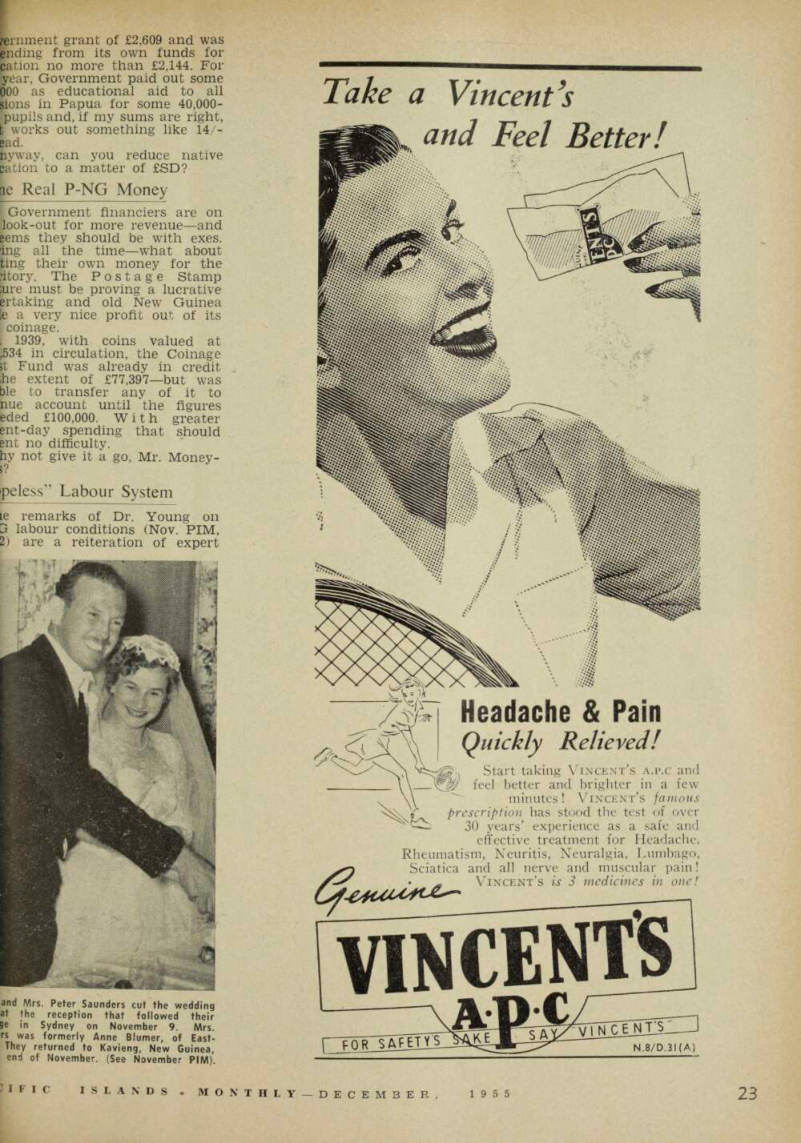
and Mrs. Peter Saunders cut the wedding at the reception that followed their [?]ge in Sydney on November 9. Mrs. [?]rs was formerly Anne Blumer, of East- They returned to Kavieng, New Guinea, end of November. (See November PIM).
inions made over the past thirty d years.
Back in 1923, when the Expro ard was wondering how to dis se of the old German plantations TNG, Lever Bros, interests from e BSIP toyed with the idea of king over all the estates; and orge Fulton, the general manager, ide a tour of inspection in the I Koonakarra. He was favourably pressed with the properties— yecially the Witu group—but our was the fly-in-the-ointment *n in those days, and the Big ■m gave the idea away.
Queen Emma,” on her Kokopo ntations, encouraged the idea of iblishing native communities, and I system worked well until the stralian Government came along i the League of Nations started Ing out about “slavery”—which certainly was not. ’he establishment of native ages on Ceylon estates has been narily successful owing to the ise population and the economic ssure which compels the natives i r ork —or else; both conditions be absent from P-NG, the Land of tity. he labour situation can only de orate, in my opinion, what with e expansion of co-operative eties and the drift of the in dues towards “white collar” jobs, smains to be seen whether mech sation will solve the problem.
re Unco-operative
nother striking example of that ional disunity amongst non ves in P-NG, which I so deplore, iven in the South Pacific Post
November 23, a front-page y dealing with reported ion between Catholic sion and the minis tration >ols on the elle Peninsula, le blitz be in the Tala s and the is has been mg up and n ever since early ’eighties, 1 down the s there have m numerous ippy incidents
which everyone wants to forget.
As the number of denominational workers in the Lord’s Vineyard has increased, so also have the nature and number of blitzes multiplied throughout the Territory as a whole, and God in his Heaven must have heaved many a sigh as He witnessed the rivalry and hatred among His workers, who had answered the Call to spread the Gospel of Peace and Goodwill amongst Men.
Whether feature stories, emphasis ing such sectional friction amongst non-natives, is wise in a country passing through the transitional stage, and where so many natives are capable of reading (if not wholly understanding) newspaper stories, is a matter of opinion.
Personally, I think everything should be done to avoid fanning any flame of sectarian difference amongst the indigenes; more especially in these days when a great proportion of the native population in the more settled areas has become organised and displays a unity in the ranks which hitherto did not exist amongst the old warring tribes, and which therefore proved a great protection to Europeans.
At this date (December 3) I have read only of one side of the argu ment, but I am glad to see that the Catholic Mission “had accepted the challenge” contained in the article and no doubt will make a logical reply. One piece which I cannot fit into the jig-saw puzzle is the fact that the most anti- Village Council community—Raluana —is a Methodist stronghold.
Too Much of a
Good Thing?
From the NSW Milk Board Journal for November I gleaned the infor-
[?]adier and Mrs. D.
Cleland receiving
ante Ruth Palmer [?] RSL Ball at Port by on November Photo by Papuan
mation that Darius To Mamua and Peni To Walaun (and note, for a wonder, their names were spelt cor rectly), aged 37 and 18 respectively, and both from the Vunamami Education Centre, near Rabaul, were
guests of the Junior Farmers’ Club’s Council when they attended a Leadership school at Bathurst.
They received considerable atten tion in the Journal, with an accom panying photo of their smiling faces, and there was a flattering blurb for the Administration Education De partment.
Darius, in a Press conference (!), gave them the good oil about “five per cent, of the population (of P-NG) of six million can read and write.” That, unfortunately, does not reflect too much credit on his knowledge of vital statistics and there was also the old, old tribute
to the “Fuzzy Wuzzy Angels,” w is overworked.
But it all shows how Austn “culture” or habits are spre;s in the P-NG with these vss Youth Movements to catch i young and mould them to a pas nearer to the heart’s desire, s other words, regiment them eaii suppose this sort of thing hr start sometimes, but to me it s a bit early in the piece. And Youth Movements can be oven Some of them remind me od Hitler Youth movement; it sugj a preparation for nationalise; the extermination of individuc
i the moulding of the future gen tions along lines approved by a ional socialist government against ich we declared war in 1939.
Jut all this is by the way. The istion is: Will Junior Farmers’ lbs, if established in P-NG to r, be a benefit to the youthful ive, or will they further confuse se primitive minds which are ;ady flat out in an endeavour to imilate the most rudimentary ics of Western civilisation? It ns that we are trying to inocu ; these primitive people in one ade with the knowledge it has en us centuries to accumulate, here is an excellent satirical toon by Jolliffe in a recent Iney periodical in which he de ls a crowd of Australian abos., paring for a corroboree, being ressed by a whiteman; and an . on the outskirts of the as ibly says: “He’s from Actors’ lity—says either we join up, or more corroborees.” 11 leave it at that. But don’t ik Union organisers, contacting natives, are restricted to native ces. My trip to NG disillusioned on that, and the discovery did make me very happy.
:ial Equality and
•istianity
he Rev. Alan Walker took his ;ion to the Nation to P-NG; and, he end of last month, in Port esby, held forth on racial flity which, he said, was “God’s Dose for Mankind.” always seems to me that the e you cry down racial discrim ion the more race-conscious )le become, and tension rises, lere has been more shouting it exterminating the colour-bar the need for racial equality ngst the white races during the - year or so than ever before. what has been the result? le Afro-Asian conference and a lounced colour bloc in UNO. And i, in itself, has made for more nity in this “United” body, e often forget that Asian itries are just as discriminating it the colour line as we are— n more so. Asian countries are more caste-conscious than we and I have yet to meet up with ew Guinea tribe which, despite communal mode of life, is not s-conscious and which, in many s, does not feel superior to the ;e race. does not necessarily follow that use the white race has modern pledge, and the know-all or the v-how, that the darker races feel ny way ethnically inferior. They illy are far prouder of their al traditions than we are. We :e according to our yard-measure aodern Speed and Greed; they ;e on other standards. » one who lived as a veritable
outcast amongst Asians during the last war, I can vouch for their in tolerant attitude towards Euro peans, and for the many degrees of racial distinction shown by one Asian country towards other Asians —which was far more marked than that which is shown by Europeans towards Asiatics.
Our whole outlook upon racial discrimination is cock-eyed and seems to be based upon the days of Uncle Tom’s Cabin. Being a fully-initiated member of the Buka tribe, I would plug for a greater tolerance and understanding and less widespread talk of racial dis crimination, segregation, prejudice or whatever you like to call it. And toleration, incidentally, does not
mean forcing our own self righteous opinions down the other fellow’s throat.
With all due respect to Alan Walker and his Mission, I truly be lieve his time, rhetoric and personal magnetism could have been used to better advantage amongst the heathen of Sydney than amongst the Christians in New Guinea ports.
Memorial Gates and
Unforgotten Names
Members of Sydney’s NG Women’s Club were able to see in November a very fine colour film taken at the opening of the Memorial Gates in Rabaul last July. (Over)
his reminds me of the Book of lembrance being compiled by the Women’s Association in Mel rne to contain the names of all lians lost in NG during the War. 3 Oct. PIM, p. 151). was surprised to learn how un >perative Canberra’s officialdom been in compiling this list, m applied to for help in this ter, both Territories and Prime ister’s Department brushed off Association and referred it to ly HQ in Melbourne, which in supplied only an inadequate list ;hose lost. Seems a bit grim, show. . a matter such as this —to per iate the names of the civilians were deemed so expendable by Top Brass—you would think s humane consideration would orthcoming. Or would you!
iappy in
Service m-Official Members of the hern Territory Legislative Coun are about as happy as their sites in P-NG if one can judge unarks of one Member —“Tiger” nan, of the Batchelor (Rum :le) electorate. he people of the Territory are isted with this undemocratic of government,” he said. He •ibed the Council as a “demo c swindle” and said it was a Mature in name only, foisted on people by the Chifley Govern ;, and that the present Govern ; had made no attempt to alter irrangements. “It is really just islature of actions of the Fed- Government,” he remarked. e President of the Council, who to listen to this criticism, was other than P-NG’s old friend . (“Clarrie”) Archer, who is g the box-seat while Admin ;or Wise is away on leave, t is, of course, if there be a seat” in those Territories, and merely “remote control” from erra). “Clarrie,” with his years cperience with green ink and ape in TNG, should know what core ought to be in Australian tories; and a lead from him for im representation in Terri- Councils could start some e noted Methodist preacher director of that Church’s on to the Nation, made a 10 tour of Papua and New Guinea November 22.
Derintendent of Police, Mr. T. a, returned to Papua-New ea in November after 4J hs leave in Australia. He will take up his new position as of Police in Port Moresby.
Dusly he was stationed in