Irresponsible Speculation
pp. 20-24 · Read in the full issue
“Freedom” of the Press
Runs Riot Over "Joyita"
The Fiji Times headline of November 20, “All Aboard Joyita Murdered —Believed Official Fiji View”, was the culmina tion of ten days of wild press speculation about the fate of the vessel and had the effect of bringing the Fiji Colonial-Secretary to the microphone to broadcast an unprecedented denial.
rr\HE full text of Mr. A. F. R.
X Stoddart’s statement appears on this page. It was broadcast on the evening of November 19. The Fiji Times story had been published that day and had been repeated (and carefully attributed to the Suva paper) by Australian newspapers immediately thereafter.
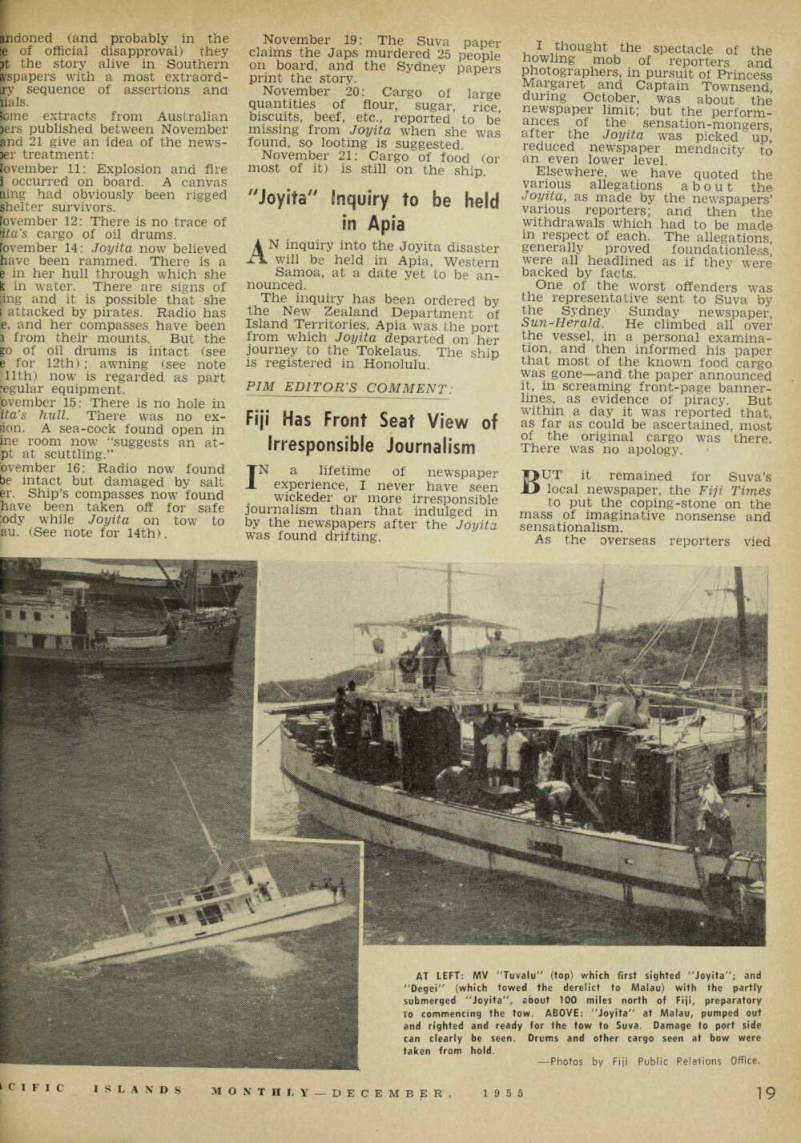
In the Australian Sunday press of November 20, the Colonial Secretary’s statement was played down, and sensational stories of alleged looting, particularly of the cargo of foodstuffs and fuel known to be aboard when Joyita sailed from Apia, were substitl |ted. Dou bts were cast on the Fiji Government view that the cause of the disaster was natural. (The 70-tons Joyita became missing in early October during what is normally a 2-days journey from Apia to the Tokelaus. RNZAF airsearch, with radar-equipped flying-boats, over 100,000 square miles of sea and islands, failed to locate her or her personnel, and was called off in mid- October. On November 10, Joyita was found, by G & E Government ship Tuvalu drifting, abandoned and partly submerged, about 100 miles
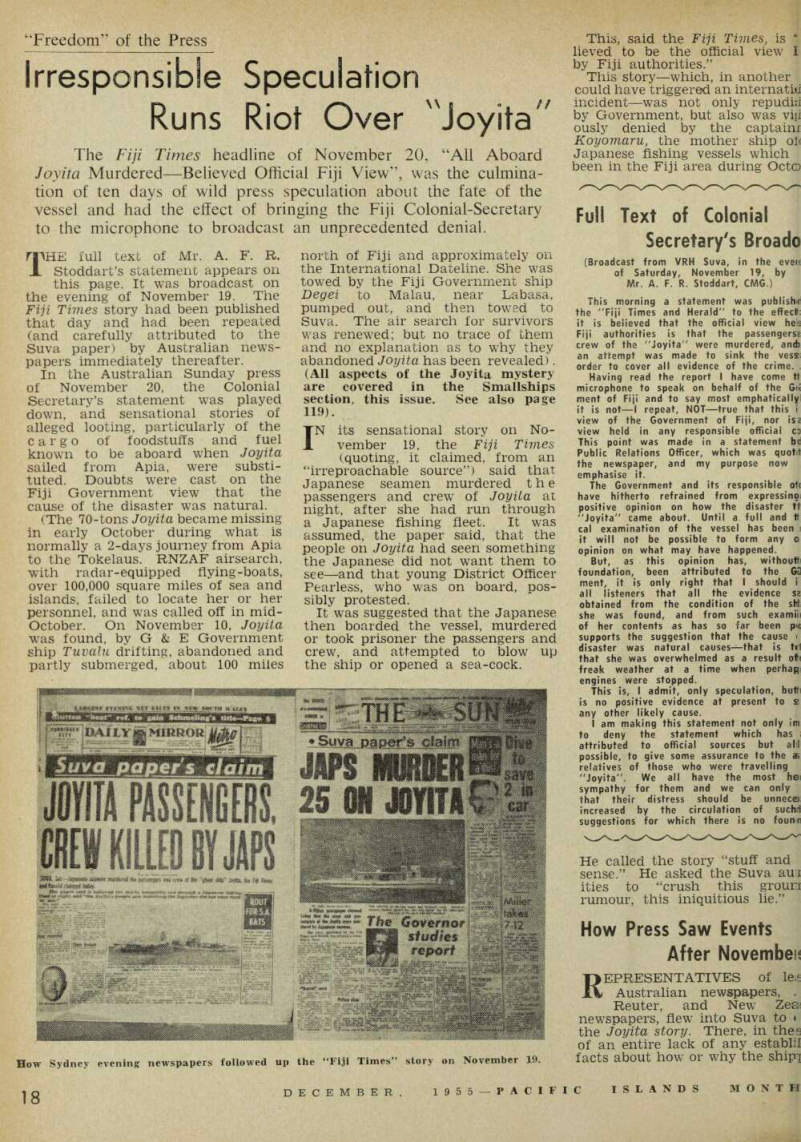
north of Fiji and approximately on the International Dateline. She was towed by the Fiji Government ship Degei to Malau, near Labasa, pumped out, and then towed to Suva. The air search for survivors was renewed; but no trace of them and no explanation as to why they abandoned Joyita has been revealed). (All aspects of the Joyita mystery are covered in the Smallships section, this issue. See also page 119). tjj its sensational story on No vember 19, the Fiji Times (quoting, it claimed, from an “irreproachable source”) said that Japanese seamen murdered the passengers and crew of Joyita at night, after she had run through a Japanese fishing fleet. It was assumed, the paper said, that the people on Joyita had seen something the Japanese did not want them to see—and that young District Officer Fearless, who was on board, pos sibly protested, it was suggested that the Japanese then boarded the vessel, murdered or took prisoner the passengers and crew, and attempted to blow up the ship or opened a sea-cock.
This, said the Fiji Times, is 6 lieved to be the official view I by Fiji authorities.”
This story—which, in another could have triggered an internatki incident —was not only repudiii by Government, but also was vig ously denied by the captainr Koyomaru, the mother ship ole Japanese fishing vessels which been in the Fiji area during Octo
He called the story “stuff and sense.” He asked the Suva aui ities to “crush this groun rumour, this iniquitious lie.”
How Press Saw Events
After November
Representatives of le.s Australian newspapers, .
Reuter, and New Zes; newspapers, flew into Suva to < the Joyita story. There, in thes of an entire lack of any establil facts about how or why the ship}
How Sydney evening newspapers followed up the “Fiji Times” story on November 19.
andoned (and probably in the :e of official disapproval) they 3t the story alive in Southern pspapers with a most extraord try sequence of assertions ana pals. tome extracts from Australian |ers published between November pnd 21 give an idea of the news ier treatment: fovember 11: Explosion and fire I occurred on board. A canvas ning had obviously been rigged shelter survivors, tovember 12: There is no trace of l ita’s cargo of oil drums, fovember 14: Joyita now believed have been rammed. There is a B in her hull through which she kin water. There are signs of |ing and it is possible that she i attacked by pirates. Radio has e, and her compasses have been i from their mounts. But the ?o of oil drums is intact (see e for 12th); awning (see note 11th) now is regarded as part regular equipment, ovember 15: There is no hole in ita’s hull. There was no ex iion. A sea-cock found open in ine room now “suggests an at pt at scuttling.” ovember 16: Radio now found be intact but damaged by salt er. Ship’s compasses now found have been taken off for safe Jody while Joyita on tow to au. (See note for 14th).
November 19: The Suva paper claims the Japs murdered 25 people on board, and the Sydney papers print the story.
November 20: Cargo of large quantities of flour, sugar, rice biscuits, beef, etc., reported to be missing from Joyita when she was found, so looting is suggested.
November 21: Cargo of food (or most of it) is still on the ship.
"Joyita" inquiry to be held
in Apia
AN inquiry into the Joyita disaster will be held in Apia, Western Samoa, at a date yet to be an nounced.
The inquiry has been ordered by the New Zealand Department of Island Territories. Apia was the port from which Joyita departed on her journey to the Tokelaus. The ship is registered in Honolulu.
Pim Editor’S Comment:
Fiji Has Front Seat View of
Irresponsible Journalism
IN a lifetime of newspaper experience, I never have seen wickeder or more irresponsible journalism than that indulged in by the newspapers after the Joyita was found drifting.
I thought the spectacle of the howling mob of reporters and photographers, in pursuit of Princess Margaret and Captain Townsend during October, was about the newspaper limit; but the perform ances of the sensation-mongers after the Joyita was picked up,’ reduced newspaper mendacity to an even lower level.
Elsewhere, we have quoted the various allegations about the joyita, as made by the newspapers’ various reporters; and then the withdrawals which had to be made in respect of each. The allegations, generally proved foundationless, were all headlined as if they were backed by facts.
One of the worst offenders was the representative sent to Suva by the Sydney Sunday newspaper, Sun-Herald. He climbed all over the vessel, in a personal examina tion, and then informed his paper that most of the known food cargo was gone—and the paper announced it, in screaming front-page banner lines, as evidence of piracy. But within a day it was reported that, as far as could be ascertained, most of the original cargo was there.
There was no apology.
BUT it remained for Suva’s local newspaper, the Fiji Tunes to put the coping-stone on the mass of imaginative nonsense and sensationalism.
As the overseas reporters vied
AT LEFT: MV "Tuvalu" (top) which first sighted "Joyita"; and "Degei" (which towed the derelict to Malau) with the partly submerged "Joyita", about 100 miles north of Fiji, preparatory to commencing the tow. ABOVE: "Joyita" at Malau, pumped out and righted and ready for the tow to Suva. Damage to port side can clearly be seen. Drums and other cargo seen at bow were taken from hold.
Photos by Fiji Public Relations Office.
th each other in the despatch im Suva of highly coloured ries, many apparently built on ya beer and a feverish imagina n, the Fiji Times became more i more excited. From Monday, yember 14, it almost foamed at I mouth daily in a chaotic display [ old poster type—“No Bodies md—Damage Suggests Collision h Large Ship” “Mystery jpens—What Happened to £l,OOO II of Banknotes” were typical— lil at noon on Saturday, member 19, it finally exploded h “All aboard Joyita Murdered? ieved Official Fiji View,” in huge e; and declared that according [“an irreproachable source in r a" (it presumably meant impeachable”!) Japanese seamen rdered the passengers and crew ;he Joyita at night. his was bad enough; but it was le much worse by the statement t this was “believed to be the :ial view held by the Fiu iorities.” his magnificent “scoop” by Fiji Times drove the overseas irters to frenzy, seemingly, mediately, they radioed the )ish to their newspapers. But ?9 ne seemed to ignore a Public itions Office statement, made at same time on Saturday, that Fiji authorities had no vledge of a theory of murder Japanese. le two evening newspapers in
Sydney literally shrieked and turned typographic handsprings. A photo graph of their respective front pages of November 19 is reproduced on page 18.
THE frenzy of the yellow-press reporters was equalled by the cold fury of the Fiji Govern ment. The wholly unjustified attack on the Japanese was bad (the Fiji Times never revealed its
“irreproachable” source); but the attempt to tie the story to Fiji officialdom was unpardonable.
A veil may be drawn over what happened in private; but, in public, the Government Secretary took the unprecedented course of going on
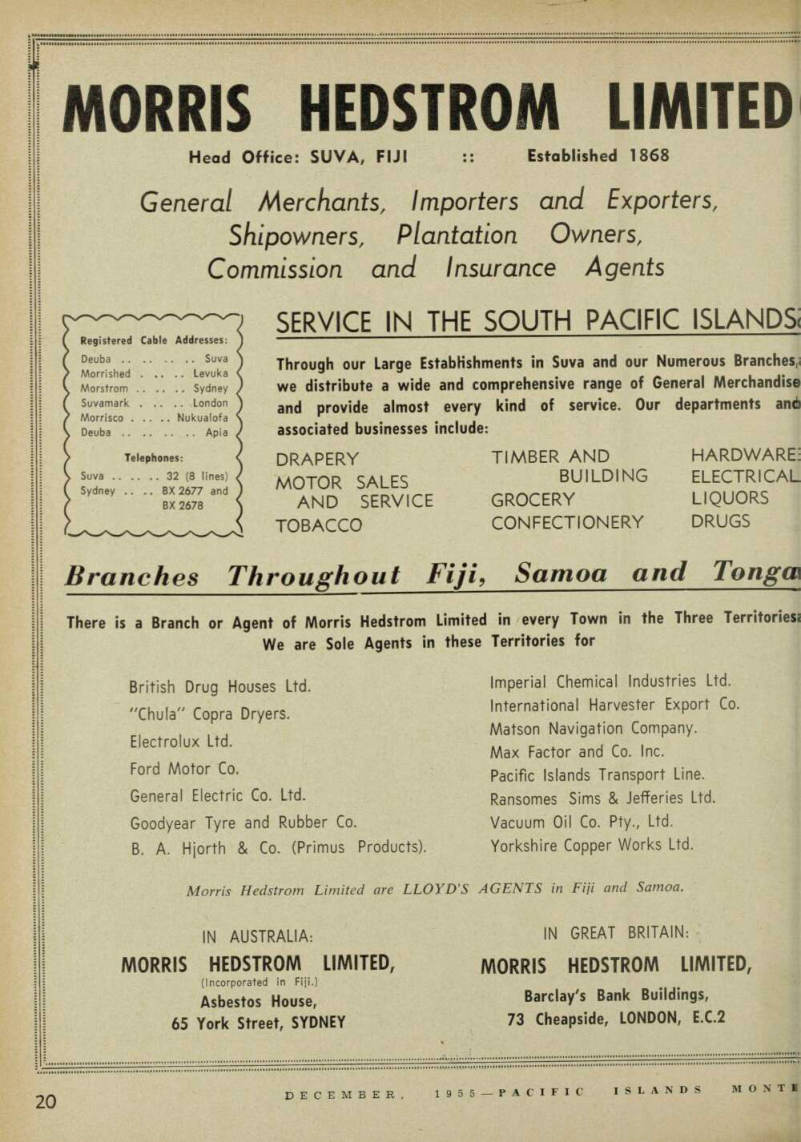
"Joyita" beached at Malau.
Photo by Fiji Public Relation Office
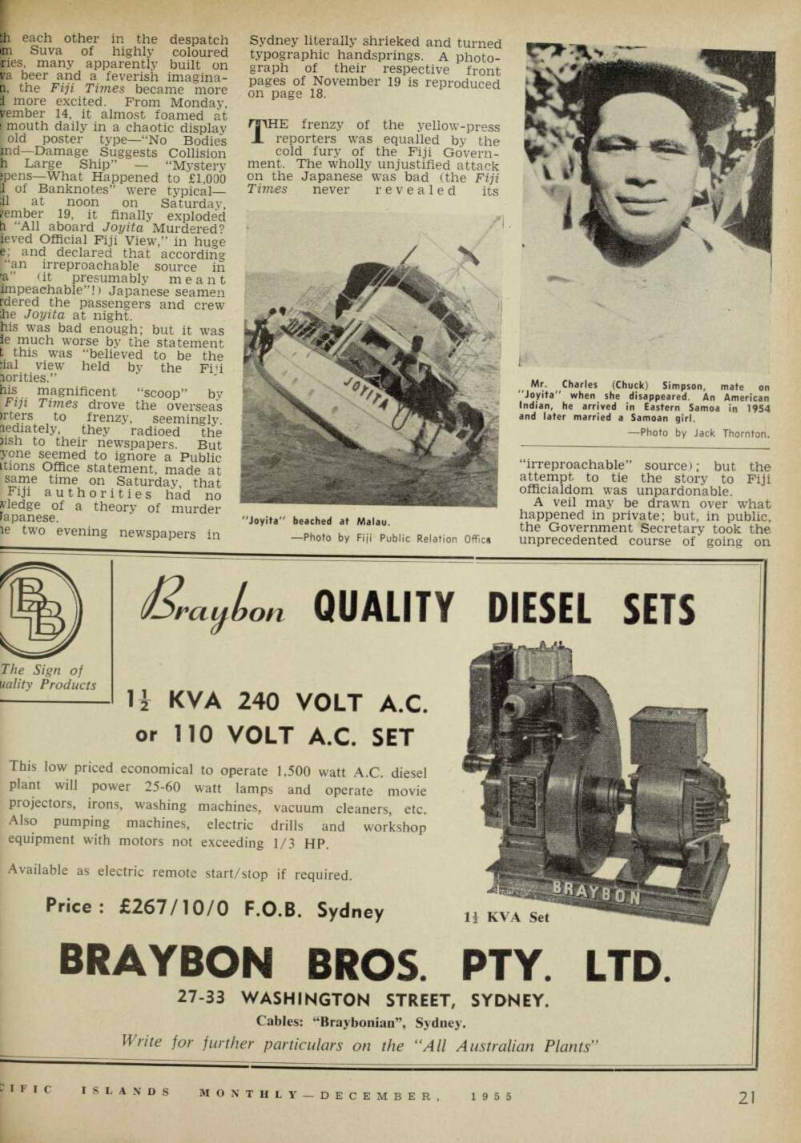
Mr. Charles (Chuck) Simpson, mate on "Joyita" when she disappeared. An American Indian, he arrived in Eastern Samoa in 1954 and later married a Samoan girl.
Photo by Jack Thornton.
the radio that evening, and denying the story in very emphatic official language.
But it was too late. The thing already had been headlined over half the world.
The overseas newspapers generally got out of it by blaming the Fiji Times for the silly story. But none of them gave to Mr. Stoddart’s statement anything like the typo graphical prominence accorded the “Japanese Murderers.”
High officialdom later had the unpleasant task of soothing a certain Japanese Embassy. One can only guess at what happened— and at high officialdom’s attempt to describe to a wondering Japanese the “freedom” enjoyed by “our
popular press.”-