The Editors' Mailbag
p. 18 · Read in the full issue
He Remembers
Carl Hoerler
Tolala, who has the required pre- War I memory, reports that he re members Carl Hoerler back in 1912, and gives the names of some people who may know more of him. (See PIM, November, page 19).
He writes: “I first met Capt.
Hoerler on board Sumatra in 1912.
He and his family were then bound for the Tasmans to trade for the E. E. Forsayth firm, and he remained there for some time. Later, I heard of him in the Solomons. Before that I believe he was a skipper on one of ‘Queen Emma’s’ schooners “I do not think he was of Ger man nationality. His son has an uphill job to gather much informa tion now.
“Those who might help are: Capt.
Carl Haug, (16) Darmstadt, Putzer strasse 6, Apt 438, Germany; Mr.
Calton Younger, 3 Dexter Street, W.
Bundaberg, Queensland; and P. (Karkar) Schmidt, whose address is c/o George Hanson, Erina Heights, NSW. If they don’t know anything, then it looks like a blue duck.”
Import Restrictions
and UNO Charter
From a former resident of New Guinea, who should know what he is writing about: “I should be interested to know how they have been able to apply those Import Restrictions in the Trust Territory of New Guinea, in view of the explicit terms of the United Nations Charter, which apply here. Article 79 of the UN charter, subsection D, reads: ‘. . . . ensures equal treatment in social, economic and commercial matters for all members of the UN and their nationals’.”
It is an interesting point. Strange things happen among the harried bureaucrats —but one cannot imagine that so important a point as that was overlooked.
An Indonesian Gent
In Singapore
One hears a good deal about the hatred of the Asiatic peoples for Britain, now systematically stirred up by the Communists (writes a Singapore friend).
But for sheer impudence and arrogance, I commend the behaviour of the so-called President of the Republic of Indonesia, Dr. Soekarno, who spent three hours here on July 18, en route to Mecca.
This gentleman was accorded the usual international courtesies. He
was met at the airport, on the out skirts of Singapore, by Governor Sir Robert Black, Chief Minister Marshall, and Chief Secretary Goode, and formally welcomed to this British Colony.
He accepted all this, apparently, as a matter of right, and saw no obligation to behave himself. He went straight to the Indonesian Em bassy, and there, addressing 3,000 residents of Singapore, he urged the people to continue their struggle for independence, assured them of In donesian aid, and urged the creation of a society to fight for all those “who still live under colonialism.”
On which we make the comment; It is all part of the pattern, which is so rapidly taking shape in South east Asia, and which so clearly is being directed by the Communists as part of their campaign for the dismemberment of the British Com monwealth. Kruschev’s snarls at Britain’s administrative record in India and Burma (headlined in early December) follow quite logic ally the gross behaviour of Soekarno (who came into prominence in In donesia ten years ago as a puppet of the Japanese).
The SW Pacific's
Slow-Growing Kauri
“There is not much kauri left in the South Pacific now,” writes “Old Trader.” “Can nothing be done to compel the people who have reaped this rich harvest to re-plant young kauri in the areas they have de nuded of the valuable trees?”
Too late now, we fear. The kauri is a very slow grower, and kauri re afforestation would appear to be uneconomic. But only the big kauri
is taken—and the ground is usm covered with tiny trees spring from the liberal seeding.
Kauri was found originally in i long string of islands running no:c west from New Zealand, and . eluding the northern end of NZ, I Caledonia, New Hebrides and southern islands of the Solemn Early timber-getters reaped harvests.
Kauri still is coming out of big Solomons island of VaniM Vanikoro Timber Co., the o tractors are ceasing operations tic as from the end of 1955; but concessionaires, Kauri Timber Ltd., probably will work the tim themselves.
The biggest kauri stands were; NZ. There is some compulsory pl;I ing there now; but the trees not be of a commercial size u they are nearly a century old.
Mr. H. Chaperlin, accountant! the timber interests on Vanik who has been South on leave, that two kauri saplings were pla;i as a navigation guide on the fi shore of Vanikoro just over 30 y* ago; and in that time they have tained a circumference at the of only 41 feet. t A number of prominent people Fiji will attend the wedding, om cember 23, of the son of Rotan*j leader of the Banaban commu (transferred from Ocean Island: Rabi, Eastern Fiji. The Banai were provided with their new hi soon after World War 11, and apq to have settled down happily thr H Seven-years-old Prince Taufaas son of Prince Tugi of Tonga, , go to school in Auckland, I probably King’s College—in twv three years. At present he is v ing Auckland with his grandmoc Queen Salote. They will later sje a few weeks in Sydney.
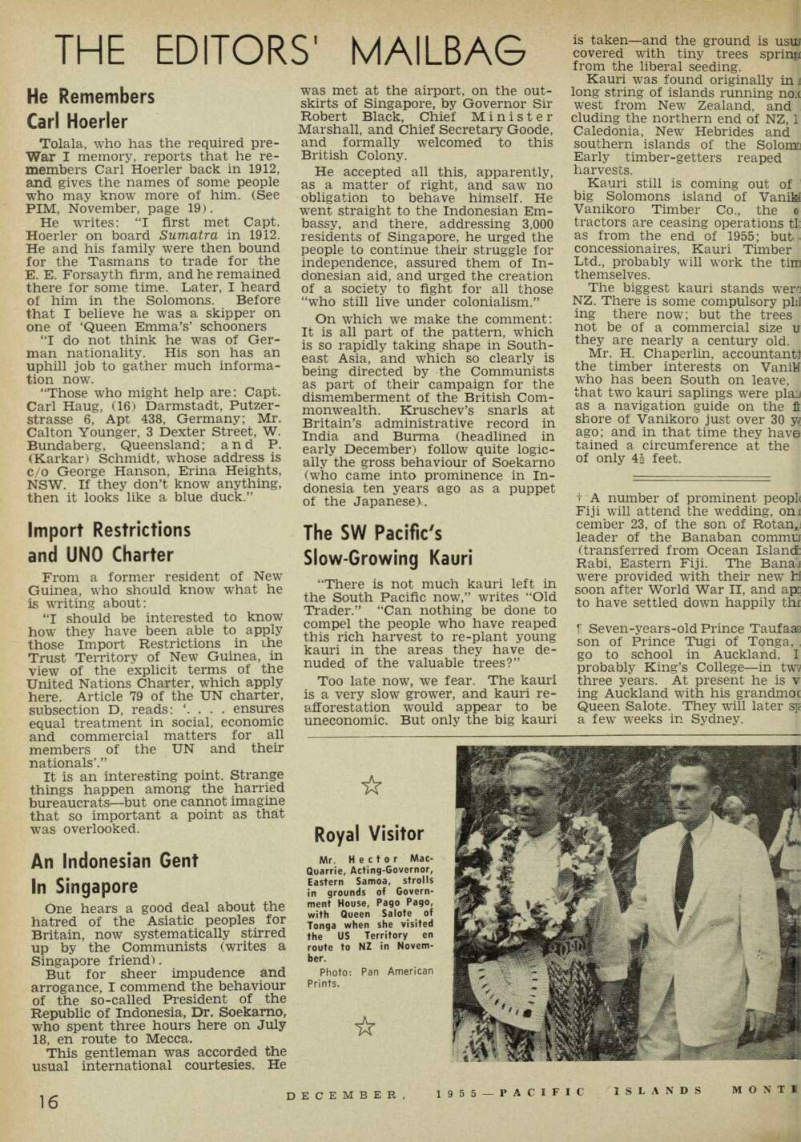
Royal Visitor
Mr. Hector Mac- Quarrie, Acting-Governor, Eastern Samoa, strolls in grounds of Govern ment House, Pago Pago, with Queen Salote of Tonga when she visited the US Territory en route to NZ in Novem ber.
Photo: Pan American Prints.