Carpenters May Buy Control
pp. 16-149 · Read in the full issue
Important Re-grouping of Financial Interests Planned
Of Morris Hedstrom
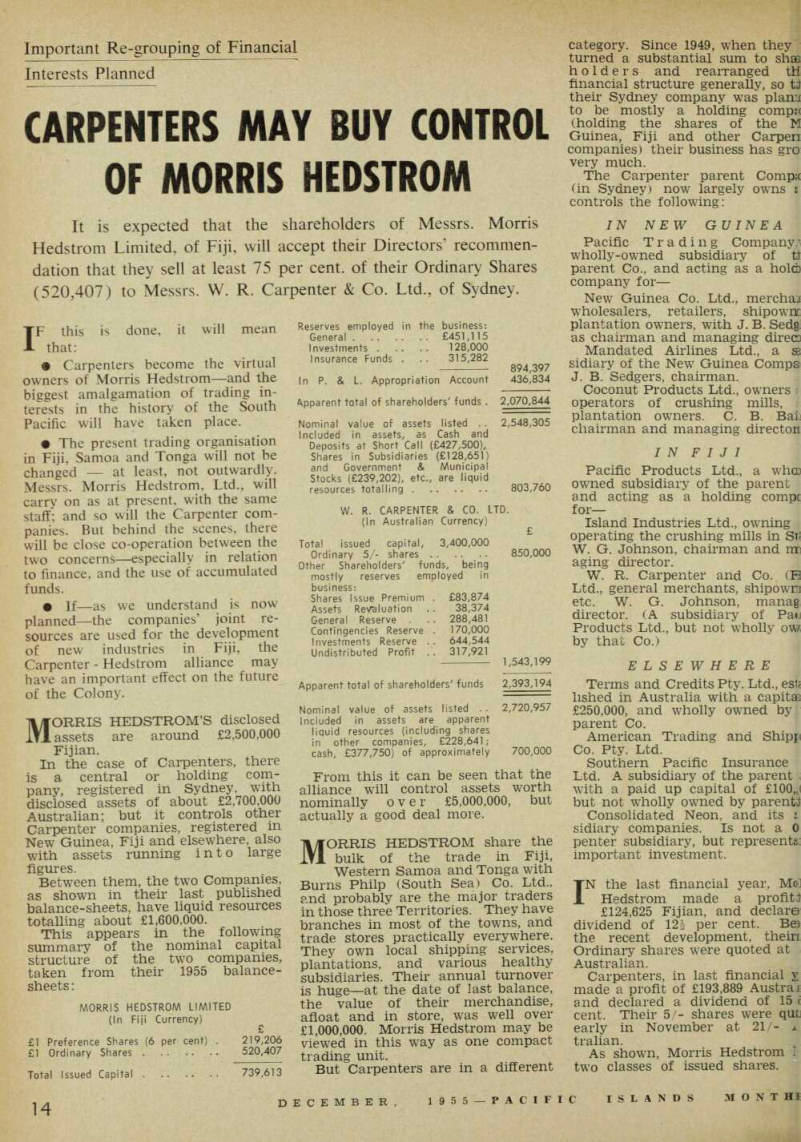
It is expected that the shareholders of Messrs. Morris Hedstrom Limited, of Fiji, will accept their Directors’ recommen dation that they sell at least 75 per cent, of their Ordinary Shares (520,407) to Messrs. W. R. Carpenter & Co. Ltd., of Sydney.
IF this is done, it will mean that: • Carpenters become the virtual owners of Morris Hedstrom —and the biggest amalgamation of trading in terests in the history of the South Pacific will have taken place. • The present trading organisation in Fiji, Samoa and Tonga will not be changed at least, not outwardly.
Messrs. Morris Hedstrom, Ltd., will carry on as at present, with the same staff; and so will the Carpenter com panies. But behind the scenes, there will be close co-operation between the two concerns —especially in relation to finance, and the use of accumulated funds. • If—as we understand is now planned—the companies’ joint re sources are used for the development of new industries in Fiji, the Carpenter - Hedstrom alliance may have an important effect on the future of the Colony.
Morris hedstrom’s disclosed assets are around £2,500,000 Fijian.
In the case of Carpenters, there is a central or holding com pany, registered in Sydney, with disclosed assets of about £2,700,000 Australian; but it controls other Carpenter companies, registered in New Guinea, Fiji and elsewhere, also with assets running into large figures.
Between them, the two Companies, as shown in their last published balance-sheets, have liquid resources totalling about £1,600,000.
This appears in the following summary of the nominal capital structure of the two companies, taken from their 1955 balance sheets :
Morris Hedstrom Limited
Included in assets, as Cash and Deposits at Short Call (£427,500), Shares in Subsidiaries (£128,651) and Government & Municipal Stocks (£239,202), etc., are liquid resources totalling 803,760
W. R. Carpenter & Co. Ltd.
(In Australian Currency)
Included in assets are apparent liquid resources (including shares in other companies, £228,641; cash, £377,750) of approximately 700,000 From this it can be seen that the alliance will control assets worth nominally over £5,000,000, but actually a good deal more.
MORRIS HEDSTROM share the bulk of the trade in Fiji, Western Samoa and Tonga with Burns Philp (South Sea) Co. Ltd., and probably are the major traders in those three Territories. They have branches in most of the towns, and trade stores practically everywhere.
They own local shipping services, plantations, and various healthy subsidiaries. Their annual turnover is huge—at the date of last balance, the value of their merchandise, afloat and in store, was well over £1,000,000. Morris Hedstrom may be viewed in this way as one compact trading unit.
But Carpenters are in a different
category. Since 1949, when they ' turned a substantial sum to shas holders and rearranged tit financial structure generally, so tJ their Sydney company was plamx to be mostly a holding comp?( (holding the shares of the M Guinea, Fiji and other Carpen companies) their business has gro' very much.
The Carpenter parent Compic (in Sydney) now largely owns s controls the following:
In New Guinea
Pacific Trading Company/ wholly-owned subsidiary of tt parent Co., and acting as a hold) company for — New Guinea Co. Ltd., mercha* wholesalers, retailers, shipownn plantation owners, with J. B. SedgJ as chairman and managing direm Mandated Airlines Ltd., a sa sidiary of the New Guinea Comps* J. B. Sedgers, chairman.
Coconut Products Ltd., owners ; operators of crushing mills, plantation owners. C. B. Bab chairman and managing director!
In Fiji
Pacific Products Ltd., a when owned subsidiary of the parent and acting as a holding compc for — Island Industries Ltd., owning operating the crushing mills in St; W. G. Johnson, chairman and rm aging director.
W. R. Carpenter and Co., (H Ltd., general merchants, shipown etc. W. G. Johnson, manag director. (A subsidiary of Paw Products Ltd., but not wholly ow by that Co.)
Elsewhere
Terms and Credits Pty. Ltd., este hshed in Australia with a capitas £250,000, and wholly owned by parent Co.
American Trading and Shipp Co. Pty. Ltd.
Southern Pacific Insurance Ltd. A subsidiary of the parent ; with a paid up capital of £IOO,J but not wholly owned by parentf Consolidated Neon, and its J sidiary companies. Is not a 0 penter subsidiary, but represented important investment.
IN the last financial year, Mo] Hedstrom made a profit f £124,625 Fijian, and declare' dividend of per cent. Bes the recent development, thein.
Ordinary shares were quoted at ; Australian.
Carpenters, in last financial y made a profit of £193,889 Austral and declared a dividend of 15 c cent. Their 5/- shares were quo early in November at 21/- i. tralian.
As shown, Morris Hedstrom ] two classes of issued shares.
(In Fiji Currency) £ £1 Preference Shares (6 per cent) . £1 Ordinary Shares 219,206 520,407 Total Issued Capital 739,613
Reserves employed in the business: General £451,115 Investments 128,000 Insurance Funds . .. 315,282 894,397 In P. & L Appropriation Account 436,834 Apparent total of shareholders' funds . 2,070,844 Nominal value of assets listed . . 2,548,305
Total issued capital. 3,400,000 £ Ordinary 5/- shares Other Shareholders' funds, being mostly reserves employed in business: Shares Issue Premium . £83,874 Assets Revaluation .. 38,374 General Reserve . .. 288,481 Contingencies Reserve . 170,000 Investments Reserve . . 644,544 Undistributed Profit .. 317,921 850,000 1,543,199 Apparent total of shareholders' funds 2,393,194 Nominal value of assets listed .. 2,720,957
eferences, carrying 6 per cent., are t affected by this deal.
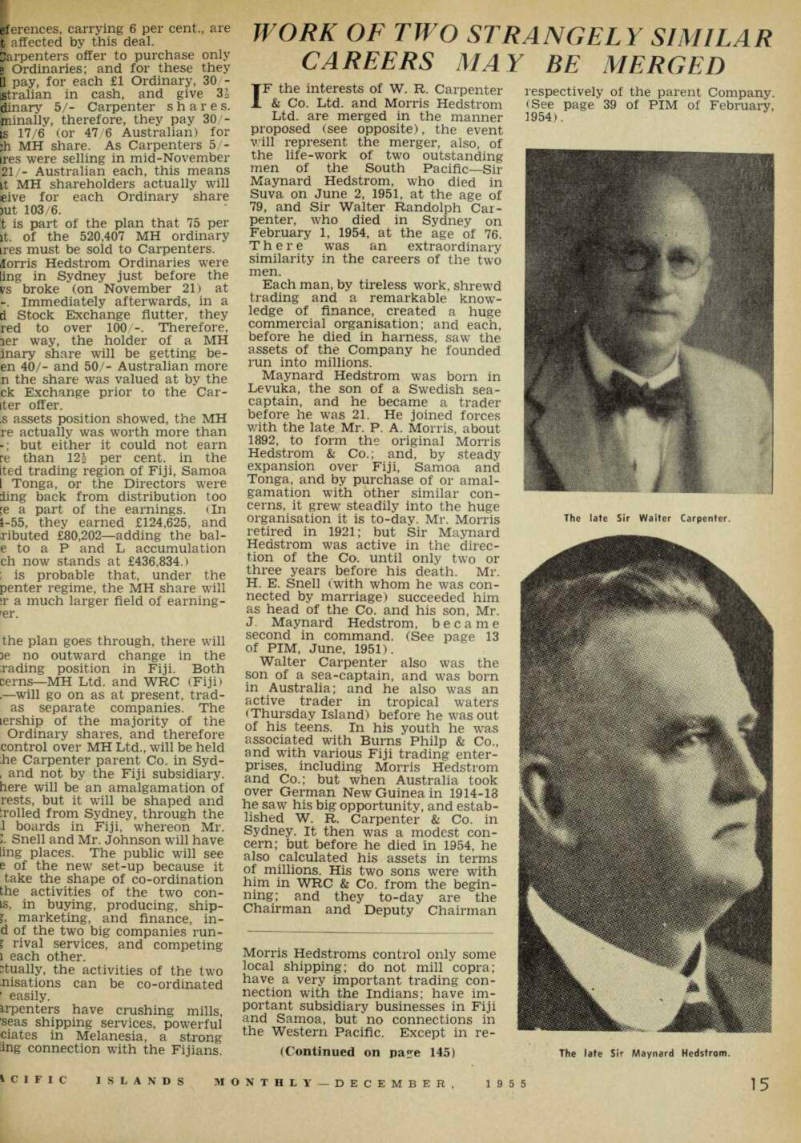
Carpenters offer to purchase only t Ordinaries; and for these they [1 pay, for each £1 Ordinary, 30 istralian in cash, and give 31 dinary 5/- Carpenter shares, niinally, therefore, they pay 30/is 17/6 (or 47/6 Australian) for ;h MH share. As Carpenters 5/ires were selling in mid-November 21/- Australian each, this means it MH shareholders actually will eive for each Ordinary share nit 103/6. t is part of the plan that 75 per it. of the 520,407 MH ordinary ires must be sold to Carpenters, dorris Hedstrom Ordinaries were [ing in Sydney just before the vs broke (on November 21) at -. Immediately afterwards, in a d Stock Exchange flutter, they red to over 100/-. Therefore, ler way, the holder of a MH inary share will be getting be en 40/- and 50/- Australian more n the share was valued at by the ck Exchange prior to the Car iter offer. .s assets position showed, the MH re actually was worth more than -; but either it could not earn re than 12 i per cent, in the ited trading region of Fiji, Samoa I Tonga, or the Directors were ding back from distribution too ;e a part of the earnings. (In 1-55, they earned £124,625, and ributed £Bo,2o2—adding the bal e to a P and L accumulation ch now stands at £436,834.) ; is probable that, under the penter regime, the MH share will ;r a much larger field of earning rer. the plan goes through, there will )e no outward change in the ;rading position in Fiji. Both cerns —MH Ltd. and WRC (Fiji) . —will go on as at present, trad as separate companies. The lership of the majority of the Ordinary shares, and therefore control over MH Ltd., will be held ;he Carpenter parent Co. in Syd , and not by the Fiji subsidiary, here will be an amalgamation of rests, but it will be shaped and trolled from Sydney, through the 1 boards in Fiji, whereon Mr.
I. Snell and Mr. Johnson will have ling places. The public will see e of the new set-up because it take the shape of co-ordination the activities of the two con is, in buying, producing, ship marketing, and finance, in d of the two big companies run- J rival services, and competing i each other. dually, the activities of the two nisations can be co-ordinated r easily. irpenters have crushing mills, seas shipping services, powerful ciates in Melanesia, a strong ling connection with the Fijians.
Morris Hedstroms control only some local shipping; do not mill copra; have a very important trading con nection with the Indians; have im portant subsidiary businesses in Fiji and Samoa, but no connections in the Western Pacific. Except in re
(Continued on 145)
Jling in Suva, and in buying and brketing copra, the two concerns b not very much in competition.
I GLANCE back at the figures L quoted shows that the two com- I panics, together, have liquid nds approaching two millions, bilable immediately for the en gagement and establishment of w industries in Fiji and adjoin ; territories—always provided, of irse, that the Administrations con ned assist in the developments itemplated. rhe Governments of both Fiji and tnoa, taking the long view, will impressed with the now rapid iwth of the local populations, it the present rate, Fiji will have f a million people (Indians and lans), and Samoa perhaps 170,000, hin 20 years. Something of a itive character must be done to vide these growing communities n means not only of subsistence, of a higher standard of life, he large resources of the Car ter-Morris Hedstrom alliance 7 be the means of assisting the nimstrations to deal with the bl J m - Despite all the rubbish £d by Socialist planners since war, there is no better way of kly and efficiently developing the iurces of a country than by the juragement of private enterprise, part from the project for the ding of a large modern hotel in a— now under way—Morris strom Ltd. have been facing a e building programme for the wal of many buildings owned by aselves and subsidiaries the rman (Mr. H. E. Snell) at the aal meeting last May, said that
this might involve expenditure of upwards of a million pounds.
It may be expected that under the new regime, these building pro grammes will soon be revised and given more definite shape.
As the tourist industry, of much importance to Fiji, is partially strangled by the lack of hotel accommodation in Suva, the new Carpenter-Hedstrom alliance may take another—and less pessimistic look at the South Seas Hotel plans.
The IVOI directorate has been trying to keep the expenditure within £250,000 by limiting the bedrooms to 36, plus modern public rooms and lavish equipment. It is likely that attempts now will be made to induce the alliance at least to increase the number of bedrooms.
IT was emphasised in a circular issued by Morris Hedstrom directors to their staffs that the proposed deal in shares would not affect staffs, in numbers or salaries For example, the Morris Hedstrom Pension Fund, liberally subsidised t ? e os°* for 28 y ears - now has about 3b6 members, a considerable group of pensioners, and accumu lated funds of nearly £400,000, earn ing £15,000 per annum. This will not be disturbed.
There almost certainly will be a rearrangement of the Companies' directorates in Suva, when the share-purchase becomes effective It is, however, understood that Mr!
H. E. Snell, head of the MH organ isation since Sir Maynard Hedstrom died, will remain on the principal
Fiji Board. The present hes quarters Boards are: Morris Hedstrom Ltd. —H. E. Sn R. Crompton, CBE, QC; R.
Crompton; J. Maynard Hedstrr R. C. Evatts; J. P. Bayly.
W. R. Carpenter & Co. Ltd. —RF Carpenter, C H. Carpenter, CJ Brownhill, W. S. Bennett, 8..
Perriman, W. G. Johnson.
Messrs. H. E. Snell and W..
Johnson will be the principal i in the new set-up in Fiji. r'.E people of Fiji may criti this amalgamation because apparently will reduce trao, competition—and such competii is a good and healthy sign, combines are suspect, anyway.
In this case, plenty of c petition will remain. Burns F (South Sea) Co. Ltd. and W 1 Carpenter & Co. (Fiji) Ltd., e pete actively with each othen all fields. Also, the Indian Chinese trading concerns are gi ing constantly in size and stren and will give the big European stt all the retailing competition Colony needs.
The Colony should benefit 1 more efficient organisation of duction and transport, while 1c nothing through restriction on tn THIS proposed alliance was on the best-kept secrets of South Pacific commercial w in 1954-55.
It actually had taken its
iape before Sir Walter Carpenter ed in February, 1954, and it was ider serious consideration in Syd iy and Suva in the ensuing 18 faiths.
Sfet none outside a very small oup had suspected it —not even len Carpenters, in September, 1955, )k the public steps necessary to srease their nominal capital from 000,000 to £2,500,000 Australian, iy alert South Pacific financier ght have smelled something in festing there, and got into the >ck Exchange for “a win.” After [only five years had passed since rpenters took formal steps to sub ntially reduce their capital, me announcement of the rpenter offer to MH came on member 21 as a complete surprise.
' Friday, MH shares were quoted the Sydney Exchange at 57/-; news was released during the ik-end; and on Monday morning shares had rocketed to around lorris Hedstrom shares are held between 900 and 1,000 people, stly in Australia and New Zea -1 The move has doubled the le of their holdings of MH Ord :ies. On November 17, 500 MH inaries were worth about £1,400 tralian; on November 21, their le was at least £2,500. here is no indication of how will finance the purchase he 400,000 or so MH Ordinaries 3h they propose to buy. Under plan, they will issue another ),000 5/- shares at par to the lors, and also pay out about ,000 Australian in cash. As their balance-sheet shows, they can the whole amount out of their ent liquid resources. But they elect to raise a further sum ash by offering a further lot of 5 - Ordinaries to the public, is obviously a matter for the •enter Directors—who do not much.