Search Abandoned for Missing Vessel
pp. 121-123 · Read in the full issue
[?]Oyita Mystery
Six weeks after she disappeared on a 280 miles voyage from Apia to the Tokelaus, it seems that Joyita , 70 tons, 75 feet, has gone to join the many unsolved mysteries of the sea. No trace of the vessel has been sighted although the sea was calm at the time and although most systematic air searches have been made.
S is usual in these cases there [ were many conflicting news- I paper despatches regarding her. [ to three weeks after the vessel led from Apia, on the evening iSunday, October 2, it was un tain whether there was 24 or 25 sons on board. Confusion was led in the earlier stages by re ling to the number of passengers, en persons, including crew, was jnded. report from Apia 19 days after I vessel was overdue, and two ks after the air search had been lituted on October 6, stated that ita had left Apia towing a freight ge—and added that “many sea i believed that she may have li dragged under by the sinking ter, in heavy seas.” 3 far as is known, this was the F mention of a barge, and it was fly a very significant feature in 1 puzzle. Apart from an assur- I by the RNZAF searchers that weather was, in the main, per ' for the search for at least a k —and that there could have i no “heavy seas”—it would ly be more likely for Joyita to [ the barge under, than vice a. But late October another ► report said there had been no :e. le greatest riddle is the complete nee of wreckage or of oil slicks he sea. Pending an inquiry, the idest theory seems to be a len and severe engine or cargo 3sion, which, blasting downwards, i the vessel so badly that she : almost instantly, complete her lashed deck cargo of drums, the hatches still battened i, and dragging the barge, if with her. ing-Commander R. K. Walker ie RNZAF said that his Sunder , flying-boats, based first on puala, W. Samoa, and later on ithala Bay, Fiji, “searched Highly twice, every possible re mile of sea and island where : a might have drifted, or been ked, or foundered.” At the it flown, he said, the radar )ment of the searching aircraft capable of detecting objects as 1 as two inches in diameter on *ea. Over 100,000 square miles a were scanned, weyer it has been frequently , a that air searches are not in •le A slight error in navigation, fitting one vital “strip” of ocean
in the methodical search would cause the speck of evidence to be missed.
EVEN in a sudden explosion some discharge of oil might be expected, and should have been sighted in the reported flying conditions.
But there again there was con fusion in the re ports. Our Apia c or r e s p ondent gave the cargo as general, plus 60 full drums of diesel fuel and a number (un stated) of empty drums.
A NZ Press Association de spatched from Apia, on Oc tober 2, gave the cargo as 80
empty, sealed, 45-gallon drums, 30 on deck, and 50 in the hold.
In addition, the ship was re ported to be fuelled for a 3,000-mile voyage. Whether all of this was in the ship’s tanks, or some of it in drums, is not clear..
Admiralty life-boat charts show the general drift of a vessel disabled in this area to be westward with'a slight southerly tendency. This should mean that if Joyita was still afloat and missed in the air search, she should finish up in Fiji, the Ellice, or New Hebrides.
In addition to the RNZAF search, a TEAL flying-boat, bound from Fiji to Samoa diverted to Horne Island on October 15, flying the
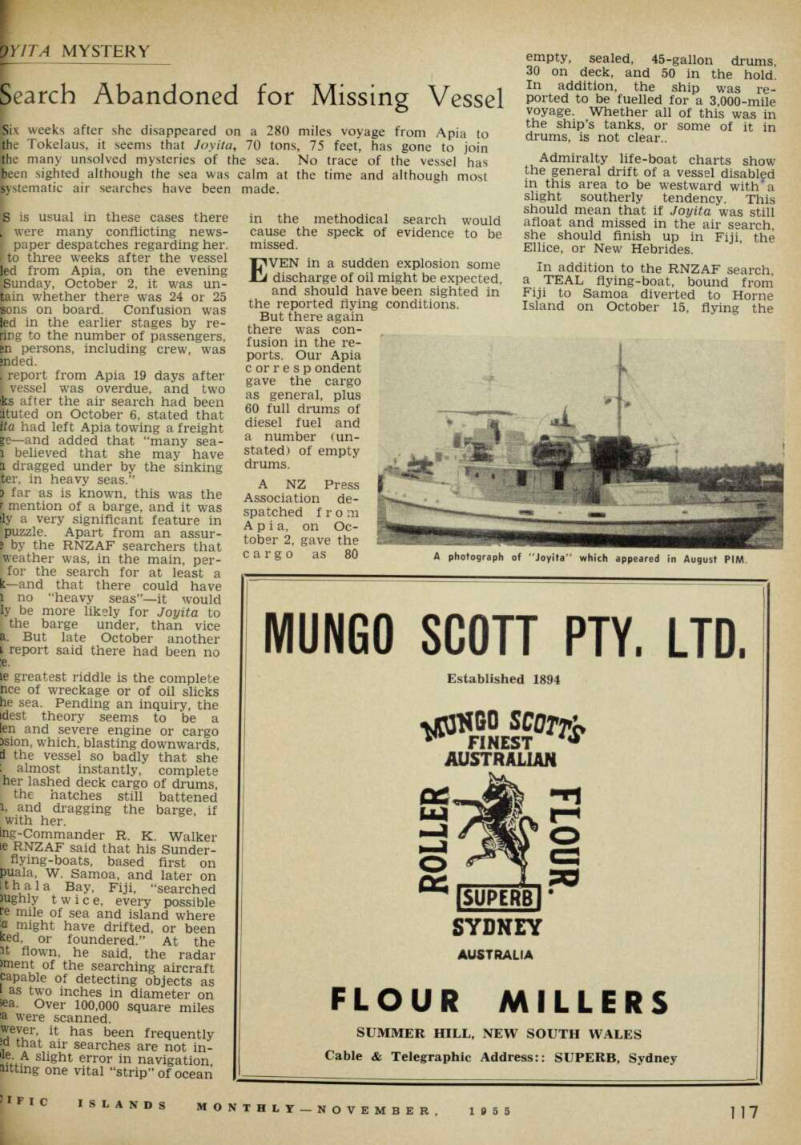
A photograph of "Joyita" which appeared in August PIM.
route at low altitude, and a H Shackleton long-range reconnaiss; aircraft which was in the area had good radar gear, made a sea: on the Fiji-Canton route. I aircraft on this route also ken sharp look-out, and one report©, light 200 miles from Nadi one nn Next day the RNZAF traced thij a Japanese fishing vessel.
Joyita was delayed at Apia bo she left with clutch trouble air was suggested that this had I immobilised her, but as she twin-screw vessel this would sumably not be the case unless I clutches failed.
Though carrying radio, the tn mitter was reported out of ao, on sailing. One report said Captain Miller had refused assist! by the Samoa Radio Departrr but as there was to be a n technician of that Depart! aboard and bound for the Toke: to service the equipment in ft islands, it can be assumed thas should have been able to get sig out of Joyita’s transmitter ifl necessity had arisen, and the had been available to make ren With this hope, Apia Radio( other island stations maints radio watch on the ship’s kr frequencies, and also broadcast structions regarding signals ti made.
On October 12, a searching’ craft picked up a suspected si; but there was no firm evidences it was from the ship and not some overseas source. No( further was heard.
This suggests that the dis was sudden and that there ws time for radio tinkering.
IN all, there seems now to been seven Europeans or Europeans and 18 Gilbo Swains Islanders, and TokeLJ aboard.
The ship’s company consistd Captain T. H. Miller, of Englai, Wales; Mr. “Chuck” Simpson American-Indian, mate; two re crew-men named Tekoka and T respectively; two Swains Islan and eight Tokelauans —rnakin crew in all.
The passengers were the; Tokelau Officer, Mr. R. D. Pe:; of NZ; Dr. A. D. Parsons, of Ir©' Mr. H. T. Hodgkinson, of NZS J. Pereira, of Apia, radio mecH; Mr. J. Wallwork and Mr. ♦ Williams, of E. A. Coxon and] Apia staff, and a Mr. McCartd whom no details are known.
Other passengers Tokelau men and one woman another report mentioned als three-year-old girls and an child of eleven.
JOYITA’S principal shares
was a well known I Museum researcher, Miss « Luomala of Honolulu, anp registered in that port. Thu
bd undergone a strict US Coast- Eard safety survey in April, 1954. [lt is understood that Capt. Miller iras, at one time, engaged to Miss
Eomala.
IFor technical reasons, the Mate, b American citizen, was registered s skipper in the ship’s papers. oyita was not licensed to carry any jissengers and had no accommoda on for any. There was bunk accom lodation for nine crew. [The Mate, Charles (or Chuck) hnpson, has been described as an stremely strong man physically; inerous and kind-hearted but a Irmidable opponent in a fight.
The vessel had lain idle in Apia )r some months since making a bkelau voyage in April this year.
Voyita was the first fishing sssel to be registered in Apia and kptain Miller had hoped to make [success of tuna fishing in that •ea. but yyas in some financial dif julties. For several years past, iptain Miller has operated a fish g business at Canton but this too id met some difficulties and legal bceedings with the Western Pacific igh Commission had been in pro ess since operations ceased there It year.
Miller is believed to have been at ti since a youth, mostly in the erchant Navy, although he served ring World War II in the Royal ivy. People who have sailed with m describe him as a splendid sea m and expert navigator.
Fhe vessel carried a 16-ft work at with outboard motor, two life fts —one 10-man and one 16-man 3n the vessel’s upper deck, and Ecient life-jackets for this number • persons, so in this respect was asiderably better found than the ijority of Island vessels. Full de ls of the vessel, which had three karate refrigerated holds, appeared [August PIM, page 109. fhe vessel was reported to be tier charter to the Apia firm of A.. Coxon and Co., who apparently ve some arrangement whereby !y handle the Tokelau copra and >ply trade goods in exchange, ler the supervision of the Tokelau leer. is the vessel is American-owned, is assumed that the Honolulu
horities will instigate an inquiry,
litional to any inquiry made by i Western Samoan Government.