This Month’S New Reading
pp. 87-91 · Read in the full issue
“More Things In
Heaven And Earth . . ”
THE spate of religious books con tinues. Mostly American in origin and usually Roman Catholic: obviously designed as a counter-blast to Communism.
I This month’s offerings (both pub lished by World Work (1913) Ltd.) are Stop, Look and Live A Christopher Thought For Every Bay of the Year, by James Keller; and Fatima, Pilgrimage to Peace, by kpril Oursler Armstrong and Martin
I. Armstrong.
[ About 10 million people are being reached by the Christopher Move ment in the USA—through books, magazines, movies, radio and tele vision: how many of these are practising “Christophers” it would >e hard to calculate as there are 10 clubs, dues, meetings or organ sation. There is a headquarters in ¥e\v York —a distribution point for literature, etc. —but essentially the novement is one for the individual vho, in his own way, by prayer and vork. strives to bring the Christian jrinciples into the fields that touch he lives of all people. This seems air enough, in an over-organised lorld. [ The book consists of 365 snippets ■f present-day human behaviour, jointing a moral—one snippet for ach day of the year—plus a Bible ext and two lines of prayer. It is Bitten in modern idiom and does lot bear any resemblance to Texts or To-day, beloved of our great [randmothers. (Australian price. 2/3). n|7HILE Christopher is unlikely to |T offend even the most rabid non [' conformist, although presented y the Roman Catholic Church, it ! perhaps unfortunate that Fatima hould be reviewed by a congenital if unpractising) Presbyterian.
Visitations, visions, visits of angels, liracles and un-natural phenomena ivolving the sun and other celestial odies are something best believed y those who have been brought Pin the Faith. Outsiders—even [lose most disposed towards admira ion of the great Roman church— nd these divine manifestations a amewhat unswallowable potion.
P you have been puzzled by the Hgrimages of recent years, when Te statue of the Lady of Fatima as been carried from Portugal to le , far corners of the world, this ook will supply some background, fv. 1916 ’ at a time when hitherto atholic Portugal was going through phase of anti-clericalism, three midren, Lucy, aged nine, and her ousins Francisco, eight, and
Jacinta, six, were tending the family sheep on the rocky slope behind Adjusrtel, a small hamlet in the parish of Fatima.
Suddenly the form of a young man, “transparent and as brilliant as crystal,” appeared to them. He said that he was the Angel of Peace and told them to pray with him.
He appeared to them three times in the following year and on May 13, 1917, preceded by flashes of lightning from a clear sky, the Lady made her first visit to the children —standing on top of a thorn husb and promised to return in each of the next five months.
The last of the appearances was made on October 13, 1917, by which time the story of the manifestations had spread widely and 70,000 people from all over Portugal had joined the children on the rocky slopes of Aljustrel. They saw nothing of the vision—but they saw the children speak with her and they also saw the miracle that had been pro mised. . . “The sun in the mid-day sky began to tremble and spin, whirling in a frenzy of fire. From it spun a thousand colours. . . It turned on itself, thrilling and twist ing, dancing in the sky.”
During her visits the Lady gave into the keeping of the children, three secrets—the first, a vision of hell; the second, a prediction of World War II and the rise of Russia The children did not tell their secrets. Within two years the two younger children had died as a re sult of the world influenza epidemic.
Lucy, in 1919, entered a religious order. Not until the thirties was the prediction about the coming war made public, by which time events were already shaping themselves and the revelation caused little sur prise.
A third prophesy still remains secret. Lucy has written it in a letter which is in the keeping of the Bishop of Leiria. It will be opened in the event of Lucy’s death
(she is a member of the Carmelite Order in the ancient town of Coimbra) or in 1960, whichever comes first.
Apart from the story of Fatima, the book is an account of the journey to Aljustreal of two Ameri cans. There are incidental close ups of life in present-day Portugal and a great deal about Aljustrel as it is during the pilgrimage and re ligious ceremonies that take place there now each year on October 13.
Stripped of its trimmings, the message of Fatima is a crusade for peace and for the Reconversion of Russia. (Australian price, 13/3).
Idriess In Australia
And New Guinea
ALTHOUGH there is nothing alarmingly profound in The Vanished People, by lon L.
Idriess, there is true fascination in the way the author deals with the unsolved, and perhaps unsolvable mystery of the unknown people who left curious rock-paintings in the caves of northern Australia—the sort of thing that the late Sir H. Rider Haggard used to delight in.
There is a peculiar eeriness about places which have known human habitation but have long been desolate, and this spirit pervades those parts of the book dealing with the Kimberleys of north-w r est Aus tralia.
In the course of adventurous wanderings, the book ranges from the Cape York Peninsula to the swamps of the Fly and Sepik Rivers m New Guinea, and the author’s survey of the indigenous peoples of all the areas traversed is at once analytical and sympathetic.
His most vivid travel-pictures con cern a journey of 1,000 miles through the “Sea of Swamps” in New Guinea, where his powers of obser vation and of description are given free rein.
Incidentally, the book is in a sense a pointed retort to those who take the easy line that the mental ities of “primitive” and of “civilised”
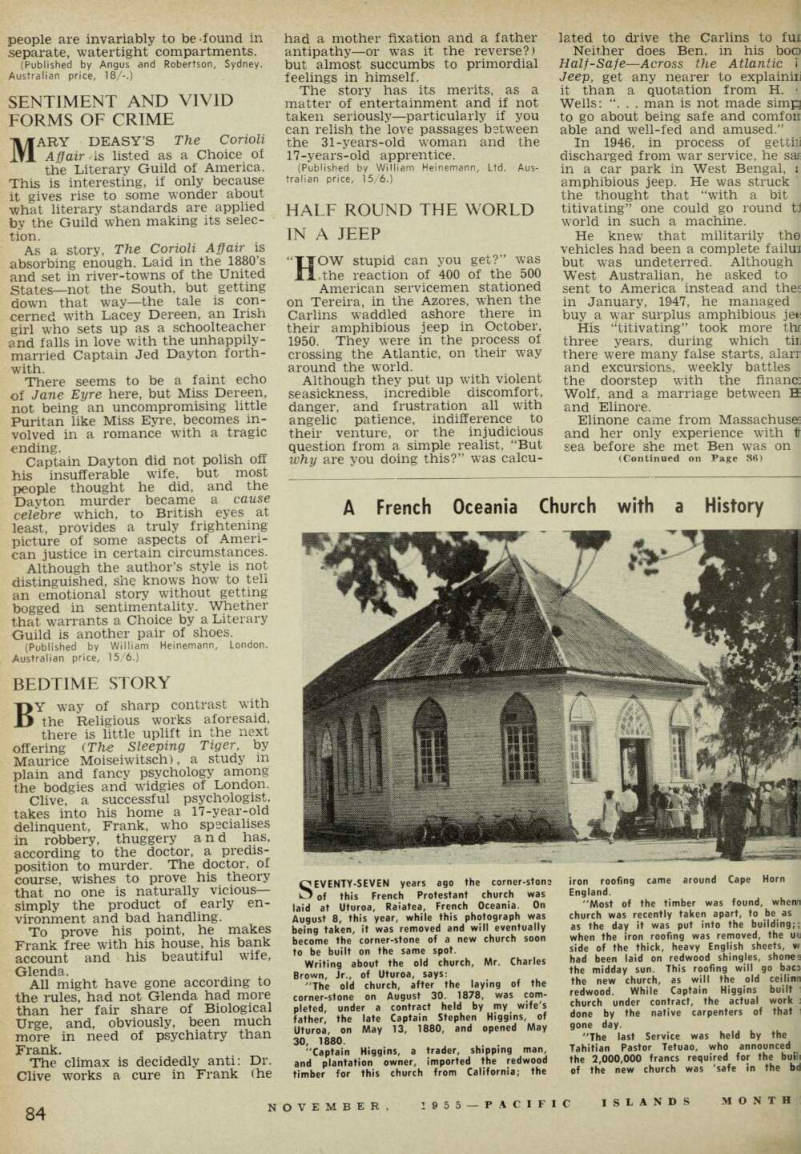
All that is Left
This former land-mark is almost gone from Apia waterfront. It is all that remains now of the German warship "Adler" which broke her back on the inner reef 200 yards offshore in the famous hurricane of 1889, Photo: Jack Thornton.
people are invariably to be-found in separate, watertight compartments. (Published by Angus and Robertson, Sydney.
Australian price, 18/-.)
Sentiment And Vivid
Forms Of Crime
MARY DEASY’S The Corioli Affair is listed as a Choice of the Literary Guild of America.
This is interesting, if only because it gives rise to some wonder about what literary standards are applied by the Guild when making its selec tion.
As a story, The Corioli Affair is absorbing enough. Laid in the 1880’s and set in river-towns of the United States—not the South, but getting down that way—the tale is con cerned with Lacey Dereen, an Irish girl who sets up as a schoolteacher and falls in love with the unhappily married Captain Jed Dayton forth with.
There seems to be a faint echo of Jane Eyre here, but Miss Dereen, not being an uncompromising little Puritan like Miss Eyre, becomes in volved in a romance with a tragic ending.
Captain Dayton did not polish off his insufferable wife, but most people thought he did, and the Dayton murder became a cause celebre which, to British eyes at least, provides a truly frightening picture of some aspects of Ameri can justice in certain circumstances.
Although the author’s style is not distinguished, she knows how to tell an emotional story without getting bogged in sentimentality. Whether that warrants a Choice by a Literary Guild is another pair of shoes. (Published by William Heinemann, London.
Australian price, 15/6.)
Bedtime Story
BY way of sharp contrast with the Religious works aforesaid, there is little uplift in the next offering ( The Sleeping Tiger, by Maurice Moiseiwitsch), a study in plain and fancy psychology among the bodgies and widgies of London.
Clive, a successful psychologist, takes into his home a 17-year-old delinquent, Frank, who specialises in robbery, thuggery and has, according to the doctor, a predis position to murder. The doctor, of course, wishes to prove his theory that no one is naturally vicious— simply the product of early en vironment and bad handling.
To prove his point, he makes Frank free with his house, his bank account and his beautiful wife, Glenda.
All might have gone according to the rules, had not Glenda had more than her fair share of Biological Urge, and, obviously, been much more in need of psychiatry than Frank.
The climax is decidedly anti; Dr.
Clive works a cure in Frank (he
had a mother fixation and a father antipathy—or was it the reverse?) but almost succumbs to primordial feelings in himself.
The story has its merits, as a matter of entertainment and if not taken seriously—particularly if you can relish the love passages between the 31-years-old woman and the 17-years-old apprentice. (Published by William Heinemann, Ltd. Aus tralian price, 15/6.)
Half Round The World
In A Jeep
‘TTOW stupid can you get?” was Xi the reaction of 400 of the 500 American servicemen stationed on Tereira, in the Azores, when the Carlins waddled ashore there in their amphibious jeep in October, 1950. They were in the process of crossing the Atlantic, on their way around the world.
Although they put up with violent seasickness, incredible discomfort, danger, and frustration all with angelic patience, indifference to their venture, or the injudicious question from a simple realist, “But why are you doing this?” was calcu
lated to drive the Carlins to fur Neither does Ben, in his boo Half-Safe —Across the Atlantic ] Jeep, get any nearer to explainiii it than a quotation from H. - Wells: . . man is not made simn to go about being safe and comfon able and well-fed and amused.”
In 1946, in process of gettiii discharged from war service, he sas in a car park in West Bengal, : amphibious jeep. He was struck the thought that “with a bit titivating” one could go round tf world in such a machine.
He knew that militarily the vehicles had been a complete failui but was undeterred. Although West Australian, he asked to sent to America instead and thee in January, 1947, he managed buy a war surplus amphibious jet; His took more thr three years, during which tiii there were many false starts, alarr and excursions, weekly battles the doorstep with the financa Wolf, and a marriage between BE and Elinore.
Elinone came from Massachuses and her only experience with tt sea before she met Ben was on (Continued on Page 86)
ocean liner, where she was seasick. This should have wa£ her. On Half-Safe she was almost continually, a pint-pot which to heave was her cons, companion.
In fact, Elinore is the most sistently sea-sick sailor we have; heard of; when the jeep had era to the other side of the AtlsJ and had taken to terra Elinore was even sea-sick v crossing the Sahara desert.
Yet, in spite of this, she was< to take her turn at the whe© keep a diary, to frequently gj? top, stripped, to keep the aeriaj in the middle of a full Atlantic: while Ben tried to use the radii to fend off the towed auxiliary tank when they were transfer petrol supplies. And alwr according to the photographs—«up with a big smile on appropq occasions and even after week sea, bathless, battered and virti foodless, land at some port, heir de vivre undimmed, and reach cope with any amount of the exhausting hospitality. Even who at any time has been renoj limp and unusable after two of mal de vner will take their • off to Elinore. Quite a girl.
When Half-Safe was acquin was a standard amphibious if that is. it had an open cockpitd virtually no freeboard. Carlin j a square sheet-metal and pes hen-coop on top of it, install! toilet under the co-driver’s strapped a belly-tank underr and towed another auxiliary i tank behind. The finished pn was about 18 ft over-all; and) a 5 ft 3 in. beam. Inside, was only a little more room in a standard sedan. The one which corresponded to the back in a car, was five feet long, t meant sleeping with legs curl© Knees tended to sieze-up after three hours of this, although: did not present any great prr as neither voyager got much oc tunity to sleep longer than thi one stretch.
Preparation of food was easy); sisting usually of heating up on the engine. Elinore, for ■ of the time was distinctly terested in any solids with thej sible exception of a passing ; at a biscuit.
The jeep fell victim to s every mishap in the man. blocked feed lines, burnt-out v burst gaskets, wrecked bes fouled-up propellor —and altJ none of them would have be major catastrophe on land, f middle of the heaving oceam mean hours and sometimes d;f super-misery while hove-to fd pairs.
lln this wise did the couple pro jess for 32 days across the Atlantic letween Halifax, Nova Scotia, and lores in the Azores; some months [awdling through this group and the rim stretch of 23 days of storm and nrricane between San Miguel and ladeira, finally touching land on tie other side of the Atlantic at lap Juby, Spanish Sahara, to rards the end of February, 1951.
Thereupon began the land journey rhich. while being less lethal in tiaracter, still had plenty of roblems. Taking a route through pain and France, with a detour to weden, they finally came to anchor I the Strand, London, on August L 1951, first portion of the round le-world operation complete.
Although there is, in truth, small »nse in this crazy adventure it )es, at the hands of Ben Carlin, ake a good book. He has a breezy, fctural style that is easy to read id. by the very nature of things, stion does not drag. Interpolations ! fractions of Elinore’s diary made i interesting variation. (Published in Australia by Collins and in Won by Andre Deutsch, Ltd. Australian price, October visitors to Fiji included
e Sheikh Mohammad A 1 Khalifah,
icle of the Ruler of Bahrain, who ade a four days’ stay.
r M. Rene Hoffherr, Governor of New Caledonia and High Commissioner for France in the Pacific, returned to Noumea in October after visiting New Zealand at the invitation of the Dominion Government At Wellington. M. Hoffherr was the guest of the Governor-General (Sir Willoughby Norrie). Commenting on the goodwill aspect of the visit a Noumea correspondent says that
throughout New Zealand M Hoffherr was given “a royal reception ” , co if P ra £ ucal demonstration of
? Raro
s?m Sa , established —and
ColleeeelfiL^
0 f 500 cases*©? tomatop? tn Zealand from f their l plot by the end of thennSSS season. a 01 tne P resent