Does 0. Scutellatus Live In Papua?
p. 83 · Read in the full issue
There Have Been Reports, but
These notes on the deadly Taipan come from ex-Papuan, Sydney H. Chance
IT behoves every resident of Papua and New Guinea, particularly Fapu a to know something of of S f r is obvious
Svp
Scc ofiri H be^ dlff l ren i v ° ne Si-icf a n s^f pent “ xr by aS that of one of the New Guinea varieties of carpet snake which abound up there. in 1867, a German named Peters, described under the name Pseudechis Scutellatus, a large snake from “South Eastern New Guinea.” Subsequently, other specimens were obtained from Northern Australia but because of its rarity, the snake has never become well known, and there appears to be some confusion concerning its identity.
The writer first heard of this Giant or King Brown Snake over 40 years ago from his father on the latter’s return from the Spencer- Gillen Anthropological Expedition. rm, i * tt /-.i- r The late Harry Chance was one of those bushmen who knew that the browns were worse than the blacks.
To this day many bushmen say that it is the other way round but that is not so, for (and here I quote D. F. Thomson, M.Sc.) the taipan, “now known as Oxyuranus scutellatus, is undoubtedly the largest and probably the most dangerous, venomous snake found in Australia.”
A seven-footer in Dr. Thomson's FarcTon? W&S not considered a very ge The taipan’s present name O. scutellatus was given to it by Dr.
Thomson and its most un-Australian vernacular name of Taipan is what
the aborigines of Western Cape York Peninsula call it.
Every Territorian knows how most Australians have difficulty with the « ai „ sound and the pau * ity of its use on the mainland There is no doubt in my mind that some Eastern “influence” caused the adoption of the word “taipan,” for freely trans lated - i 1: means Big Boss or Big Shot, j n Far East! More than a coincidence, surely, J A The Cape York and Arn h e ru land natives hold the taipan in great dread (the Arnhemlanders call it Obarko). When annoyed and about to attack, the taipan does not flatten its body dorsa-ventrally but draws in its sides, making its hack bone like a keel. It also has the habit of raising one or two coils of its body several inches clear of the ground and at the same time it erects its tall in the air and waves jf o to c .^ d t i ro behaviour giving a slnls *' er appeal ance.
Unlike most snakes which seize and chew their victims, the taipan snaps three or four times before taking hold, snapping again at in tervals wr i^ er doe * not know of any survivor from a taipan bite. Does anyooay.
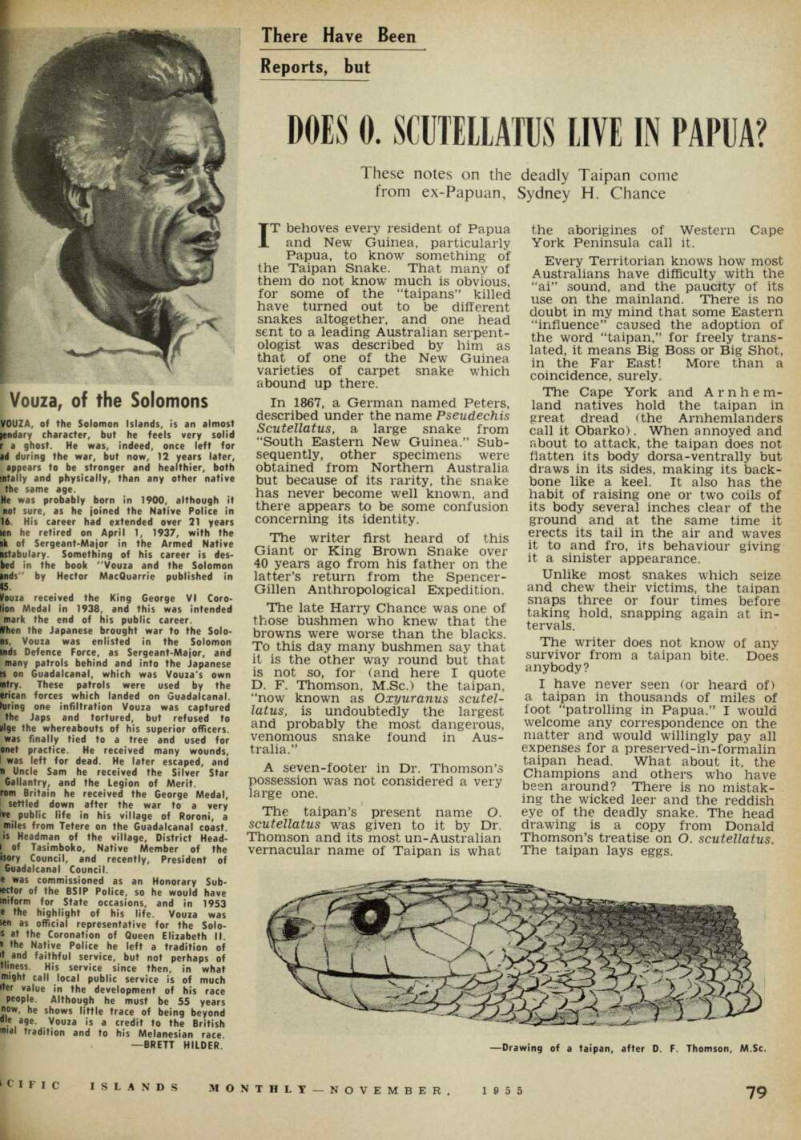
I have never seen (or heard of) a taipan in thousands of miles of foot “patrolling in Papua.” I would welcome any correspondence on the matter and would willingly pay all expenses for a preserved-in-formalin been around? There is no mistak mg the wicked leer and the reddish eye of the deadly snake. The head drawing is a copy from Donald Thomson’s treatise on O. scutellatus.
The taipan lays eggs.
Vouza, of the Solomons
VOUZA, of the Solomon Islands, is an almost gendary character, but he feels very solid [?]host. He was, indeed, once left for [?]ad during the war, but now, 12 years later, appears to be stronger and healthier, both mentally and physically, than any other native the same age.
He was probably born in 1900, although it not sure, as he joined the Native Police in 16. His career had extended over 21 years [?]en he retired on April 1, 1937, with the [?]k of Sergeant-Major in the Armed Native constabulary Something of his career is des bed in the book "Vouza and the Solomon ands" by Hector MacQuarrie published in 45.
Vouza received the King George VI Coro tion Medal in 1938, and this was intended mark the end of his public career.
When the Japanese brought war to the Scio [?]ns, Vouza was enlisted in the Solomon ands Defence Force, as Sergeant-Major, and many patrols behind and into the Japanese es on Guadalcanal, which was Vouza's own entry These patrols were used by the American forces which landed on Guadalcanal, During one infiltration Vouza was captured the Japs and tortured, but refused to [?]lge the whereabouts of his superior officers, was finally tied to a tree and used for coronet practice. He received many wounds, was left for dead. He later escaped, and n Uncle Sam he received the Silver Star Gallantry, and the Legion of Merit, From Britain he received the George Medal, settled down after the war to a very [?]ve public life in his village of Roroni, a miles from Tetere on the Guadalcanal coast, is Headman of the village, District Head [?] of Tasimboko, Native Member of the derisory Council, and recently, President of Guadalcanal Council. e was commissioned as an Honorary Sub [?]ector of the BSIP Police, so he would have uniform for State occasions, and in 1953 [?]e the highlight of his life. Vouza was [?]sen as official representative for the Solo [?]s at the Coronation of Queen Elizabeth 11. [?]the Native Police he left a tradition of [?]t and faithful service, but not perhaps of [?]lmess. His service since then, in what might call local public service is of much [?]ter value in the development of his race people. Although he must be 55 years now, he shows little trace of being beyond dle age. Vouza is a credit to the British [?]nial tradition and to his Melanesian race.
Brett Hilder.
—Drawing of a taipan, after D. F. Thomson, M.Sc.