Tropicalities
pp. 81-82 · Read in the full issue
Magazine Section
In The Wake Of Kon-Tiki
r" [OR HEYERDAHL, of Kon-Tiki fame, with his wife, son aged 16, daughter aged 2, and twelve ther researchers, cleared Panama I October 16 in the ex-fishing jssel Christian Bjelland, bound rst for Easter Island.
Since Heyerdahl (and companions) lade the famous Kon-Tiki drift om Peru to the Tuamotu, he has intinued research in South America id the Galapagos in his efforts to •ove that some, if not all, ancient flynesian stock originated in South merica.
The present expedition, which was ganised in Norway, will make filings and excavations at Eatser land in search of early artifacts, b completion of work there the rty will move on to Pitcairn, angareva, and other islands of ench Oceania.
It is not yet known how long e party expects to spend at Easter land.
Little Sweetness In The
Grog
¥ the Rarotonga High Court in September, the presiding Com missioner remarked on the very w “bush-beer” cases before the urt on that day.
Tt is a pity,” said the Bench, lat this sugar shortage cannot t longer.”
Fo which the Police Prosecutor )lied, “It may be, Sir, that the ivemment might consider re icting the importation of sugar.”
Perhaps. But the Court should ow that bush-beer, Rarotonga le, is by no means dependent on sugar. Canned fruit, dried at, golden syrup, molasses, or ai candy is called into use when lessity strikes; and when the rst comes to the worst the Jeteners are omitted entirely, ere may be some wry faces round I bucket—but the potency is still
re.-
Jps.
Scotsman Wrote Of Fiji
IN 1808-09 HE story of William Lockerby, master-mariner and man of action, who spent nine turbulent pths m Fiji in 1808-09, is re ™Jy C. R. Rowson in the utical Magazine.
Lockerby, who was born in Scot land in 1782, but became a Liver pool man, was chief officer in the Jenny, a full-rigged ship, when he landed in hot water at Sydney. It came to the sensitive ears of Gov ernor William Bligh (formerly of the Bounty) that, when dealing with soldier cargo-broachers, Lockerby had used the injudicious phrase: “Damn you and the Governor, too!”
After being fined 20 guineas and given a month to cool down in the local gaol, Lockerby rejoined his ship, which sailed in ballast from Port Jackson, in March, 1803, hoping to pick up sandalwood somewhere in the Islands.
Arriving eventually in Fiji (pre sumably at Bua, in Vanua Levu, scene of tragic
Incidents in the days of the sandalwood racket), Lockerby landed with a few sailors to arrange for the collection of the wood. But long-standing dis agreements with the master of the Jenny came to a head, and the ship ultimately sailed without Lockerby and several other men.
In his journal, the young Scots man tells how he and his com panions lived for nine months among warring Fijian tribes, add ing: “Eight months thereof I lived quite naked.”
Throughout their stay the Britons were entirely de pendent for sust e n a nee on friendly local chiefs.
Presumably life had its compen sations, because when the ship Favourite arrived, Lockerby helped to collect sandal wood but elected
to stay with the Fijians.
Later, however, he left in the General Wellesley and, after a period in China, he returned to his wife and child at Liverpool after an absence of 3h years.
Lockerby’s journal, containing an extremely valuable account of Fiji as it was a century and a half ago, was published by the Hakluyt So ciety, London, before World War 11.
Raising The Banner Of
Freedom
THE sheet music of The Banner Of Freedom is now on sale in Western Samoa at 2/6 per copy.
Samoans and Americans in E Samoa might well object to the title on the two-coloured cover, for above the red and blue flag of W. Samoa are the following words in big print:
The Banner Of Freedom—
Samoan National Anthem.
There are also Europeans and others in Apia who, since publica tion of the sheet music, have stated that there can be only one National Anthem in W. Samoa— God Save The Queen.
The cover of the sheet music of The Banner Of Freedom describes
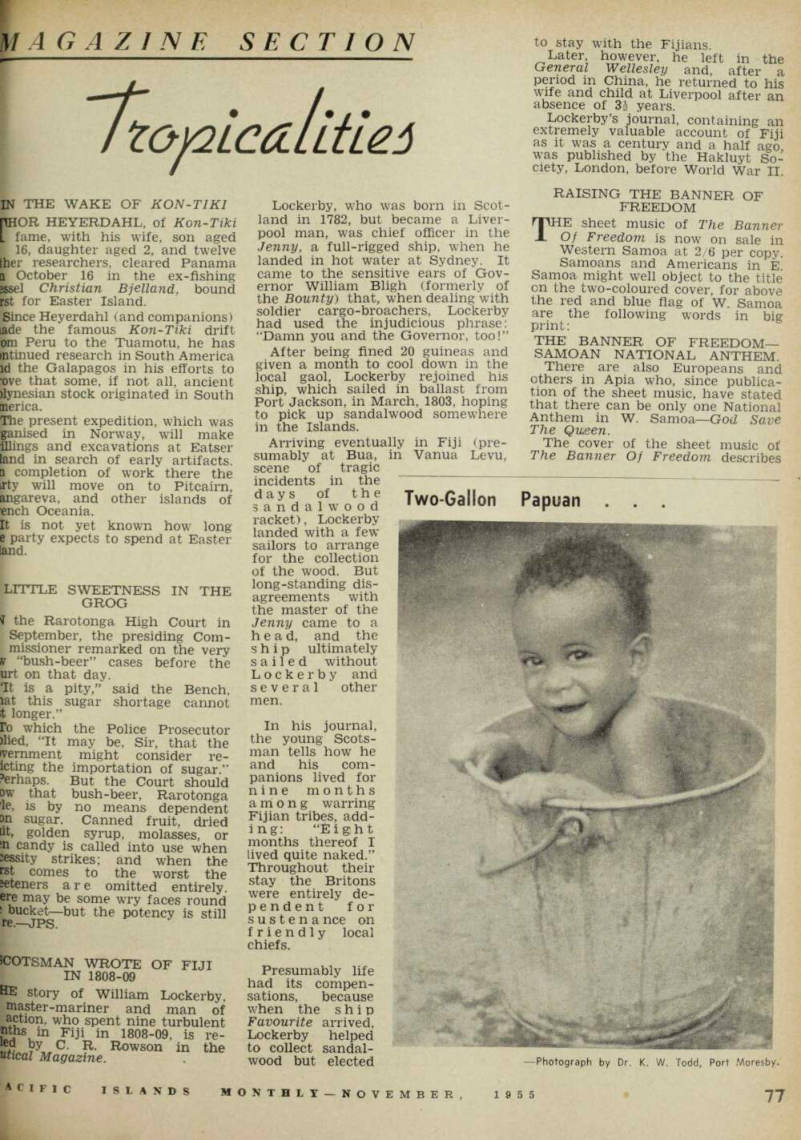
Two-Gallon Papuan . . .
Photograph by Dr. K. W. Todd, Port Moresby.
it as an anthem selected by the council of a committee set up to choose an anthem to be played at the raising of the flag of the Samoan Government. It was com posed for the flag-raising at which W. Samoa’s flag was first hoisted beside that of NZ.
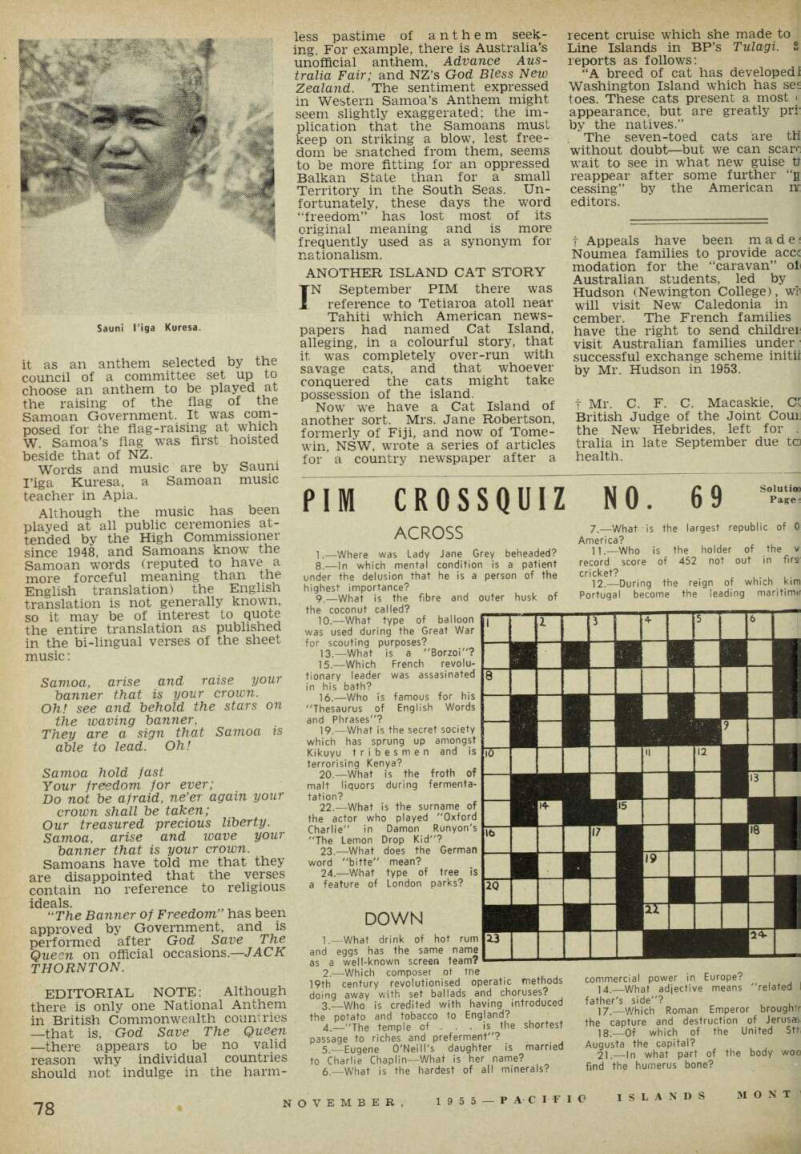
Words and music are by Sauni I’iga Kuresa, a Samoan music teacher in Apia.
Although the music has been played at all public ceremonies at tended by the High Commissioner since 1948, and Samoans know the Samoan words (reputed to have a more forceful meaning than the English translation) the English translation is not generally known, so it may be of interest to quote the entire translation as published in the bi-lingual verses of the sheet music: Samoa, arise and raise your banner that is your crown.
Oh! see and behold the stars on the waving banner, They are a sign that Samoa is able to lead. Oh!
Samoa hold fast Your freedom for ever; Do not be afraid, ne’er again your crown shall be taken; Our treasured precious liberty.
Samoa, arise and wave your banner that is your crown.
Samoans have told me that they are disappointed that the verses contain no reference to religious ideals.
“The Banner of Freedom” has been approved by Government, and is performed after God Save The
Queen on official occasions.
Thornton.
Jack
EDITORIAL NOTE: Although there is only one National Anthem in British Commonwealth countries —that is, God Save The Queen —there appears to be no valid reason why individual countries should not indulge in the harm
less pastime of anthem seek ing. For example, there is Australia’s unofficial anthem, Advance Aus tralia Fair ; and NZ’s God Bless New Zealand. The sentiment expressed in Western Samoa’s Anthem might seem slightly exaggerated; the im plication that the Samoans must keep on striking a blow, lest free dom be snatched from them, seems to be more fitting for an oppressed Balkan State than for a small Territory in the South Seas. Un fortunately, these days the word “freedom” has lost most of its original meaning and is more frequently used as a synonym for nationalism.
Another Island Cat Story
IN September PIM there was reference to Tetiaroa atoll near Tahiti which American news papers had named Cat Island, alleging, in a colourful story, that it was completely over-run with savage cats, and that whoever conquered the cats might take possession of the island.
Now we have a Cat Island of another sort. Mrs. Jane Robertson, formerly of Fiji, and now of Tome win, NSW, wrote a series of articles for a country newspaper after a
recent cruise which she made to Line Islands in BP’s Tulagi. S reports as follows: “A breed of cat has developed!
Washington Island which has see toes. These cats present a most « appearance, but are greatly prr by the natives.”
The seven-toed cats are th without doubt —but we can scan*; wait to see in what new guise tt reappear after some further “h cessing” by the American nr editors. t Appeals have been mad e 5 Noumea families to provide accc modation for the “caravan” ol< Australian students, led by Hudson (Newington College), wr will visit New Caledonia in cember. The French families have the right to send children visit Australian families under • successful exchange scheme initii by Mr. Hudson in 1953. t Mr. C. F. C. Macaskie, C' British Judge of the Joint Com: the New Hebrides, left for . tralia in late September due to health.
Sauni l[?]iga Kuresa.