New Mg Import Tax Will Boost
p. 17 · Read in the full issue
Mystery Revenue
Cost Of Living
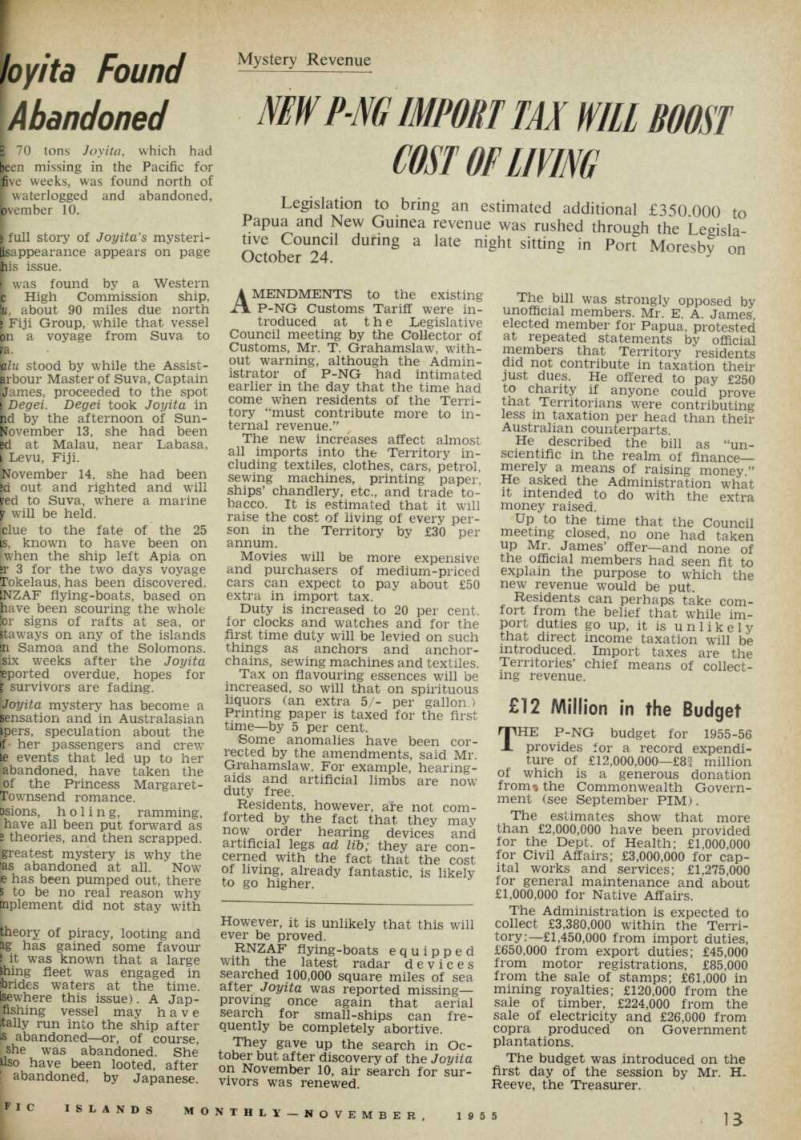
Legislation to bring an estimated additional £350.000 to Papua and New Guinea revenue was rushed through the Legisla tive Council during a late night sitting in Port Moresby on October 24. J
Amendments to the existing P-NG Customs Tariff were in troduced at the legislative Council meeting by the Collector of Customs, Mr. T. Grahamslaw, with out warning, although the Admin istrator of P-NG had intimated earlier in the day that the time had come when residents of the Terri tory “must contribute more to in ternal revenue.”
The new increases affect almost all imports into the Territory in cluding textiles, clothes, cars, petrol, sewing machines, printing paper, ships’ chandlery, etc., and trade to bacco. It is estimated that it will raise the cost of living of every per son in the Territory by £3O per annum.
Movies will be more expensive and purchasers of medium-priced cars can expect to pay about £5O extra in import tax.
Duty is increased to 20 per cent, for clocks and watches and for the first time duty will be levied on such things as anchors and anchor chains, sewing machines and textiles.
Tax on flavouring essences will be increased, so will that on spirituous liquors (an extra 5/- per gallon.) Printing paper is taxed for the first time—by 5 per cent.
Some anomalies have been cor rected by the amendments, said Mr.
Grahamslaw. For example, hearing aids and artificial limbs are now duty free.
Residents, however, are not com forted by the fact that they may now order hearing devices and artificial legs ad lib; they are con cerned with the fact that the cost of living, already fantastic, is likely to go higher.
The bill was strongly opposed by unofficial members. Mr. E. A. James, elected member for Papua, protested at repeated statements by official members that Territory residents did not contribute in taxation their just dues. He offered to pay £250 to charity if anyone could prove that Territorians were contributing less in taxation per head than their Australian counterparts.
He described the bill as “un scientific in the realm of finance— merely a means of raising money,”
He asked the Administration what it intended to do with the extra money raised.
Up to the time that the Council meeting closed, no one had taken up Mr. James’ offer—and none of the official members had seen fit to explain the purpose to which the new revenue would be put.
Residents can perhaps take com fort from the belief that while im port duties go up, it is unlikely that direct income taxation will be introduced. Import taxes are the Territories’ chief means of collect ing revenue.
£l2 Million in the Budget
The P-NG budget for 1955-56 provides for a record expendi ture of £12,000,000—£83 million of which is a generous donation from* the Commonwealth Govern ment (see September PIM).
The estimates show that more than £2,000,000 have been provided for the Dept, of Health; £1,000,000 for Civil Affairs; £3,000,000 for cap ital works and services; £1,275,000 for general maintenance and about £1,000,000 for Native Affairs.
The Administration is expected to collect £3,380,000 within the Terri tory:—£l,4so,ooo from import duties, £650,000 from export duties; £45,000 from motor registrations, £85,000 from the sale of stamps; £61,000 in mining royalties; £120,000 from the sale of timber, £224,000 from the sale of electricity and £26,000 from copra produced on Government plantations.
The budget was introduced on the first day of the session by Mr. H.
Reeve, the Treasurer.