[?]He Arabs Had A
pp. 123-124 · Read in the full issue
[?]ffee Round the World
Word For It
EW GUINEA now has followed [other Pacific Islands into the ranks of coffee-growers. But jr many Islanders know the hi nting history of coffee? rabica coffee is a native of rssinia, and from there spread [Arabia, where it was called hweh.” It is interesting to note t while it flourished abroad, its ivation languished at home, and f in the last few years, coffee [ been imported by Abyssinia q Brazil, and new plantations set in its original home land, obusta, a stronger, coarser ee, is a native of the Congo, aldi, an Arabian goat herds i of the 9th century, is credited 1 having discovered its use as feverage. Others claim that a yish named Hadji Omer, driven of Mocha in 1285 AD, lived for 5 by eating berries from a coffee and that he was the first to k hot water in which he had ped some of these berries after , browning them over his fire, le credit for popularising coffee i beverage belongs to Arabia as ras a Mohammedan priest who Dduced the custom of coffee king to his countrymen. Its y popularity, however, did not linue without opposition, and use of its exhilarating effect it i became the object of religious iidice. Nevertheless, coffee drink spread throughout Syria and lascus and by 1554 AD it had me so popular in Constantinople Turkish coffee houses flourished st mosques were deserted. Again antagonism of the Mohammedan sts followed and they brought pleasures of coffee drinking jr the ban of the Koran. ■om the City of the Sultan the tice swept westward as Italian, ich, Dutch and German mer its and scholars brought back i the East strange tales of the jhtful new beverage made from les of the coffee tree. By 1615 people of Venice, and by 1644 e in Marseilles, were drinking it; land, Holland and Germany , followed.
I its popularity spread it was natural that the cultivation the coffee trees should also ad to the tropical colonies of e countries which had come to .rd this delicious beverage as of their daily lives. By 1696 :e culture had spread from 3ia to Java. Ten years later imens of some trees were taken le Botanical Gardens at Amster . 1714, the gift of some of these 5 from the Amsterdam Botanical dens by the Magistrate of that to Louis XIV of France—in-
auspicious as it was at the time — was to become significant later. For in 1720 Louis XIV directed his friend, Captain des Clieux, to take a seedling across the Atlantic to
Martinique, one of the French possessions in the West Indies, How des Clieux was forced to share his own reduced ration of drinking water with his much-beloved plant
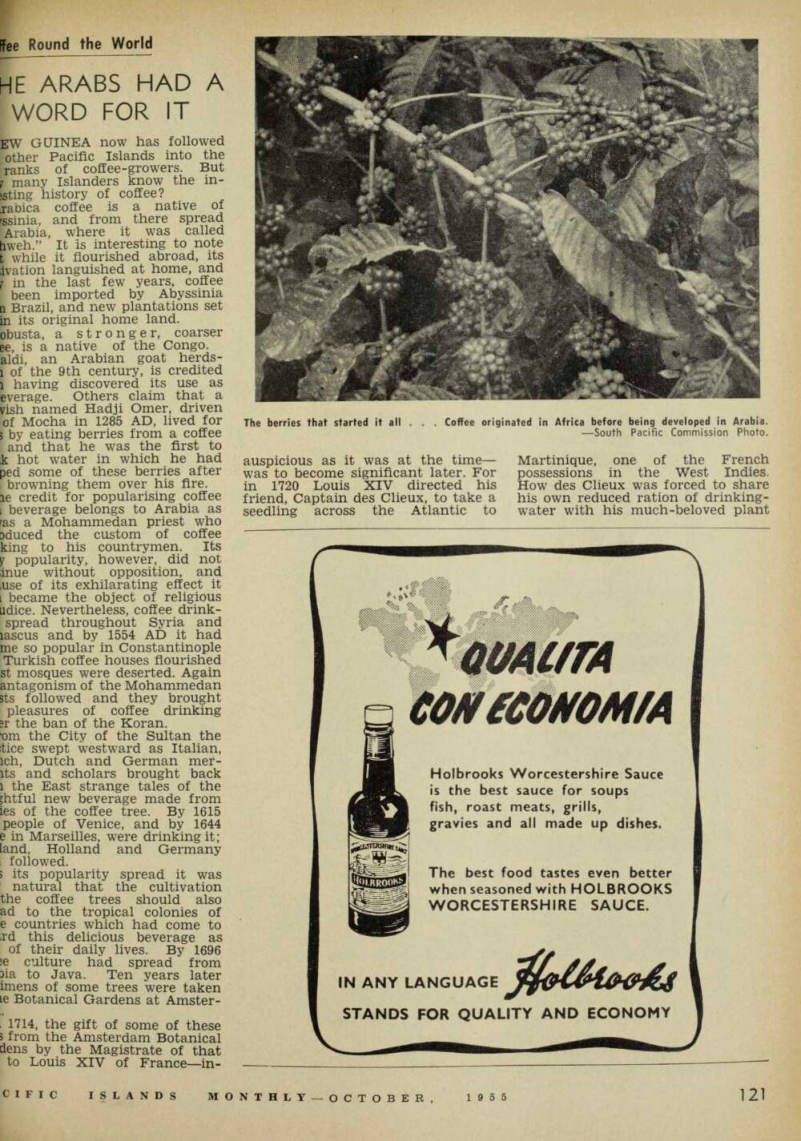
The berries that started it all... Coffee originated in Africa before being developed in Arabia. —South Pacific Commission Photo.
is told as the outstanding ini lon S voyage. And soc 1720 the map of the coffee-gn world began to witness a chs a change that in the future v see the New World countries plying practically all the v coffee requirements.
In Spaniards intro the coffee plant to their posse on the mainland of South Air To-day both Colombia and I as well as most other countn Latin America, produce coffe= these, Brazil is the largest P r od- ucer i Colombia ranks seccr ar . e many schooc thought as to how coffee shof brewed—and as many gadge £ brewing it. s 8 Britishers— who are tradition drinkers—are reputed to be anr the greatest despoilers of coff© m recent years, probably as suit of American influence, we improved somewhat.