News Of The Small-Ships
pp. 103-113 · Read in the full issue
P Happened In This Month:
fctober, 1804, ushered in the E tragic incident of the first re led sandalwood expedition ever ail from Australia. ie brig Union, Captain Pendle i arrived off Tongatabu on jember 30 from Sydney, having ed up eleven sandalwood cutters Jorfolk Island. Next morning, >ber 1, a man described as a iy came off to the ship in a ie. From hi m the captain aed that there was plenty of [alwood on the island, so cap [ supercargo, and six men ed. Large numbers of Tongans e out to the ship displaying $ friendliness and seeking to d but the mate, Mr. Daniel [ht, left in charge, was cautious.
Ie were dangerous days in the ids. He would not permit jlers. His suspicions were ler heightened when the shore y failed to return at night ixt morning the Malay again rned with a verbal message [ the captain to send a large j ashore to join him. As the kge was verbal the mate would accept it. lat afternoon, to the astonish \ of all, a European woman was
brought out in a canoe. She, too from a distance, urged the crew to come ashore, but refused to answer questions in regard to herself and the wherefore of her being on the island. Again the following day the woman was brought out by a party of Tongans, but this time it was clear that she was acting under duress, and the worst fears were confirmed when she suddenly screamed that the shore party had all been murdered, as she plunged from the canoe. To prevent her recapture the crew opened fire on the Tongan canoes, which withdrew.
The woman proved to be Eliza beth Morey, who with a negro servant had been spared in an at tack on the Duke of Portland two years earlier. She had since lived as the “guest” of a Tongan chief.
The Union sailed immediately for Sydney, arriving back with the tragic news on October 25. Little then did all hands realise that the ill-luck which October had ushered in, was to be something far worse before the end of November.
The brig sailed again a week or so later, in late November she was wrecked on Koro Island, Fiji, and every man aboard was slaughtered by the local people. So ended the first tragic sandalwood expedition.
Report for 1954, recently published, shows a slight decline in the total number and tonnage of vessels registered with the Fiji Marine Board last year. The number fell f rom 96 to 91 vessels, and the ton nage f rom 3,712 to 3,382. The fleet wa s made up of 49 motor vessels, 28 auxiliaries, 9 barges, 3 sailing craft, and 2 steamers. Of these, 49 were owned by European organisa tions, 13 by the Fiji Government, 7 b y Fijians, and 22 by others-mainly Indians. Largest vessel was Burns Philp & Co.’s MV Yanawai, 434-GT.
The foregoing refers only to vessels trading within the Fijis. There are other vessels registered in Suva, such as the 3,875-GT Suva operat ing on the trans-Paciflc service for Pacific Shipowners Ltd. (subsidiary of W. R. Carpenter & Co.),
For Eastern Samoa:—Mr.
‘Bill ’ Steffany, owner of the well known small vessel Samoa, which has operated a cargo and passenger
service between Pago Pago and Apia for many years, is adding to his fleet. He has purchased a con verted US Army APC fishing vessel named Isabel Rose, in California.
Captain Bob Payes and engineer Jim Sword, of the E. Samoa Gov ernment vessel Manu’a Tele were to fly north in September to deliver the ship. It is understood that Isabel Rose will take over the Pago Pago-Apia service, after she has been prepared for the passenger trade, and Samoa will operate on the Pago Pago-Manu’a Islands run.
WRECK SOLD:—The 300-tonner Rannah, high and almost dry on the shore reef off Avarua, Rarotonga, since last November 16, has been sold to Wells Brothers, of Pelorus Sound, New Zealand. It was in tended that a salvage party would leave for Rarotonga in September, but arrangements for the salvage launch failed and Mr. F. A. Wells was expected by air. It is not known whether the purchasers hope to refloat the vessel or will dis mantle her. Rannah, built in Tas mania in 1944, is a wooden, standard type vessel similar to a number in the New Guinea trade. She has a refrigerated hold. She was pur chased from New Zealand owners by Mr. D. C. Brown, of Rarotonga, in mid-1953, and registered in Suva.
Following the wreck she became the property of the insurance company, who advertised her for sale on the reef early this year.
REDEPLOYMENT: —Three vessels on the Fiji Register were trans ferred elsewhere in September, one
towing the others. The towing craft was BP’s 126-GT wooden auxiliary single-screw ketch Moala, built by Whippy’s, of Suva, in 1947.
Measuring 835 ft x 22 ft x 75 ft and powered by a 120-hp Crossley diesel, she was one of a number of almost identical craft built by Whippys at about that time. Moala and Adi Gaetane, 11 -GT auxiliary cutter, were being transferred to BP’s New Hebrides Branch, Moala no doubt being freed by the recent purchase
of Vasu for the Fiji trade.
Gaetane was built by Sakhr Levuka, in 1948, measures 36 i 12 ft x 3.7 ft and has a Sin petrol motor.
Also in the tow was the Vavf Oil Co.’s powered oil lighter Fraser, 102-GT. This barge shipped to Suva from Sydne several pieces in mid-1953. W\ together there she entered se as the F-16, operating between the new Vunda Pt. oil terminal
idi Airport. She measures 68 ft j ft x 10 ft, has a capacity of X) gallons in four tanks, and is ered with a pair of 118-hp cules petrol motors. She is now erve on the New Caledonia coast he result of expanding business e. A land pipeline has taken * her Fiji duties. oala, partly aided by the engines ;he lighter, completed the de yto Noumea in 82 days. Adi tane dropped out of the con in the New Hebrides 5 days of Suva.
Oniu In Trouble:—With A
of copra from Niuafoou for ualofa aboard, Tonga Copra ketch A’oniu turned up at 1 early October, ten days from 1 Can Island”. igine bearings had seized, and r setting sail for Nukualofa, rary winds forced Captain Te- Fifita to lay a new course—for pair shop.
A. L V A G E.:— Henrietta, New idonia coaster mentioned last th as wrecked, has yielded up a j percentage of her cargo of
Dleum products, though the
?1 is unlikely to be salvaged, rding to a Noumea corre dent.
IJUVENATED; — Havannah, 205- Noumea vessel which has been Auckland on survey for some 1, cleared there again for her e port on September 9. She cargo for Norfolk Island en e.
)R Lord Howe;—Mr. Ces
Ison, of Auckland, lately skipper the Lord Howe vessel Flying d, is reported to have purchased Sydney fishing vessel Kingfish ugh the agency of Captain aedy for use in Lord Howe irs, mainly by tourists visiting popular resort.
BELL:—It is not often that lip’s bell falls to Davy Jones’ :er without the ship, and even common for it to be recovered, in this case it was only the Locker. It appears that at it one bell in the forenoon :h recently, as the NZGS Maui are's major refit proceeded at tern Viaduct wharf, Auckland,
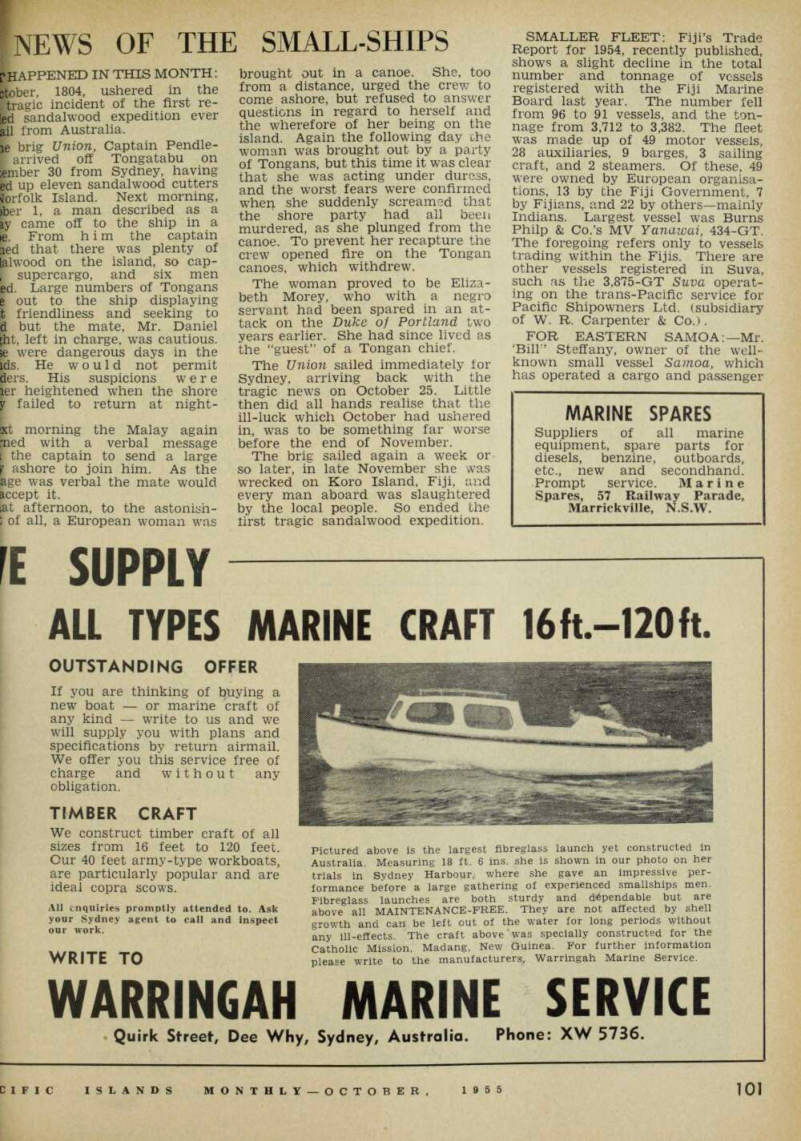
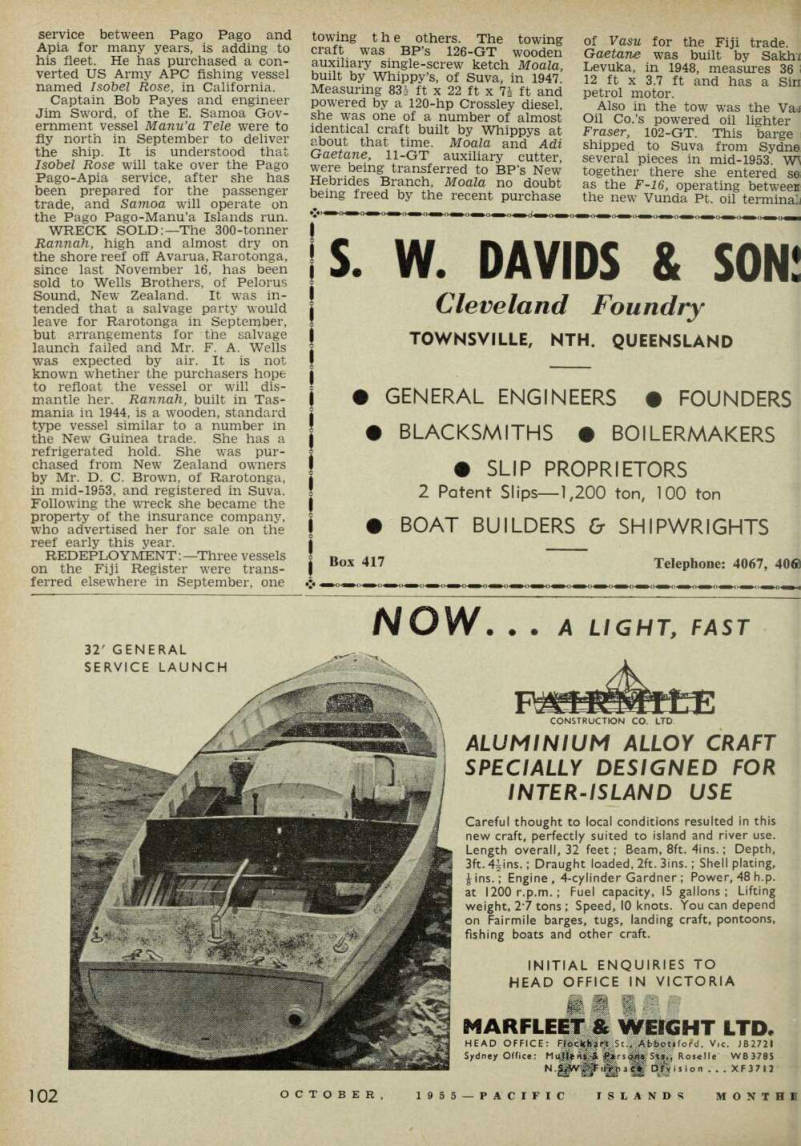
Left "Henriette", Le Dinh Cao's 48-ton coaster, lost on a New Caledonia reef in August. (Photo by Robert Laubreaux). Right: "Rannah", old as she lies on the reef off Avarua, Rarotonga. (Photo by Ronald Powell).
hip’s bell, being passed ashore easons unknown, slipped from jer’s hands and plunged to the lur bottom. But not for long, iding Auckland frogman, Mr. r. Subritzky (of an old NZ ing family, incidentally) was ht to the scene and located the in quick time, thus ending ly another interesting chapter mi Pomare’s chequered history.
LIVERED: The handsome sturdy two-masted schooner line, 66 *ft x 151 ft x 81 ft., ioned elsewhere in September was delivered to Mr. Jack ston, of Rabaul, in September. line was built in 1936 by W. L.
Holmes & Co., of Sydney. She is planked with 2-inch Kauri and powered with a 120-hp Atlas diesel.
The sale was arranged by Sydney ship-broker Captain Kennedy.
Unknown Vlsltors:—Re
ferring to a call made by the Ger man raider Atlantis at Vanavana atoll, Tuamotus, during World War 11, as mentioned last month, Cap tain Nicholas, owner of the atoll, has comment. The local natives, he says, told him that they had seen a lifeboat pulling back to a ship but had not made contact with the Germans. The people were making copra on another islet across the lagoon at the time of the raider’s
visit, and it was not known that the ship had been a German raider.
Noumea Slipway:—The New
Public Works Department slipway at He Nou, Noumea, is now nearing completion and will be in service before the end of the year. It will accommodate vessels of up to 1,000
Left: Captain J. C. Radley, Marine Superintendent for the Seventh Day Adventist's fleet all craft stationed in the Western Pacific, on leave in Sydney in August. Right: The men slivered Mr. Oscar Newman's "Lakeleo" from Sydney to the New Hebrides late in August. from right is Captain Max Stanton, in command.
tons deadweight and will be a valuable addition to that port’s facilities.
Nautical School:—In The
matter of nautical training for local boys, Netherlands New Guinea is apparently ahead of most Pacific Territories. A nautical school at Hollandia is operating courses in navigation, nautical knowledge, and engineering and turning out boys at the rate of 60 per annum.
Practical instruction is given aboard an old pilot vessel.
MISSION FLEET:—Recently on leave in Sydney was Captain J. C.
Radley, of Rugen Harbour (Put Put), New Britain, Captain Radley is in charge of the Seventh Day Adventist Mission’s Western Pacific fleet of small craft. This fleet now consists of 45-ft launches stationed at Kavieng, Madang, Wewak, Buka, Kolombangara and Honiara, and 28-footers at Rugen Harbour, Manus, Malaita and Marovo Lagoon.
Captain R.adley was very well known as skipper of Ambon (since sold) at the time of the Japanese invasion of New Guinea.
HONIARA PORT;—Following re commendations made by two ex perts last year, the British Secretary of State has now given approval to the development of new port facilities at Honiara, British Solo mons. The work will be in three
stages. This first stage includes building a 270-ft wharf on the east side of Point Cruz to accommodate local craft and lighters. Depths alongside will slope from 10 ft up to 4 ft at the inner end. Steel sheet piles will be used. At the NE end a stub-jetty 25 ft wide will be extended to the 5-fathom line
to provide some shelter in thr season. There will be a las landing stage for passen Customs and cargo sheds wii erected just off the wharf, equipment to be provided wilt elude some 30 ft x 9 ft lighten 80-hp towing launch, two nr cranes, two tow-motors witl
ers. Stage-2 of the plan, not approved, will include moorings large vessels. Stage-3 depends flow important the mineral dis hes on Guadalcanal prove to Ls major port development would called for if the field proves [ The first stage is estimated jst £158,000 and will be financed »ly by the Protectorate’s share Japanese war assets. Work [ld start by mid-1956. tfG SLIPWAY:—The Nether s New Guinea Government has jnenced construction of a marine lay at Manokwari. Vessels of ;o 2,500 registered tons will be mmodated.
[Ng George Vi Memorial
HT; —A valuable new naviga il aid came into operation in British Solomons in August, need by public collection, as a lorial to the late King George the light is located near Cape ranee at the western end of ilalcanal. Mounted on a 30-ft ;e tower it has a visibility of dies at sea level. Characteristics three one-second white flashes, one second between flashes, wed by 15 seconds eclipse—the i thus completed three times minute.
Ustger To Navigation:
e Mr. R. Dethbridge, of the sh Solomons, was chugging I in his 40-ft launch Kusima itly between the islands of seul and Vella Lavella, six ; whales suddenly surfaced 25 way. A head-on collision was owly avoided as the whales laid orth-westerly course at about tots, throwing substantial bow is as they “steamed” away on surface.
Jrricane Warnings:
n this appears another hurri season will be in the offing a summary of the existing radio ling service voice broadcasts be topical. ,ndi Aeradio provides the most )rehensive service. Normally, station makes only one voice dcast per day, at 0915 GMT on kc/s, but once a hurricane has ed in the area from the mons east to the Cooks, and the equator south to Norfolk id and shows signs of moving > any island group, Nadi comes with the latest information ly GMT (e.g. 0030/0130 GMT, This station is best heard de the Fiji Group, there being rea of skip, especially at night, le Fiji Group is threatened the , broadcast station on 840/930/kc/s gives bulletins on each r hour until the danger has 3d. Suva Post Office on 4445 also gives bulletins to the local , and will provide the latest •mation on request. Ships call 073.9 kc/s.
For the New Hebrides area Vila gives routine broadcasts at 2115 GMT on 3450 kc/s, but when danger threatens, hourly bulletins are given on the hour or half-hour.
In the Cook Islands there are no routine weather broadcasts, but when a hurricane has formed local craft are kept advised at the regular shipping communications times of 0030, 1930, and if necessary 0730 GMT on 2012 kc/s. Ships calling an 2182 kc/s can obtain information on request. This year the Rarotonga broadcasting station on 5050 kc/s is also likely to be used for hourly bulletins when danger threatens. Nandi on 7530 kc/s is
usually readable in this area also, Samoa is rarely troubled by hurricanes. There is no routine voice shipping service from Apia, but the broadcasting station on 1420 kc/s gives a weather broadcast during the local news session at 0600 GMT and would, no doubt, be used for warning if required. Pago Pago keeps ship watch on 2182 kc/s, replying to calls on 2845 kc/s.
Weather available on request in hurricane conditions. Local low powered broadcasting station on 1120 kc/s would, no doubt, be used for local warnings if required, Tonga is occasionally hit by hurricanes. There is no broadcast
jation. Nandi serves this area on 7530 kc/s and Nukualofa ains ship watch on 2182 kc/s 1740-0940 GMT, with weather nation on request, answering 6 same frequency. ;he Solomons the broadcasting a on 1030 kc/s gives routine er broadcasts at 0745 GMT, o doubt more frequently when F threatens. On the shipping ncy of 5826 kc/s there are e broadcasts at 0400/2300 Monday to Friday, 2300 GMT turday. Hurricane warnings ;iven on every GMT hour ing an alert. Ships calling on )r 6280 kc/s weekdays 2100and 0300-0530 GMT (Sat. 100, Sun. 2100-2330 GMT) )btain weather on request— ra Radio on 5286 kc/s. Nadi 0 kc/s also serves this area.
Ng The Rounds:—The
1 naval patrol vessel Tiare re returned to Noumea from a nile Island cruise. As naval \ vessel based on Noumea for I years past, Tiare, an ex ric a n Yard Minesweeper I is now well known in most Pacific Island ports east of :a. The present cruise began iy, when Governor Hoffherr aken on an official visit to Next port was Suva, from the Governor flew back to
Noumea. Tiare had her annual sur vey at the Suva PWD Yard, then departed again for Futuna and Wallis and from there to Apia where a stay of four days was made.
Next port ( Was Pago Pago from whence the annual pilgrimage to the tomb of the La Perouse Expedi tion victims in Massacre Bay, Tutuila, took place. The ship again touched at Suva on the run back to Noumea, where she arrived on
September 4.
ELSIE-B LOSS:—After three weeks’ invesigations into the loss of the Port Moresby vessel Elsie-B, a marine court found that the probable cause of her foundering in the Gulf of Papua was through the vessel having been overwhelmed by following seas in heavy weather, due to excessive loading by the stern. It also found that three of the five native vrew were lacking in experience. The court censured a radio operator who had inter cepted the first distress call but had taken no action until a second dis tress call was made 16 minutes later.
The court found that the master was a competent seaman and that there was no proof of overloading.
Captain James I. Carlton and his crew of five natives were lost with the ship.
VITI RESUMES: —MV Viti, which suffered a major engine breakdown
in July, at the height of the Cook Islands tomato season when she was most needed in transporting the fruit to the New Zealand market, cleared Auckland again on Sep tember 24 to resume her stand-in duties until Maui Pomare is recom missioned.
French Visitors:—The 3,000-
ton French sloop Francis Gamier, formerly of the Italian Navy, was a visitor to Noumea in September.
With 9 officers and 160 men aboard the sloop arrived from Indo China on September 17, and was to leave with Governor Hoffherr on an official visit to New Zealand later in the month. From there she would sail for Papeete for further orders.
Also expected in South Pacific waters later this year is the 9,000ton training cruiser Jeanne d’Arc, accompanied by the sloop Grandiere.
Both have previously visited Island ports some years ago. Jeanne d’Arc has a complement of 27 officers and 550 men and can accommodate 120 student officers.
PERSONAL; —Captain A. R.
Peckham, recently in command of the new GEIC Te Matapula, has re signed. In September, he brought the Tuvalu south from Tarawa to Suva for refit. Also aboard was Captain G. Douglas, skipper of
Maureen prior to his recent fur lough, who will assume command of Tuvalu.
Station Commissioned:
Fiji Royal Naval Vounteers Re serve’s new station at Bay of Islands, Suva, was to be officially commissioned on October 21. On October 13, a 72-ft SDML was to leave Auckland manned by some of the reservists. North of Auckland she was to rendezvous with HMNZS Kaniere, which will sail from Bluff and escort the launch on the 1,140mile, 6-day passage to Suva. The SDML will be the flagship of the Unit, on loan from the RNZN. The name to be given to the Suva station was not known early Oc tober, but the commissioning would be attended by the NZ Chief of Naval Staff, Rear-Admiral J. E H Mcßeath, DSO, DSC, RN.
NEAR MlSSES:—French Oceania reports two recent near disasters.
On August 24 the 205-ton schooner Tagua, under Captain Salmon, was anchored and loading at Takoto atoll, Tuamotu, when a sudden squall caused her to drag, smashing her steering gear and stern post.
She made Papeete under jury rig.
On September 15 the new 83-ton Vaitaporo, manoeuvring while she loaded at Takapoto, Tuamotu, went onto the reef when her engine room telegraph failed to respond through mechanical trouble. The
false keel was lost and a hole punched in the hull below the en gmeroom before a radioed SOS brought the "52-ton Suzanne to drag her clear. Captain Henri Vemau don was cleared of blame at a marine inquiry later. Temporary repairs permitted Vaitaporo to reach Papeete slipway.
News of Cruising Ys
• GLORIA MARIS heads the roll this month. This staysail schoones x 21 ft. x 12 ft., registered in P<l has ust completed a scientific colleoi in Micronesia and is now refittingg Palau islands, in readiness foo expedition to Netherlands New Guin In an advertisement elsewhere in
ew are being sought. Our information indicate who the actual owners of uoner now are, but she was acquired ir at Newport Beach, Cal., and fitted her present duties by the well-known in Ernest Chamberlain and Bill Crea id chartered in February this year by jral Science Foundation of Philadelphia, ith a special winch for deep-sea dredg -1 sailed for Micronesia on Cruise No. 1. f passage was made to Honolulu, and ay passage from there on to Koror, rich the collection of marine molluscs :ed. This work was directed by Mr. fr Abbott, curator of molluscs at the I and Mr. A. J. Ostheimer 3rd, presi- F the Natural Science Foundation of ihia. Collection proved fruitful, some cies being obtained.
In expeditions the schooner is avail [any special charter work offering, r Chamberlain and Bill Crealock, illy, were foundation members of the Ocean Cruising Club.
PALOMA, on the reef at Maiao Island, Tahiti, was sold by owner William m in September to M. Henri Lambert Je for a reported sum of 30,000 Pacific EA2I4 approx.). Details appeared last ie French yacht MOANA and the i NORDLYS both cleared Papeete west- I mid-September, MOANA in continua a world under-sea-photography cruise. [ intended calling at Rarotonga, a port, Pago Pago, Apia, Suva, thence [Papeete by February.
IOENIX, the husky Japanese-built 50i which Dr. Earle Reynolds, his wife (children, and a crew of three Japanese (sing the world, cleared Rarotonga >r 1 for Samoa, Fiji, and New Zealand.
Holds is an American anthropologist [ Japanese crewmen are university I of Hiroshima. A stay of a week le at Rarotonga and the yacht arrived go September 8.
IKAYA, originally heading for the US ickland, has changed plans. Owner ayes cleared Suva in mid-August for ia Levuka. He then planned to head ■, the New Hebrides and make Cairns hurricane season. Hayes had two com on clearing Suva.
TILE BEAR, with "Buzz" and June i of San Francisco, called at Pago te August, and entered Suva mid ir. Next port would be Auckland, irhich no definite plans had been made.
HITI, "Tahiti"-type ketch, with Lorrin id Phillip Schroeder of Honolulu, was Pago September 5-23, then clearing and Suva.
PPY RETURN, converted ocean lifeboat, for New Zealand, reached Cristobal 7 and cleared the canal a few days Ikipper Tom Acland hopes to reach by early December.
IL ISOBEL, 50 ft. fishing launch, was Kilkeel, Ireland, for Russell, NZ, via in September. Owner George McDonell, ill, hopes to complete the cruise in ths.
CHARD & JOHN, another fishing boat d by a New Zealander, L. J. Highan orne, cleared Newlyn, Cornwall, in for New Zealand, touched Bermuda, ptember, and was to call at Kingston, Tahiti, Suva. With skipper Highan ie other New Zealanders, three Aus and a Dane. und for New Zealand, a 40 ft. cutter, jnknown, turned turtle in Tangier some time ago. The yacht had cleared fish port in May. With 64-year-old rter, of New Zealand, was an English f two girls. In August they were try hitch-hike back to England by first opportunity.
• BISSY GIRL, which cruised the Pacific in the mid-1930'5, cleared Sydney August 23 under new ownership, bound Barrier Reef, New Caledonia, and thence Auckland next year in time for the planned Auckland-Suva yacht race. • HORIZON, 40 ft. double-ender ketch of Sydney, sailed early August for Barrier Reef waters. Owners AAerv. and Barbara Cannon plan to head for New Zealand and probably the islands from there early next year. • DAYDREAM, another Sydney cruising yacht, is preparing to sail for New Zealand and per haps further afield soon. f • MARCO POLO, owned by New Zealander Tony Armit, now on a world cruise, was re ported recently at Rodriguez, Indian Ocean. • SARONG, Auckland-built ketch which sailed the Tasman some years ago, recently changed hands in Sydney and returned to Auckland.
The new owners may head her Islandwards at the end of the hurricane season.
• A 40 ft. ketch, name unKnown as yet, cleared the Hamble River, England, in July for Buenos Aires, Cape Town, Perth, Auckland, San Francisco and Panama. Aboard are English men Harry Erskine, Dick Denning, and Alex.
Mac Kay. She will no doubt show up in the Islands in due course, if all goes well. • Yachtsman-writer Edward Allcard, on his present world cruise, will sail via the Horn to New Zealand, Australia, and the Cape—so apparently will not be seen in the Islands. t The Cook Islands export of
mother-of-pearl shell, almost all
from Manihiki atoll, fell consider ably in the last financial year.
The quantity was 244 tons, com pared with 309, 301, 459, 313, and 288 tons in the respective preceding: years.