Tropical Climate
pp. 91-93 · Read in the full issue
[?]Ultry In The Islands
[?]ecial Problems of [?]ick-Raising Tropical Climate
By R. F. Rankin
yr anyone interested, in poultry vonld he hard to find a more \fying or profitable hobby I breeding one's own stock. If moultry-keeper in the tropics is void the annual expense of im ing chickens it is essential that hould understand enough of the ciples of breeding to ensure that I chickens he raises will be of the Ward he desires. is much easier to ruin a strain ban to improve it, and if the rould-be breeder relaxes and es nature to work unguided he iviting disaster. fture has no place for the high being, pure-bred hen, and F a few generations of haphazard fling, the once well-formed [producer will more nearly re )le her scraggy ancestors from Bungles of Malaya, lere are two sets of influences :h counteract the law that like bees like and which cause dif ices to appear in each succeed generation.
The first of these is atavism, or throwing back. Offspring sometimes show characteristics which appear in neither of the parents but which perhaps reflect back to remote ancestors. The only thing to do to prevent a recurrence of this is never to use birds for breeding if they show any undesirable traits which are alien to that breed as it is to day.
THE second factor counteracting like-produces-like is “prepot ency.” Some fowls have the power of transmitting to their off
spring in a marked degree certain of their own qualities. This power is known as prepotency and it is only consistently found after long years of careful breeding.
It is this sustaining and passing on of desirable traits that makes the pure-bred bird so superior. For in the pure-bred fowl offspring will more nearly resemble parents if mated wdth care.
It is obvious that the quality of prepotency is especially important in the male, for he can pass it on through ten or a dozen breeding
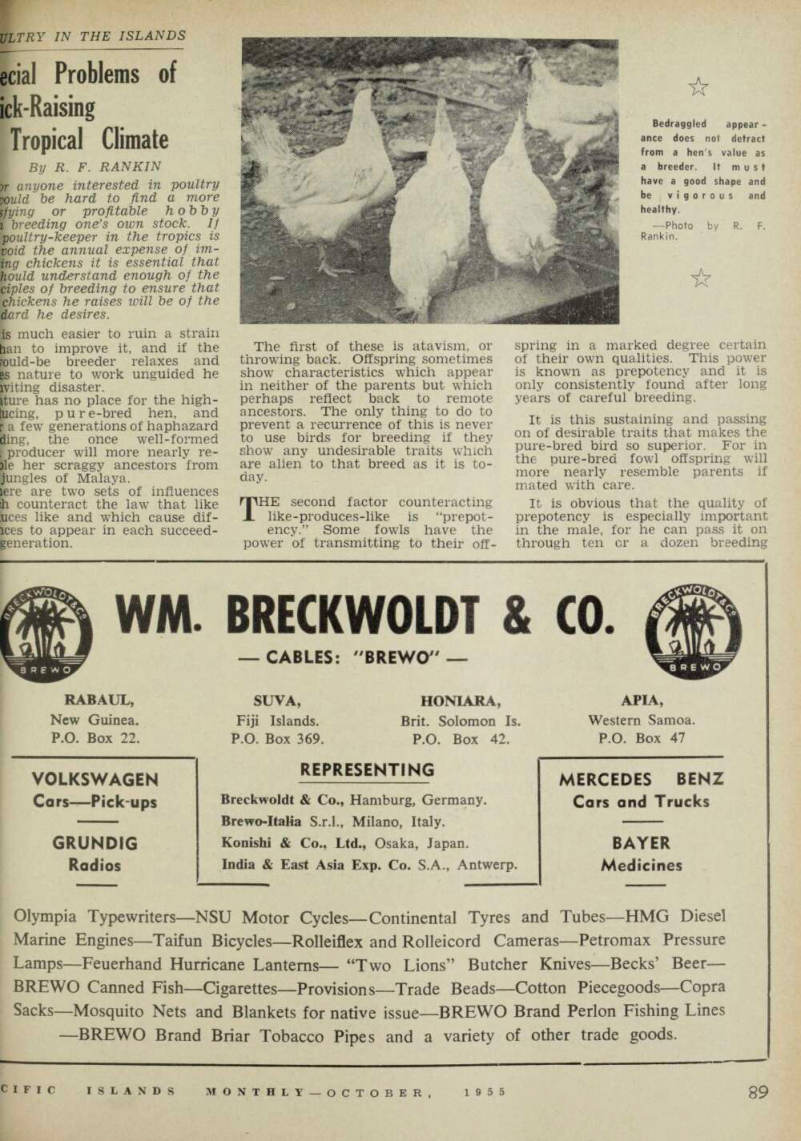
Bedraggled appear ante does not detract from a hen's value as a breeder. It must have a good shape and be vigorous and healthy. —Photo by R. F.
Rankin.
hens in the one pen. But apart from his sexual vigour a more fundamental reason makes the rooster more important than the hen in matters of breeding.
Differences in egg laying ability are inherited. However, whereas a high producing hen will not neces sarily have high producing daughters, mediocre and poor laying ability will be passed on. High pro duction is passed on from a hen through her sons. In other words, if you wish to breed for high pro duction you must use a rooster bred from a high producing hen.
ONE more factor affects the hen between chicken and laying stage and that is environment.
You may have chickens of the best possible strain and yet they may turn out to be profitless layers.
This sad state of affairs might be solely the result of mismanagement —improper care, housing and feed ing.
A jungle fowl in a few generations of good management and feeding will show a remarkable increase in egg production. A pure-bred fowl will degenerate just as remarkably if not given the right treatment.
The first necessity in breeding is to establish a standard. Decide upon what breed you will concentrate and determine what qualities you will aim for.
Hens are divided into light and
heavy breeds. The heavy breeds such as Orpingtons, Australorps and Rhode Island Reds are generally dual purpose—they are reasonably good layers and make good eating.
The light breeds such as leghorns are kept mainly for their high egg production. Naturally they are just
as edible, but there is not so n of them.
Personally, I favour white horns but in the tropics they to have a breeding drawback w I shall mention later.
Having decided on the be study it thoroughly so that youj
tect all the good qualities and nits in any bird of that breed. [HERE is one drawback as re- Fgards breeding which hens, I especially leghorns, seem to ler from in the tropics. [ii colder climates most hens have annual summer moult, when they e old feathers and have a spell ,m laying. This spell enables jm to build up their constitution tnext season’s laying. Without i spell egg size and shape is in led to deteriorate, t has been my experience, mainly ,h leghorns, that in the tropics is keep on laying without rest, in acquaintance of mine had aewhat the same experience with s in the tropics. t is essential that breeding eggs [of a good uniform size and ipe. f egg quality has deteriorated be ise of this sustained laying, the rious solution is to get eggs for eding before deterioration sets in e., in the first season of laying, you start breeding at 12 months I approximate weights of white torn pullets should be 4 lb. and jsters 5 lb. Australorps and Rhode md Reds should be a pound or
[ heavier.
here are three methods of breed i pure-bred fowls. They are »wn as in-breeding, line-breeding I out-crossing. [-BREEDING means the mating |of birds that are closely related over a number of generations. ► objects or in-breeding are to ire the best qualities and formity as quickly as possible, bust not be carried too far or it [ result in loss of vigour and eral deterioration. However, if wish to perfect a strain of your i you must start with in-breed and then proceed with line- Jding. ine-breeding is also the mating birds of close relationship, but y are mated with the definite . of emphasising the qualities of ancestor. ! you have a particularly good ster, you will mate sire and ghter to increase the proportion the rooster’s blood or qualities the subsequent generation, lilarly, you can mate mother and or any other mixture calculated ncrease the blood of a particular estor. he longer line-breeding is carried and the greater the proportion the blood of the original estor in the flock, then the >nger will be the tendency to duce the ancestor’s qualities, onsistent line-breeding brings us er to “like produces like,” and vided we have established good lities this achieves the aim of breeder of pure-bred poultry, ►ut -crossing means mating your
hens with a rooster of the same breed but no relation whatever. The addition of outside blood often greatly improves the flock but, of course, there is always the posi sibility of the reverse happening.
The new rooster should be tried out on a few hens to see that his progeny are what you desire. If so he should be kept as long as he is useful.
THERE remain only two more terms with which the breeder or purchaser of poultry may come into contact. They are single mating and double mating.
Single mating is the ordinary mating of a pen of hens and roosters in an effort to produce chickens with the most desirable qualities.
Both hens and roosters are selected with the utmost care, the weak nesses of one being counterbalanced
by the strong points of the other.
Double mating consists of mat ing one pen to produce desired male qualities and another to produce de sired female qualities. This will not attract the backyard farmer, but it provides an absorbing hobby for those who have the time and money to explore the intricacies of breed ing.
The main idea behind double mating is to achieve standards de manded of show birds. It is un fortunately true that even in poultry beauty and utility do not go always hand in hand. f Mr. A. M. Wilkie, Assistant Financial Secretary, Kenya, who has been seconded as Development Secretary, Western Pacific High Commission, assumed duty at Honiara in September.