Tropicalities
pp. 79-80 · Read in the full issue
Magazin Esection
Snail Licks Snail
INAILS are locked in mortal com ) bat at Saipan, according to a f recent United Nations report on ie United States Trust Territory
{Micronesia.
Mr. Elias P. Sablan, reporting on gricultural developments, says he Sieves that an answer has been Kind to the problem of the de ductive giant snails which were Produced to the Territory—and, aring World War 11, to other South acific territories—by the Japanese.
The answer? Another snail, nailer, tougher, and a lover of iant-snail meat.
Tests carried out at a small islet ear Saipan have resulted in almost 11 the giants falling victims to the toarfs. [The dwarfs will now be introduced rogressively to other islands.
[Special Correspondence
bfOST people who move to chillier FI parts of the globe after years [ in the Islands are bound to con ;act homesickness sooner or later, id a Sydney contributor says that B suffers acutely with the arrival I Fijian or Polynesian letters.
On the other hand, the same com lentator points out that Islands Jrrespondence can sometimes be >me a trifle one-sided unless pre mtions are taken. A useful step 1 to bring away from the Islands supply of stamped aerogrammes hich, addressed by the exile to imself, are duly sent in otherwise npty envelopes to defaulters.
In Fijian cases, this system of )gging of consciences is reported )be 99 pc effective. In fact, if le returned aerogramme (filled to ie last quarter-inch) is not an gered promptly, there comes a jrsely-worded further communica on indicating that the boot is now n the other foot.
The system has minor complica ons, of course. For instance, a ijian soldier (territorial) wrote: Just before parade was dismissed imebody passed the word to me lat there was a letter at the djutant’s office. My sergeant was little annoyed when I showed igns of leaving ahead of the word, fe was muttering where did I think was going and I was muttering fiat my inside was upset and I mst leave very urgently. . . When opened the letter and found the irmail form with nothing on any
side whatever I asked the corporal; Has the date of April Fool been changed? He said he didn’t think it had, and so I realised that I must nil the form without more excuse, Here it is.”
The 1 pc failure, it appears, had every reason for being so. A relative reported that the cause of silence was an addition to the family arriving simultaneously with the contracting of chicken-pox by the proud father.
Malden Windjammers
MANY old windjammers ended their days on the shores of the now abandoned guano island of Malden, in the central Pacific.
It is doubtful, however, whether any of them were as curious as the “windjammers” which actually sailed across Malden’s sun-parched surface—and still sit rusting there to-day Perhaps unique in Malden’s heyday was the system of transporting the dug guano from the rich eastern end of the island to the ship loading-point eight miles away on the leeward side.
The empty tramway trucks were manhandled across to the excava-
tion area by the Cook Islands labourers, but when loaded, sails were hoisted and the trucks, quickly gaining speed under pressure of the fresh trade wind, were soon speed ing westward at up to 20 miles an hour.
Men riding the trucks were occasionally hurt when the “skipper” failed to give the order to take in sail in time, and the loaded trucks lept the rails at the western terminus.
According to a Tahiti schooner skipper who called at Malden dur ing World War 11, en route from Christmas Island, the old railway trucks were still standing there at that time. Few calls are made at Malden now.
Papuans As Divers
WITH training, Papuan divers could rival the famous divers of the Torres Strait region and Papuan trochus would become a potential goldmine for the Terri tory, says Mr. Noel Maloney, a Port Moresby trader.
Suggesting that Papuan divers should be sent to Torres Strait for training, Mr. Maloney said that there were excellent divers in the Papuan coastal villages, but they recovered only the shells lying on the reefs.
It was essential, he added, that the industry should be fully organised among the Papuans. At present, divers who made a good haul often stopped diving until the money they received for the shell had been spent.
Mr. Maloney said that Papuan trochus was gaining a high reputa tion overseas, and he had had in-
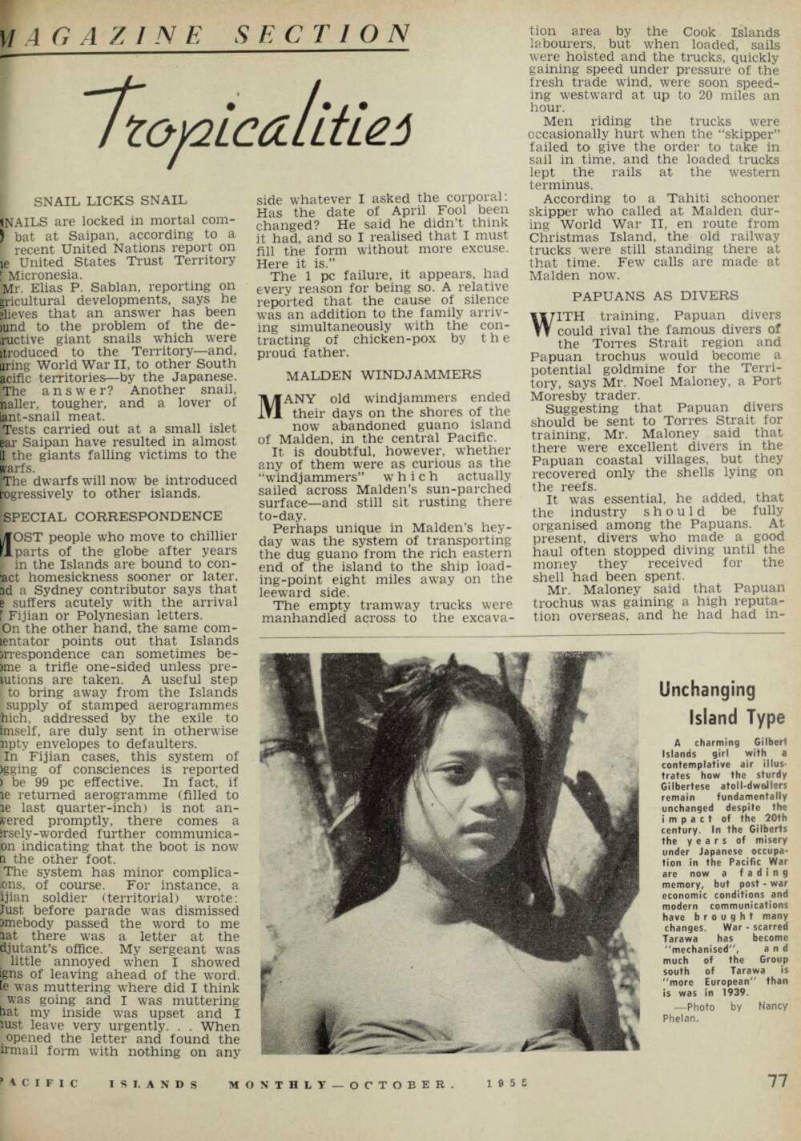
Unchanging
Island Type
A charming Gilbert Islands girl with a contemplative air illus trates how the sturdy Gilbertese atoll-dwallers remain fundamentally unchanged despite the impact of the 20th century. In the Gilberts the years of misery under Japanese occupa tion in the Pacific War are now a fading memory, but post-war economic conditions and modern communications have brought many changes. War-scarred Tarawa has become “mechanised", and much of the Group south of Tarawa is “more European" than is was in 1939. —Photo by Nancy Phelan.
quiries from as far afield as Italy, Japan, Hongkong and Holland.
Scientific New Look
MANY hands were figuratively raised in horror when a Sydney University lecturer in anthro poligy (Dr. Ronald M. Berndt) told the British Association for the Ad vancement of Science, at Bristol, in
September, that, in his opinion, can nibalism was “a nourishing and hygienic means of disposing of the dead.”
The subject is unlikely to cause any noticeable commotion in those parts of the Island world where the custom has long been eliminated.
Incidentally, in Anatomy of Para dise, J. C. Furnas points out with dispassionate calm that although “Polynesianophiles” imply that can nibalism was “missing all over Polynesia” when Europeans arrived, it was extremely lively in New Zealand and the Marquesas, known in the Tuamotu, and sporadic in Tonga and Samoa.
After emphasising that Fiji probably excelled any other island group in technical progress, he adds: ‘“Cannibalism in so advanced a set ting is a striking example of the strange things that people insist on doing. It was specially striking in the Fijian, who is one of the toughest and most intelligent of Islanders, and certainly the most likeable as well.”
To-day, says Furnas, cannibalism sometimes sounds comic to people reared on jokes about boiled missionary, and to others it is shocking. But in its own time and place it was neither, being “merely a pressure -releasing institution as intimately bound up with the com munity as saloons were with old time Sierra mining camps.”
The Teka Game
THE throwing of the teka jave is an ancient Island gai known throughout Melanej and Polynesia, but it has died m re cent years in the Cook Islan The teka is a type of reed ti grows in some islands, and there a Mangaian ute, or song of prat which tells of a champion telf thrower named Turi, who is si< posed to have thrown a teka a diJ ance of half a mile.
The teka javelins were fitted m round hardwood heads, and wv 8 ft long. They wv thrown underarm, either sing handed, double-handed, or with! sennit cord attachment which creased the power of the throw champion had to be adept at’ three types of throw.
By 1926 the teka had died outd Rarotonga and the imported gam of cricket, football and basketld had taken a firm hold.
In Mangaia the game was bannr as the children used to play it the roads, sometimes with disastro resu 1 ts to pedestrians or t windows of nearby houses. . In Mangaia to-day the teka re' is used as a material for maki' the low-crowned, broad-brimro hats that the women wear to churn The reeds are cut and the pith 1 moved. They are then dried ■ three days and a further three da. of fine, painstaking plaiting pi< duces a hat that is light, cheap, a£ very attractive.