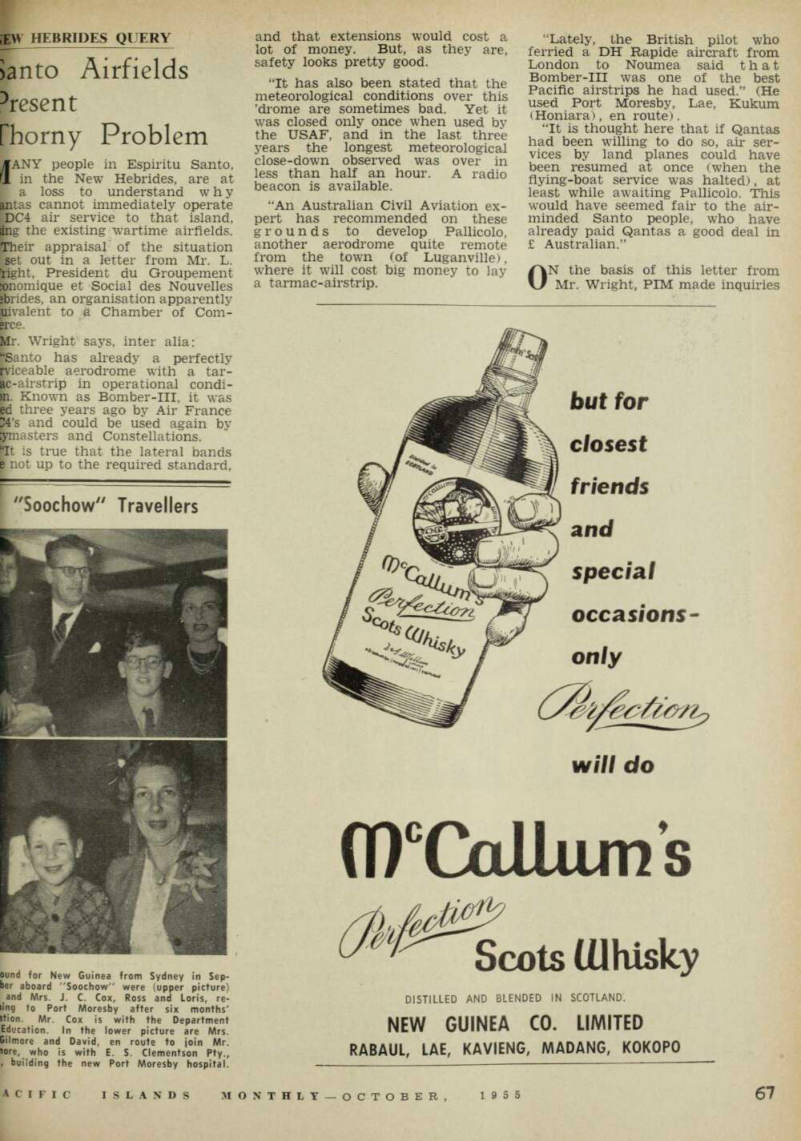
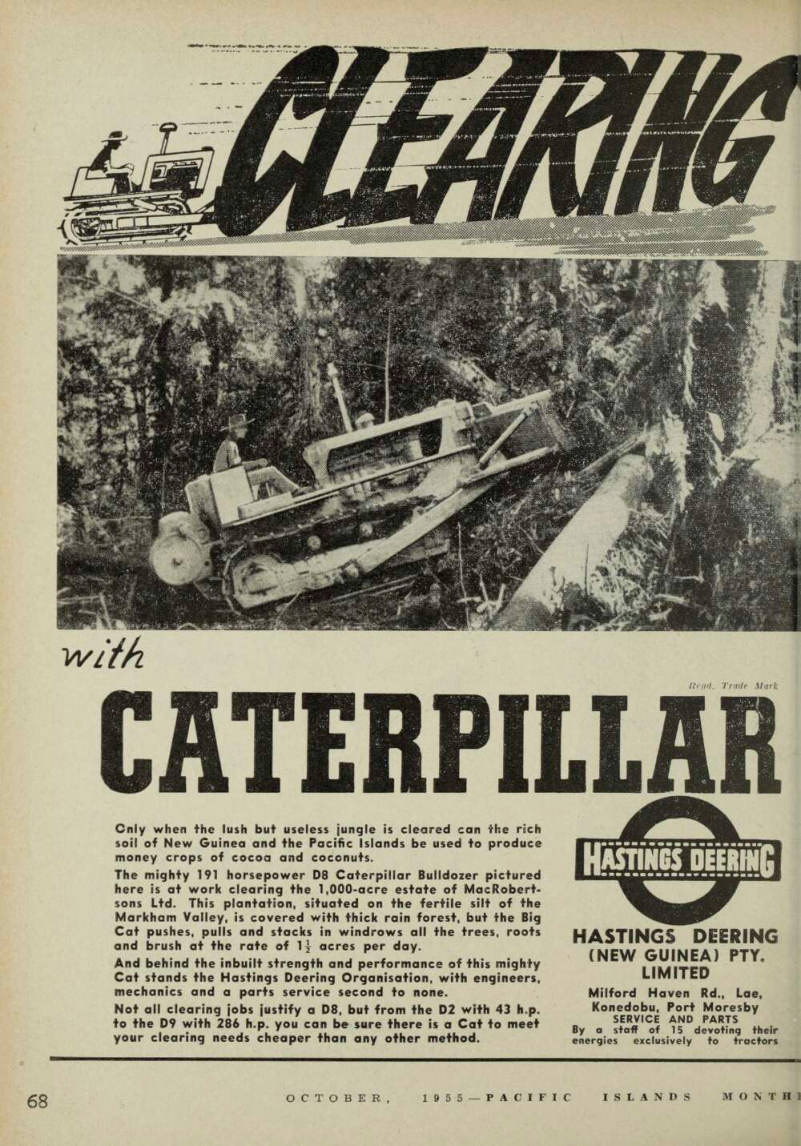
"Soochow" Travellers
pp. 69-71 · Read in the full issue
and that extensions would cost a lot of money. But, as they are, safety looks pretty good.
“It has also been stated that the meteorological conditions over this ’drome are sometimes bad. Yet it was closed only once when used by the USAF, and in the last three years the longest meteorological close-down observed was over in less than half an hour. A radio beacon is available.
“An Australian Civil Aviation ex pert has recommended on these grounds to develop Pallicolo, another aerodrome quite remote from the town (of Luganville), where it will cost big money to lay a tarmac-airstrip.
‘Lately, the British pilot who ferried a DH Rapide aircraft from London to Noumea said that Bomber-111 was one of the best Pacific airstrips he had used.” (He used Port Moresby, Lae, Kukum (Honiara), en route).
“It is thought here that if Qantas had been willing to do so, air ser vices by land planes could have been resumed at once (when the flying-boat service was halted), at least while awaiting Pallicolo. This would have seemed fair to the air minded Santo people, who have already paid Qantas a good deal in £ Australian.”
ON the basis of this letter from Mr. Wright, PIM made inquiries
[?]ound for New Guinea from Sydney in Sep [?]ber aboard "Soochow" were (upper picture) [?]and Mrs. J. C. Cox, Ross and Loris, re [?]ing to Port Moresby after six months' [?]tion. Mr. Cox is with the Department Education. In the lower picture are Mrs. [?]Gilmore and David, en route to join Mr. [?]ore, who is with E. S. Clementson Pty., [?], building the new Port Moresby hospital.
several quarters and obtained the [lowing replies: In 1946, Mr. Fricker, of the Aus- Sfan Department of Civil Aviation, spected the potential civil air ids at Santo and decided that ose worthy of consideration for velopment were Pallicolo and
ganville.
Between June 15 and June 23, 1954, th airfields were again inspected Mr. D. V. Davies, Senior Airport Rneer of the department of iril Aviation, with the assistance Captain J. L. Grey, of Qantas.
Neither airstrip, at the present le, meets the recommended mini im standards laid down by the ternational Civil Aviation Organ tion for use by DC4 aircraft.
Hr. Davies, in his report, said he isidered it essential that in re bilitating either of the airfields, ;y should be raised to minimum AO standards for DC4 aircraft ore commencing scheduled opera ns and his estimate of the cost Fdeveloping Pallicolo to this ndard was approximately £15,000 \ than developing Luganville to similar standard. furthermore, Pallicolo was roured because it is at sea level opposed to Luvanville, which is vated at approximately 500 feet, d the meteorological records, ich were examined at the jiritu Santo Meteorological Office,
showed that Pallicolo would enjoy approximately 25 per cent, more days per annum of weather suitable for DC4 operations than Luganville.
WHILE both airstrips were suit able for wartime operations and are still suitable for charter operators or non-scheduled carriers, the Department of Civil Aviation subscribes strictly to the standards laid down by the Inter national Civil Aviation Organisation and as neither of these airfields meets the minimum standards set by this international body, they are not prepared to authorise their use by a scheduled Australian carrier until certain rehabilitation work is carried out.
Operations from Bomber-111 might be uneventful, but if by any chance an accident did occur, the accusing finger would certainly be pointed at Qantas and the Aus tralian Civil Aviation authorities for
permitting flights into an airport which did not meet the minimum safety standards laid down by the ICAO on the basis of world-wide experience.
In the face of this, it seems that there is nothing for it but for the Santo airfield rejuvenators to get busy. t Reputed to be the world’s largest and most beautiful butterfly, a Vic toria Regina, collected in the Solomon Islands by Mr. R. G.
Bartlett, retired Queensland school teacher, was displayed at a Too woomba festival in September. t Twenty-three students from New Zealand’s Island Territories were attending the Central Medical School, Suva, last financial year. Of these 10 were medical students, five dental, five public health, two X ray, and one laboratory.