Wedding at Rabaul[?]
pp. 30-33 · Read in the full issue
as some of the Sydney papers it “the Bainings Islands inquii It is a good thing for two res It will save the washing of of soiled linen and it creai precedent that, when a Govern official is out on a job to qr disturbance, his actions doc necessarily place him with onu in the boob if he or his parti forced to take direct action.
In the past only too freqij incidents of a somewhat s< nature have resulted in ruinr young man’s carreer for the s reason that he was made a offering for the gods of the LJ of Nations and/or UN Trust© Such an attitude, forced oc Administration by higher autlf has created considerable disse; in the ranks of young DS od and, together with the incrr] power of the Public Service Ass tion, undoubtedly has aft recruitment of new officers.
In these days of orgj? employees’ associations it doe* require much imagination visualised a sudden “stop wok “rolling strike” which seriously affect the functions ■ Native Affairs Department thn out the Territory.
The days of class distinctio fading and a victimised servant has not the same prejj; for taking direct action as i past.
Be Prepared!
The old Boy Scout mottt Prepared, is well worthr thoughtful consideration in days of cold wars, interna, tensions and aggressiveness < our Near North.
Such thoughts must have im Minister Hasluck when at El at the opening of the Legii; Council Chambers he (according to the official Facv Figures No. 45) relative tf bombing of Darwin in 1942,
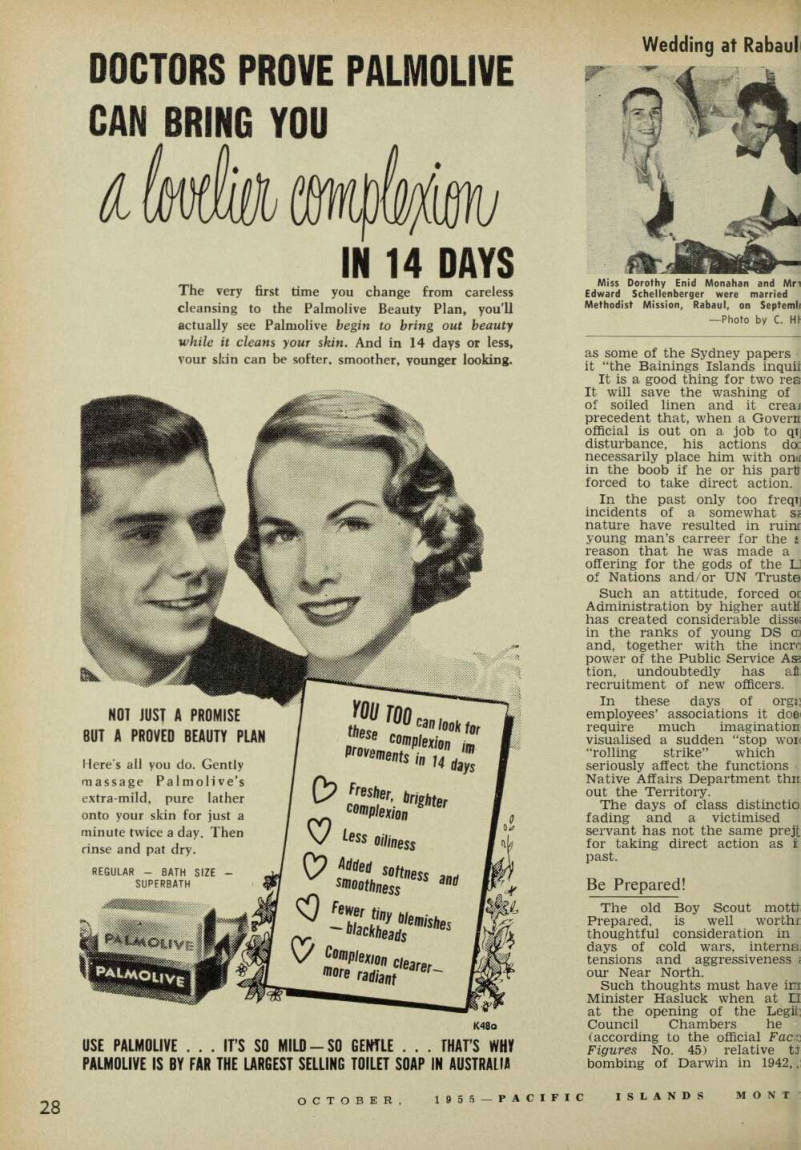
Miss Dorothy Enid Monahan and Mr[?] Edward Schellenberger were married Methodist Mission, Rabaul, on Septem[?] —Photo by C. H[?]
>re were 243 killed and 350 unded: “It is not much use re nting history unless we attempt Craw from the account some iful lessons.
Amongst the lessons of the raid Barwin was that the situation ich made the raids so damaging I been created in the months lediately before the raid took •e. The comparative defenceless- I of the whole nation, in which Imorft than 20 years political aes had argued against each & as to whether any defence at ■ was necessary, and every losal for defence had been bsed. We have had one warning it what happened on past [ires. What happens next fends on us all.”
Guineaites can read paul” where “Darwin” is lioned and they have a true are of the set-up in January, [ id what would be the picture 155 if a northern invasion came? iless the Services have their aces well camouflaged, I would that the position is worse than as in 1941. inay be wrong. I hope I am, bne must remember that the b mind is more complex than is in pre-war days.
Administration Accounts
Once again the Auditor-General has a tilt at the apparent slap happy system by which the P-NG Administration controls its account ing of public moneys and, despite scathing criticism in the past by Auditor-General Brophy, continues to carry on blithely in the same carefree manner.
If all Mr. Brophy says is correct— and he is not a man who goes off half-cocked where official statements are concerned—it would seem the Audit Department itself is due for some criticism for not forcing a tighter control and better admini stration in P-NG.
Or is it that checkers of. public funds have lost their power and are slapped down or ignored by money-drunk officials who defy the fundamental rules of accountancy?
Criticism of the laxity of Admini stration accounting methods has even been voiced by the Judiciary in P-NG and for “Treasury subsidiary accounts” to be so “incomplete and inaccurate” from 1946 to 1953 “that no reliance could be placed upon them” is certainly alarming.
Says the report in part; “Economic development and demand for Administrative facilities have outstripped the potential of the Administration both in money and man-power.” (Oven
Government bodies do not take adverse criticism kindly, and despots resent it. Nevertheless we still are officially classed as a democratic country, and as such the people are entitled to a voice in the way in which their money is spent and collected.
During my recent visit to P-NG I heard considerable comment from officials and others on the Admini stration’s extravagant expenditures, and it appeared to me that much of this extravagance was due to the generous grant from Australia which P-NG did not earn but acquired, for more or less senti mental reasons, to bring enlighten ment to an undeveloped people.
This duty appeared to have, at times, a very broad interpretation and in one instance particularly I was somewhat puzzled to appreciate the justification in this category of the construction of an elaborate archway at the gates approaching Government House at Konedobu.
Certainly a Parliamentary Party was due in the near future, but I couldn’t help speculating as to what the late Sir Hubert Murray would have thought and said of such a structural extravagance.
Religious Competition
There has been a gathering of the Church of England clans in
Sydney at the General Synod, including a lay representative from New Guinea in the person of Sgt.-Major John Guise, of the Royal Papuan Constabulary, whose presence was well publicised by the newspapers.
Bishop Strong, of Papua, made a plea for the Church to become
“South-east Asia minded” even went so far as to sug that Australia might become Trustee under the UN for much-discussed West New Guii He envisaged the Muslim f being introduced there in event of Indonesia taking control. And, of course, thas
ust what would happen, as I [guested some time ago.
If this did occur, then one could lualise a greater unity, perhaps, hongst the 20-odd Christian tominations now vying for the mis of the heathen in P-NG. hinatown No. 2 see that a Rabaul medico is ing to market (and quite jus iably, too) over the sub-standard editions prevailing at Rabaul’s linatown No. 2, situated in Matupi rm. without doubt the buildings and I living conditions are the worst have seen in the Territory, and »y reflect no credit on the [horities for allowing them to re lin so.
Lny collection of second-hand h hovels is an eyesore, but China to No. 2 in South Rabaul reaches
[all-time low.
krhat struck me as particularly pngruous in this area was the king of late American cars be rth rusty and twisted iron sheds, p to so-called dwellings out of Ich stepped glamorously-gowned bese lassies looking as fresh as [duco on the Cadillacs. It would |ear that Chinatown No. 2 is hick passing problem which no rernment department wants to Idle. But it must be somebody’s ton. nd talking of ugly clusters of ited iron huts, Moresby’s once uresque village of Hanuabada tow a sorry-looking collection of els with cackling fowls under th the living quarters.