Rabaul
p. 21 · Read in the full issue
Derelict Shantytown
[?]lum Area of Rabaul Under Attack
SHE name Chinatown, writes a I Rabaul correspondent, V. H. iedlander, used to suggest Oriental nc, mandarins in flowing robes, Red voices in dimly-lit buildings d quiet gardens, tea served in per-thin cups, and, in short, an a (or an illusion) of mystery, hence and exotic fascination. But Himpsc of Chinatown at Rabaul Iters any notions of the kind. 5 a populated area, Rabaul’s w Chinatown” came into being p the war, when several hundred lese moved into the Matupi in area. piled labour and tools were fee. and building materials were fcer. Bush timber and old cor ked iron were used to build fes of shanties amid the junk I discarded war material that red the place. le unfortunates settled down, fcrarily they thought, and after igqurs of the Japanese oepupat- Ithis was at least an improve t. They were advised not to Id money on their huts because k expected that the whole area p be surveyed, cut up into al fents and offered for tender. (ice the war, the Chinatown jation has increased by at least b, and the district has become
felict slum.
pidreds of natives live in far I squalid conditions than the
Chinese. Men, women and children exist in humpies dilapidated almost beyond belief.
IN 1954, when the Lands Depart ment surveyed Matupi Farm and divided the area into allotments, it was found that sometimes three or four families were living on one surveyed block and that many huts were built over block-boundaries.
Last November 132 blocks were put up for tender. More than 200 persons applied, and the successful tenderers were ordered to build houses to a minimum value of £1,500 on their blocks within nine months.
This seemed reasonable enough until it was realised that the pros pective housebuilder had first to evict the people living on his land.
And since there were still about 90 families without land of their own or alternative sites to move to, the impasse remained.
When the nine months had elapsed, not more than half a dozen purchasers had completed or started building on their land.
In September 45 blocks of land in the Matupi Farm Extension area were being applied for by tender by more than 90 persons. After the allocation of these blocks, about 50 would still be without land.
DR. ERIC WRIGHT, of Rabaul, said in late September that the New Chinatown area contained many hovels, heaps of junk and conditions favourable to the spread of disease. Roads were in a deplor able condition, and the dust was causing considerable hardship to many people.
Dr. Wright suggested that the Administration should provide the destitute people with sufficient materials to build themselves decent houses. This, he held, was the only way to eliminate the present squalid conditions.
Dr. Wright attributed the situa tion to Administration indecision over a firm policy for housing the local Chinese people.
He added that he would like to see an old men’s home built at Rabaul, or the present Asiatic hos
pital turned into an old men’s home and a new hospital built. He also suggested that old-age pensions should be paid to deserving cases.
The Administrator of Papua-New Guinea (Brigadier D. M. Cleland) has announced that he has called for an immediate investigation into Dr. Eric Wright’s claim that conditions at Rabaul’s New Chinatown were worse now than they were ten years ago.
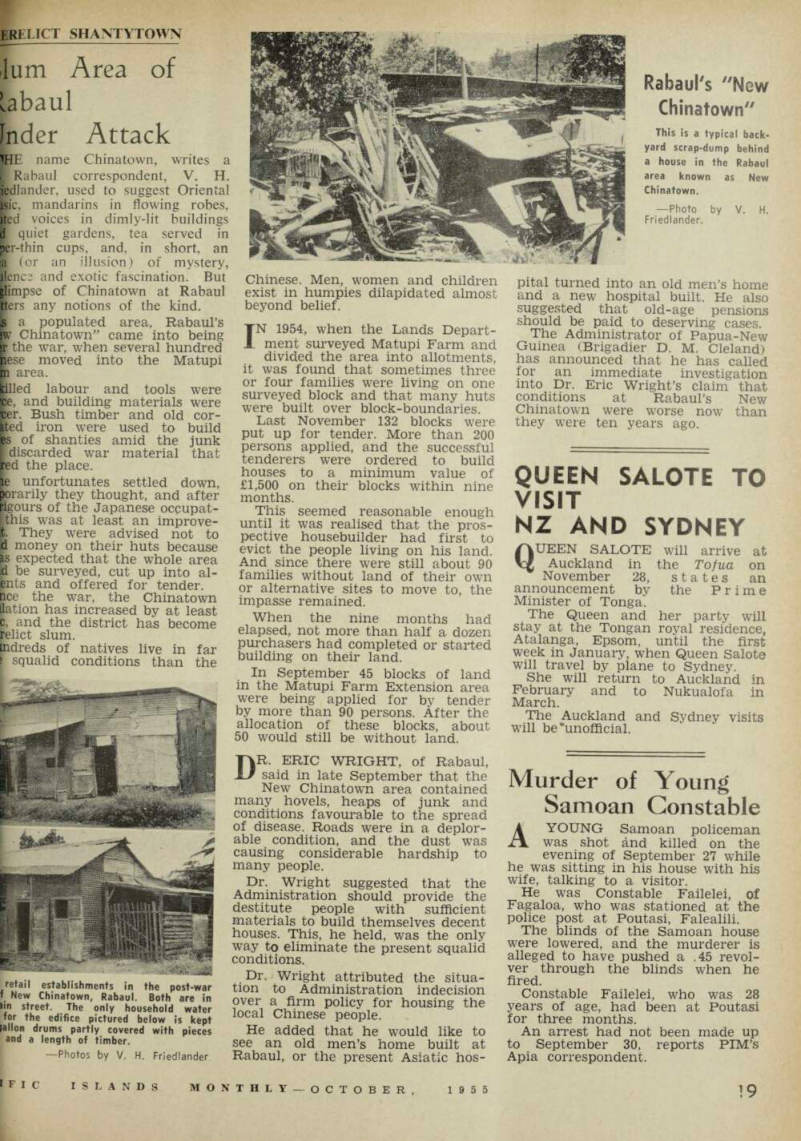
[?]retail establishments in the post-war of New Chinatown, Rabaul. Both are in [?]in street. The only household water for the edifice pictured below is kept [?]allon drums partly covered with pieces [?]and a length of timber. —Photos by V. H. Friedlander.
Rabaul's "New
Chinatown"
This is a typical back yard scrap-dump behind a house in the Rabaul area known as New Chinatown. —Photo by V. H.
Friedlander.