Drift
p. 131 · Read in the full issue
Disputed Origin
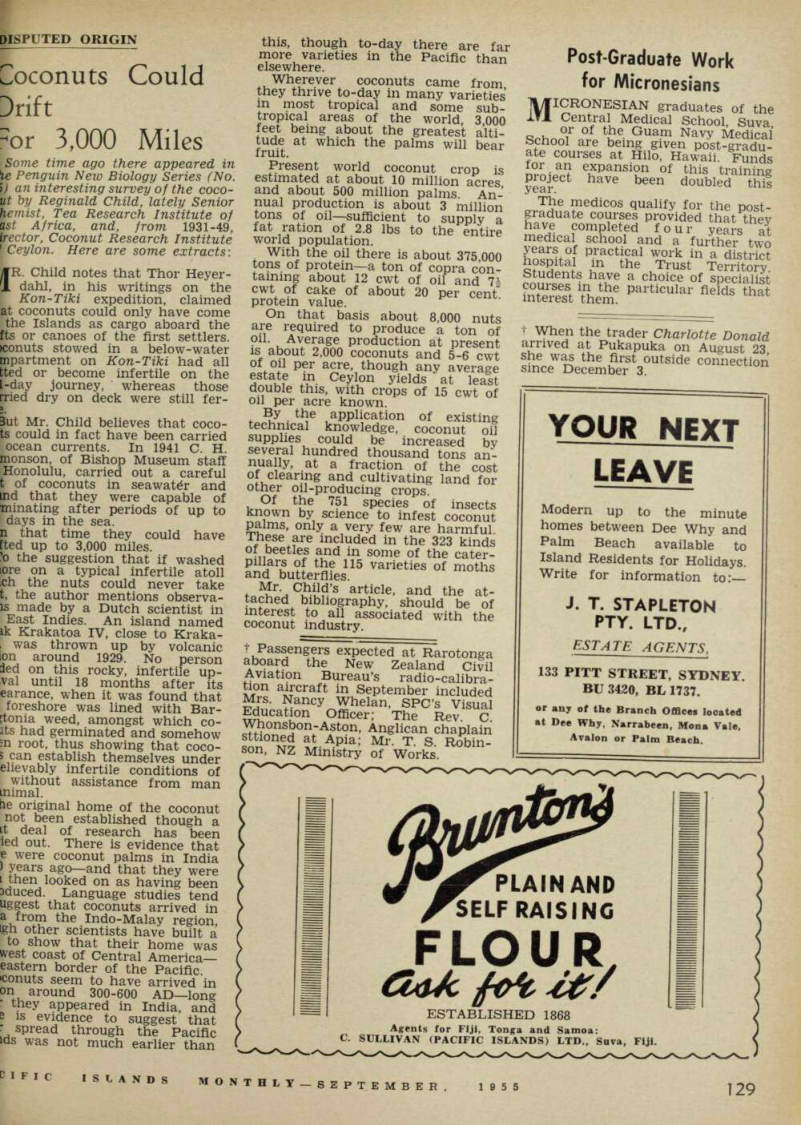
Coconuts Could Drift For 3,000 Miles
Some time ago there appeared in ie Penguin New Biology Series (No. \) an interesting survey of the coco ut by Reginald Child, lately Senior jiemist, Tea Research Institute of ast Africa, and, from 1931-49, I rector, Coconut Research Institute Ceylon . Here are some extracts : IR. Child notes that Thor Heyer -1 dahl, in his writings on the Kon-Tiki expedition, claimed at coconuts could only have come the Islands as cargo aboard the fts or canoes of the first settlers. >conuts stowed in a below-water mpartment on Kon-Tiki had all tted or become infertile on the l-day journey, whereas those tried dry on deck were still fer 3ut Mr. Child believes that coco ts could in fact have been carried ocean currents. In 1941 C. H. monson, of Bishop Museum staff Honolulu, carried out a careful t of coconuts in seawater and tnd that they were capable of minating after periods of up to 1 days in the sea. n that time they could have fted up to 3,000 miles. ’o the suggestion that if washed tore on a typical infertile atoll ,ch the nuts could never take t, the author mentions observa is made by a Dutch scientist in East Indies. An island named ik Krakatoa IV, close to Kraka , was thrown up by volcanic ion around 1929. No person aed on this rocky, infertile up val until 18 months after its earance, when it was found that foreshore was lined with Bar ftonia weed, amongst which co lts had germinated and somehow ;n root, thus showing that coco -5 can establish themselves under eheyably infertile conditions of without assistance from man inimal. tie original home of the coconut not been established though a it deal of research has been led out. There is evidence that e were coconut palms in India y® ars a So —and that they were i then looked on as having been iduced. Language studies tend uggest that coconuts arrived in a * r °m the Indo-Malay region, 1 igh other scientists have built a . to show that their home was 'vest coast of Central America— I eastern border of the Pacific, ►conuts seem to have arrived in I on around 300-600 AD—long , ’ they appeared in India, and ' e is evidence to suggest that ( spread through the Pacific ids was not much earlier than I
this, though to-day there are far more varieties in the Pacific than elsewhere. coconuts came from they thrive to-day in many varieties m most tropical and some sub tropical areas of the world, 3 000 feet being about the greatest alti tude at which the palms will bear fruit.
Present world coconut crop is estimated at about 10 million acres and about 500 million palms An nual production is about 3 million tons of oil—sufficient to supply a fat ration of 2.8 lbs to the entire world population.
With the oil there is about 375,000 tons of protein—a ton of copra con taining about 12 cwt of oil and 11 cwt of cake of about 20 per cent* protein value.
On that basis about 8,000 nuts are required to produce a ton of oii. Average production at present is about 2,000 coconuts and 5-6 cwt of oil per acre, though any average estate m Ceylon yields at least double this, with crops of 15 cwt of oil per acre known.
By the application of existing technical knowledge, coconut oil supplies could be increased bv several hundred thousand tons an nually, at a fraction of the cost of clearing and cultivating land for other oil-producing crops. \rrSl t ? e species of insects known by science to infest coconut palms, only a very few are harmful These are included in the 323 kinds of beetles and in some of the cater -115 varieties of moths and butterflies. art i cle ’ and the at tached bibliography, should be of interest to all associated with the
coconut industry.
t Passengers expected at Rarotonga aboard the New Zealand Civil Aviation Bureau’s radio-calibra "°n ai T rcraf t tn September included Mrs. Nancy Whelan, SPC’s Visual Education Officer; The Rev. C Whonsbon-Aston, Anglican chaplain Qrm TvrS AP la ; Mi*. T. S. Robin son, NZ Ministry of Works.