Papua-New Guinea
pp. 123-128 · Read in the full issue
Past And Present
Dld Friends and View in Papua-New Guinea
By Gordon Thomas
LTO sooner had I stepped aboard Bulolo for my first visit to [ Papua and New Guinea for ten ears than Vic Pennefather, one of he oldest Australian residents of TJG, loomed up on deck. [He was looking forward to a few arm months at his Tokua planta ion, near Kokopo.
His usual happy mood was re- Iforced by the fact that his horse corawin had won the first race at iandwick: what greater joy for Vic, noted sporting man in the Terri >ry and at one time one of the est bats in any New Britain XI?
It is just over 40 years since Vic rst went to NG.
He was travelling with his uighter, Joan, who, incidentally, it a few of the younger hearts a- Bttering.
And then there were the Normoyles Chris and Mona—one of the finest mples I know (and I have known iem for over 20 years). (Chris was going to Moresby after ave to take over the duties of pimissioner of Police; not an easy sk, but one he should know well, ough I do not envy him his job th the ever-changing native out -3k these days. But Chris has the perience, temperament and back ound, and Mona will be a great Ip in every way.
Lhen there was Fred Godson. He st went to the Solomons in 1908 id knew all the old-timers, of lorn we yarned for hours on end. r years he has been in rubber in tpua, and has learned to take fe as it comes. *nd Shirley Greenwood—a Bright >ung Thing among the gnarled I-timers. She was on a holiday P to her mother, just outside ibaul. Her father for years was BP manager and inspector in 3 Islands. He had his own siness later at Rabaul before the ps captured him and he was lost. ®ther bearer of a name well own in old BP circles was irgaret Aumuller, doing the round p. Fifty years ago her dad, orge, joined BP in the Islands fl was for years at Samarai. Her mdfather was Cairns’ second tyor.
T Brisbane several old Islanders l came to visit; Dr. and Mrs.
Sinclair—both looking well; in Ross, Guy Broad (on long ve), Ernie Slee and his wife; ;k Owen, wife and a few of the i children—Doreen (the wife) is ipusm of Ray Parer; Mrs. Battis Mrs. Symes with her son. t was here, on the return trip, I met Pat and Mrs. Holmes.
He was for years Secretary for Lands in P-NG and now is attached to the Lands Department at Bris bane. All looking well; all eager to talk of the land where for many life had really started.
Here were Ted Fulton, his wife and three children. They had escaped from the Victorian cold to the warmth of the northern capital
and were now bound for their NG home at Makurapau.
Another Brisbane passenger was Ron Clammer, an old-time police officer, heavier and heartier than ever, returning from leave.
IN the old days the arrival of an overseas vessel at any Islands port was an event, and the world and his wife turned out to welcome the travellers.
It was somewhat disappointing, as we edged towards the Moresby wharf, to see so few locals interested in our arrival. I searched for familiar faces and saw but three— Judge Andy Kelly, his charming
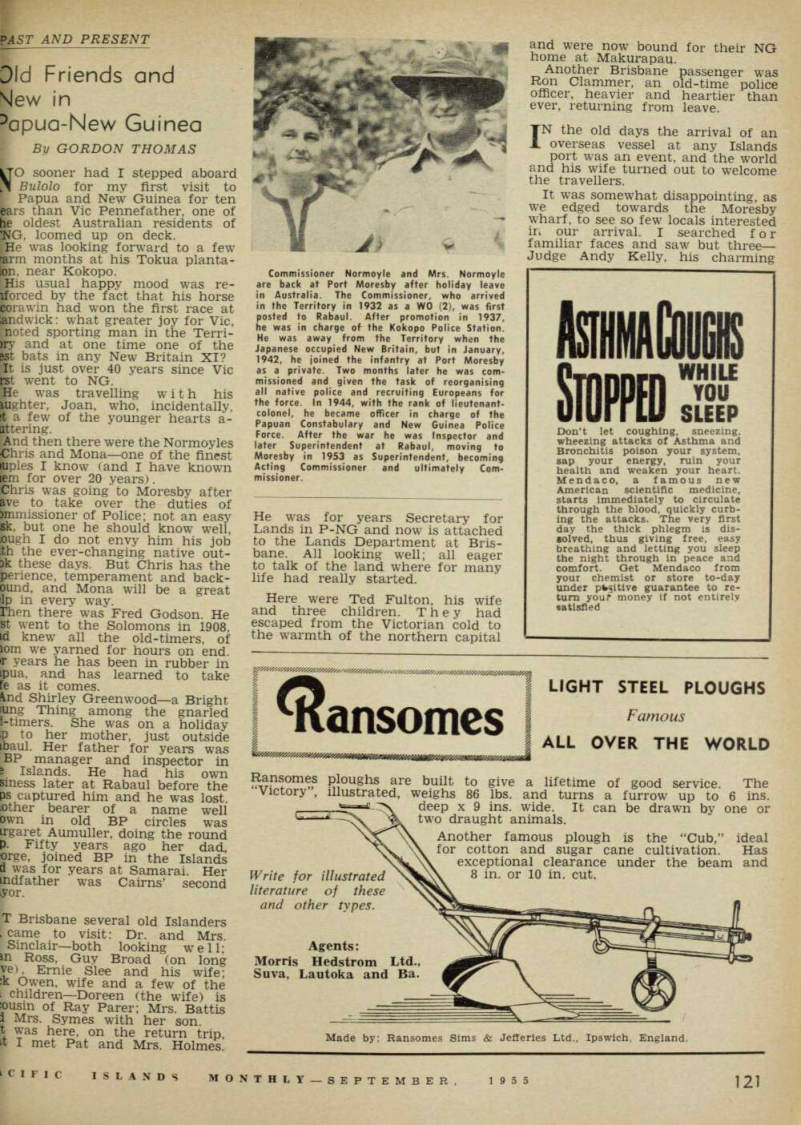
Commissioner Normoyle and Mrs. Normoyle are back at Port Moresby after holiday leave in Australia. The Commissioner, who arrived in the Territory in 1932 as a WO (2), was first posted to Rabaul. After promotion in 1937, he was in charge of the Kokopo Police Station.
He was away from the Territory when the Japanese occupied New Britain, but in January, 1942, he joined the infantry at Port Moresby as a private. Two months later he was com missioned and given the task of reorganising all native police and recruiting Europeans for the force. In 1944, with the rank of lieutenant colonel, he became officer in charge of the Papuan Constabulary and New Guinea Police Force. After the war he was Inspector and later Superintendent at Rabaul, moving to Moresby in 1953 as Superintendent, becoming Acting Commissioner and ultimately Com missioner.
wife (she to greet her mother, v was on board) and Jim Pain Superintendent of Police and lii changed from pre-war days Rabaul.
Later, there came tootling al. in a jeep, complete with trai dogs and native henchman, bear G A. V. Stanley, retired now fi his geologising with the APC, tl whom there is none with a be; knowledge of P-NG or with a rr extensive library of the Territ; He told me he was busy on history of New Guinea—long wani Our arrival at Moresby coincii with a sitting of the Legislai Council in the Red Cross Hall Ela Beach. It was here I met mi old-timers; energetic Jimmy Ja:j (full of beans as usual), st: Fairfax-Ross (he was one of party who dragged me out f:: custody with the Japs in ’4 Steve Lonergan, little altered spite his onerous administrat duties, smiling and optimis Doris Booth, quiet and forceful; of yore; Larry Dwyer, bluff as enthusiastic, short-circuiting i tape wherever possible and get: things done ; Keith McCan cheerful and bright, despite the I of Native Affairs sitting on broad shoulders; George WhittaE white-haired, but robust and ful; fight as ever; Bob Bunting, a m lad when I saw him last, and stolidly matured and level-head: IN other places I came across « Ahearn, an important cog in the APC machinery justly proud of the results of recent Flood Relief Fund; Fe’
Holloway, old Digger and old fn
>f Rabaul days, and now of Steam jhips; Alan Willis, whom I last saw n 1921 down Bougainville way, now i plantation executive with Steam hips.
And then on my return to Port I net two old friends—Bill Groves ,nd Tony Anthony. The former is Mrector of Education, a job for diich he is well fitted and does ex remely well; while Tony is No. 2 n the Lands Dept., where there re scores of headaches, but Tony emains his quiet, unperturbed, like ble self as I have always known im. |Les Clout stuck his head around iie corner while I was with Tony, nd is little changed.
Then there was Bernie Ryan, BP’s lanager in Port now, quiet, un ified as in Rabaul days. To him I owe a most pleasant drive to buna Falls and Koitaki.
At Samarai, “scorched earth” in le War and now a veritable model >wn and pretty as a picture, I let only one old-timer whom 1 aew; BP manager Gabriel, a bit jed, but full of kindness and vim. iT Lae there was Flora Stewart L at her Cecil pub. She had not I changed greatly since the days hen I was her guest in the ttirties at the Top Pub at Wau, id there, too, was daughter Ela, juried and complete with babe.
On the hill I met old Henry
Eckhof, little changed since the days when he managed Matanatar plantation for the Exproboard in the ’2o’s, and outside the shop Ernie Serafini grasped my hand and talked of old Rabaul days.
At the District Office there was big Bill Seale, smiling as ever, and A. L. King, still digging amongst files and half-yearly returns of f,„- T -v. at the neat, tiim Library there was Vivian Thwaite, capable b an £ P roud tremelySr Inthe town. ‘ S F ]° Gil ™o r ? greeted me at the Madang Hotel as she had greeted me at various other pubs at Kokopo and Rabaul in days gone by. She as , not s 9 bright as usual. Husband Jack was in bad health. I was sorry to miss Jack - It was at Madang that I met Ru pert Haviland and D. O. Skinnen, and Freda E|lw < nee Mathieson), all in the District Office, ° uti at the Native Hospital Office I. met a g ain Roma Bates, the brave little widow of Madang’s one-time District Commissioner, Charlie Bates, who in ’45 was in charge of the party releasing me from Jap anese captivity. Roma was smiling and battling against odds, and to her I “dips me lid.”
Out at Lombrum there was only one familiar face, that of handsome Norman Whitely, who is a well
known ngure in the Admiralties, popular and prosperous.
“I never regret your sending me up here in ’2l” he said, referring to the days when he was an Ex proboard plantation man. He was due south by the August Bulolo.
IT was only natural that the meet ing of old friends reached its peak when we tied up at Rabaul, First to meet my eye was Jack Chipper, striding up and down the wharf superintending (for some reason) the berthing of the first overseas vessel at the partly-com pleted wharf, which is a credit to the town.
And then swarming up the gang way came cheerful Jack West, Max Lees (now right-hand man to Vic Pennefather, and little the worse for his thirty-odd years in NG); and Cresswell, quiet and stolid as of old. The favourable turn of Fortune’s wheel had left him un changed.
There was Norman Duncan and his charming wife, both extending a warm welcome to the old home town. There, too, was Mrs. Linda Pratt, who was up for the opening of the Memorial Gates. She was repre senting the NG Women’s Clubs in Australia. And Mrs. Greenwood was there to meet her daughter, Shirley Up in the town round the clubs and pubs and places where men meet, I came with pleasure on many
>ld-time friends, with other friends vho were only names until I met hem.
At the New Guinea Club I yandered round gazing at the ihotographs of bygone years; Nobby Jlark, the president of pre-war ears, the photograph showed him s Chief Warden, wearing the sign f office. There were also the hotographed records of old com littees, all most nostalgic.
It was here, beneath the chairs nd tables, that we had crouched hen the first Japanese planes came yer in ’42. club is the one building that ill retains most of its old-time dry. Here I met Les Corbet, Dldier Williams, Noel Barry, Frank Disen and Gilbert Renton, the tter having sent me a note from proka when I was at Lae: “I’ll see m in Rabaul, Matey.”
N a Government office I met Reg ißigby, surrounded by legal tomes [and the endless files that always em to accumulate even in the best gulated offices. A good soul is jg. and one most fitted for his job I dealing out justice from the pch.
On to BP’s, where George Clarke cupied the managerial chair, a tie older, a little wiser* but still iich the same—quick-spoken, keen id alert. Here, too, was Kenward, jently come in from Kavieng; and rs. Targett, smiling soul, not tinged a bit despite the many ars that have passed. Tucked ray in a corner was Pat—Miss iterson—one of BP’s oldest staff imbers. We spoke of “Mac,” the [pping man of bygone years and ddy Dodd, who had died recently.
Severing outside the store, I came on Mrs. Miller —Bright Young ing of Rabaul in War I days, still iling and generous. Her “boy” rsented me with a luscious pine ole: “Present belong Missus,” he d. and I saw her disappearing her jeep. )n the site of the old Neu inea Compagnie, the new New inea Co. (alias WRC) operated i my guide and mentor pointed * to me “the prettiest girl in haul” as we passed the cashier’s ce. I can quite believe him, too.
Ve sighted Jack Sedgers in the tance, his smile had not altered, ugh his waistband had. iater on there were meetings with ibrose Thomas and Vic Pearson, Colyer, Watsons. Their offices od across the street from where spent many hectic months of ttbing when with the Japs, in Rebaul Freezer building. It was eed a pleasant change! iEN in Chinatown: The first old friend to greet me was Meen, known well as Rabaul’s photo pher. He had progressed since was a clerk in the Agriculture oartment’s office, but was still
the same methodical man of yore.
Many other old-time faces I met, too, but gone are their names.
One evening, in the Kombiu Club, I met again old friends from Amboina, the Carolines and local
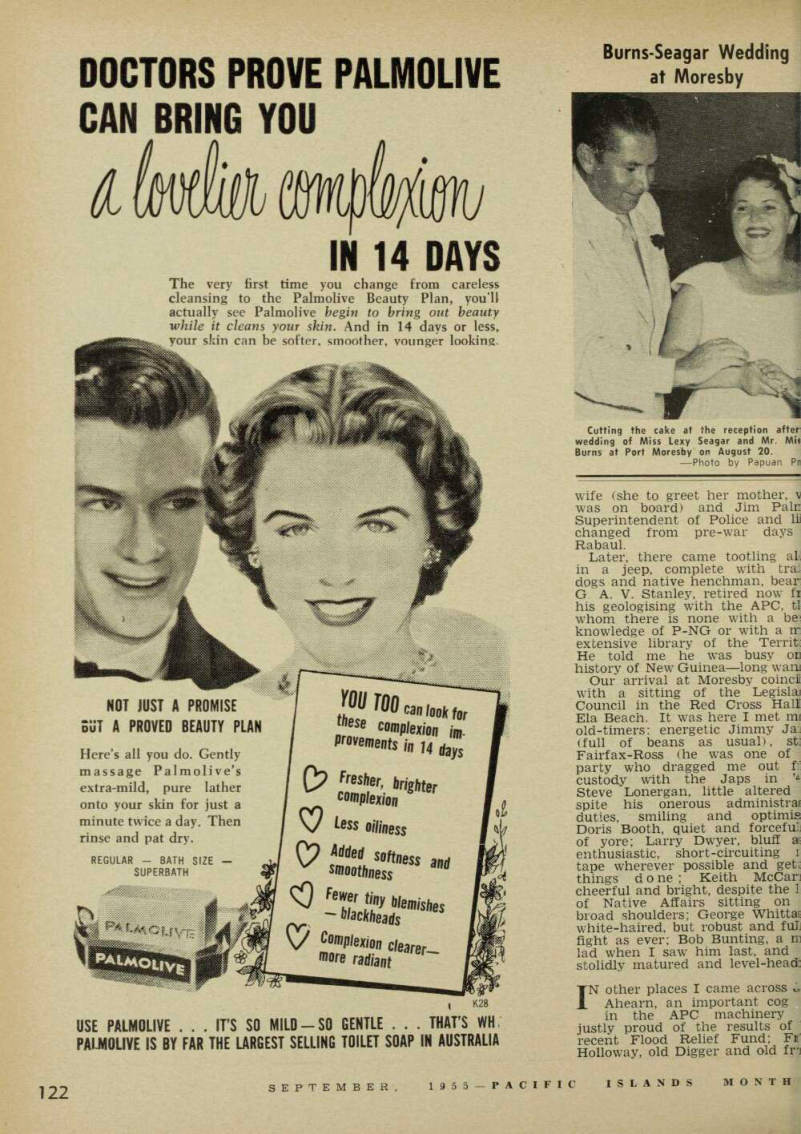
Engagement
at Moresby
The engagement has been announced at Port Moresby of Sister Joan Graham, of the Euro pean Hospital, and Mr.
Paul Patterson, of the Commonwealth Bank.
Photo by Papuan Prints.
born of varied groups. We tal of old times; they sang harmon: songs and spoke of present problems and world tendencies, I loved every moment of it.
NOR can I forget my na friends, whom the bush wire had informed of my comin My old office-boy—grown a i with wife and child, grinning presenting me with a basket we sat yarning in the tinata, wl I thought I had almost forgot but I hadn’t. And there y natives from Matupi who gath. round me at the Bung, all se ingly glad to see me once ag From them I learned more t statistics could tell me.
And so, like Fitzpatrick and.
Traveltalks, I say “Farewell to Guinea,” land in which my h lies buried deeply and where thoughts are always with t; many friends —not all of therm friends. I made some new frii for whom I have the greatest: gard and feel they will carry the traditions of New Guine; land to be worked for and a which will repay those who y for it.