About Quality
pp. 119-120 · Read in the full issue
Urgent Problems
Meeting Complaints
Of Islands Copra
WHAT causes the development of a rubbery flavour when coconut ail pressed from some South Seas :opra is exposed to sunlight? This flavour, which is carried into nargarine, seriously affects the •eputation of Pacific Islands copra in he United Kingdom, and the luestion, among many others, is liscussed in The Manufacture of Hopra in the Pacific Islands, by W. /. D. Pieris, MA, DipAg, BSc, FLS South Pacific Commission Technical ►aper No. 82). [Reference was made to this aluable new publication in August TM. It should be read in con unction with Mr. Pieris’ recom aendations for the rehabilitation f the Pacific copra industry, liblished in the SPC Quarterly mlletin, Vol. 4, No. 1, of January, 954, and Technical Paper No. 48, he Management of Coconut Planta ins in Western Samoa, by D. R. A. den, and Technical Paper No. 19. ■fiport of Copra Grading.
These will soon be followed by realth from the Coconut, in which lr. Pieris deals with the selection f seed coconuts and the raising
ad transplanting of seedlings.
The present paper by Mr. Pieris ttitains a wealth of practical in irmation and advice, much of hich is probably quite unknown to iany Pacific producers who have ;en in the game for years.
There has been little post-war aancial inducement to take irticular pains as regards copra lality, and probably many post er producers have a somewhat izy idea as to what constitutes ►od copra.
The answer to the question is tely to assume considerable iportance after December, 1957, len the British MOF buying ntract ends.
PIERIS raises a curious 1 point in regard to copra contamination.
'Pi 110 the most serious Dblems of oil crushers in the lited Kingdom at the present ne,” he says, “is the frequent velopment of a rubbery flavour on posure to sunlight of coconut oil sssed from South Sea copra, ice this objectionable flavour is rned into margarine, the sale uity of the oil for edible purposes, )ecially for the manufacture of p-grade margarine, is seriously ected.” J
? hiTS io c n ’i ¥ r - pieri f sa y s - , has shown that sulphur contamination a mvste C r a v Se ’ bUt h ° W !t 0001118 is a mystery.
Copra from Ceylon, the Seychelles and Tonga has never been so contaminated Unl , . , . .. , Holds of ships which had
previously carried sulphur were suspect, as were the sacks used nn Plantations, but such sources have not accounted for all cases A soarce 18 known to be through the practice on certain plantations of sprinkling sulphur on the dryer fires in the belief that
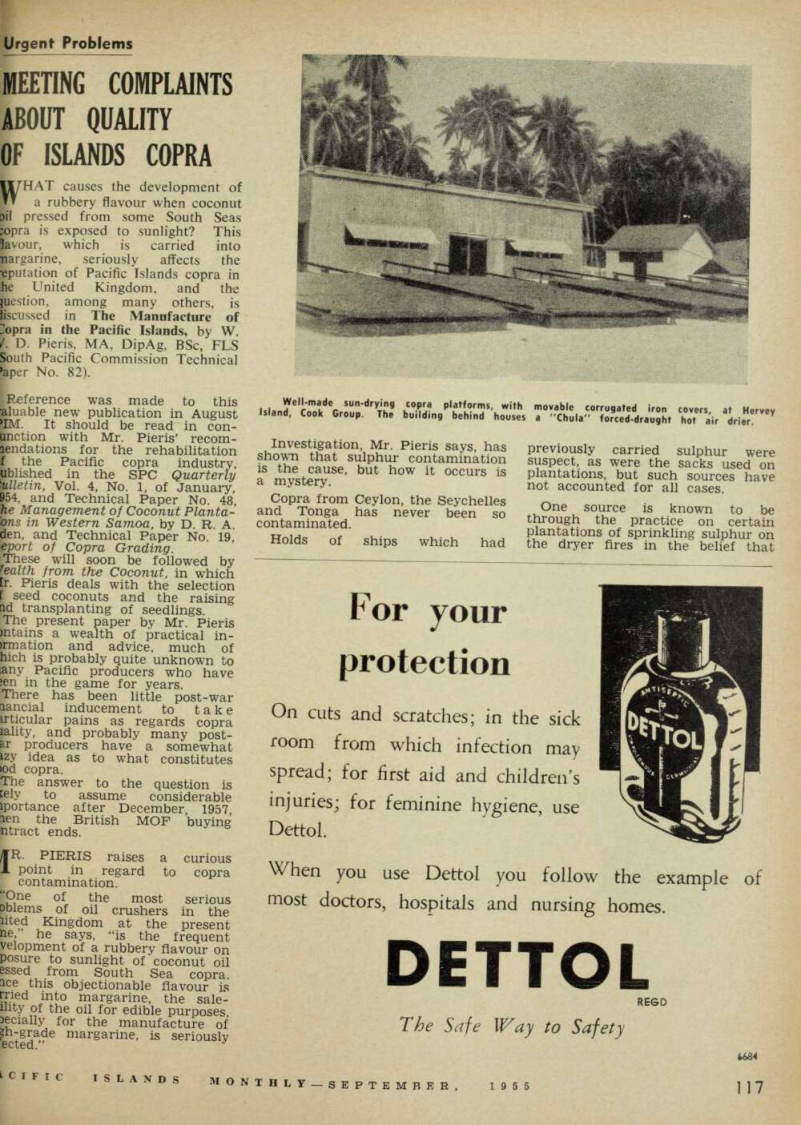
well-made sun_drying copra platforms, with movable corrugated iron covers at Hervey Island, Cook Group. The building behind houses a "Chula" fored-draught hot air drier
the fumes protect the drying kernels. Such disinfection, says Mr. Pieris, is totally unnecessary, and planters would be well advised to discontinue the practice.
PACIFIC copra, Mr. Pieris says, contains a great deal of rubbish, some of which does costly damage to the crushing machinery.
Magnetic items—bolts, knives, and all sorts of pieces of machinery —are commonly found and easily extracted by powerful magnets before the crushing, but large stones, non-magnetic metals, etc., are the cause of much trouble.
Some appear to have been deliberately added —part of a bicycle wheel, for example, found in a consignment.
Comparing the Islands with Ceylon, Mr. Pieris says that an average skilled plantation hand in Ceylon can easily husk 2,500 nuts in an 8-hour day. In Papua-New Guinea, the average rate does not exceed 1,000 when the nuts are collected by the husker, and 500 when he has to collect them himself.
This difference, Mr. Pieris considers, is undoubtedly partly due to the better-designed husking implement used in Ceylon. Full details of this implement, with sketch and dimensions, are given in Paper No. 82.
The main part of the paper is taken up with a description of the
many alternative types of dryers, with plans and detailed instructions for using them.
This is probably the best practical survey of the copra industry yet to be made available to Pacific producers. At 6/- Stg. a copy from South Pacific Commission agencies (see advertisement, August
PIM), it is a “must” for s associated with the industry. t The New Caledonia Departure: of Agriculture estimates the de population of the island at aboi 100,000 beasts. Last year 38 tons hides were exported to Australia ai the United States.