Savings Bank
pp. 84-97 · Read in the full issue
The Very Long Arm of the Savings Bank
By Peter England
IN no country in the world, perhaps, is the Long Arm of the Law so long, so rentless, or so inescapable, as in the Territory of New Guinea.
This is due partly to the efficiency of District Services and the native Police Force, and partly to a number of local conditions into which I do not propose to delve at the moment.
The fact remains that if you are wanted by the authorities, you will be found; you cannot hide, and you cannot escape. It is good that this is so; it discourages criminals and advances the cause of civilisation.
Sometimes even people who are not criminals must be taught the advantages of a benevolent Admini stration.
Which brings me to my story.
Needless to say, all the characters in this narrative are fictitious —or do I mean fabulous? No matter, WELL, then. At the principal station on one of the largest rivers in the Territory—the name of which I have forgotten—there once resided an Assistant District Officer who shall be known, for the purposes of this story, as Ruston Hornsby. Rusty, for so he was called by the friends, was a very sound ADO. He was efficient and just and his memory was as that of the elephant.
By his native subjects he was held in awe, and rightly so. Of a robust and imposing stature, with a voice of intimidating resonance,
when he spoke he expected to be obeyed at the double, as he usually was; when he wasn’t, the repercussions of his wrath were felt by the offender and his famil: even to the third and fourtH degrees of kindship.
He held the reins of tion in a firm and sensitive hand and the other ends of the reinu extended to the furthest bounds 0( his domain.
Like all Assistant District Officers Rusty was not only Chie; Magistrate of his sub-District, bui also Coroner, Postmaster, Chief-of; Police, Treasury and Custonu Officer, Storekeepeer, and Agem for the Bank.
When there were sufficient Fatrc Officers on the station he wai able to delegate some of thes< duties. At other times he had t: do the lot on his own. But thi did not worry Rusty; he could di all, or any part, of his job back wards, as the saying goes.
Well, with the large variety c business transacted at the Distrio Office, and in a populous sub District such as this, you can easili imagine that there were usuall numbers of Luluais, Tu 11 u 1 s petitioners, claimants, creditors, anc other members of the general publ:. waiting to present their cases o business. And since, in Ne- Guinea, the individual rarely make a business trip without the escon of two or three relations, advisen
(Continued on Page 94)
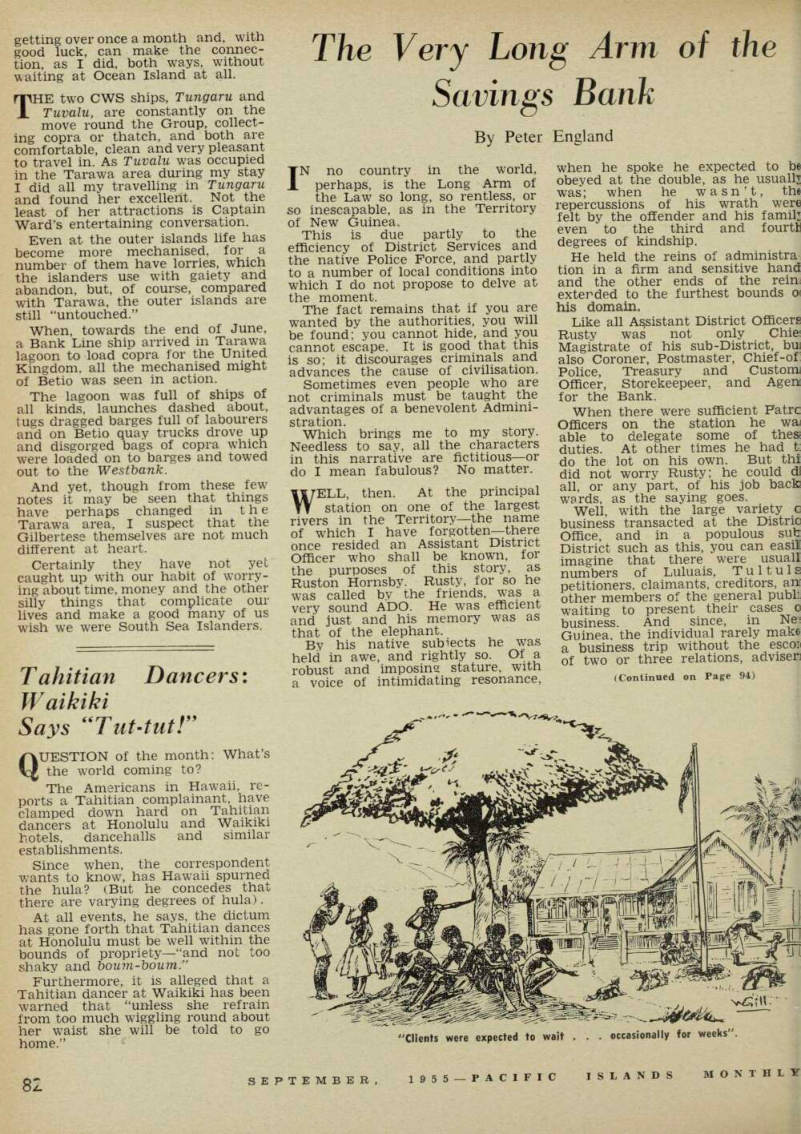
"Clients were expected to wait . . . occasionally for weeks".
supporters, or other hangers-on, it is not surprising that there were frequently a hundred or more natives sitting under the shade trees leading to the office.
Having explained their business to the Duty-Constable posted on the office verandah, clients were expected to wait. And wait they did, sometimes for days and occasionally for weeks, and woe betide them if they did not answer their names whey they were called.
Now it happened that a young man named Saragau accompanied his Luluai on an official visit to the Kiap. They came from the foothills at the head of the furthest tributary away on the borders of the District.
The Luluai’s business was not of great importance, and consequently did not have a very high priority on the waiting list; however, after four or five days’ wait, it was completed and they prepared to return home.
Then it occurred to Saragau to draw a pound from his modest bank account in order to make a few purchases at one of the local trade-stores. He approached the Duty-Constable and was escorted
into the office where he produced his pass-book and a junior Patrol Officer made out the necessary withdrawal slip.
The PO handed the slip and the pass-book to the Constable, who thereupon carried them into the inner office, gave a smart
salute, and placed them on Rusty’£ desk. Rusty returned the salute gave the documents a perfunctori glance, and said.
“Tell him to wait.”
The Constable about-turnec marched out again to Saragau, am with a wave of the hand in thj
Indirection of the shade-trees, said: f “You wait!”
I So Saragau waited. In the f afternoon, at four o’clock, the I office closed down; Rusty and the PO went home for baths before up to Club for their f customary game of billiards. The Duty-Constable locked up and then went down to the waiters and dis- missed them for the day; warning I them, however, to be sure to be rback at eight in the morning, and maski humbug.
I The next day was Saturday, and [mail day; Rusty decided to suspend ; all other business in order to get off some urgent returns to Port I The following day, of course, was Sunday.
I Monday happened to be a Public Holiday. [ Tuesday, so it turned out, was 'the Medical Assistant’s birthday, and —hell, what does a day matter anyway?—it was duly celebrated, t On Wednesday, Rusty woke up avith the daddy of a hangover, and wisely decided to stay in bed and treat it with rum and aspirin. 3Tou have to look after your health in the bush.
ON Thursday, still feeling far from well, Rusty went over to the office. The first thing he saw on his desk was a bank pass book containing a withdrawal slip.
He opened it and sang out for the Duty-Constable; [ “Call Saragau!”
After some five minutes, the Constable returned to say that Saragau had left for home two lays previously. Rusty looked up Pith peevish annoyance: [ “Well, go and bring him back!” le bellowed. 1 The Constable, handing over his irderly duties to the next man on he roster, went out to bring faragau back. i Hiring a canoe and a crew of our from the local village he set iut on his journey. At each village p the way he changed canoes and lired a new team of paddlers. He ravelled up the main river for ix days, and for three further days le followed a tributary.
Then he spent two days raversing sac-sac swamps and unai ridges. The following day e started to ascend the-foothills, nd on the afternoon of the 12th ay after leaving the station, he rnved at Saragau’s village.
He can hardly be blamed for iking a day’s spell before he ;arted on the return journey; when e did he was accompanied by aragau, Saragau’s wife, two tambu )usins, and the Tultul. With the elp of the current, the trip back as made in a little under nine ays.
The morning following their •
arrival, the Constable escorted a rather frightened Saragau to the office, and reported to Rusty.
Rusty picked up the pass-book, which still lay at the top of the pile of documents on his desk made the necessary entries, took a pound note from the cash box, and handed it back with the book to Saragau: “Im tasol!” said Rusty.
Maski humbug: Don't let us have any nonsense.
Im Tasol: That is all. t Monsieur P. Ferlande has been appointed director of the Bank of Indo-China in French Oceania, in succession to M. Le Sourd.
t Contracts have been let in Paris for the construction of a new Gov ernment radio communications re ception station at He Nou, Noumea.
The station will cost about £A6O 000 At nearby Magenta a new transmit ting station is now nearing com pletion, at a cost of £A150,000. t A Honolulu report dated August 22 said that a US Navy pilot had reported an island forming through volcanic activity “375 miles north west of Honolulu.” “North-west” was probably used in a very loose sense as there is extremely deep water in that area. More probably the activity was near Necker Island, west-north-west of Honolulu, on the air route to Midway.